
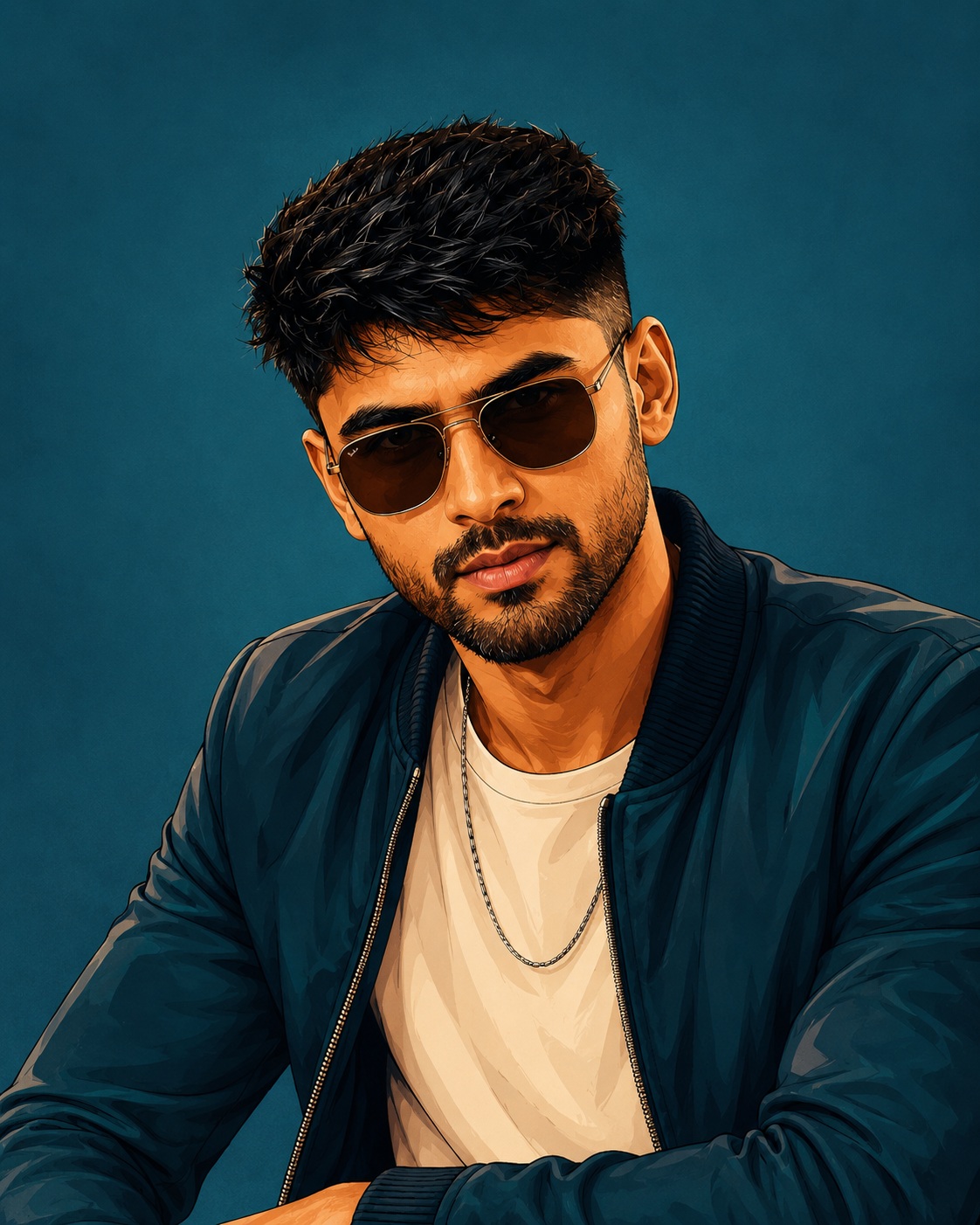
Digital Portrait Illustration
This prompt describes a highly controlled portrait artwork built around a single male subject and a clean, modern illustrated presentation. The central idea is not to create a busy scene, but to preserve the visual simplicity and recognizable character of the reference while translating its photographic qualities into a refined digital illustration. The result is intended to feel polished, youthful, confident, and editorial, with a strong graphic identity created through color, shape, controlled shading, and carefully preserved facial details.
The main subject is a man shown in a half-body or upper-torso composition. His presence is intentionally restrained rather than oversized. The reference establishes the amount of visible body, the relationship between the head and shoulders, and the amount of empty background surrounding him. Maintaining those proportions is important because the design depends heavily on negative space. The subject sits slightly toward the lower-middle portion of the vertical frame, leaving a generous area of clean teal-blue space above him.
Identity is one of the most important aspects of the concept. The face is meant to remain recognizable, with the facial structure, eyes, nose, jawline, beard pattern, hairstyle, and natural proportions preserved. The prompt specifically emphasizes authentic identity rather than an overly polished or generic illustrated face. Natural facial asymmetry and recognizable facial planes are therefore part of the visual character. The skin is interpreted through painterly rendering, but it should still retain believable structure and texture instead of becoming smooth plastic or an exaggerated cartoon surface.
The facial expression contributes to the youthful and confident personality of the portrait. The smile shape is treated as an important identifying feature, while the head angle and direct facial engagement are retained from the main reference. The neck and head connection is also carefully controlled so that the illustration keeps natural anatomy. The prompt gives particular importance to maintaining the original tilt and alignment, which helps preserve the attitude and personality of the reference.
The sunglasses are a defining facial accessory. Their position, lens placement, thin metallic frame, bridge, reflections, and temple alignment all contribute to the identity of the portrait. They are not treated as a generic fashion accessory that can be freely redesigned. Instead, their visual relationship with the eyes, nose, temples, and head angle remains consistent with the reference. This makes the sunglasses part of the subject’s recognizable appearance and overall styling.
The hairstyle is another significant micro-detail. Hair volume, directional strands, silhouette, and the relationship between the hair and forehead are carefully preserved. The beard is similarly important, with attention to its edges, density, texture, and relationship to the jawline. These details help prevent the subject from becoming a generic illustrated male character and support a more personalized editorial appearance.
The outfit has a clear layered structure. The subject wears a dark teal bomber-style jacket with a visible zipper and ribbed collar. Underneath is a simple off-white or cream crew-neck T-shirt, accompanied by a thin metallic chain necklace. The clothing is deliberately uncomplicated so that it supports the face and color composition rather than competing with them. Jacket seams, zipper placement, collar construction, shirt neckline, folds, and drape all contribute to the visual accuracy of the design.
Color is one of the strongest characteristics of this concept. The background is dominated by a deep teal or blue field that creates a calm, contemporary foundation. The jacket remains within the same dark teal-navy family, allowing the clothing to connect visually with the background without disappearing completely. Against this cool environment, the skin uses warm burnt-orange, ochre, and brownish tones. This warm-versus-cool contrast gives the portrait visual energy while preserving a sophisticated editorial palette.
The hair and beard are rendered in near-black tones, while the sunglasses use dark brown or similarly deep lenses. The shirt provides a muted cream accent that breaks up the darker clothing and helps create a small area of visual brightness around the neckline. Rather than relying on many colors, the artwork uses a controlled palette with strong tonal separation. This makes the portrait feel intentional, modern, and graphically cohesive.
The background is intentionally minimalist. There are no landscapes, rooms, furniture, decorative patterns, props, environmental objects, or unnecessary scenery. The plain teal field acts almost like a studio backdrop, giving the subject room to breathe. This simplicity also reinforces the editorial quality of the artwork and makes the face, clothing, sunglasses, and color relationships the primary visual elements.
The lighting is soft and illustrated rather than aggressively photographic. Subtle dimensional shading gives structure to the face, neck, jacket, and clothing folds. The artwork should feel dimensional without becoming a conventional photorealistic photograph. Controlled highlights and shadows help describe facial planes and garment construction while preserving the stylized nature of the artwork.
The desired art treatment combines crisp controlled linework with sophisticated painterly shading. Edges should be clean and intentional, while internal areas can contain nuanced tonal transitions. The style sits between graphic portrait design and premium digital painting. It should not look like a flat cartoon, an inexpensive filter, or an unfinished sketch. Instead, the visual language is polished enough to resemble professional editorial artwork.
Composition and camera perspective are locked to the main reference. The three-quarter body orientation, head angle, shoulder direction, torso position, crop, and camera relationship are all essential. The prompt deliberately prevents the source person’s separate reference from influencing the pose. This distinction ensures that identity can be preserved without unintentionally changing the composition.
Body proportions are similarly controlled. Shoulder width, torso thickness, neck size, head-to-body ratio, and visible anatomy should remain believable and consistent. The concept specifically avoids exaggerated muscles, oversized hands, oversized heads, distorted limbs, or unnatural proportions. The subject should retain a natural physical presence within the stylized treatment.
The artwork is designed to remain completely text-free. There are no names, captions, titles, signatures, logos, watermarks, labels, decorative letters, or graphic typography. The negative space is valuable precisely because it remains clean. This allows the portrait to function as a standalone visual piece without competing graphic elements.
A major strength of this concept is its disciplined visual hierarchy. The face is the emotional anchor, the sunglasses add personality, the jacket establishes the darker structural mass, the cream shirt creates contrast, and the teal background provides the overall visual field. Warm skin against cool surroundings creates the primary color relationship, while controlled linework and painterly shading provide the finishing layer.
The concept is particularly useful for profile artwork, personal branding, social media portraits, editorial graphics, digital posters, portfolio presentations, creative profile images, fashion-inspired artwork, and modern personal identity pieces. Its minimalist background also makes the composition adaptable to different digital layouts while retaining a strong standalone appearance.
The overall design purpose is to combine recognizable personal identity with a sophisticated illustrated aesthetic. Instead of relying on excessive decoration, the artwork gains impact from accurate facial character, strong color contrast, clean composition, confident styling, and refined digital rendering. Every major element has a defined role, which keeps the final visual focused and professional.
[[[
1. Main Goal & Scenario
Reconstruct the MAIN REFERENCE as a premium stylized digital illustration portrait, preserving its exact composition, visual treatment, framing, pose, clothing arrangement, and teal-blue minimalist background.
2. Identity Mapping & Face Scale
Use the PERSON SOURCE only for the person’s exact face identity and natural body thickness. Preserve recognizable facial structure, eyes, nose, jawline, beard pattern, hairstyle, and facial proportions.
3. Pose Source Lock
100% LOCK the pose, head angle, shoulder orientation, torso position, arm placement, crop, and camera perspective from the MAIN REFERENCE. Never borrow pose information from the PERSON SOURCE.
4. Typography Letter Content Lock
No typography or name/text is required anywhere in the reconstructed image.
5. ONE TEXT ONE PLACE Lock
NO TEXT. Do not add captions, names, titles, signatures, labels, or decorative lettering.
6. Exact Text Style & Size Replication Lock
Not applicable because the requested output contains no text.
7. Direct Text Injection Command
Do not inject any text. Keep the entire composition clean and text-free.
8. No Giant Central Figure Lock
Maintain the exact figure scale and placement of the reference. Do not enlarge the subject beyond the original framing or allow the portrait to dominate the canvas unnaturally.
9. Vibe, Color & Mood Lock
Replicate the reference’s clean, youthful, confident, polished illustrated mood. Preserve the dominant deep teal/blue background and the warm orange-brown skin rendering with dark navy-teal clothing.
10. Micro-Details & Crop
Preserve the exact hair volume and directional strands, sunglasses position, smile shape, beard edges, jacket seams, zipper, necklace, shirt neckline, shoulder crop, and bottom-edge framing.
11. Identity, Raw Skin & Anti-Fake
Preserve authentic facial identity without plastic beautification. Translate natural skin texture into controlled painterly illustration detail while retaining pores, facial planes, beard texture, and realistic facial asymmetry.
12. Hand-Prop & Neck-Head Alignment
Preserve the sunglasses as the exact facial prop, including lens placement, thin metallic frame, reflections, bridge, and temple alignment. Maintain natural neck-to-head anatomy and the original head tilt.
13. Body Proportion & Limb Scaling
Keep the same shoulder width, torso thickness, neck size, head-to-body ratio, and visible body proportions as the reference. No exaggerated muscles, oversized hands, or distorted anatomy.
14. Outfit Fit, Drape & Wrap
Reproduce the exact outfit: dark teal bomber-style jacket with visible zipper and ribbed collar, plain off-white/cream crew-neck T-shirt underneath, and thin metallic chain necklace. Preserve the original fit, folds, drape, and layering.
15. Selective Color & Tone Mapping
Use a controlled illustrated palette: deep teal background and jacket, warm burnt-orange/ochre skin tones, near-black hair and beard, dark brown sunglasses lenses, and muted cream shirt. Preserve the reference’s strong tonal separation.
16. No Random Logos & Clean Text
No logos, branding, watermark, signature, symbols, or unauthorized graphic elements anywhere in the image.
17. Perfect Spelling & Text Rendering
No text is permitted, so no lettering should appear accidentally.
18. Text Ratio & Style Lock
No text. Preserve the original negative space and minimalist background exactly rather than filling it with typography.
19. Opacity, Layering & Ghost
No ghost figures, duplicate subjects, transparency effects, overlays, or secondary portraits. One clean subject only.
20. Duplicate Mapping & Pose Variety
No duplicates. Generate exactly one person in exactly one pose matching the MAIN REFERENCE.
21. Professional Quality Boost
Premium editorial digital illustration, crisp controlled linework, sophisticated painterly shading, clean edge definition, rich tonal modeling, high-resolution finish, polished professional artwork.
22. Body Visibility & Scene Density
Keep the same half-body/upper-torso visibility and generous plain background space. Do not add scenery, furniture, objects, patterns, or environmental details.
23. Composition/Camera & Lighting
Vertical portrait composition matching the reference aspect ratio. Subject centered slightly toward the lower-middle area with generous teal negative space above. Preserve the three-quarter body orientation, direct facial engagement, soft illustrated lighting, and subtle dimensional shading.
24. Quality Lock & User Customization
Reconstruct the image as a faithful premium digital illustration of the same person. Preserve identity, pose, framing, outfit, color palette, background, facial expression, sunglasses, hairstyle, and all major visual relationships from the MAIN REFERENCE. No name or text should be added.
25. Bad Output Mistakes & Negative Prompt
BLOCK: wrong identity, generic face, face paste, plastic skin, photorealistic conversion, wrong pose, copied PERSON SOURCE pose, normalized pose, broken neck, bad anatomy, distorted face, bad hands, hulk hands, oversized head, wrong body thickness, wrong sunglasses, missing sunglasses, wrong hairstyle, wrong beard, wrong outfit, incorrect jacket color, wrong shirt, missing necklace, wrong crop, wrong camera angle, wrong background, detailed scenery, random objects, random logos, watermark,
signature, unauthorized text, hallucinated names, hardcoded names, duplicate person, ghost figure, multiple poses, extra limbs, extra fingers, deformed fingers, flat lighting, dull colors, excessive saturation, muddy shadows, inconsistent illustration style, photorealistic skin, generic cartoon face, low detail, blurry edges, amateur artwork, AI artifacts, WRONG VIBE, WRONG COLOR PALETTE, altered aspect ratio, excessive background detail. ]]]
” https://prompt.mahantababu.com/
https://en.wikipedia.org/wiki/Artificial_intelligence
https://prompt.mahantababu.com/digital-portrait-illustration/