
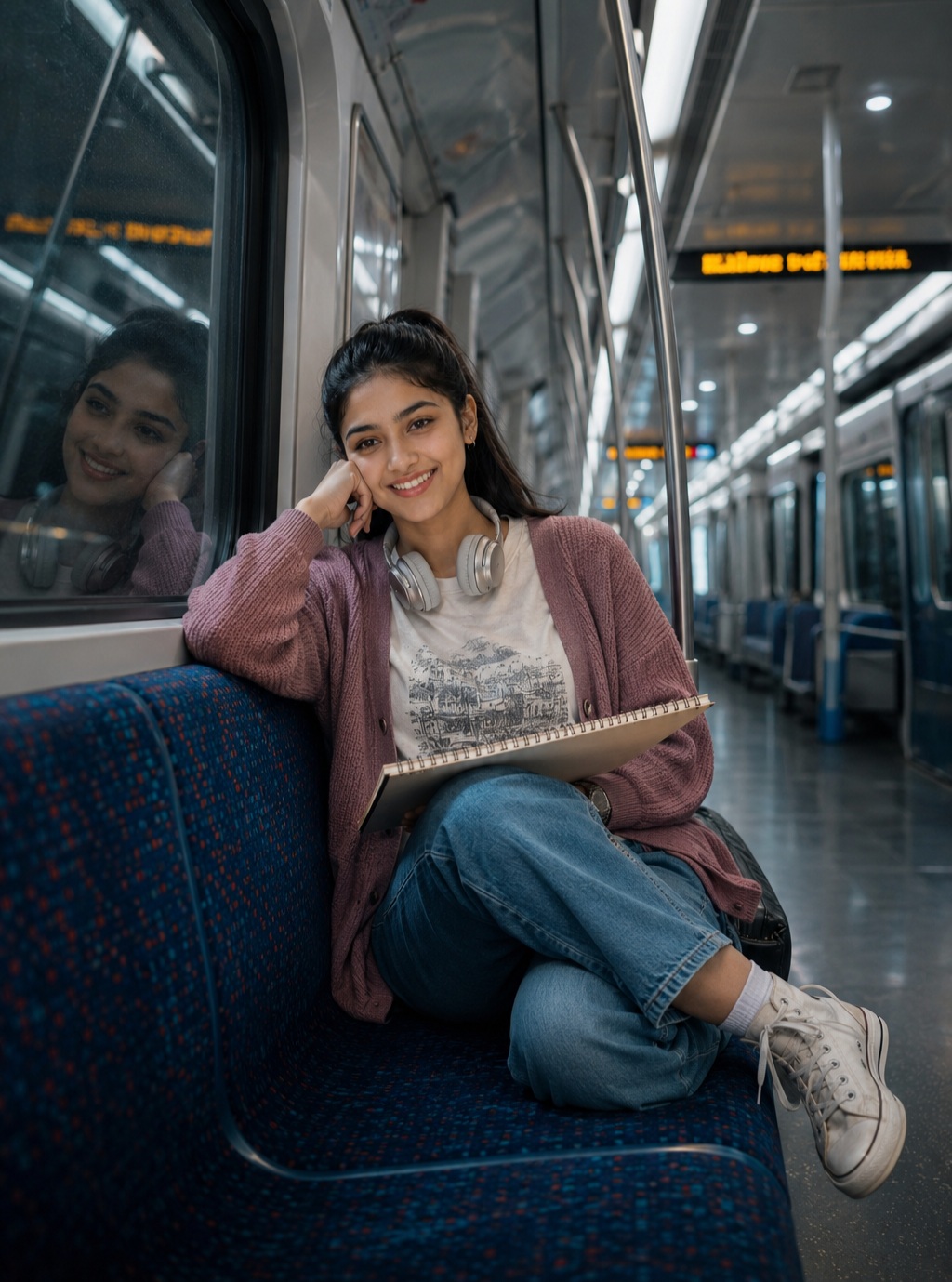
Cinematic Metro Portrait
The main creative idea centers on a young woman sitting quietly inside a modern metro or train carriage while remaining absorbed in her own thoughts. The scene is designed to feel like a genuine photographic moment rather than a staged studio portrait. The woman is part of the carriage environment, and the surrounding architecture contributes strongly to the storytelling. Seats, windows, poles, ceiling structures, aisle lines, environmental signage, and the moving world outside all help establish the location. The result is intended to communicate the feeling of being physically present in a busy city while mentally enjoying a private, peaceful moment.
The main subject is a young woman whose facial identity is treated as an important visual anchor. Her natural facial structure, body thickness, curly hair, cheek contour, eyes, and proportions are meant to remain believable and recognizable. Her appearance is not described as an exaggerated fashion transformation. Instead, the emphasis is on authentic facial detail and a natural human presence. The skin is expected to retain visible pores, subtle texture, minor imperfections, and realistic variation. This makes the face feel like it belongs to a real photograph rather than a heavily processed beauty image.
Her expression contributes heavily to the emotional tone. The overall feeling is introspective, dreamy, calm, and slightly melancholic. She appears comfortable within her own thoughts, as though she is listening to music, sketching, or simply allowing the journey to pass around her. The expression is not an exaggerated smile or dramatic sadness. It is much quieter. That restrained emotion gives the portrait a more sophisticated editorial character and allows viewers to interpret the scene personally.
The pose is one of the most carefully defined aspects of the concept. The woman is seated sideways, with her head naturally resting against one hand. Her relaxed posture suggests that she has settled comfortably into the train rather than intentionally posing for a camera. The hand supporting her cheek is particularly important because the finger placement, wrist angle, and contact between hand and face contribute to the realism of the gesture. The neck and head need to appear naturally connected, while the shoulders and upper body retain a believable relaxed position.
The legs and lower body also contribute to the candid feeling. The crossed-leg positioning, shoe visibility, and relationship between the knees, feet, and sketchbook establish the visual rhythm of the seated pose. Rather than making the body look artificially symmetrical or fashion-model perfect, the concept emphasizes the original relaxed positioning. This gives the subject a genuine commuter quality. The viewer should feel that this is a natural moment captured during travel rather than a carefully arranged fashion pose.
The sketchbook is an important storytelling object. It rests across the woman’s lap and suggests creativity, imagination, and personal concentration. Its placement is closely connected to the seated body position and crossed legs, so it feels like something the woman is naturally carrying or using rather than a decorative prop added to the composition. The sketchbook subtly suggests that she may be an artist, designer, student, or simply someone who enjoys drawing during a journey.
The headphones add another layer of personality. Positioned around her neck, they suggest music, private listening, and emotional escape from the surrounding environment. Together, the headphones and sketchbook create a strong sense of personal space. The woman is physically surrounded by other possible passengers and the infrastructure of the train, but the visual storytelling keeps her emotionally separate from the outside world. This contrast between public transportation and private thought is one of the strongest ideas in the scene.
The outfit has a casual yet fashionable quality. The textured dusty-rose or mauve cardigan introduces a soft, warm visual element and contrasts nicely with the cooler train environment. Underneath it is a light graphic T-shirt, followed by blue jeans and white high-top sneakers. The outfit feels contemporary and approachable rather than excessively luxurious or theatrical. The clothing folds, fabric texture, layering, and overall fit contribute to the sense of realism.
The cardigan is especially valuable for the color balance because its dusty-rose or mauve tone can complement the warmer skin tones while remaining visually distinct from the cool cyan and teal surroundings. The blue jeans provide a grounded everyday quality, while the white high-top sneakers add a recognizable casual fashion detail. The headphones and sketchbook complete the styling without overwhelming the scene.
The metro environment is not simply a background. It functions as a major storytelling element. The surrounding train interior provides context, scale, depth, and visual structure. Seats, poles, ceiling lines, windows, and aisle geometry create strong leading lines that naturally direct attention through the composition. The scene therefore feels spatially convincing rather than like a portrait pasted into a generic transportation setting.
The left side of the scene contains an especially important reflective window. The woman’s face appears subtly within the glass, creating a secondary visual layer. This reflection is intended to be transparent, soft, slightly distorted, and naturally integrated with the surface of the window. It should not appear like another solid person. The reflection corresponds to the same seated woman, maintaining her head position and pose while responding realistically to the optical properties of glass.
This reflection adds emotional depth because it creates a visual connection between the woman and the moving world outside. It can feel almost dreamlike, as though her thoughts are blending with the city passing beyond the carriage. At the same time, the reflection remains understated. It should support the primary subject instead of competing with her. Its softness and transparency help maintain the hierarchy of the composition.
The outside environment on the right side of the frame is characterized by motion blur. This introduces the sensation that the train is moving quickly through an urban environment while the woman remains relatively still. That contrast between motion and stillness is central to the mood. The city becomes an abstract flow of light, shapes, and color, while the woman’s quiet expression provides an emotional anchor.
The color treatment is strongly cinematic. Cool cyan and teal tones dominate parts of the train environment, creating a modern metropolitan feeling. These cool colors are balanced by warm skin tones and amber environmental highlights. The combination creates a rich contrast without becoming excessively stylized. Deep shadows add depth, while controlled highlights preserve detail in the face, hair, clothing, glass, and train surfaces.
Lighting is soft and atmospheric rather than theatrical. The woman’s face remains readable without appearing artificially spotlighted. Ambient train lighting helps integrate her with the carriage. The glass reflection responds naturally to the surrounding illumination, and the exterior motion blur provides additional color variation. The overall lighting language resembles premium editorial photography, where realism and atmosphere are carefully balanced.
The camera perspective is another defining element. The vertical 9:16 composition provides a contemporary portrait format while preserving the complete seated body and substantial environmental context. The camera sits relatively low, matching the seated perspective of the reference. The woman occupies the lower-middle to right region rather than becoming a huge central figure. This allows the train architecture to remain visible and meaningful.
Strong leading lines from the ceiling, aisle, and carriage structure help guide the eye. The reflective window on the left balances the subject, while the motion-blurred exterior on the right creates a sense of movement. The composition therefore has visual tension without feeling crowded. The crop also protects important details such as the curly hair, hand-to-face contact, sketchbook, crossed legs, headphones, and visible sneakers.
The overall art direction is highly photorealistic and editorial. Realistic skin pores, natural fabric texture, physically believable reflections, accurate lighting, subtle film grain, and controlled depth of field all contribute to a premium photographic character. The scene should feel like it was captured with professional equipment under real conditions rather than designed as a flat illustration.
The concept also relies heavily on restraint. There is no need for decorative typography, poster lettering, captions, slogans, signatures, watermarks, or artificial graphic elements. The absence of text allows the viewer to experience the photograph through facial expression, pose, clothing, environment, lighting, and reflection. Any environmental signage remains a natural part of the train and does not become a readable graphic feature.
The body proportions are carefully controlled by separating identity from pose. The facial identity and natural body thickness belong to the subject identity source, while the main reference establishes the pose, limb placement, composition, and environmental relationships. This separation protects the character of the reference while keeping the person recognizable. Hands, fingers, arms, legs, feet, and facial scale all need to remain anatomically consistent.
The creative purpose is to capture the feeling of a private emotional moment inside a public environment. A metro carriage normally represents movement, routine, noise, and crowds, but the woman appears mentally somewhere else. The sketchbook suggests creativity, the headphones suggest personal listening, the reflection suggests introspection, and the blurred city suggests continuous movement. These details work together to tell a story without needing words.
This style can work especially well for editorial fashion photography, lifestyle storytelling, music-related visual concepts, urban portrait collections, creative portfolios, social media presentation, magazine-style artwork, and personal photography projects. It has enough fashion influence to feel polished while retaining the everyday authenticity of a commuter scene.
For the viewer, the strongest benefit is the layered storytelling. The first impression comes from the woman’s face and relaxed gesture. A closer look reveals the sketchbook, headphones, clothing texture, window reflection, train architecture, and moving city outside. Each detail contributes to the same emotional idea. The frame can therefore remain visually engaging beyond the initial portrait impression.
The concept is strongest when realism and mood are treated as equally important. It does not depend on excessive effects, artificial beauty, dramatic typography, or exaggerated visual tricks. Instead, the creative impact comes from precise physical relationships, believable light, natural skin, authentic clothing, realistic glass, controlled color grading, and carefully maintained composition.
Ultimately, the scene describes a sophisticated urban portrait built around quiet solitude, creativity, movement, and personal identity. The woman remains naturally integrated into the train rather than being transformed into a giant poster figure. The environment remains dense and believable, the reflection stays secondary, and the cinematic color treatment gives the ordinary commuter setting a refined editorial atmosphere. The result is a visual concept that feels intimate, realistic, contemporary, and emotionally open to interpretation.
[[[
1. Main Goal & Scenario
Reconstruct the MAIN REFERENCE as a photorealistic cinematic portrait of a young woman sitting inside a modern metro/train, preserving the exact composition, perspective, atmosphere, framing, and visual storytelling.
2. Identity Mapping & Face Scale
Use the PERSON SOURCE only for the subject’s exact facial identity and natural body thickness; do not copy anything else from the person source.
3. Pose Source Lock
Lock 100% to the MAIN REFERENCE pose: seated sideways, head resting naturally against one hand, relaxed posture, legs positioned exactly as shown, sketchbook resting across the lap; never normalize or beautify the pose.
4. Typography Letter Content Lock
The MAIN REFERENCE contains no typography design that needs reconstruction; do not invent decorative lettering, poster text, or graphic typography.
5. ONE TEXT ONE PLACE Lock
No text at all. Do not add names, captions, titles, labels, slogans, signatures, or decorative words.
6. Single Horizontal Line Text Lock
No text is permitted, therefore no typography layout should be introduced anywhere in the image.
7. Direct Text Injection Command
Do not render any text or names anywhere in the image.
8. No Giant Central Figure Lock
Keep the subject naturally integrated into the train interior exactly like the reference; no oversized central figure, no poster-like enlargement, no person standing over the composition.
9. Micro-Details & Crop
Preserve the exact curly hair shape, head tilt, cheek contour, hand-to-face contact, headphone placement, sketchbook angle, crossed-leg positioning, shoe visibility, reflection placement, and vertical crop of the reference.
10. Identity, Raw Skin & Anti-Fake
Preserve exact facial identity with realistic pores, subtle skin texture, natural imperfections, authentic eyes and facial structure; absolutely no plastic skin, beauty-filter smoothing, face paste, or artificial symmetry.
11. Hand-Prop & Neck-Head Alignment
Match the hand supporting the cheek precisely, including finger placement and wrist angle; preserve natural neck-to-head alignment and the exact interaction with the sketchbook and headphones.
12. Body Proportion & Limb Scaling
Use the MAIN REFERENCE for all pose and limb positioning while using the PERSON SOURCE only for body thickness; maintain anatomically realistic hands, arms, legs, feet, and facial scale.
13. Outfit Fit, Drape & Wrap
Reproduce the reference outfit precisely: textured dusty-rose/mauve cardigan, light graphic T-shirt, blue jeans, white high-top sneakers, and headphones around the neck; preserve exact fit, folds, drape, and layering.
14. Selective Color & Tone Mapping
Preserve the cinematic teal-and-warm color contrast of the reference: cool cyan/teal train lighting balanced with warm skin and amber signage; retain deep shadows, rich saturation, and atmospheric color separation.
15. No Random Logos & Clean Text
Do not introduce random logos, watermarks, signatures, invented brands, captions, or readable artificial text; any unavoidable environmental signage should remain naturally blurred/unreadable like the reference.
16. Perfect Spelling & Text Rendering
No generated text whatsoever; do not hallucinate readable words, names, letters, advertisements, or signage.
17. Text Ratio & Style Lock
No typography or text elements; preserve the photographic visual hierarchy of the MAIN REFERENCE.
18. Opacity, Layering & Ghost
Preserve the subtle train-window reflection of the woman’s face on the left side, including its transparency, softness, position, and natural distortion; the reflection must remain secondary and ghostlike rather than becoming another solid person.
19. Duplicate Mapping & Pose Variety
The visible reflection must correspond exactly to the seated subject’s pose and head position, with natural glass distortion; never create an additional independent duplicate person.
20. Vibe & Mood Decoding
Capture the introspective, dreamy, slightly melancholic commuter mood: quiet solitude, creative daydreaming, intimate travel moment, candid fashion-editorial feeling, and cinematic urban atmosphere.
21. Professional Quality Boost
Ultra-photorealistic, high-end editorial photography, crisp facial detail, realistic fabric texture, natural skin pores, realistic glass reflections, physically accurate lighting, premium cinematic color grading, subtle film grain, no AI artifacts.
22. Body Visibility & Scene Density
Keep the full seated body composition and surrounding train environment visible as in the reference; preserve the sketchbook, headphones, seats, windows, poles, ceiling, signage, and moving train outside without simplifying the scene.
23. Composition/Camera & Lighting
Vertical 9:16 composition with the same low seated-camera perspective, subject positioned in the lower-middle/right area, strong leading lines from the train aisle and ceiling, reflective window on the left, motion-blurred train exterior on the right, shallow-to-moderate depth of field, soft cinematic ambient lighting.
24. Quality Lock & User Customization
Reconstruct ONLY what is established by the MAIN REFERENCE and the permitted PERSON SOURCE identity mapping; do not redesign, beautify, modernize, simplify, or add creative elements. Maintain the exact aspect ratio and photographic realism.
25. Bad Output Mistakes & Negative Prompt
wrong identity, generic face, face paste, plastic skin, smooth skin, beauty filter, wrong pose, copied person-source pose, normalized pose, broken neck, bad anatomy, bad hands, extra fingers, hulk hands, wrong body scale, wrong outfit, altered cardigan, altered jeans, missing headphones, missing sketchbook, wrong shoe design, incorrect reflection, solid duplicate person, duplicate pose mismatch, giant central person, posterized subject, artificial symmetry, flat lighting, dull colors, excessive warm tint, excessive teal, fake bokeh, unrealistic train interior, distorted architecture, random logos, watermarks, signatures, unauthorized text, names, captions, slogans, readable hallucinated signage, spelling mistakes, typography, multiple people, extra limbs, AI artifacts, low detail, low resolution, amateur photography, oversharpening, excessive HDR, cartoon, illustration, CGI look. ]]]
” https://prompt.mahantababu.com/