
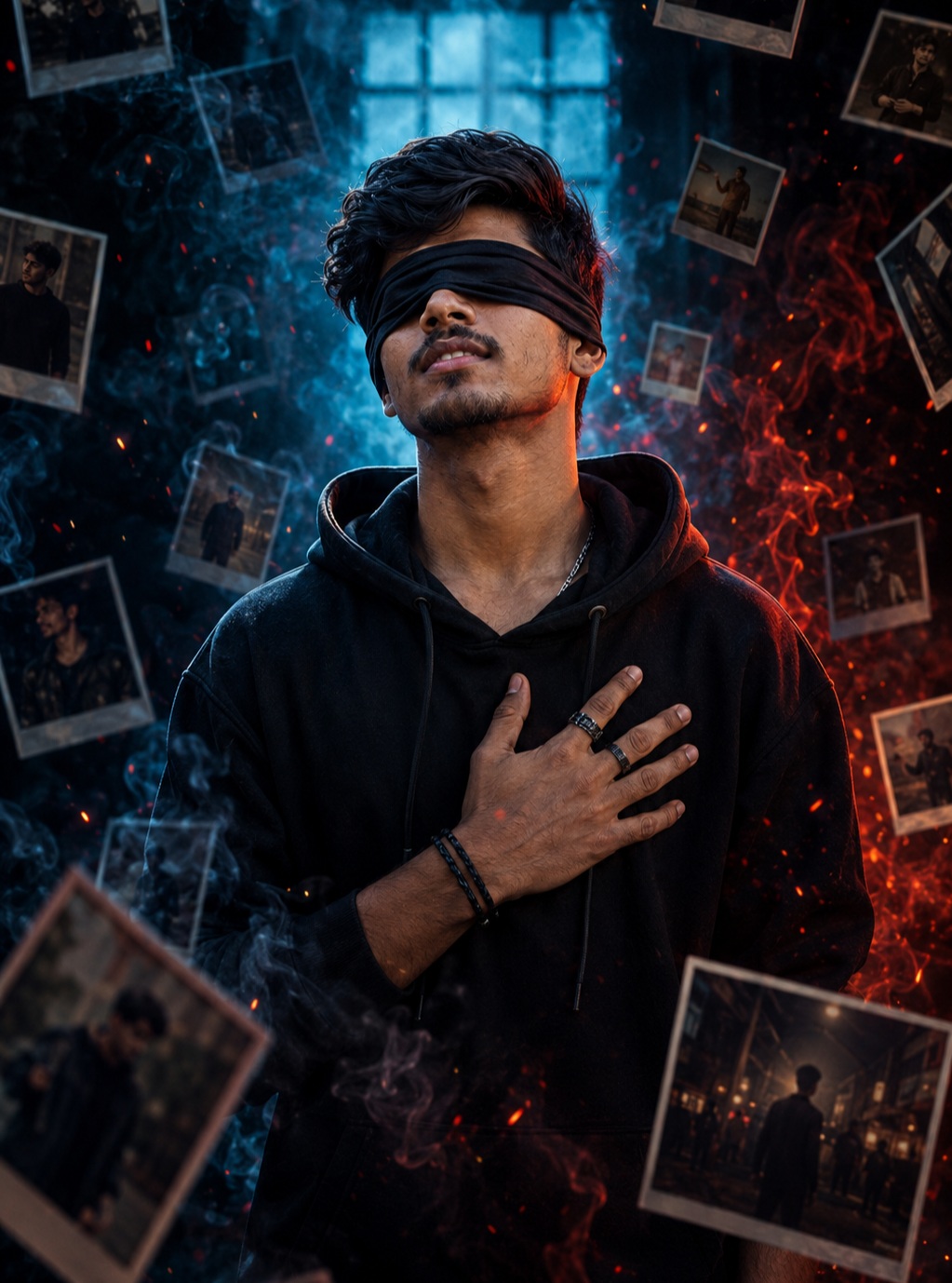
Cinematic Blindfold Portrait
The prompt describes a highly controlled cinematic portrait concept built around mystery, emotional isolation, and psychological tension. The central subject is a single male figure whose identity needs to remain faithful to the supplied person reference while the visual storytelling, pose, clothing, atmosphere, and composition are taken from the main reference. This separation is important because the concept is designed to preserve recognizable facial identity without allowing the identity source to change the established visual language of the scene.
The main subject appears in a blindfolded pose with the head raised slightly upward. This creates an immediate sense of vulnerability, uncertainty, and emotional conflict. The raised head and extended neck introduce a subtle feeling of surrender or searching, while the blindfold prevents the viewer from receiving the usual emotional information from the eyes. Because the eyes are hidden, attention naturally shifts toward the facial structure, beard, lips, jawline, neck, hands, clothing, and surrounding visual symbols.
The expression is intended to remain natural and psychologically serious rather than exaggerated. The face should retain authentic skin texture, visible pores, beard detail, small imperfections, and photographic grit. The prompt specifically avoids artificial beauty treatment, excessive smoothing, plastic-looking skin, or an overly polished appearance. This gives the portrait a grounded editorial quality, allowing the emotional atmosphere to feel more believable and mature.
The pose is one of the strongest structural elements. The shoulders, torso orientation, head angle, neck extension, and hand position are treated as fixed relationships rather than loose suggestions. One hand rests firmly across the chest, creating a strong emotional gesture. The fingers, knuckles, wrist angle, rings, bracelet, and contact between the hand and hoodie are all important because the hand becomes a major storytelling element. It can suggest protection, anxiety, restraint, memory, or an attempt to hold oneself together.
The clothing is deliberately understated but visually rich. A black oversized hoodie forms the primary wardrobe element, with natural folds, cuffs, drawstrings, layered neckline details, and fabric volume contributing to the portrait’s depth. A visible chain adds a subtle accessory layer without becoming a distracting focal point. The oversized silhouette supports the psychological atmosphere because the clothing feels protective and enveloping rather than fashion-forward in a conventional commercial sense.
The surrounding environment is dense and atmospheric. Floating Polaroid-style photographs appear around the subject at different distances and depths. These photographs represent memories, fragments of the past, or disconnected moments of personal experience. Their varied positioning helps create a surreal environment without turning the composition into fantasy illustration. Some photographs are intended to appear sharp, while others become softly blurred or partially obscured by foreground bokeh.
The photographs are especially important because they introduce visual storytelling beyond the main portrait. Rather than functioning as simple decorative objects, they create the impression that the subject is surrounded by memories that cannot be fully accessed. Their different poses and photographic moments prevent the scene from feeling repetitive. Variation in perspective, scale, opacity, focus, and spatial placement creates a believable layered environment.
Smoke adds another atmospheric layer. It softens transitions between the subject and background while creating areas of diffusion around the floating photographs. Sparks and embers introduce tiny points of movement and energy. These particles can make the environment feel unstable and emotionally charged. Together, smoke, sparks, embers, photographs, and light form a dense cinematic space that feels more like a psychological memory than a conventional studio portrait.
The lighting is based on a deliberate cool-versus-warm contrast. A blue or cyan window-like glow provides the primary background atmosphere, creating a cold and distant feeling. In contrast, red-orange rim lighting catches the edges of the subject, hoodie, smoke, and surrounding particles. This opposing color relationship creates tension between isolation and intensity. The cool background can suggest emotional distance, while the warmer rim light adds urgency and inner conflict.
The tonal treatment is deep and cinematic. Blacks should remain rich but should not lose all texture. Dark clothing, hair, smoke, and environmental elements need enough tonal separation to remain readable. Highlights are controlled rather than excessively bright, allowing the red-orange light and cyan glow to act as purposeful accents. The overall palette supports a serious psychological-drama aesthetic instead of a cheerful or fashion-commercial appearance.
Composition is equally important. The subject remains dominant while still being integrated into the surrounding environment. The reference framing, camera angle, headroom, perspective, and subject scale are treated as essential visual relationships. The central figure should not suddenly become oversized or repositioned because that would change the emotional balance. The surrounding photographs and atmospheric effects should support the subject rather than compete with him.
The camera feel is intended to resemble premium professional photography. Realistic depth of field helps separate near photographs from distant photographs while maintaining a convincing sense of physical space. Facial and fabric details should remain crisp where appropriate, while smoke, embers, and background elements can naturally soften with distance. The result should feel like a carefully photographed editorial scene rather than a flat digital composite.
The concept also relies heavily on micro-detail. Individual hair strands, beard texture, hoodie fibers, blindfold folds, jewelry, fingers, rings, bracelet surfaces, smoke patterns, tiny sparks, and photographic edges all contribute to realism. These details matter because the scene contains many layers, and each layer needs believable physical characteristics. The richer the small details, the more convincing the overall psychological environment becomes.
The blindfold is more than a wardrobe accessory. It becomes the primary visual symbol of uncertainty and emotional disconnection. Covering the eyes removes direct visual communication and forces the viewer to interpret the subject through posture and environment. The floating photographs then become an external representation of memory, while the hand across the chest becomes an internal representation of emotion.
The design purpose is to create a portrait that feels mysterious, introspective, dramatic, and slightly surreal while remaining grounded in photographic realism. It can work especially well for cinematic social media artwork, personal editorial portraits, dramatic profile imagery, music-related visuals, fashion campaigns, psychological storytelling, poster concepts, album-style artwork, and premium personal branding.
The strongest creative quality comes from the balance between control and atmosphere. The pose is tightly defined, yet the surrounding smoke and photographs create movement. The face remains natural, while the lighting becomes dramatic. The clothing stays simple, while the environment becomes complex. The image therefore feels visually rich without losing a clear central subject.
Another important feature is the absence of typography. The composition is intentionally kept clean of names, titles, captions, logos, watermarks, signatures, and invented lettering. This leaves the visual storytelling independent from graphic design elements and allows personal text to be introduced later if desired. Keeping the scene text-free also protects the cinematic atmosphere from unnecessary distractions.
Overall, the prompt describes a sophisticated psychological portrait built from identity accuracy, locked pose relationships, expressive hand placement, dark wardrobe styling, layered memory photographs, atmospheric smoke, contrasting cinematic illumination, and authentic photographic texture. Every major component supports the same emotional idea: a person surrounded by fragments of memory while being unable to see them clearly. The result is designed to feel intimate, mysterious, emotionally heavy, and visually premium.
[[[
1. Main Goal & Scenario
Reconstruct the Main Reference as a premium cinematic psychological-drama portrait, preserving the exact composition, atmosphere, subject placement, photographic density, and dramatic storytelling of the reference.
2. Identity Mapping & Face Scale
Use the PERSON SOURCE only for the subject’s exact face identity and natural body thickness. Do not copy pose, clothing, background, or composition from the PERSON SOURCE.
3. Pose Source Lock
100% lock the pose from the MAIN REFERENCE: blindfolded head raised slightly upward, shoulders positioned exactly as shown, torso orientation unchanged, and one hand placed firmly across the chest.
4. Typography Letter Content Lock
No typography, no 3D letters, and no name/text elements anywhere in the reconstruction.
5. ONE TEXT ONE PLACE Lock
NO TEXT. The user may add their own name or text later.
6. Single Horizontal Line Text Lock
No text is required. Preserve the reference composition without creating empty typography areas.
7. Direct Text Injection Command
Do not render any text, name, title, caption, watermark, signature, or lettering.
8. No Giant Central Figure Lock
Keep the subject’s scale and framing exactly like the MAIN REFERENCE; do not enlarge, shrink, or reposition the central figure.
9. Micro-Details & Crop
Preserve the exact hair volume and strands, blindfold folds, beard texture, lips, jawline, neck angle, hand position, finger spacing, rings, bracelet, hoodie drawstrings, chain, floating photographs, smoke, sparks, and edge crops.
10. Identity, Raw Skin & Anti-Fake
Maintain exact facial identity with realistic pores, beard texture, natural skin imperfections, and photographic grit. No plastic skin, beauty retouching, face smoothing, or artificial facial reconstruction.
11. Hand-Prop & Neck-Head Alignment
Match the reference hand placement precisely across the chest, including wrist angle, finger curvature, knuckles, rings, bracelet, and contact with the hoodie. Preserve the exact upward head tilt and neck extension.
12. Body Proportion & Limb Scaling
Use the MAIN REFERENCE for pose and proportions, while using the PERSON SOURCE only for natural body thickness. Keep realistic hands and limbs; no oversized or muscular distortion.
13. Outfit Fit, Drape & Wrap
Recreate the exact black oversized hoodie, hood shape, folds, drawstrings, layered neckline, chain, cuffs, and natural fabric drape from the MAIN REFERENCE.
14. Selective Color & Tone Mapping
Preserve the reference’s deep cinematic contrast: cool blue/cyan window light in the background balanced against intense red-orange rim lighting, embers, and smoke. Keep blacks rich without crushing detail.
15. No Random Logos & Clean Text
No logos, watermarks, signatures, brands, captions, or invented graphical elements.
16. Perfect Spelling & Text Rendering
No text is required. Leave the image completely text-free so the user can add their own name later.
17. Text Ratio & Style Lock
Do not alter the original image aspect ratio or crop. Maintain the same vertical cinematic framing.
18. Opacity, Layering & Ghost
Recreate the floating Polaroid-style photographs at varied depths, including sharp, semi-blurred, and foreground-bokeh photographs. Preserve their different opacity levels and spatial layering.
19. Duplicate Mapping & Pose Variety
Floating photographs should contain varied photographic moments and different poses rather than repeated identical images. Maintain their approximate positions, perspective, blur, and depth from the MAIN REFERENCE.
20. Vibe & Mood Decoding
Dark, mysterious, emotional, cinematic, introspective, dramatic, slightly surreal, and psychologically intense. The blindfold and floating memories should create a strong feeling of mystery and emotional isolation.
21. Professional Quality Boost
Ultra-realistic professional photography, premium cinematic grading, crisp facial and fabric detail, realistic depth of field, controlled highlights, volumetric light, atmospheric smoke, natural film grain, high-end editorial poster quality.
22. Body Visibility & Scene Density
Keep the subject dominant in the frame while maintaining the dense surrounding environment of floating photographs, smoke, sparks, embers, and atmospheric particles.
23. Composition/Camera & Lighting
Match the MAIN REFERENCE camera angle, centered portrait framing, focal length perspective, subject scale, and headroom. Strong cool window backlight creates a glowing vertical background while red-orange side/rim light defines the subject and smoke.
24. Quality Lock & User Customization
Reconstruct the image faithfully with no unauthorized creative changes. NO NAME / NO TEXT. The final image must remain clean and text-free so the user can add their own name later.
25. Bad Output Mistakes & Negative Prompt
wrong identity, generic face, face paste, plastic skin, smooth skin, beauty filter, wrong pose, copied PERSON SOURCE pose, normalized pose, broken neck, bad anatomy, bad hands, hulk hands, wrong finger placement, wrong rings, wrong bracelet, wrong hoodie, wrong clothing, wrong body thickness, wrong head tilt, wrong crop, wrong camera angle, flat lighting, dull colors, excessive warm tone, missing blue window light, missing red rim light, missing photographs, repeated photographs, floating photographs in wrong positions, missing smoke, missing sparks, missing embers, random logos, watermarks, signatures, captions, names, typography, text, random letters, hallucinated words, unauthorized text, giant central figure, over-beautified face, low detail, low density, amateur quality, AI artifacts, distorted fingers, duplicated limbs, unrealistic skin, incorrect composition. ]]]
” https://prompt.mahantababu.com/
https://en.wikipedia.org/wiki/Artificial_intelligence
https://prompt.mahantababu.com/cinematic-blindfold-portrait/