
Holi Festival Portrait
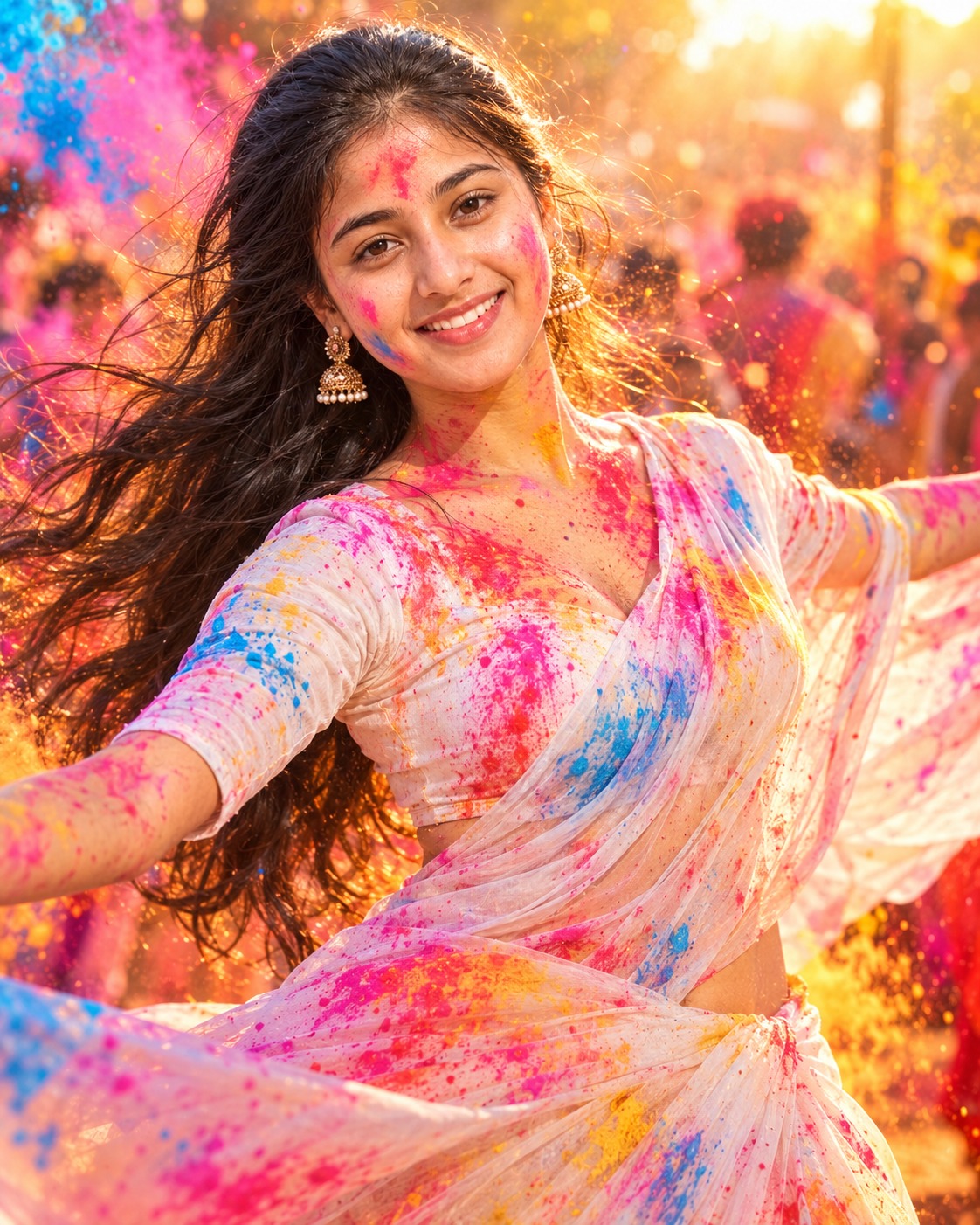
The Holi Festival Portrait concept captures the carefree happiness, color, and excitement of Holi through a vibrant, cinematic photographic composition. The central subject is a young woman celebrating the festival with a natural, expressive smile. Rather than presenting a formal or carefully posed studio portrait, the concept focuses on a spontaneous moment filled with movement, laughter, flying color powder, and warm sunlight. Every visual element contributes to the feeling of being surrounded by a lively Holi celebration.
The most important feature of this concept is its approach to facial identity. The reference image establishes the overall visual appearance, including the subject’s position, head angle, expression, clothing, lighting, and surroundings. The supplied personal photograph serves as the source of the recognizable facial identity. This separation allows the creative concept to retain its original visual character while incorporating the intended person’s natural facial features. Details such as the eyes, nose, lips, facial proportions, and skin texture contribute to a believable photographic appearance.
The facial expression is a major part of the portrait’s emotional impact. The woman is laughing with her mouth open and teeth visible, creating an impression of genuine excitement and unrestrained happiness. Her head tilts slightly backward, while her face remains directed toward the camera. This combination gives the expression a spontaneous quality, as if someone captured the perfect moment during a celebration. The relaxed shoulders and slightly angled torso support the natural, carefree body language.
The pose is equally important to the composition. The woman’s arms extend outward, creating a broad silhouette that communicates freedom and movement. Her body remains within a medium portrait crop, extending from the head to the hips. The arms and fabric approach the edges of the frame, giving the photograph a sense of movement beyond the visible area. This framing makes the subject feel connected to the surrounding celebration rather than isolated against a plain backdrop.
The outfit establishes a striking contrast with the colorful environment. A traditional white Indian blouse is paired with a lightweight, translucent white saree or draped fabric. The white material provides a bright foundation against the rich pigments scattered across the clothing. Its folds, flowing edges, and delicate transparency create visual texture, while the draping adds movement to the overall composition. The clothing is not intended to look freshly cleaned or redesigned. Its colorful stains are an essential part of the festival atmosphere.
Holi pigments appear across the chest, shoulders, sleeves, and saree in shades of red, pink, blue, orange, and yellow. These marks suggest direct participation in the celebration. Some colors form concentrated splashes, while others appear as scattered powder and softer smudges. The combination of bright fabric and vivid pigment makes the outfit one of the most recognizable features of the concept. It also creates a strong connection between the subject and the festive environment.
The woman’s long, dark hair contributes another layer of motion. It flows outward toward both sides of the frame, creating a dynamic silhouette around her face. Individual strands and larger sections of hair respond to the implied movement of the moment. The hair is not simply a static styling detail; it helps communicate energy and spontaneity. Ornate gold jhumka earrings complement the traditional outfit and provide small points of warm metallic detail near the face.
Lighting gives the scene much of its cinematic character. Strong golden sunlight enters from the upper-right background, creating a warm glow around the hair and shoulders. This backlighting separates the woman from the background and makes the airborne powder appear luminous. Highlights on the skin and fabric feel connected to the surrounding light, while the shadows retain enough depth to preserve the photograph’s dimensional quality. The lighting creates warmth without losing the finer details of the face.
The background is deliberately soft and atmospheric. It suggests a crowded Holi celebration through blurred figures, colorful clouds, floating particles, and glowing festival lights. Rather than making every person or object clearly identifiable, the scene uses shallow depth of field to keep attention on the central subject. Warm orange and yellow illumination fills much of the background, while pink and red powder clouds add intensity. Blue pigment haze on the left provides contrast and prevents the warm palette from becoming visually monotonous.
Color grading is one of the defining characteristics of the concept. Coral red, magenta, hot pink, electric blue, orange, and golden yellow work together to create a highly saturated festive appearance. Deep reddish-brown shadows balance the bright highlights, giving the photograph richness instead of a flat, uniformly bright look. The balance between warm sunlight and cooler blue pigments helps separate different areas of the composition and gives the scene greater visual depth.
The photographic style emphasizes realistic skin texture, detailed facial features, natural proportions, and convincing interactions between light, fabric, hair, and airborne particles. Shallow depth of field creates a clear distinction between the subject and the background. The central face remains the main point of attention, while the surrounding colors form a vivid supporting frame. This approach combines the spontaneity of festival photography with the polish of a professional cinematic portrait.
The vertical 2:3 composition makes the concept suitable for social media posts, festival-themed profile imagery, personal celebration albums, and seasonal creative collections. Its medium framing gives enough space to appreciate the face, outfit, earrings, flowing hair, and colorful stains without losing the intimacy of a portrait. The absence of typography, logos, borders, and watermarks keeps the presentation focused on the person and the atmosphere.
Another important feature is the consistency of the visual identity. The concept relies on preserving the relationship between the facial expression, head position, body posture, outfit, and light direction. When these elements remain visually consistent, the face integration feels more natural. The original color distribution, clothing condition, hair silhouette, background density, and crop all contribute to the recognition of the reference’s style.
For users who appreciate colorful Indian festival photography, this concept offers a distinctive balance of tradition, emotion, and contemporary visual presentation. The white saree and gold earrings establish a traditional foundation, while the airborne pigments and dramatic sunlight introduce movement and cinematic depth. The result is a festive portrait concept that feels expressive, personal, and visually rich, making it appropriate for Holi memories, seasonal profile pictures, celebration albums, and creative social media presentations.
[[[
REFERENCE ANALYSIS
- Image type: Vertical Holi festival portrait, vibrant cinematic photography, approximately 2:3 aspect ratio.
- Composition: A young woman occupies the center, framed from the head to the hips. Her flowing hair spreads toward the left and right, while her body is slightly angled.
- Pose: Head tilted slightly backward, face turned toward the camera, mouth open in a joyful laugh, shoulders relaxed, arms extended outward, with the right side of the frame cutting off part of the arm and flowing fabric.
- Outfit lock: White traditional Indian blouse with a white, lightweight, translucent saree or draped fabric. Preserve all multicolored Holi powder stains, splashes, fabric folds, transparency, and original draping.
- Face and accessories: Large joyful smile, visible teeth, natural facial proportions, long dark windblown hair, ornate gold jhumka earrings, and colorful powder across the forehead, cheeks, neck, shoulders, and clothing.
- Lighting: Strong golden sunlight in the upper-right background, warm backlighting around the hair, luminous highlights, soft circular golden bokeh, and natural shadow detail.
- Color grading: Extremely vibrant orange, golden yellow, coral red, magenta, pink, and electric blue. Rich saturation and vibrance, with warm highlights and deep reddish-brown background shadows.
- Background: Blurred Holi celebration, colorful airborne powder clouds, floating particles, indistinct people, and warm festival lights. No sharply defined background subjects.
- Atmosphere: Spontaneous happiness, energetic celebration, flying powder, movement, and a sunlit festive mood.
- Rendering style: High-detail photographic realism with shallow depth of field, natural skin texture, crisp facial details, dynamic hair movement, and cinematic light scattering.
- Text and graphics: No typography, logos, borders, or watermarks.
MASTER PROMPT
Use the supplied reference image as the master blueprint. Replace only the reference character’s face with the supplied user identity. COMPLETELY IGNORE the user’s original photo pose and body; force the user into the exact body pose, hand placement, and posture of the reference character.
Recreate the reference as closely as possible: a vertical, highly vibrant Holi festival portrait of the user laughing joyfully, head tilted slightly backward, face turned toward the camera, mouth open in a natural smile with visible teeth, shoulders relaxed, torso slightly angled, and arms extended outward in the same position as the reference. Preserve the original head angle, gaze direction, facial expression, body position, hair movement, crop, and camera perspective.
IDENTITY REPLACEMENT: Use the user’s actual facial identity, retaining their recognizable facial features, natural skin texture, eye shape, nose, lips, and facial proportions. Blend the user’s face seamlessly into the reference character’s head position, expression, lighting, and photographic style. Preserve natural head-to-body proportions. Do not enlarge the head or shrink the body. Do not transfer the user’s original body, pose, clothing, or background.
CRITICAL OUTFIT LOCK: Preserve the reference’s exact white traditional Indian blouse and lightweight, translucent white saree or draped fabric. Maintain the same garment design, neckline, folds, transparency, draping, fabric movement, and multicolored Holi powder stains. Preserve the red, blue, pink, orange, and yellow pigment splashes on the chest, shoulders, sleeves, and saree. The outfit must remain visibly powder-stained, not clean, redesigned, replaced, or modernized.
HAIR AND ACCESSORIES: Preserve the reference’s long, loose, dark hair blowing dramatically toward the sides, the same hair volume and silhouette, and the ornate gold jhumka earrings. Keep the original placement and visibility of these elements.
COLOR AND VIBRANCE LOCK: Preserve the reference’s intense Holi color palette with exceptionally rich red, coral, magenta, hot pink, electric blue, orange, and golden yellow pigments. Maintain strong saturation and vibrance, luminous powder clouds, crisp colorful particles, and rich warm golden highlights. Keep the same fiery orange-red background, deep reddish-brown shadows, golden bokeh, and radiant sunlight. Do not desaturate the colors or shift the image toward a different palette.
LIGHTING AND ATMOSPHERE: Reproduce the strong golden sunlight entering from the upper-right background, warm backlighting around the hair, glowing airborne Holi powder, soft circular golden bokeh, natural facial highlights, and the original shadow depth. Preserve the reference’s exposure, contrast, light direction, and warm festival atmosphere. Do not flatten the lighting or artificially brighten the face.
BACKGROUND AND EFFECTS: Preserve the blurred festival crowd, warm orange and yellow illumination, pink and red clouds of Holi powder, blue pigment haze on the left, airborne particles, and shallow depth of field. Maintain the exact visual density and distribution of the background elements. Do not add new objects, remove existing effects, introduce typography, or redesign the environment.
COMPOSITION LOCK: Maintain the original vertical 2:3 composition, medium portrait crop from head to hips, central subject placement, hair extending across the frame, arms and fabric extending toward the edges, and the same camera viewpoint. Do not zoom, recenter, expand the frame, change the crop, or expose additional body areas.
Maintain exact scale, proportion, crop, visibility. Preserve 1000% of all visual information including darkness, grading, mood, lighting, shadows, contrast, saturation, composition, environment, objects, background, text, props, rendering, outfit (exact style/color/condition), reference pose (exact body position/hands/expression), vibe (exact emotional tone), and natural human anatomy (correct head-to-body ratio, proportional hands/limbs, no distortions).
Output must look IDENTICAL to the reference except for the face swap. Do NOT brighten, enhance, modify, change outfit, reference pose, or vibe. The only intended identity modification is the user’s face. Preserve the original photographic realism, facial integration, natural anatomy, color vibrance, golden-hour lighting, powder textures, and dynamic movement.
EDITABLE VARIABLES
- [USER IDENTITY]: Use the face from the user’s supplied photo; preserve recognizable facial identity and natural facial proportions.
- [OUTFIT]: Exact reference outfit — white blouse and translucent white saree, covered in vivid Holi powder stains.
- [TEXT]: None.
- [OBJECT CHANGE]: None.
- [POSE CHANGE]: None; reference pose is mandatory.
- [ADDITIONAL EDIT]: Preserve the reference’s already high saturation and vibrance. Do not introduce additional stylistic changes.
NEGATIVE PROMPT
identity loss, different face, original character’s face, incorrect facial identity, user’s original pose, user’s original body posture, wrong head angle, wrong gaze, altered facial expression, closed mouth, forced smile, different body position, altered hand placement, different outfit, changed outfit color, clean white clothing, new clothing, missing Holi stains, altered fabric folds, redesigned saree, missing earrings, changed hair silhouette, straightened hair, static hair, incorrect head-to-body ratio, oversized head, tiny hands, disproportionate limbs,
deformed hands, extra fingers, extra limbs, distorted anatomy, bad proportions, shortened body, enlarged body, altered camera angle, wrong crop, zoomed-in framing, recentered subject, expanded frame, full-body composition, redesigned background, removed crowd, added objects, missing powder clouds, missing airborne particles, altered lighting direction, brighter exposure, lifted shadows, washed-out colors, low saturation,
dull colors, oversaturation beyond the reference, orange color cast replacing original tones, lost golden highlights, flattened contrast, altered bokeh, changed mood, different artistic style, unwanted illustration, plastic skin, excessive skin smoothing, beauty filter, face enhancement, artificial facial lighting, inconsistent shadows, mismatched face perspective, visible face-swap seams, blurry face, generic aesthetic, text, logos, watermarks, borders, unnecessary embellishments ]]]