
Gritty Thriller Collage
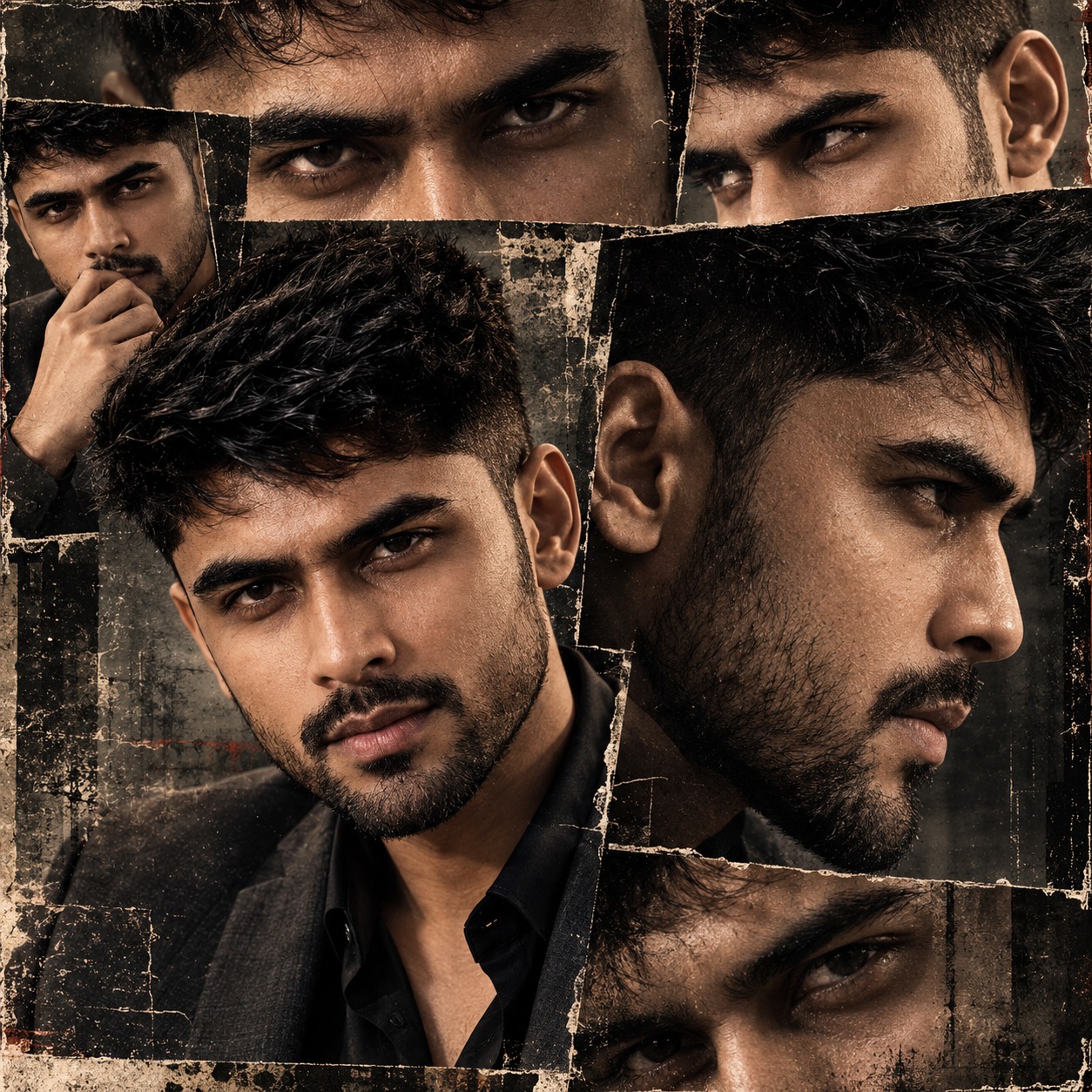
The Gritty Thriller Collage concept combines hyperrealistic portrait photography, psychological thriller aesthetics, and distressed editorial design. Its main subject is a rugged, mature man whose intense gaze, thick beard, textured skin, and dark hair establish a strong visual identity. Rather than presenting a conventional single portrait, the composition explores the same character through several tightly cropped photographic panels. Each fragment reveals a different aspect of his face, creating a layered visual experience that feels mysterious, dramatic, and emotionally charged.
The character’s appearance is deliberately natural and weathered. His hair is thick, dark, and slightly messy, with irregular strands that add depth and realism. A dense beard and full mustache define the lower half of his face, while coarse facial hair creates intricate texture around the cheeks, jaw, and mouth. The skin retains visible pores, wrinkles, under-eye creases, and natural imperfections. These details give the subject a mature, experienced appearance without relying on artificial beauty retouching or exaggerated facial features.
The eyes are among the most important elements of the design. They appear focused, intense, and serious, supported by furrowed eyebrows and visible lines across the forehead. The expression communicates tension and determination rather than a simple display of anger. Slightly parted lips and natural facial creases add another layer of emotional complexity. This controlled expression allows viewers to imagine a story behind the character, which is especially valuable for thriller-inspired visual artwork.
The primary portrait occupies the left-center portion of the composition. It shows the man in a three-quarter view, with his head turned slightly toward the right while his gaze remains directed toward the camera or just beside it. The tight crop emphasizes the eyes, nose, cheeks, mouth, and beard. By showing the face at close range, the composition makes small details feel important. The viewer can notice skin texture, individual beard strands, and subtle differences between illuminated and shadowed areas.
A second large portrait fills much of the right side. This fragment presents the same character in a distinct right-facing profile. The forehead, nose, cheek, lips, jawline, mustache, and beard form a strong silhouette. The profile provides a visual contrast with the three-quarter portrait, allowing the character to be viewed from another angle without changing his identity. The transition between the two large panels creates a sense of depth and psychological tension.
Smaller photographic fragments appear along the upper and lower edges. These panels focus on the eyes, eyebrows, forehead, and surrounding skin. Some reveal only a single eye beneath a furrowed brow, while others show both eyes and a small portion of the nose. A narrow eye detail near the bottom adds another visual layer. These cropped views make the character feel as though he is being examined through multiple photographic frames, encouraging the viewer to study the expression more closely.
The composition uses a square format with very little empty space. Rectangular and slightly diagonal panel divisions overlap to form an irregular editorial grid. The large facial portraits provide the main structure, while the smaller fragments fill the remaining areas. Dark seams and distressed boundaries help distinguish each photograph without making the overall design feel like a clean, uniform grid. This asymmetrical arrangement creates visual movement even though the subject remains largely still.
Lighting contributes heavily to the mood. Strong directional side lighting reveals the brow, cheekbone, nose ridge, and selected beard strands while allowing the opposite side of the face to fall into deep shadow. The contrast is dramatic but remains focused on facial structure. Small highlights in the eyes prevent the gaze from disappearing into darkness, while subtle illumination along the beard preserves its texture. The result feels intimate, intense, and cinematic rather than brightly lit or commercially polished.
The color palette is intentionally restrained. Charcoal black, ash gray, dirty beige, muted sepia, and pale gray highlights replace bright, saturated colors. The nearly monochromatic treatment creates a timeless, weathered appearance and keeps attention on facial details. Warm brown undertones prevent the image from feeling completely flat, while pale highlights provide contrast against the dark background. The limited colors also help the separate panels feel like parts of the same visual world.
Texture is another defining feature. Fine film grain, rough skin detail, coarse facial hair, distressed print effects, and subtle paper-like overlays give the collage an analog character. The surface resembles an aged photographic contact sheet or a weathered editorial print. These effects should support the portrait rather than obscure it. The eyes and important facial contours remain the sharpest areas, while secondary fragments can appear slightly softer to create depth.
The background is mostly concealed behind the layered photographs. This keeps the design focused on the character instead of a recognizable location. Dark, textured areas appear in the gaps between panels, reinforcing the low-key atmosphere. There are no prominent titles or elaborate decorative elements competing with the faces. The visual story is carried by the expression, the panel arrangement, the lighting, and the contrast between shadow and texture.
The overall mood is ominous, raw, serious, and introspective. The character seems to belong to a psychological thriller, crime drama, or intense cinematic story. His expression suggests unresolved tension, while the multiple viewpoints create a sense of fragmented memory or different sides of the same personality. The result does not need a visible action scene to feel dramatic. Its impact comes from the close examination of a single character.
This visual concept is suitable for thriller-themed posters, cinematic character studies, social media artwork, creative portfolio pieces, editorial covers, music artwork, and dark personal branding. It can also inspire designers who want to explore portrait collage, dramatic monochromatic grading, or distressed photographic textures. The square composition is especially adaptable to profile graphics, album artwork, and other compact visual formats.
The strongest aspect of this concept is the way its individual choices support one another. The facial texture establishes realism, the intense eyes create emotional focus, the contrasting camera angles add variety, and the dark sepia palette maintains visual unity. The overlapping panels introduce complexity without requiring a detailed environment. Together, these elements create a distinctive character-centered design that feels rugged, cinematic, and memorable.
[[[
A. REFERENCE ANALYSIS
- Style: Hyperrealistic gritty portrait photography, psychological thriller poster, dark monochromatic editorial collage.
- Composition: Square 1:1 canvas, tightly packed multi-panel collage of the same rugged male character, with overlapping rectangular and diagonal portrait fragments.
- Primary portrait: Large bearded face in the left-center, angled slightly toward the right, with a broad, intense expression and visible facial creases.
- Secondary portrait: Large right-facing side profile on the right, emphasizing the nose, brow, cheek, beard and deep facial shadows.
- Upper panels: Cropped eyes, brows and forehead details arranged in narrow horizontal and rectangular segments.
- Lower panel: Small, partially cropped eye detail near the bottom edge.
- Expression: Intense, stern and weathered; furrowed brows, focused eyes and natural facial tension.
- Lighting: Dramatic directional side lighting, deep shadows, restrained highlights and strong facial texture.
- Palette: Charcoal black, ash brown, dirty gray, muted sepia and pale gray highlights.
- Texture: Rough skin, pronounced wrinkles, coarse beard strands, fine film grain, distressed print and matte grunge overlays.
- Background: Minimal dark textured backdrop, largely concealed by the layered portrait panels.
B. MASTER PROMPT
Photorealistic Gritty Cinematic Portraiture + Dark Psychological Thriller Poster Aesthetic + Hyperrealistic Male Character Photography + Monochromatic Sepia Color Grading + Desaturated Charcoal and Ash-Brown Palette + Deep Black Shadows + High-Contrast Chiaroscuro Lighting + Weathered Skin Texture + Extreme Close-Up Portraits + Multi-Panel Character Collage + Fragmented Visual Storytelling + Distressed Analog Film Finish.
CANVAS AND COMPOSITION: Create a square 1:1 dark cinematic poster composed of multiple overlapping photographic fragments depicting the same rugged, middle-aged male character. Fill nearly the entire canvas with tightly cropped facial portraits, using an irregular editorial grid, uneven rectangular panels, slight diagonal segmentation and visible seams between the photographs. Place the largest frontal-to-three-quarter portrait in the left-center, a large right-facing side-profile portrait across the right half, several cropped eye and forehead panels along the upper edge, and a narrow eye-detail fragment near the bottom. Keep the image densely layered, asymmetrical and visually compressed, with very little empty background. Every panel must depict the same consistent character, not a collection of different people.
MAIN LEFT-CENTER PORTRAIT: Show a rugged, mature man with a thick, dark, coarse beard, a full mustache, messy dark hair and deeply textured skin. His head is turned slightly toward the right in a three-quarter view, while his eyes look intensely toward the camera or just beside it. His brows are furrowed, his forehead creased and his lips slightly parted in a tense, weathered expression. Frame tightly around the head, emphasizing the forehead, eyes, nose, cheeks, mouth and dense beard. Preserve realistic facial asymmetry, pronounced wrinkles, pores, rough skin, under-eye creases and individual beard hairs. Use hard directional side lighting to reveal the texture on one side of the face while the opposite side falls into deep shadow.
RIGHT SIDE-PROFILE PORTRAIT: Fill the right half with a separate close-up of the same man in a strong right-facing side profile. His forehead slopes toward a prominent nose, his eye looks forward along the direction of his face, and his cheek, jawline, mustache and thick beard form a sharply defined silhouette. Keep the head orientation distinctly in profile rather than frontal. Emphasize rough skin, fine wrinkles around the eye, textured brow hairs and dense beard strands. Illuminate the bridge of the nose, upper cheek and selected beard edges with narrow side-light accents. Allow the far side of the face to merge into deep charcoal shadow. Crop closely around the forehead, nose, lips and beard to create an intense, claustrophobic composition.
UPPER EYE PANELS: Across the upper edge, arrange several narrow photographic fragments containing extreme close-ups of the character’s eyes, eyebrows, forehead and surrounding skin. One panel may emphasize a single piercing eye partially hidden beneath a furrowed brow; another reveals both eyes and the bridge of the nose within a very tight crop. Keep the gaze intense and serious. Render fine eyelashes, irregular eyebrow hairs, skin creases, under-eye texture and tiny specular highlights. Separate the fragments with dark seams and rough printed edges, preserving the impression of layered photographic contact sheets.
LOWER EYE FRAGMENT: Add a narrow, partially cropped close-up near the bottom edge, showing one dark eye and a small portion of the surrounding brow and skin. Keep this panel secondary and partly concealed by the main portrait fragments. Maintain consistent eye color, facial texture and identity across all panels.
CHARACTER CONSISTENCY: Maintain the same mature male character throughout the collage, with a thick coarse beard, full mustache, messy dark hair, weathered skin, pronounced facial lines and intense eyes. Vary only the camera crop and head orientation between panels. Do not introduce different identities, alter facial proportions between fragments or create duplicate eyes within a single face. Keep the facial details grounded in realistic human anatomy.
CAMERA AND PERSPECTIVE: Use extreme close-up and macro portrait framing, with a slight low-angle impression in the larger portraits. The main left portrait is a tight three-quarter facial view; the right portrait is a tight side profile; the upper and lower fragments are macro eye details. Keep perspective distortion restrained and natural. Prioritize facial geometry, beard texture and expressive eyes rather than showing the full body. No wide shots or large environmental backgrounds.
LIGHTING AND SHADOWS: Dramatic low-key illumination with a hard directional key light from the upper side, creating pronounced highlights on the brow, cheekbone, nose ridge and selected beard hairs. Use strong shadow falloff across the opposite side of the face. Preserve subtle reflected light in the eyes and limited highlights along the beard. Maintain rich shadow detail without lifting the dark areas excessively. Avoid frontal beauty lighting, flat illumination and bright studio backgrounds.
COLOR GRADING: Strictly restrained monochromatic sepia and charcoal grading. Use ash gray, dirty beige, muted brown, faded ivory and deep black. Desaturate any natural skin coloration, keeping the overall image almost monochrome with subtle warm-brown undertones. Preserve pale gray highlights on the skin against deep, dark facial shadows. Apply strong tonal separation and high micro-contrast without making the image glossy or artificially sharpened.
TEXTURE AND FINISH: Hyperrealistic skin pores, coarse beard strands, fine mustache hairs, forehead wrinkles, under-eye lines, rough cheek texture, stray hair strands and natural imperfections. Overlay subtle analog film grain, fine noise, distressed print texture and a matte paper-like surface. Add restrained edge vignetting and gentle background defocus where visible. Keep the eyes and key facial contours sharply defined while allowing secondary panel details to appear slightly softer. Preserve an unpolished, raw editorial finish.
PANEL EDGES AND GRAPHIC DESIGN: Use irregular rectangular divisions, tight overlapping crops, slightly angled panel boundaries and dark, distressed seams. Blend the photographic fragments with subtle rough-paper texture and faded ink artifacts. Keep the composition photographic rather than illustrated. Avoid decorative colors, prominent text, large logos or elaborate graphic elements that distract from the faces.
FINAL VISUAL RESULT: A square, high-contrast psychological thriller character poster built from extreme close-ups of one rugged, bearded man. A large three-quarter portrait anchors the left side, a sharply defined right-facing profile fills the right, and cropped eye details run across the top and bottom. Deep charcoal shadows, ash-brown highlights, rough skin, coarse facial hair, distressed film grain and fragmented panel geometry create an intense, raw and ominous atmosphere.
C. EDITABLE VARIABLES
| Variable | Current value |
|---|---|
| [USER IDENTITY] | One consistent rugged male character across all panels |
| [CAMERA ANGLE] | Tight eye-level to slight low-angle views |
| [POSE & BODY GEOMETRY] | Head-and-face crops only |
| [FACE DIRECTION & EXPRESSION] | Three-quarter view, right-facing profile, intense gaze |
| [CAMERA & PERSPECTIVE] | Extreme close-ups, macro eye details, square canvas |
| [OUTFIT & ACCESSORIES] | Mostly outside the crop; unspecified |
| [LIGHTING & SHADOWS] | Hard directional side light, deep low-key shadows |
| [COLOR & MOOD] | Monochromatic charcoal, ash brown and sepia |
| [TEXTURE & EFFECTS] | Distressed print, analog grain, matte grunge |
| [BACKGROUND & OBJECTS] | Minimal dark background behind layered panels |
| [TEXT] | None specified |
| [ASPECT RATIO] | Square 1:1 |
| [AUTHORIZED CHANGES] | None specified; preserve the collage structure |
D. NEGATIVE PROMPT
Different people in different panels, inconsistent character identity, duplicate facial features, extra eyes, malformed eyes, mismatched beard shape, clean-shaven face, thin beard, altered facial proportions, smooth youthful skin, beauty retouching, plastic skin, excessive denoising, excessive sharpening, artificial facial hair, unrealistic wrinkles, exaggerated scars, invented wounds, exaggerated anger, cartoon expression, distorted nose, malformed mouth, asymmetrical eye placement beyond natural anatomy,
extra facial features, full-body framing, wide-angle environmental shot, bright background, colorful lighting, saturated colors, blue and teal grading, orange cinematic wash, glossy beauty lighting, flat frontal illumination, crushed black shadows without texture, blown highlights, heavy bloom, excessive lens flare, excessive film grain, unreadable foreground typography, large title text, clean modern poster design, uniform grid layout, missing eye panels, missing right-facing profile, hard digital cutout edges, painterly rendering, illustration, anime, 3D character render, watermark, logo, unrequested accessories or background elements.
E. RECONSTRUCTION BLUEPRINT
A square, gritty psychological-thriller poster made from tightly cropped photographs of the same rugged, mature man with messy dark hair, a thick coarse beard, a full mustache and deeply textured skin. The left-center contains a large three-quarter portrait with furrowed brows and an intense gaze. A sharply defined right-facing side profile fills the right half, highlighting the nose, brow, cheek, mustache and beard. Several narrow macro photographs of his eyes and forehead span the upper edge,
with another cropped eye fragment near the bottom. Arrange all panels asymmetrically, with overlapping rectangular crops, slight diagonal divisions and distressed seams. Use dramatic side lighting, deep charcoal shadows, muted ash-brown and sepia highlights, realistic pores, pronounced wrinkles, individual beard strands and subtle analog film grain. Keep the background dark and minimal, the contrast strong, the palette nearly monochrome and the overall finish raw, weathered and cinematic.
F. LIMITATIONS
- The reference uses several very tight crops, so complete head shapes, body position and clothing cannot be established reliably.
- Exact age, identity, eye color and specific facial marks should not be invented beyond what is visibly supported.
- The precise original panel boundaries and any tiny printed details may vary during image generation.
- For consistent facial identity across the collage, use a suitable identity reference and image-conditioning tools where available. A text prompt alone cannot guarantee exact identity or pixel-perfect reproduction.
]]]