
Male Double Exposure
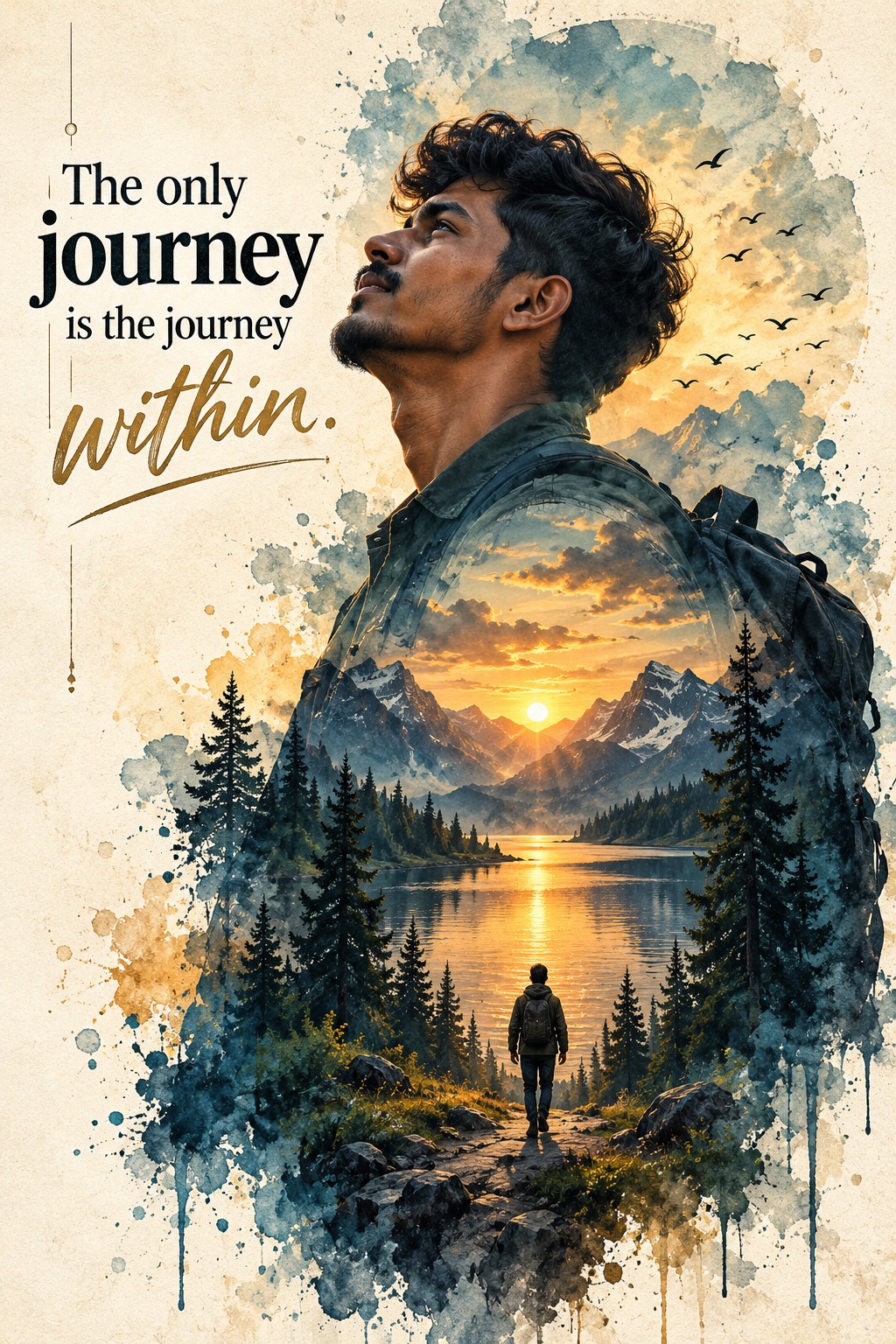
The main idea behind this Male Double Exposure concept is the connection between a person’s inner world and the journey that unfolds throughout life. It combines a dramatic male profile with a peaceful mountain landscape, creating a visual story about reflection, solitude, personal growth, and discovering meaning beyond everyday experiences. Instead of presenting a conventional portrait, the concept uses the human silhouette as a space where an entire natural environment becomes part of the subject. This relationship between the person and the landscape gives the artwork its distinctive character.
The central figure is an adult man shown in a strong side profile. His face turns toward the left, while his chin lifts upward and his head tilts slightly backward. This posture creates a feeling of looking toward something beyond the immediate surroundings. It can suggest hope, curiosity, determination, or a quiet moment of self-reflection. The raised head also creates a graceful profile line that contrasts with the rugged forms of the mountains inside the silhouette. In this Male Double Exposure composition, the body language communicates emotion without relying on an exaggerated facial expression.
The man’s appearance remains understated and natural. Thick, curly, slightly tousled hair creates an irregular outline around his head, with small strands adding texture and character. A short beard and subtle moustache help define the lower part of his face. The forehead, nose, lips, chin, and jaw remain recognizable through their contours, even though the facial details are mostly concealed in shadow. This restrained treatment keeps the attention on the overall profile rather than turning the subject into a conventional close-up portrait.
His clothing consists of a dark charcoal or deep teal top with a raised collar. A rounded backpack sits behind the upper back, extending the silhouette and reinforcing the theme of travel. These simple clothing details have symbolic importance. The backpack suggests preparation, movement, independence, and the willingness to carry personal experiences along the way. The dark outfit also allows the brighter landscape and warm sunset to stand out. The Male Double Exposure concept therefore uses everyday outdoor clothing to support a broader story about exploration and inner change.
The landscape is the defining visual feature. Layered mountain peaks rise around a low golden sun, creating a dramatic horizon inside the man’s silhouette. The distant ridges appear pale and atmospheric, while the nearer slopes become darker, greener, and more substantial. This gradual transition between distant and foreground scenery creates depth. The mountains feel expansive without overwhelming the central subject, and their rugged shapes add a sense of scale to the otherwise quiet scene.
Below the mountains, a calm alpine lake carries the light of the setting sun toward the foreground. Fine horizontal ripples break the reflection into delicate bands, while an elongated path of amber and gold draws the eye toward the horizon. The water provides a visual bridge between the distant sunlight and the darker lower portion of the composition. In this Male Double Exposure artwork, the lake also works as a metaphor for stillness, clarity, and the opportunity to pause and consider one’s direction.
A tiny lone hiker walks toward the distant sunlight near the bottom center of the landscape. Seen from behind, the traveler carries a small backpack and wears dark outdoor clothing. The figure is intentionally much smaller than the surrounding mountains and the large human silhouette that contains the scene. This dramatic difference in scale creates one of the concept’s strongest storytelling elements. The man represented by the main silhouette and the solitary traveler inside the landscape appear connected through the shared theme of a journey, while the tiny figure emphasizes the vastness of the world ahead.
Evergreen pine trees frame the lake and establish the character of the mountain environment. Taller trees near the foreground create dark vertical accents, while trees along the distant shores help define the edges of the water. Their pointed forms contrast with the softer mountain ridges and the circular glow of the sunset. Small black birds appear across the upper-right sky, bringing movement to the otherwise still scene. These birds also help connect the natural landscape to the open space around the man’s head.
The background uses aged ivory rather than plain white. Its gentle cream tone gives the poster the feeling of a printed fine-art piece that has developed character over time. Fine paper grain, subtle weathering, and scattered distressed marks prevent the empty space from feeling sterile. Behind the upper-right portion of the head, a broad watercolor wash introduces muted sage, gray-green, pale teal, and warm beige. This soft circular form provides visual balance and helps the dark silhouette blend naturally into its surroundings.
Watercolor textures are important because they soften the boundary between photography and illustration. Pigment blooms, irregular paint splashes, dry-brush marks, and fine vertical drips create the impression of an artwork assembled from several expressive materials. Some edges remain clearly defined, particularly around the profile, while other areas dissolve into scattered pigment. This contrast gives the composition an organic appearance. The Male Double Exposure style feels carefully layered without losing the rough, tactile qualities associated with traditional watercolor and distressed paper.
The color palette balances warm and cool tones. Golden yellow, amber, and ochre surround the setting sun and its reflection. Deep teal, charcoal, and forest green establish the darker parts of the silhouette and landscape. Pale blue-gray mountain ridges introduce atmospheric distance, while antique cream and muted sage keep the background soft. These colors work together to create visual depth without depending on intense saturation. The warmth of the horizon becomes more noticeable because it sits against the cooler shadows of the surrounding environment.
Lighting is deliberately cinematic. The low sun creates a luminous focal point, with a gentle halo around the horizon and a bright reflection stretching across the lake. Subtle highlights along the man’s curls, neck, shoulder, and backpack help separate the silhouette from the background. His face remains largely underexposed, preserving the contemplative character of the profile. This lighting approach gives the Male Double Exposure concept a strong visual hierarchy: the viewer first notices the silhouette, then discovers the landscape and follows the light toward the distant horizon.
Typography provides the poster’s emotional message. The quote, “The only journey is the journey within.”, sits on the left in vertically arranged lines. Refined black serif lettering gives the opening words a literary quality, while the larger treatment of “journey” establishes a clear focal point within the text. The final word, “within,” appears in flowing golden-brown calligraphy with an extended underline. This shift from formal typography to expressive handwriting adds warmth and reinforces the personal nature of the message. A thin hanging line, a small black dot, and restrained golden accents complete the editorial layout without distracting from the quote.
The composition works because every element has a clear purpose. The left side provides calm negative space for reading, while the central and right portions carry the visual weight of the figure and landscape. The upward-facing profile creates a strong diagonal direction, and the golden horizon gives the eye a destination. The lake reflection, tiny hiker, trees, and birds provide smaller details that reward closer viewing. This arrangement makes the poster interesting from a distance while preserving layers of meaning when viewed more closely.
The Male Double Exposure concept is suitable for motivational posters, personal-growth graphics, travel-themed artwork, inspirational social media posts, editorial covers, and creative portfolio presentations. It can also support content about mindfulness, self-discovery, adventure, resilience, and life transitions. Its visual language is serious but not overly dramatic, making it appropriate for designs that aim to feel thoughtful, refined, and emotionally engaging.
For viewers, the appeal lies in the relationship between the recognizable human form and the expansive world contained within it. The mountains represent challenges and possibilities, the lake suggests reflection, the sunset signals transition, and the lone hiker represents the ongoing process of moving forward. These associations are open to interpretation, allowing different people to connect the same scene with their own experiences. The result is a cohesive creative concept in which landscape photography, watercolor texture, silhouette design, and meaningful typography work together to communicate a simple idea: the most important journeys often begin with an inward look.
[[[
A. REFERENCE ANALYSIS
- Style: Surrealist double-exposure artwork blended with cinematic landscape photography, watercolor textures, and inspirational poster design.
- Camera and pose: Large male side-profile silhouette facing left, head tilted backward, chin raised, and gaze directed upward. Thick curly hair, subtle beard, dark clothing, and a backpack.
- Composition: Vertical 2:3 poster. The large silhouette dominates the center and right, while the left side contains motivational typography and generous cream-colored negative space.
- Landscape: Mountain peaks surround a golden sunset above a reflective lake. A tiny lone hiker walks toward the horizon, framed by pine trees.
- Lighting: Warm amber sunlight contrasts with deep teal, forest-green, and charcoal shadows. The figure remains predominantly silhouetted.
- Textures and effects: Double exposure, watercolor pigment blooms, distressed paper grain, irregular paint splashes, scattered birds, and vertical paint drips.
- Typography: Black serif lettering paired with golden handwritten script. Preserve the exact quote: “The only journey is the journey within.”
B. MASTER PROMPT
Create a cinematic surrealist double-exposure artwork in a vertical 2:3 aspect ratio, designed as a sophisticated motivational fine-art poster. Combine a large, dark male profile silhouette with a breathtaking mountain landscape at golden sunset, blending photorealistic landscape elements with distressed watercolor textures, painterly pigment splashes, and elegant editorial typography.
MAIN SUBJECT AND POSE: Place a large adult male figure across the center and right side of the composition, visible from approximately the upper torso upward. Show him in a strong left-facing side profile, with his head tilted backward, chin raised, neck extended, and nose pointing diagonally toward the upper-left. Give him thick, tousled, curly dark hair with irregular flyaway strands and a short beard and subtle moustache.
Keep the facial features mostly obscured by deep shadow, retaining the recognizable contour of the forehead, nose, lips, chin, and jaw. Dress him in a dark charcoal or deep teal top with a raised collar. Position a dark, rounded backpack behind his upper back. Preserve the contemplative silhouette and understated clothing details.
DOUBLE-EXPOSURE LANDSCAPE: Integrate a majestic mountain valley into the entire silhouette. Place a radiant golden-yellow sun low on the horizon, centered between rugged, layered mountain peaks. Extend a calm alpine lake from the distant valley toward the lower foreground, featuring delicate horizontal ripples and an elongated vertical reflection of the sun. Add dark evergreen pine trees along both shores, with taller foreground trees framing the water. Place a single tiny hiker near the bottom center, seen from behind, wearing dark outdoor clothing and a small backpack, walking toward the distant sunlight. Maintain the dramatic scale difference between the enormous human silhouette and the solitary traveler.
Build depth with pale blue-gray distant mountain ridges, muted teal middle-distance slopes, deep forest-green forests, and charcoal foreground rocks. Blend the landscape organically into the man’s head, neck, shoulders, torso, and backpack, while retaining a clearly recognizable profile silhouette. Scatter numerous small black bird silhouettes across the upper-right sky, varying their sizes, spacing, and wing positions.
BACKGROUND AND MIXED-MEDIA TEXTURE: Use a pale aged-ivory paper background with subtle grain, weathered speckles, and distressed print texture. Behind the upper-right portion of the head, add a broad circular watercolor wash in muted sage, gray-green, pale teal, and warm beige. Let the silhouette dissolve along selected edges into irregular watercolor blooms, scattered pigment particles, organic ink splashes, and fine vertical paint drips near the bottom corners. Combine translucent watercolor washes, dry-brush marks, and restrained grunge details. Keep the left background relatively clean for typography.
LIGHTING AND COLOR: Illuminate the valley with a low, luminous amber-gold sunset. Create a soft halo around the sun and a brilliant golden reflection across the lake. Add restrained warm highlights to the mountain ridges and subtle cool rim definition along the man’s profile, curls, shoulder, and backpack. Keep the face and clothing intentionally underexposed. Use deep teal, charcoal, forest green, blue-gray, muted sage, antique cream, and golden ochre. Preserve the strong warm-versus-cool contrast, rich shadow depth, atmospheric mountain haze, and soft luminous horizon. Avoid excessive brightness, oversaturation, artificial neon colors, or glossy commercial retouching.
TYPOGRAPHY AND GRAPHIC LAYOUT: Reserve the upper-left and middle-left area for the exact motivational quote:
“The only journey is the journey within.”
Arrange the words in vertically stacked lines. Use refined black serif typography for “The only,” an oversized bold serif treatment for “journey,” and smaller black serif lettering for “is the journey.” Render “within” in flowing golden-brown handwritten calligraphy with a graceful, extended underline. Preserve the original spelling, punctuation, line hierarchy, and approximate placement. Include a thin hanging vertical line with a small black dot near the top-left and a few delicate golden geometric accents. Maintain generous negative space and clear separation between the quote and the main figure.
FINAL ART DIRECTION: Sophisticated cinematic double-exposure poster, introspective visual storytelling, symbolic solitude, environmental portraiture, fine-art conceptual photography, watercolor collage, distressed archival-paper texture, atmospheric landscape painting, and minimalist editorial graphic design. Keep the upward-facing male profile, integrated mountain lake, low golden sun, lone hiker, pine trees, birds, cream background, and original quote as the essential visual anchors. Produce a cohesive, layered composition with natural landscape detail and deliberately painterly edges.
C. EDITABLE VARIABLES
| Variable | Current specification |
|---|---|
| Subject | Male silhouette with curly hair and short beard |
| Pose | Left-facing profile, head tilted upward |
| Clothing | Dark top or jacket; backpack |
| Composition | Vertical 2:3 double exposure |
| Landscape | Mountains, pine forest, reflective lake |
| Main light | Golden sunset |
| Palette | Teal, forest green, cream, amber |
| Effects | Watercolor splashes, pigment blooms, paint drips |
| Text | “The only journey is the journey within.” |
| Authorized changes | None specified; preserve the reference |
D. NEGATIVE PROMPT
Front-facing portrait, downward-facing head, lowered chin, incorrect profile direction, altered head tilt, smiling face, exaggerated facial features, brightly illuminated face, visible detailed eyes, different hairstyle, clean-shaven face, missing backpack, light-colored clothing, extra people, multiple hikers, duplicate silhouettes, buildings, city skyline, modern architecture, desert landscape, ocean, daytime sky, missing mountains, missing lake reflection, missing golden sun, missing pine trees, missing birds, misplaced hiker,
incorrect double exposure, landscape outside the intended silhouette, hard cutout edges, excessive photographic realism in the entire artwork, glossy digital finish, oversaturated colors, neon lighting, excessive orange grading, brightened shadows, flattened contrast, excessive lens flare, heavy bloom, motion blur, cartoon styling, anime, plastic skin, excessive sharpening, artificial HDR, smooth vector background, clean white background without texture, missing watercolor splashes, missing paint drips, excessive grunge, illegible typography, misspelled quote, altered wording, incorrect font hierarchy, misplaced text, extra slogans, unwanted logos, watermarks, decorative elements absent from the reference.
E. RECONSTRUCTION BLUEPRINT
Create a vertical inspirational poster on aged ivory paper. A huge dark male silhouette occupies the center and right, with thick curly hair, a short beard, a raised chin, and a left-facing profile. A dark backpack projects behind his upper back. His face and clothing remain mostly in deep teal and charcoal shadow.
Inside the silhouette, a golden sun rests between layered mountain peaks, illuminating a reflective lake and a narrow path leading toward the horizon. A lone backpacker walks away from the viewer near the bottom center. Pine trees frame the lake, and black birds scatter across the upper-right sky. Cool blue-gray mountains and forest-green shadows contrast with the amber sunset.
Watercolor stains, pigment splashes, distressed paper grain, and fine paint drips dissolve the silhouette into the background. On the left, the quote “The only journey is the journey within.” appears in stacked black serif lettering, finishing with flowing golden-brown script and an underline. The overall image feels contemplative, atmospheric, painterly, and cinematic.
F. LIMITATIONS
- The original portrait’s exact identity, camera settings, and clothing construction cannot be established from the image.
- Exact typography, small decorative details, and double-exposure boundaries may vary between image-generation systems.
- This text prompt describes the visual target in detail but cannot guarantee pixel-perfect reproduction. A reference-conditioned workflow with masking and composition controls can improve fidelity.
]]]