
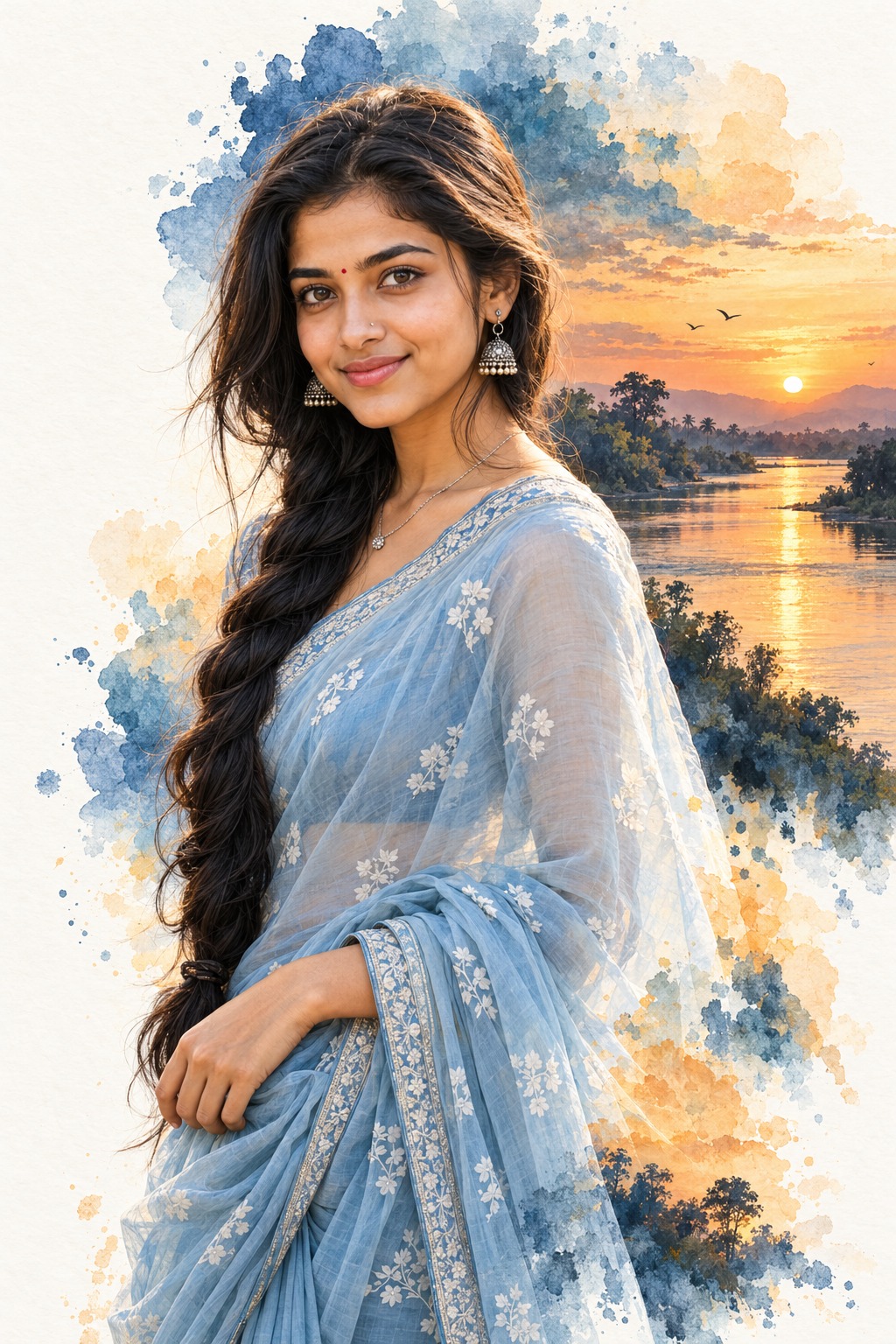
Watercolor Saree Portrait
The Watercolor Saree Portrait concept combines realistic Indian portrait photography with expressive watercolor illustration and a dreamy double-exposure landscape. It presents an elegant South Asian woman in traditional attire, surrounded by delicate pigment washes and a peaceful sunset river scene. The visual direction balances the authenticity of a photographic portrait with the softness and artistic freedom of watercolor painting. The result feels graceful, reflective, feminine, and sophisticated.
The main subject is a young adult South Asian woman positioned slightly left of center in a vertical composition. Her body turns gently away from the viewer, while her face turns back toward the camera. This three-quarter pose creates a natural sense of movement and gives the portrait a relaxed, editorial quality. Her shoulders remain comfortable, and her chin is slightly raised. A gentle closed-mouth smile and direct gaze communicate warmth, calmness, and quiet confidence.
Her facial styling emphasizes natural beauty rather than dramatic makeup. Expressive dark brown eyes, softly defined eyebrows, delicate eyelashes, and subtle eyeliner establish the eyes as an important focal point. Muted rose-red lips add warmth, while softly contoured cheeks create dimension without appearing heavily sculpted. A small round red bindi introduces a traditional Indian detail, and a tiny metallic nose stud adds a delicate highlight. Natural skin texture and restrained retouching preserve the realistic character of the portrait.
The woman’s long, dark hair is arranged in a thick braid that falls over her left shoulder. The hair has natural volume around the crown, with a few loose strands near the temples to soften the face. Individual strands and interwoven sections give the braid a detailed, realistic appearance. Its diagonal placement creates a natural line through the composition, directing attention from the face toward the sari and waist.
Traditional silver jewelry completes the styling. Ornate jhumka earrings frame the face, introducing decorative shapes and small metallic reflections. A fine necklace with a modest pendant rests against the clothing, while several silver bangles surround the wrist of the hand gathering the sari. The accessories are elegant without overpowering the subject. Their cool metallic tones complement the pale blue fabric and reinforce the delicate character of the design.
The sari is one of the most important visual elements. Its pale sky-blue color creates a soft, airy appearance that works beautifully with the watercolor background. The lightweight fabric is semi-transparent, with naturally flowing folds and delicate white floral embroidery. A narrow silver-blue embroidered border follows the drape of the sari, creating fine lines that help define the fabric’s shape. Subtle blue-gray shadows distinguish overlapping layers and preserve the sense of realistic textile depth.
The woman’s right hand, appearing on the viewer’s left, gently gathers the sari near her waist. Her fingers curve naturally around the material, creating small folds and a relaxed gesture. Several silver bangles frame the wrist and catch the soft illumination. The opposite arm remains mostly concealed behind the body and fabric, allowing the composition to retain a clean silhouette without unnecessary visual detail.
The background introduces the concept’s most distinctive feature: a tranquil landscape that gradually emerges from watercolor pigment clouds. The outer environment remains bright ivory-white, with generous open space around the upper and left portions of the composition. This negative space gives the artwork a clean, gallery-like quality and allows the portrait to stand out.
Behind the woman’s head and right shoulder, watercolor blooms in navy, slate blue, smoky teal, and pale blue create an expressive transition. These pigment clouds have irregular edges, translucent layers, and delicate variations in density. Some areas appear soft and misty, while others contain stronger blue marks and small paint droplets. Their organic appearance creates a contrast with the carefully defined facial features and embroidered clothing.
A peaceful river landscape emerges within the right side of the composition. The water extends from a distant horizon toward the lower-right foreground, providing a clear sense of depth. A low golden-white sun sits near the horizon and casts a shimmering vertical reflection across the river. This luminous pathway introduces a warm focal point that balances the cool blue watercolor forms.
Distant trees line the riverbanks, forming soft silhouettes against the glowing sky. The landscape may include gently layered hills, but the details remain understated so the scene does not compete with the portrait. A few small bird silhouettes cross the sky, adding a sense of openness and natural movement. The river, trees, birds, and sunset work together to create a quiet, contemplative atmosphere.
The color palette balances cool and warm tones. Pale sky blue, navy, slate blue, and teal establish the watercolor character, while cream, pale peach, amber, and golden-orange introduce the sunset’s warmth. The golden reflection draws attention toward the right side, while the cool pigment clouds create a visual connection with the sari. Warm skin tones prevent the portrait from feeling cold and help maintain a natural photographic appearance.
Lighting plays an important role in unifying these different elements. Soft frontal illumination highlights the forehead, nose, cheeks, and lips without producing harsh shadows. Gentle shading beneath the nose and chin maintains facial depth. Delicate highlights along the braid, sari border, earrings, and bangles emphasize fine textures and reflective surfaces.
The double-exposure treatment allows the woman’s silhouette to blend gradually into the illustrated landscape. Rather than presenting a rectangular picture placed behind the subject, the landscape appears to emerge through the hair, shoulder, torso, and sari. Irregular watercolor edges and translucent pigment layers soften the transition. This approach creates the impression that the portrait and landscape belong to the same artistic composition.
The realistic portrait remains crisp, while the surrounding landscape retains a softer painterly appearance. Fine watercolor-paper texture, feathered pigment edges, subtle atmospheric glow, and gentle tonal transitions help preserve this distinction. The face and important clothing details stay clearly defined, while distant trees and river reflections appear more atmospheric.
The vertical 2:3 format supports the portrait’s elegant proportions. The woman occupies the left side, and the landscape opens toward the right. This arrangement creates a balanced relationship between human expression and natural scenery. The open background also makes the artwork suitable for refined digital displays, portrait collections, decorative prints, and artistic social media presentations.
This concept can be useful for Indian ethnic fashion portfolios, personal portrait artwork, cultural-themed creative projects, elegant profile images, fine-art photography collections, and watercolor-inspired editorial designs. It is particularly appealing to people who appreciate traditional clothing presented through a contemporary artistic treatment. The combination of realistic facial detail, delicate embroidery, and a sunset landscape gives the concept a distinctive identity.
The strongest feature of the Watercolor Saree Portrait is the harmony between the subject’s traditional styling and the natural environment. The blue sari connects with the watercolor clouds, the silver jewelry complements the cool palette, and the golden sunset adds warmth. The braid and gathered fabric create natural lines, while the river reflection draws the eye through the landscape.
Ultimately, the Watercolor Saree Portrait concept celebrates grace, cultural elegance, and artistic storytelling. Its realistic portrait details establish authenticity, while watercolor textures and double-exposure blending introduce imagination. The quiet expression, traditional jewelry, flowing sari, open ivory background, and luminous sunset combine to create a sophisticated visual concept that feels personal, peaceful, and timeless.
tes a balanced relationship between human expression and natural scenery. The open background also makes the artwork suitable for refined digital displays, portrait collections, decorative prints, and artistic social media presentations.
This concept can be useful for Indian ethnic fashion portfolios, personal portrait artwork, cultural-themed creative projects, elegant profile images, fine-art photography collections, and watercolor-inspired editorial designs. It is particularly appealing to people who appreciate traditional clothing presented through a contemporary artistic treatment. The combination of realistic facial detail, delicate embroidery, and a sunset landscape gives the concept a distinctive identity.
The strongest feature of the Watercolor Saree Portrait is the harmony between the subject’s traditional styling and the natural environment. The blue sari connects with the watercolor clouds, the silver jewelry complements the cool palette, and the golden sunset adds warmth. The braid and gathered fabric create natural lines, while the river reflection draws the eye through the landscape.
Ultimately, the Watercolor Saree Portrait concept celebrates grace, cultural elegance, and artistic storytelling. Its realistic portrait details establish authenticity, while watercolor textures and double-exposure blending introduce imagination. The quiet expression, traditional jewelry, flowing sari, open ivory background, and luminous sunset combine to create a sophisticated visual concept that feels personal, peaceful, and timeless.
[[[
A. REFERENCE ANALYSIS
- Style: Photorealistic Indian portrait blended with watercolor landscape illustration and surreal double-exposure compositing.
- Camera: Eye-level, three-quarter portrait, approximately waist-up, vertical 2:3 framing.
- Pose: Torso turned slightly away; face turned back toward the camera. One hand gathers the sari at the waist, with the wrist adorned by silver bangles.
- Expression: Gentle closed-mouth smile, direct gaze, relaxed eyebrows, and a slightly raised chin.
- Outfit: Pale sky-blue translucent sari with white floral embroidery, silver jhumka earrings, a small red bindi, a tiny nose stud, and a delicate necklace.
- Hair: Long, dark, thick braid falling over the left shoulder.
- Lighting: Soft, warm facial illumination contrasting with cool blue watercolor textures and golden sunset light.
- Background: Clean ivory-white negative space, blue watercolor splashes, distant trees, flying birds, a reflective river, and a low golden sun.
- Effects: Double exposure, organic pigment bleeding, irregular watercolor edges, painterly landscape blending, and soft atmospheric glow.
B. MASTER PROMPT
Create a photorealistic fine-art portrait of a young adult South Asian woman wearing an elegant pale sky-blue traditional sari, seamlessly blended with a dreamy watercolor landscape at sunset. Use a vertical 2:3 composition, eye-level camera perspective, natural portrait proportions, and medium close-up framing from the top of the head to the hips.
FACE AND EXPRESSION: Give the woman natural facial anatomy, a warm medium-brown complexion, expressive dark brown eyes, defined eyebrows, subtle eyeliner, delicate eyelashes, softly contoured cheeks, muted rose-red lips, a small round red bindi, and a tiny metallic nose stud. Her face is turned toward the camera in a gentle three-quarter view, with a level chin, direct gaze, and subtle closed-mouth smile. Preserve natural skin texture, realistic facial details, and soft, restrained beauty retouching.
POSE AND HAND PLACEMENT: Position her torso at a slight three-quarter angle, turned away from the camera toward the viewer’s right, while her head turns back toward the viewer. Keep her shoulders relaxed and her upper body upright. Her right hand, appearing on the viewer’s left, bends inward across the lower torso and gently gathers the sari fabric near the waist. The palm faces inward toward the fabric, and the fingers curve naturally around the gathered cloth. Place several silver bangles around this wrist. Keep the opposite arm largely concealed behind the torso and sari; do not invent a visible hand or unsupported limb position.
HAIR AND ACCESSORIES: Style her dark brown-to-black hair with natural volume at the crown, swept away from the forehead, with a few loose strands framing the temples. Create a long, thick, neatly interwoven braid draped over the shoulder on the viewer’s left, extending diagonally down the front of the torso. Add ornate silver jhumka earrings with layered dangling details and a fine necklace with a small understated pendant. Preserve realistic metallic highlights and individual hair strands.
CLOTHING: Dress her in a lightweight, semi-transparent pale sky-blue sari with delicate white floral embroidery, a narrow silver-blue embroidered border, and naturally flowing fabric folds. Drape the sari diagonally across the chest and around the waist. Use subtle blue-gray shadows to define the translucent layers and retain realistic textile texture. Keep the blouse understated and mostly concealed beneath the sari.
DOUBLE-EXPOSURE LANDSCAPE: Keep the outer background bright ivory-white, with generous negative space along the top and left edges. Behind the woman’s head and right shoulder, create irregular watercolor blooms in navy, slate blue, smoky teal, and pale blue. Blend these pigment clouds into a serene sunset landscape that emerges through the right side of her hair, shoulder, torso, and sari.
Include a calm river extending from a distant horizon toward the lower-right foreground. Place a low golden-white sun near the right side of the horizon, casting a long, shimmering vertical reflection across the water. Add distant tree silhouettes along the riverbanks, softly layered atmospheric hills if appropriate, and a few small dark bird silhouettes in the sky. Use warm cream, pale peach, amber, and golden-orange tones around the sunset, contrasting with the cool blue watercolor washes.
LIGHTING AND FINISH: Illuminate the woman’s face with soft, warm frontal light, gentle highlights across the forehead, nose, cheeks, and lips, and subtle shadows beneath the nose and chin. Add delicate highlights to the braid, sari border, earrings, and bangles. Preserve crisp facial detail while keeping the landscape softly painterly. Use refined tonal contrast, subtle atmospheric glow, fine watercolor-paper texture, translucent pigment layering, irregular paint droplets, and naturally feathered edges.
FINAL COMPOSITION: Maintain a clear visual balance between the realistic portrait on the left and the luminous sunset river on the right. Allow the woman’s right-side silhouette to dissolve organically into the landscape and watercolor splashes, without hard cutout edges. The final artwork should feel graceful, serene, sophisticated, and handcrafted, combining traditional Indian fashion portraiture with fine-art watercolor illustration. Preserve the specified pose, direct gaze, gentle smile, braid, sari, jewelry, hand placement, white negative space, blue pigment clouds, golden sunset, reflective river, trees, and birds.
C. EDITABLE VARIABLES
Locked elements
Face direction and expression, three-quarter torso angle, long left-side braid, sky-blue embroidered sari, silver jewelry, red bindi, nose stud, hand gathering the sari, white negative space, and sunset double-exposure effect.
Adjustable elements
Watercolor intensity, blue-to-gold color balance, sunset brightness, pigment density, landscape softness, paper texture, and portrait retouching intensity.
Identity replacement
If using a separate identity photo, replace only the woman’s facial identity with the supplied person’s recognizable features. Preserve the reference head angle, expression, lighting, hairstyle, body pose, clothing, and composition.
D. NEGATIVE PROMPT
Wrong identity, altered facial proportions, mixed identities, duplicate faces, extra people, broad grin, closed eyes, incorrect gaze, wrong head angle, frontal squared shoulders, altered body pose, incorrect hand placement, unnatural fingers, fused fingers, extra limbs, missing bangles, floating hands, malformed anatomy, short hair, loose unbraided hair, altered sari color, opaque fabric, missing embroidery, redesigned jewelry, missing bindi, missing nose stud, artificial skin, excessive beauty retouching, plastic skin,
excessive smoothing, over-sharpening, oversaturated colors, harsh facial shadows, excessive orange grading, globally applied watercolor effect, landscape covering the face, hard compositing edges, rectangular landscape overlay, busy full-frame background, missing white negative space, missing river reflection, missing sunset, excessive birds, additional buildings, unrelated objects, invented text, typography, logos, watermarks, excessive glow, heavy film grain, cartoon rendering, generic fantasy styling.
E. RECONSTRUCTION BLUEPRINT
A graceful South Asian woman stands left of center in a pale blue embroidered sari, her torso turned slightly away while her face looks directly toward the viewer with a soft, closed-mouth smile. Her thick dark braid falls over her left shoulder. Silver jhumka earrings, a small red bindi, a tiny nose stud, and silver bangles complement the traditional styling. Her right hand gathers the sari at her waist, creating natural fabric folds.
The surrounding ivory-white space transitions into expressive blue watercolor clouds on the right, where a tranquil river landscape appears within the woman’s silhouette. A low golden sunset illuminates distant trees and casts a shimmering reflection across the water. Small birds cross the horizon. Cool navy and slate-blue pigment blooms contrast with warm peach and amber light. The portrait remains realistically rendered, while the landscape dissolves into layered translucent washes, irregular paint splashes, and softly feathered watercolor edges.
F. LIMITATIONS
- The precise camera and lighting equipment cannot be determined from the reference.
- The opposite hand and arm are largely obscured, so their exact position should remain unspecified.
- The watercolor landscape is interpreted as a digital double-exposure effect rather than a literal reflection on the subject.
- A text prompt can guide the composition but cannot guarantee exact facial identity or pixel-perfect reproduction. An identity reference and localized masking can improve fidelity when supported by the image-generation system.
]]]