
Watercolor Woman Illustration
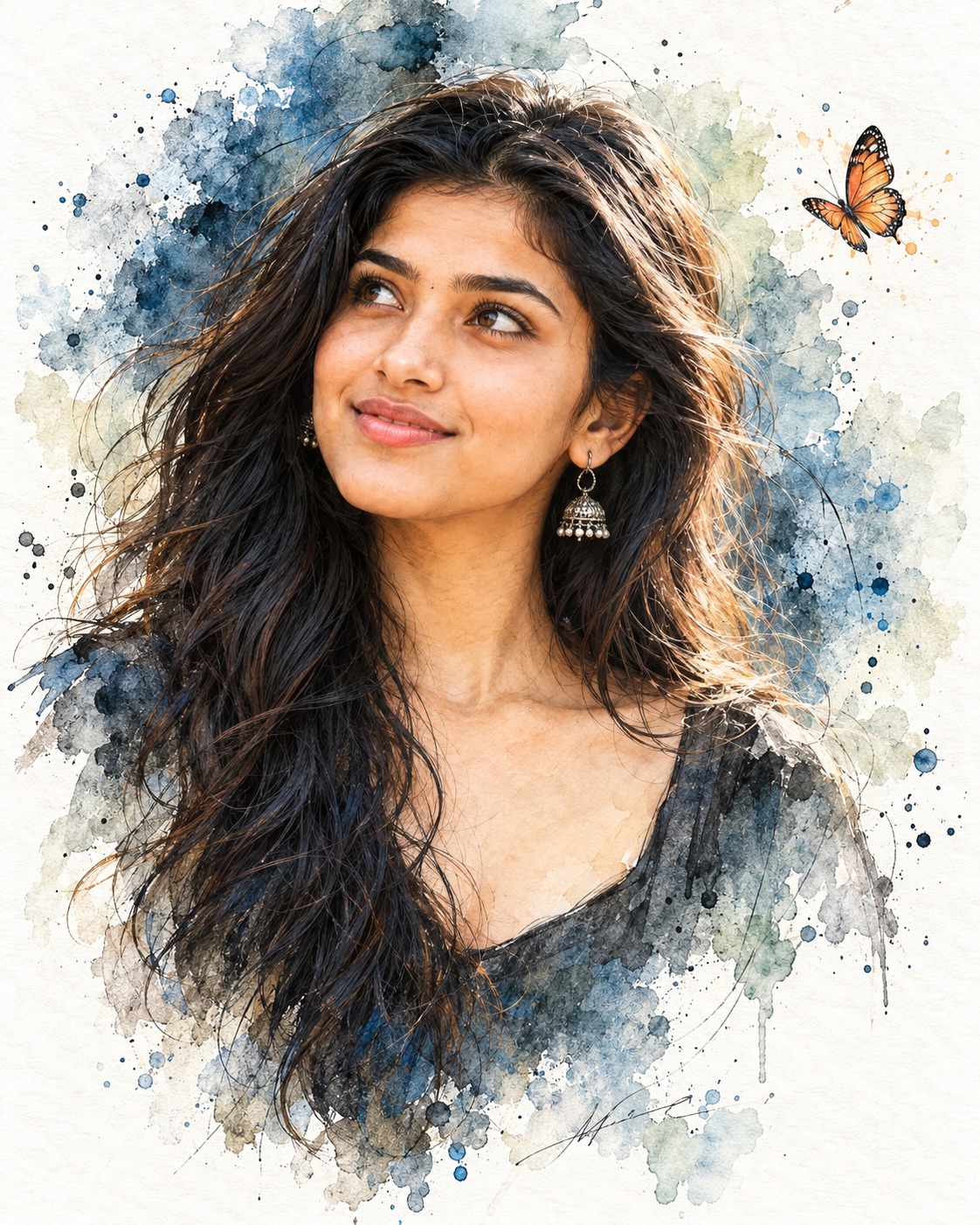
The Watercolor Woman Illustration concept combines the softness of traditional watercolor painting with the delicate realism of a carefully rendered female face. It describes a contemporary fine-art composition that feels personal, expressive, and quietly joyful. Rather than presenting a conventional photographic portrait, the concept brings together recognizable facial details, loose painted textures, and a light, open background. The result is a visual style that feels handcrafted and artistic while keeping the woman’s face at the center of attention.
The main subject is a young adult woman shown from the upper chest upward. The framing keeps attention on her face, hair, and expression without introducing unnecessary scenery. Her head is positioned slightly left of the canvas midpoint, giving the composition an asymmetrical quality. This placement makes the portrait feel more spontaneous and natural than a perfectly centered studio photograph. The surrounding white space allows the subject to stand out while giving the painted elements room to breathe.
The woman’s expression contributes strongly to the mood. Her head turns gently toward the left, and her eyes look upward in the same direction. Her chin is slightly raised, and her lips are softly parted in a relaxed smile. The expression is neither overly cheerful nor serious. It suggests a quiet moment of curiosity, hope, or reflection. Natural eyebrows, softly defined eyelashes, and realistic proportions help retain the human character of the face.
The face is the most refined area of the composition. Warm beige skin tones, subtle peach highlights, and restrained shadows provide gentle definition around the forehead, cheeks, nose, lips, and chin. The skin treatment remains natural rather than glossy or heavily retouched. Soft transitions between light and shadow help the facial features appear dimensional without competing with the looser painting surrounding them. This contrast between facial clarity and expressive texture is one of the defining characteristics of the concept.
The hair creates a dramatic silhouette around the head. It is dark brown to black, with abundant volume, irregular waves, loose strands, and small flyaways. Instead of appearing carefully styled, the hair has a naturally tousled appearance. Smoky blue-gray highlights add visual variety and connect the hair to the surrounding cool-colored paint. Some edges seem to dissolve into the watercolor washes, allowing the hair and background to interact as parts of the same artwork.
The clothing is deliberately understated. A dark charcoal or black garment with a modest rounded-to-V-shaped neckline provides a simple base beneath the face. Soft folds suggest the fabric without introducing excessive detail. Prominent jewelry and elaborate accessories are absent, keeping the portrait focused on expression, hair, and artistic texture. The dark garment also provides a visual anchor against the pale background and creates a natural transition toward the darker pigments around the shoulders.
The background is primarily pale ivory-white. This choice is important because it creates openness and prevents the composition from feeling crowded. Instead of filling the entire surface with color, the artwork uses irregular patches of slate blue, smoky gray, muted teal, charcoal, and soft sage. These washes gather around the hair and shoulders, forming an organic frame that varies in density. The paint appears to spread, fade, and break apart naturally rather than ending at a rigid border.
Watercolor behavior is central to the visual identity. Transparent layers overlap to create subtle differences in color and depth. Pigment blooms introduce uneven areas where the paint appears to have expanded across damp paper. Feathered edges soften the boundaries between color and white space, while scattered droplets and tiny ink specks bring energy to otherwise quiet areas. These details suggest the unpredictable beauty of traditional painting and give the artwork a more tactile appearance.
Fine ink marks and graphite-like contours add another layer of expression. They can be perceived around selected edges of the hair, facial features, and painted shapes. Their role is subtle: they provide structure without turning the illustration into a heavily outlined drawing. This balance allows the face to remain readable while the surrounding elements retain their loose, fluid quality. The combination of watercolor, ink, and pencil-inspired details creates a mixed-media character that feels more complex than a single painting technique.
The butterfly is the principal decorative accent. It appears in the upper-right portion of the composition, separated from the dark hair silhouette. Its orange wings and black markings introduce a small area of warm, concentrated color. Because the rest of the palette is dominated by cool blues, gray, sage, and ivory, the butterfly naturally attracts attention. Its placement also balances the woman’s upward-left gaze, adding a subtle relationship between the subject and the surrounding space.
Lighting is soft and diffuse in appearance. Warm highlights on the forehead, cheeks, nose, and lips give the face a gentle glow, while shadows beneath the nose, chin, and jaw provide understated depth. There are no harsh edges or dramatic studio shadows. This treatment supports the intimate mood and works well with the transparent quality of watercolor. The overall color balance combines warm skin with cool background pigments, creating contrast without relying on excessive saturation.
The vertical 4:5 format is suitable for contemporary portrait presentation. The tight head-and-shoulders crop makes the face the immediate focal point, while the loose painted edges prevent the frame from feeling restrictive. Limited headroom preserves the irregular hair silhouette, and generous negative space around the outer edges gives the illustration an airy appearance. The lower portion gradually blends into the washes, allowing the shoulders and clothing to become part of the overall artistic composition.
A faint signature-like flourish near the bottom introduces the suggestion of a finished artwork. It remains secondary to the portrait and functions as a subtle visual detail rather than a major text element. The composition does not depend on typography, decorative borders, or a detailed setting. Its appeal comes from the relationship between the woman’s expression, the silhouette of her hair, the cool watercolor washes, and the small butterfly.
This style can be useful for personalized art collections, creative profile graphics, editorial illustrations, printable wall art, art portfolios, blog imagery, and social media posts. It can also provide inspiration for greeting cards, thoughtful gifts, journal covers, and contemporary design projects where a personal subject should feel artistic rather than strictly photographic. The limited palette and open background make the concept adaptable to different layouts without losing its recognizable character.
The greatest strength of this visual approach is its balance between realism and artistic freedom. The face remains expressive and understandable, while the surrounding paint introduces movement, texture, and individuality. The result feels delicate without being empty, detailed without being crowded, and colorful without becoming overpowering. Every element serves the same overall purpose: presenting a woman through a soft, modern, handcrafted fine-art aesthetic that feels calm, expressive, and memorable.
[[[
A. REFERENCE ANALYSIS
- Style: Dreamy watercolor portrait illustration, mixed-media fine art, watercolor-and-ink aesthetic.
- Camera and framing: Vertical 4:5 composition, tight head-and-shoulders portrait, near-frontal camera with the face turned three-quarters toward image-left.
- Pose: Head slightly tilted, chin gently raised, shoulders relaxed, torso facing approximately forward.
- Expression: Eyes gazing upward and left, lips slightly parted in a gentle, natural smile.
- Hair: Voluminous, tousled dark brown-to-black hair, loosely gathered with irregular waves, flyaways, and smoky blue-gray highlights.
- Clothing: Dark charcoal garment with a low rounded-to-V-shaped neckline; fabric details are understated.
- Background: Predominantly pale ivory-white, with irregular blue-gray, teal, charcoal, and muted sage watercolor washes around the hair and shoulders.
- Signature detail: A small orange-and-black butterfly in the upper-right quadrant.
- Lighting: Soft, diffuse facial illumination, warm beige highlights, gentle shadows beneath the nose and chin.
- Textures: Transparent watercolor layers, pigment blooms, ink splatters, fine graphite contours, feathered edges, and subtle paper grain.
- Composition: Face near the upper center, slightly left of midpoint; ample white negative space, especially around the outer edges.
- Typography: A faint handwritten signature-like detail near the bottom center. Exact lettering is not reliably legible.
B. MASTER PROMPT
Dreamy Watercolor Portrait Illustration + Photorealistic Facial Rendering + Mixed-Media Fine-Art Painting + Expressive Watercolor-and-Ink Aesthetic
Create a vertical 4:5 fine-art portrait illustration of a young adult woman, framed from the upper chest upward against a predominantly pale ivory-white background. Combine softly realistic facial rendering with loose, expressive watercolor washes, delicate ink marks, charcoal-inspired shading, and subtle paper texture. The image should feel artistic, airy, intimate, and dreamlike, with a refined face surrounded by irregular, organically dissolving pigment.
CAMERA AND COMPOSITION: Use a near-frontal, eye-level portrait perspective with the face rotated into a three-quarter view toward image-left. Position the head near the upper center, slightly left of the canvas midpoint. Crop the image at the upper chest, with the shoulders and clothing gradually blending into the painted background. Preserve limited headroom above the irregular hair silhouette and ample white negative space around the outer edges. Keep the face as the primary focal point, with a small orange-and-black butterfly in the upper-right quadrant.
POSE AND EXPRESSION: The torso faces approximately forward while the head turns toward image-left. Tilt the head slightly and raise the chin gently. Direct both eyes upward and left, away from the viewer. Give the woman a subtle, relaxed smile with softly parted lips and naturally defined eyebrows. Maintain realistic facial proportions and a calm, gently cheerful expression. Do not exaggerate the smile or change the upward-left gaze.
FACE AND SKIN: Render the eyes, nose, lips, cheeks, and chin with delicate tonal transitions. Use warm beige skin tones, soft peach highlights, muted natural shadows, and restrained facial definition. Keep the central face comparatively refined and softly realistic, with light painterly blending and subtle skin texture. Add natural dark eyes, gently defined eyelashes, softly shaped eyebrows, and a muted pink lip tint. Avoid overly polished beauty-retouching or artificial skin smoothness.
HAIR: Create a large, voluminous silhouette of dark brown-to-black hair, loosely arranged in tousled waves around the head. Let the hair expand irregularly above the crown and across both sides of the face. Use overlapping charcoal-like masses, delicate individual strands, wispy flyaways, and smoky blue-gray highlights. Allow some hair sections to dissolve into the surrounding watercolor pigment. Maintain a strong dark silhouette against the pale background.
CLOTHING AND ACCESSORIES: Show a dark charcoal or black garment with a modestly low, rounded-to-V-shaped neckline. Keep the fabric understated, with soft painted folds and limited texture. Do not add prominent accessories. A very fine necklace-like line may be included only if subtle and consistent with the composition.
WATERCOLOR AND INK TECHNIQUE: Surround the head and shoulders with irregular translucent watercolor washes in slate blue, smoky gray, muted teal, charcoal, and soft sage. Use wet-on-wet blending, pigment blooms, layered transparent washes, diffused ink stains, and feathered paint edges. Concentrate the darkest pigment around the upper-left hair silhouette and selected areas beside the face. Add expressive brush marks, scattered pigment droplets, tiny ink specks, and delicate graphite contours. Let the paint dissolve organically into the white background rather than forming a solid border.
BUTTERFLY DETAIL: Place one small orange-and-black butterfly in the upper-right quadrant, close to but clearly separated from the hair silhouette. Render its wings with warm orange pigment, dark outer edges, and small black markings. Keep it delicate and distinct, providing the primary warm color accent against the cool watercolor palette.
LIGHTING AND COLOR: Use soft, diffuse-looking illumination across the face, with warm highlights on the forehead, cheeks, nose, and lips. Keep shadows gentle under the nose, chin, and jaw. Balance warm skin tones against cool blue-gray and teal background pigments. Use a restrained palette of ivory, charcoal, slate blue, dusty teal, muted sage, and warm beige, with orange reserved primarily for the butterfly.
PAPER TEXTURE AND FINISH: Add fine watercolor-paper grain, subtle graphite-like construction lines, and delicate irregularities in pigment density. Preserve the contrast between refined facial features and rougher, more expressive hair and background edges. Keep the face clearly readable while the shoulders, hair tips, and lower composition blend into translucent washes. Include a faint handwritten signature-like flourish near the bottom center without introducing prominent or unrelated text.
FINAL RESULT: A delicate watercolor-and-ink portrait with an upward-left gaze, parted-lip smile, tousled dark hair, cool blue-gray pigment washes, pale ivory negative space, and one orange-and-black butterfly. The finished image should resemble a handcrafted contemporary watercolor illustration rather than a conventional photograph, with organic paint textures, expressive splatters, soft facial shading, and an asymmetrical fine-art composition.
C. EDITABLE VARIABLES
- [USER IDENTITY]: Young adult woman; exact identity unspecified.
- [CAMERA ANGLE]: Near-frontal, eye-level perspective.
- [POSE & BODY GEOMETRY]: Head slightly tilted, chin raised, shoulders relaxed, chest-up crop.
- [FACE DIRECTION & EXPRESSION]: Three-quarter turn toward image-left, upward-left gaze, gentle parted-lip smile.
- [CAMERA & PERSPECTIVE]: Tight head-and-shoulders framing, vertical 4:5 composition.
- [OUTFIT & ACCESSORIES]: Dark charcoal garment; prominent jewelry not visible.
- [LIGHTING & SHADOWS]: Soft diffuse illumination, warm facial highlights, gentle shadows.
- [COLOR & MOOD]: Ivory, slate blue, charcoal, muted teal, sage, and warm peach.
- [TEXTURE & EFFECTS]: Watercolor blooms, pigment splashes, ink marks, graphite contours, paper grain.
- [BACKGROUND & OBJECTS]: White negative space, organic watercolor washes, one orange-and-black butterfly at upper-right.
- [TEXT]: Faint, illegible signature-like flourish near the bottom.
- [ASPECT RATIO]: Vertical 4:5.
- [OBJECT CHANGE]: None.
- [POSE CHANGE]: None.
- [ADDITIONAL EDITS]: Preserve the watercolor-and-ink treatment and asymmetrical pigment distribution.
- [NEGATIVE CONSTRAINTS]: No photorealistic-only finish, heavy outlines, additional butterflies, elaborate scenery, or unrequested accessories.
D. NEGATIVE PROMPT
Photographic-only rendering, 3D CGI, anime, cartoon face, exaggerated smile, direct eye contact, downward gaze, rightward gaze, incorrect head orientation, altered facial proportions, overly smooth plastic skin, excessive makeup, voluminous polished salon hairstyle, straight flat hair, bright saturated background, solid colored backdrop, hard geometric paint borders, vector graphics, thick uniform outlines, excessive black ink, dense background clutter, additional butterflies, multiple insects, flowers, buildings, landscape scenery, elaborate jewelry, sunglasses, extra accessories, harsh directional lighting, hard facial shadows, excessive orange grading, oversaturation, excessive contrast, artificial glow, heavy blur on facial features, over-sharpening, missing watercolor texture, missing white negative space, prominent typography, legible invented signature, watermark, altered crop, horizontal composition.
E. RECONSTRUCTION BLUEPRINT
A vertical watercolor-and-ink illustration depicts a woman from the upper chest upward against an ivory-white background. Her head sits near the upper center, slightly left of the midpoint. She turns her face three-quarters toward image-left, raises her chin gently, and looks upward with a soft, slightly open-lipped smile. Her voluminous dark hair spreads irregularly around the crown and sides, with loose waves, individual flyaway strands, and smoky blue-gray highlights. She wears a simple dark charcoal garment with an understated neckline.
Translucent watercolor washes in slate blue, muted teal, charcoal, and sage surround her hair and shoulders. Pigment blooms, scattered droplets, fine ink specks, and feathered paint edges dissolve into the surrounding white space. The face remains comparatively refined, with warm beige skin, gentle shadows, and delicate facial definition. A small orange-and-black butterfly floats in the upper-right quadrant, balancing the cool palette. Fine paper grain and a faint handwritten flourish near the bottom complete the handcrafted mixed-media aesthetic.
F. LIMITATIONS
The watercolor texture and organic paint boundaries are stylistic targets rather than guaranteed exact matches; image conditioning can improve visual fidelity.
The exact facial identity and precise head-tilt angle cannot be established from the stylized appearance alone.
The clothing type and possible necklace detail are ambiguous, so they should remain understated.
The handwritten mark is not legible enough to reproduce reliably.
]]]