
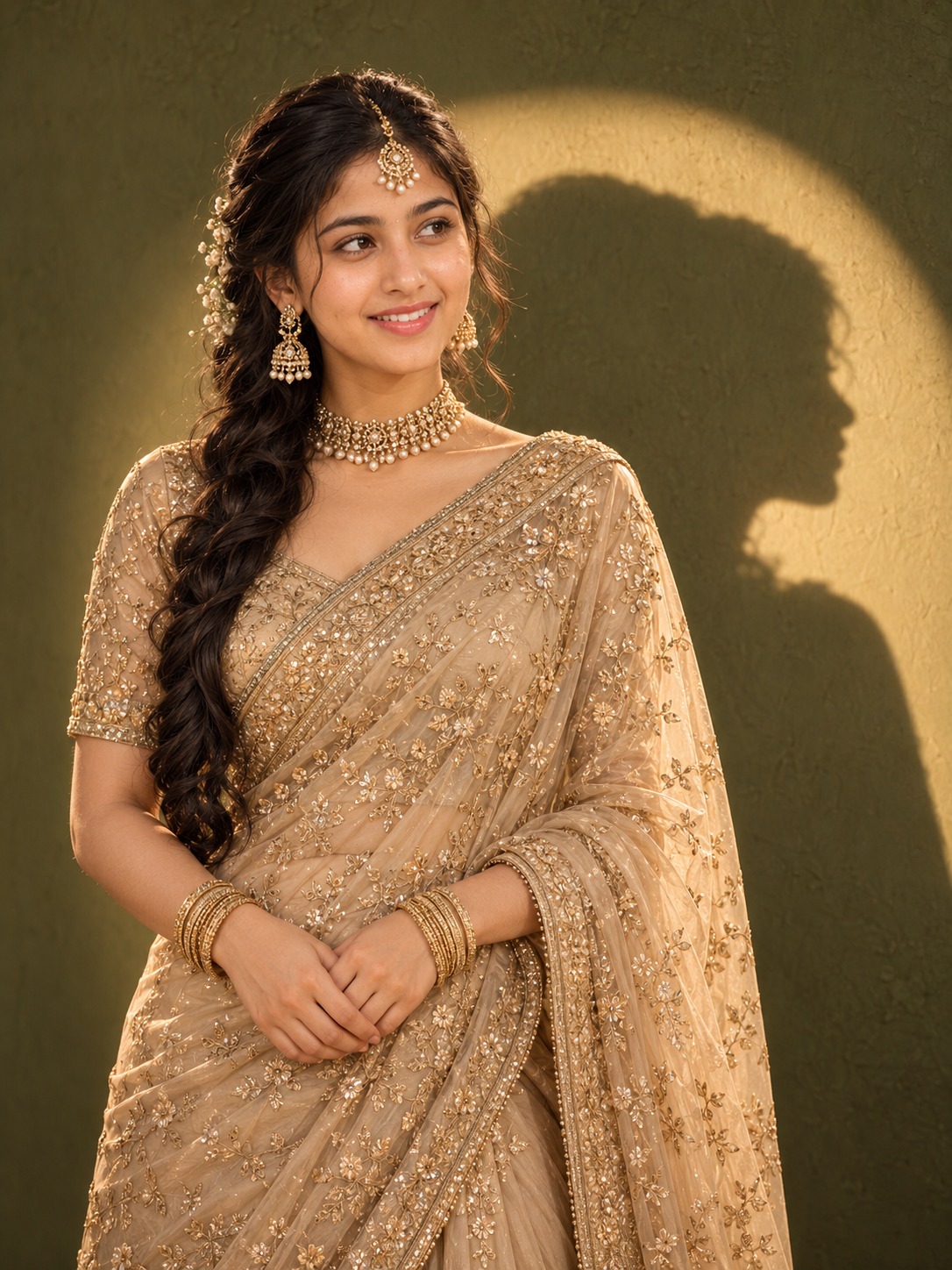
Bridal Saree Portrait
The Bridal Saree Portrait concept combines traditional Indian bridal fashion with refined studio photography and dramatic light-and-shadow composition. The visual focuses on a woman wearing a champagne-beige saree decorated with intricate gold embroidery, complemented by traditional jewelry and long, dark wavy hair. Instead of using a crowded wedding venue or elaborate decorative setting, the concept relies on a simple olive-green background, warm directional lighting, and a striking silhouette to create a sophisticated editorial appearance.
The main subject stands slightly left of the center of the frame. This placement is important because it creates open space on the right side for the large shadow projected onto the wall. The composition feels balanced without requiring additional objects or decorative elements. The Bridal Saree Portrait uses this negative space as a defining design feature, allowing the illuminated subject and her silhouette to work together as two connected visual elements.
The camera perspective is natural and eye-level, giving the viewer a comfortable sense of looking at the subject directly from a normal standing position. The framing extends from approximately the thighs upward, providing enough room to show the saree’s draping, the blouse, the jewelry, and the woman’s posture. The medium-distance perspective also helps maintain natural facial proportions and avoids the exaggerated appearance sometimes associated with very wide-angle photography.
The woman’s body is angled slightly toward the right, with her shoulders relaxed and her hands gently clasped near her lower waist. Her head turns in the same general direction, and her gaze follows toward something outside the frame. A soft, natural smile gives her expression warmth without making the portrait appear overly posed. This relaxed body language creates a sense of quiet confidence and makes the overall presentation feel graceful and timeless.
Her hands are an important part of the pose. They rest together naturally, allowing the gold bangles and fabric details near the waist to remain visible. The wrists, fingers, and elbows contribute to a composed silhouette without drawing unnecessary attention away from her face. The pose is formal enough for bridal fashion but relaxed enough to retain a candid quality.
The hairstyle combines long, dark waves with partial braiding and small decorative accessories. Much of the hair falls over the shoulder on the left side of the frame, creating a flowing line that complements the saree. Fine individual strands and natural texture help the hairstyle appear realistic. The traditional maang tikka sits near the center of the hair parting, adding a familiar bridal detail while connecting the hairstyle with the jewelry.
The champagne-beige saree is the main fashion feature. Its understated color provides a softer alternative to bright red or strongly saturated bridal clothing. Gold floral embroidery, metallic threadwork, delicate ornamental patterns, and small embellishments add richness to the fabric. The blouse and visible saree sections are decorated in a coordinated style, creating a consistent appearance throughout the portrait.
The translucent pallu drapes over the shoulder and follows the natural contours of the body. Its sheer edge catches the warm light, making the fabric appear delicate without losing its structure. The embroidery remains visible across the folds, while the silk-like surface introduces a gentle sheen. These textile details give the Bridal Saree Portrait its luxurious character while preserving a restrained and sophisticated look.
Traditional jewelry completes the ensemble. A gold maang tikka decorates the forehead, an ornate choker frames the neckline, and statement earrings add detail around the face. Stacked gold bangles provide visual interest near the hands. Each piece contributes to the bridal identity without overwhelming the saree. Subtle metallic highlights create the impression of real gold, allowing the jewelry to look polished rather than excessively sparkly.
The makeup follows the same understated approach. Defined eyebrows, softly blended eye makeup, subtle eyeliner, and a muted nude lip color complement the champagne palette. Natural skin texture remains visible, with gentle highlights across the forehead, cheeks, and face. Restrained retouching supports a professional photographic appearance without making the subject look artificial or overly smooth.
Lighting is the central storytelling element in the Bridal Saree Portrait. A strong, warm spotlight illuminates the woman from the upper-left or front-left direction. It brings attention to her face, forehead jewelry, necklace, embroidered blouse, and the folds of the saree. The light creates depth by allowing certain areas of the clothing to glow while other areas fall into softer shadow.
The circular pool of light on the wall adds a second layer of visual interest. It resembles a controlled studio spotlight, creating a warm illuminated area that fades into darker olive-green tones around the edges. This simple background treatment establishes atmosphere without introducing distracting objects. The spotlight also helps separate the woman’s figure from the surrounding wall.
The large profile shadow on the right side is the most distinctive feature of the composition. Its outline follows the shape of the woman’s head, hairstyle, neck, and shoulders. Because the shadow is positioned opposite the subject, it visually connects the lighting direction with the arrangement of the frame. The silhouette creates a sense of depth and adds a fine-art quality to what might otherwise be a straightforward fashion portrait.
The olive-green wall provides a muted backdrop for the champagne and gold clothing. Its matte finish and subtle plaster-like texture prevent the background from appearing completely flat. The contrast between the earthy green, warm beige, and dark charcoal shadow creates a calm, sophisticated color scheme. The Bridal Saree Portrait relies on this controlled palette rather than bright decorative colors.
Color grading reinforces the timeless mood. Champagne beige, antique gold, olive green, warm brown, and charcoal form the main palette. Golden highlights introduce warmth, while earthy shadows provide depth. Restrained saturation helps the fabric and jewelry retain realistic colors. The result feels elegant and cinematic without relying on excessive glow, heavy filters, or exaggerated contrast.
Texture is equally important to the visual finish. Individual hair strands, visible embroidery, realistic silk folds, and subtle wall grain give the portrait a tactile quality. Selective sharpness helps preserve the details of the eyes, jewelry, and clothing, while the background remains visually quiet. This balance makes the image feel polished without losing its natural photographic character.
The Bridal Saree Portrait concept can suit bridal fashion portfolios, traditional clothing promotions, wedding inspiration collections, personal portrait styling, and editorial social media content. Its minimal background makes the clothing easy to appreciate, while the dramatic shadow provides a distinctive visual signature. The composition can also serve as inspiration for studio photography that combines traditional attire with contemporary fine-art lighting.
Overall, the concept celebrates Indian bridal styling through subtle colors, detailed craftsmanship, traditional accessories, and carefully controlled illumination. Its strongest feature is the relationship between the subject and the shadow: the woman remains warmly illuminated while her silhouette gives the background depth and visual meaning. This balance of simplicity, texture, and drama creates an elegant portrait with a timeless editorial feel.
[[[
A. REFERENCE ANALYSIS
- Style: Photorealistic Indian bridal portrait photography with a traditional ethnic fashion editorial aesthetic.
- Composition: Vertical 3:4 portrait, framed from approximately the thighs upward. The subject stands slightly left of center, leaving open space on the right for a dramatic wall shadow.
- Camera angle: Eye-level, medium-distance portrait with natural perspective and minimal distortion.
- Pose: Standing with the torso angled slightly toward image-right, shoulders relaxed, and hands gently clasped at the lower waist. The head turns slightly toward image-right.
- Expression and gaze: Soft, natural smile with a gentle sideways gaze. Facial expression appears composed and relaxed.
- Hair: Long, dark, wavy hair arranged with partial braiding and small decorative accessories, cascading over the shoulder on image-left.
- Outfit: Champagne-beige traditional saree with intricate gold embroidery, fine metallic threadwork, floral embellishments, and a translucent pallu draped over the shoulder.
- Jewelry: Gold maang tikka, ornate choker necklace, statement earrings, and stacked gold bangles.
- Lighting: Strong directional warm light illuminates the subject from the upper-left/front. A circular pool of light on the wall produces a sharply defined profile shadow extending toward image-right.
- Background: Minimal matte olive-green wall with subtle texture, a warm circular spotlight, and a large dark silhouette shadow.
- Color grading: Muted olive green, champagne, beige, antique gold, and warm brown, with restrained saturation and rich shadow depth.
- Texture: Natural skin detail, visible hair strands, finely rendered embroidery, realistic silk folds, and subtle background grain.
B. MASTER PROMPT
Photorealistic Indian Bridal Portrait Photography + Traditional Ethnic Fashion Editorial + Dramatic Chiaroscuro Studio Portrait
Create a refined, photorealistic Indian bridal portrait in a vertical 3:4 composition. Show a young adult Indian woman standing slightly left of center against a muted olive-green studio wall. Frame her from approximately the thighs upward, preserving generous negative space on the right where a large, sharply defined silhouette of her head and upper body is projected onto the wall. The image should feel timeless, intimate, elegant, and cinematic, with natural facial features, intricate traditional styling, warm golden illumination, and dramatic directional shadows.
CAMERA AND COMPOSITION: Use an eye-level camera angle with a natural portrait perspective and minimal distortion. Keep the subject at medium distance, occupying approximately two-thirds of the frame height. Position her slightly left of center, with the right side reserved for the projected shadow. Maintain a simple, uncluttered composition with clear separation between the illuminated subject and the dark background silhouette. Use a portrait-lens aesthetic, approximately 50–85 mm equivalent as an estimate, with the face and clothing in crisp focus and the background subtly softened.
POSE AND EXPRESSION: The woman stands gracefully with her torso angled slightly toward image-right and her shoulders relaxed. Her head turns gently toward image-right, and her eyes follow the same general direction rather than looking directly into the camera. Give her a soft, natural smile with relaxed lips and a calm expression. Her forearms rest comfortably in front of her lower waist, with both hands gently clasped together. Keep the wrists, fingers, and elbows anatomically natural. Preserve a relaxed, candid quality rather than an exaggerated bridal pose.
FACE AND SKIN: Render realistic Indian facial features, natural facial proportions, defined brows, detailed eyes, subtle eyeliner, softly blended eye makeup, and a muted nude lip color. Retain natural skin texture, delicate facial highlights, and realistic shadow transitions. Apply only restrained beauty retouching. Avoid excessive smoothing, artificial facial symmetry, or exaggerated makeup.
HAIR AND ACCESSORIES: Style the hair in a long, dark, wavy arrangement with partial intricate braiding and decorative hair accessories. Let the thick waves cascade over the shoulder on image-left and continue down the back. Add fine individual hair strands, a traditional gold maang tikka centered near the hair parting, ornate statement earrings, a richly detailed gold choker necklace, and stacked gold bridal bangles. Render the metal with subtle, realistic highlights rather than excessive sparkle.
SAREE AND EMBROIDERY: Dress the subject in a sophisticated champagne-beige and muted gold traditional saree. The blouse and visible saree fabric feature intricate floral embroidery, fine metallic threadwork, delicate ornamental motifs, and small gold embellishments. Drape the sheer pallu naturally over the shoulder, allowing its translucent edge and embroidered border to catch the light. Reproduce realistic silk texture, subtle sheen, fine stitching, and natural fabric folds around the torso and clasped hands. Keep the overall outfit elegant and understated, with the beige-gold embroidery clearly visible against the muted background.
DRAMATIC LIGHTING: Use a single strong, warm directional spotlight from the upper-left/front of the subject. Illuminate her face, forehead jewelry, necklace, blouse, and the folds of the saree with warm champagne-gold highlights. Add only a subtle frontal fill to retain facial detail in the shadows. Create a gentle rim light along portions of the hair and shoulder. The illumination should resemble a controlled studio spotlight with a defined circular pool of warm light on the wall behind her.
PROJECTED WALL SHADOW: Cast a large, recognizable silhouette of the woman’s head, hairstyle, neck, and upper shoulders onto the wall on image-right. The shadow should show a distinct side-profile outline consistent with her head direction and the position of the light source. Keep the silhouette dark charcoal-green with a relatively crisp edge, slightly softened only at the outer boundary. Maintain realistic spatial alignment between the woman, the spotlight, and the projected shadow. Do not create additional shadows or duplicate silhouettes.
BACKGROUND: Use a simple matte olive-green wall with faint plaster-like texture and subtle tonal variation. Place a circular warm beige spotlight behind the subject, creating a softly illuminated disk that fades into darker olive-green edges. Keep the wall free of furniture, flowers, decorative props, text, and unnecessary details. Use restrained vignette shading around the corners to focus attention on the subject and her silhouette.
COLOR GRADING AND FINISH: Maintain a muted palette of olive green, champagne beige, antique gold, warm brown, and charcoal. Use warm golden highlights and earthy, desaturated shadows. Preserve natural skin tones, rich but controlled contrast, detailed embroidery, and clean separation between light and shadow. Apply subtle fine-art texture, restrained micro-contrast, and selective sharpening to the eyes, hair, jewelry, and embroidered fabric. Avoid excessive saturation, orange color casts, artificial glow, and crushed shadow detail.
FINAL RESULT: An elegant, photorealistic Indian bridal studio portrait with a natural sideways gaze, champagne-gold embroidered saree, traditional jewelry, long wavy hair, and a dramatic circular spotlight casting a clearly recognizable profile shadow across a muted olive-green wall. Preserve the minimalist composition, realistic anatomy, warm cinematic lighting, and timeless editorial aesthetic.
C. EDITABLE VARIABLES
- [USER IDENTITY]: Indian woman; specific identity not provided.
- [CAMERA ANGLE]: Eye-level, natural portrait perspective.
- [POSE & BODY GEOMETRY]: Standing, torso angled slightly right, hands clasped at the waist.
- [FACE DIRECTION & EXPRESSION]: Gentle rightward gaze, soft smile.
- [CAMERA & PERSPECTIVE]: Medium portrait, thighs-up crop, estimated 50–85 mm equivalent.
- [OUTFIT & ACCESSORIES]: Champagne-beige embroidered saree, sheer pallu, gold choker, maang tikka, earrings, and bangles.
- [LIGHTING & SHADOWS]: Warm directional spotlight, circular wall illumination, distinct profile shadow.
- [COLOR & MOOD]: Muted olive, champagne, antique gold, warm brown.
- [TEXTURE & EFFECTS]: Silk texture, metallic embroidery, realistic hair strands, subtle wall grain.
- [BACKGROUND & OBJECTS]: Minimal olive-green wall; no additional props.
- [TEXT]: None.
- [ASPECT RATIO]: Vertical 3:4.
- [OBJECT CHANGE]: None.
- [POSE CHANGE]: None.
- [ADDITIONAL EDITS]: Preserve the original lighting direction, shadow placement, and understated bridal styling.
- [NEGATIVE CONSTRAINTS]: No extra shadows, excessive retouching, altered clothing colors, cluttered backgrounds, or anatomy errors.
D. NEGATIVE PROMPT
Cartoon, anime, illustration, CGI, plastic skin, excessive skin smoothing, artificial facial features, exaggerated smile, direct eye contact, incorrect head direction, unnatural standing pose, malformed hands, extra fingers, missing fingers, twisted wrists, distorted jewelry, duplicated accessories, missing maang tikka, missing earrings, incorrect saree draping, bright red fabric, saturated yellow gold, inaccurate embroidery, flat fabric texture, excessive sequins, excessive hair smoothing, harsh overexposure, flat frontal lighting, multiple light sources, missing circular spotlight, incorrect shadow direction, blurry shadow silhouette, extra shadows, duplicate silhouette, floating shadow, inconsistent light direction, cluttered background, furniture, flowers, text, watermark, excessive orange grading, oversaturation, crushed blacks, artificial bloom, excessive sharpening, heavy vignette, changed framing, extreme wide-angle distortion.
E. RECONSTRUCTION BLUEPRINT
A woman wearing a champagne-beige and gold embroidered saree stands slightly left of center in a vertically framed studio portrait. Her torso faces slightly toward the right, her head turns in the same direction, and she wears a gentle smile while looking off-camera. Her hands rest together at her waist. Long dark waves cascade over one shoulder, complemented by partial braiding, a gold maang tikka, an ornate choker, statement earrings, and gold bangles.
A warm directional spotlight illuminates her face and embroidered outfit while creating a circular pool of light on a matte olive-green wall. A large, crisp profile shadow of her head and upper body stretches across the wall to the right, forming the composition’s defining visual feature. The saree’s metallic embroidery catches the golden highlights, while the translucent pallu reveals delicate fabric detail. Muted earthy colors, realistic skin texture, controlled contrast, and soft background falloff create an elegant, cinematic Indian bridal portrait.
F. LIMITATIONS
- The exact camera and lighting specifications are estimates based on the visual appearance.
- The precise embroidery patterns and hair accessories may vary in reconstruction.
- The projected shadow may need careful lighting or compositing controls to maintain a realistic profile and consistent direction.
- Text-only prompting cannot guarantee an exact reproduction; a reference image and localized editing tools can improve fidelity.
]]]