
Gothic Portrait Illustration
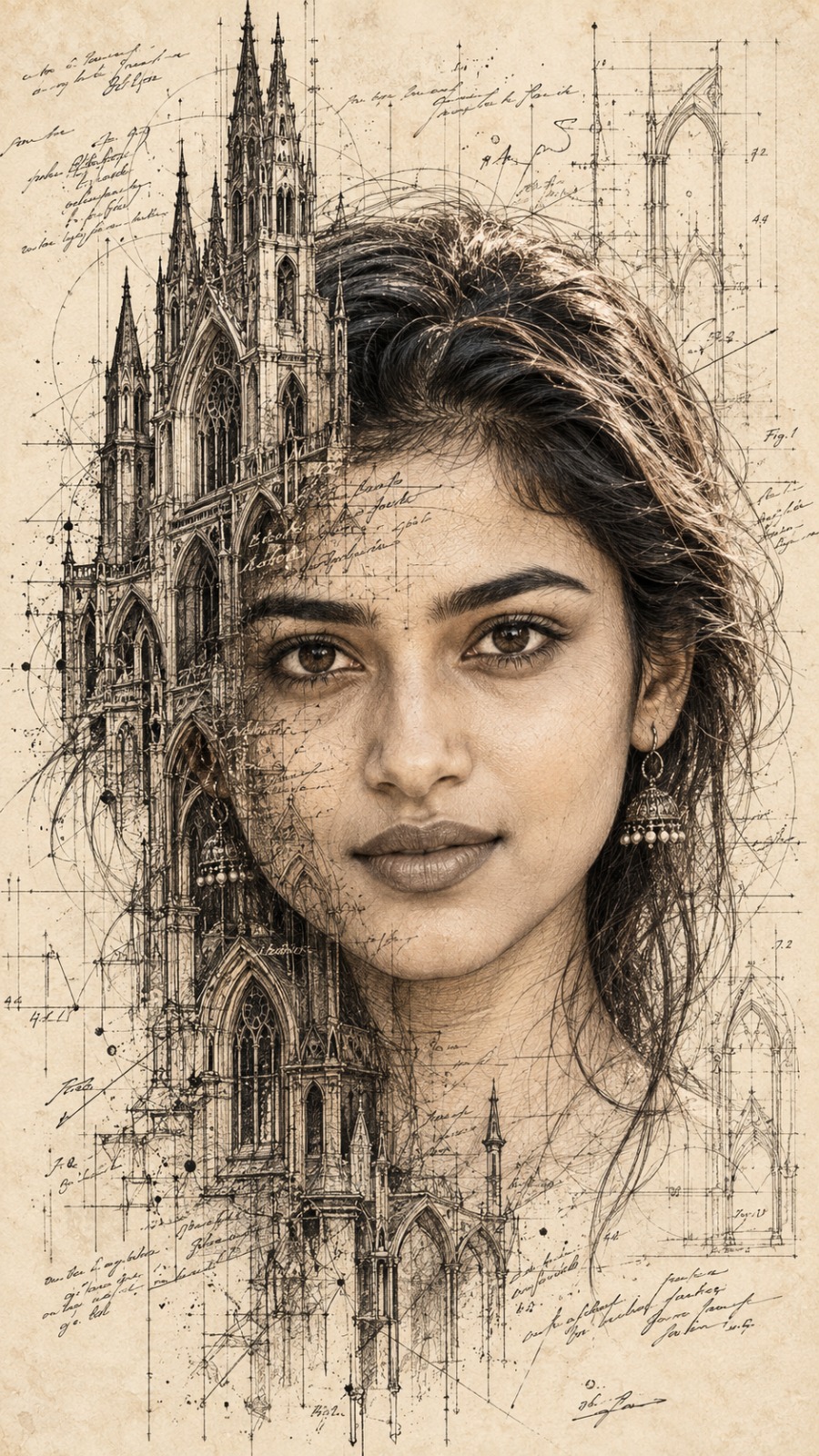
Gothic Portrait Illustration is a fine-art concept that brings together human portraiture, historic architecture, and the expressive qualities of hand-drawn technical sketches. The central idea is to make a woman’s face and a Gothic cathedral appear as parts of one connected visual structure. Rather than treating the building as a separate background element, the composition allows architectural details to grow across one side of the face, creating a surreal and intellectually engaging artwork.
The main subject is a woman shown in a tight frontal close-up, extending from the crown of her head to the lower neck. Her face sits at the center of a vertical composition, with the eyes, nose, and mouth forming a clear visual axis. The straight-on viewpoint creates direct engagement with the viewer. Her head remains upright, and the balanced placement of her facial features gives the illustration a composed, almost sculptural quality.
Her expression is serious, calm, and contemplative. Dark almond-shaped eyes look directly outward, creating a sense of connection and quiet intensity. Thick, arched eyebrows frame the eyes, while long eyelashes add definition to the upper eyelids. The straight nose and softly shaded sides maintain a natural facial structure. Her cheekbones are defined without exaggerated contours, and the tapered jawline helps establish a clear silhouette.
The lips are full and slightly parted, with restrained shading that gives them dimension without turning the illustration into a photographic beauty portrait. The expression avoids a broad smile or dramatic emotion. Instead, it suggests thoughtfulness, concentration, and a quiet relationship between the human subject and the architectural forms surrounding her.
The hairstyle is an important part of the composition. Dark hair is swept backward from the forehead, forming a smooth curved shape over the crown and around the right side of the head. Deep charcoal areas create the main mass of the hair, while fine pencil strokes describe individual strands and subtle variations in texture. A few loose flyaway lines extend beyond the silhouette, connecting the hairstyle to the surrounding sketch marks.
The most distinctive feature is the Gothic cathedral integrated into the left side of the woman’s face. Tall, slender spires rise from the forehead toward the top edge of the artwork. Beneath them, narrow towers, pointed arches, lancet windows, columns, buttresses, and intricate tracery extend downward. The architecture spreads across the left temple, cheek, jawline, and neck, giving the impression that the building is emerging from the portrait itself.
This architectural integration creates a layered visual experience. Some lines follow the natural contours of the face, while others introduce the vertical geometry of towers and the repeated shapes of windows. Construction grids and crosshatched shadows connect the two systems. The cathedral does not simply sit beside the woman; its lines become part of the portrait’s structure. This fusion gives the artwork its surrealist character and makes the relationship between human form and historic architecture the main subject.
The architecture draws inspiration from traditional European Gothic buildings, recognizable through their tall spires, pointed arches, narrow windows, vertical emphasis, and ornamental detailing. These elements create an impression of height, complexity, and historical depth. The tall forms also work naturally with the vertical format, leading the viewer’s attention upward from the face toward the upper margin.
Fine technical drawing marks surround the portrait. Vertical axes, horizontal alignment guides, intersecting grids, measurement-like strokes, and preliminary pencil contours give the artwork the character of an architectural sketchbook. Some lines are barely visible, while others are darker and more definite. This variation makes the illustration feel exploratory, as if the artist has developed the portrait and cathedral together through multiple drawing stages.
Handwritten annotations add another layer of visual texture. Small cursive marks, arrows, architectural marginalia, and loose technical scribbles appear around the face and across selected facial and architectural areas. Their scale, direction, and density vary throughout the composition. Most are ornamental rather than intended as readable text. They suggest observations, measurements, and artistic thinking, reinforcing the relationship between portrait drawing and architectural study.
The drawing style combines fine pen-and-ink work with graphite shading and engraving-inspired detail. Delicate contour lines describe the face, while denser crosshatching creates darker regions around the eyebrows, upper eyelids, hair, and architectural recesses. Fine strokes build the nose, cheekbones, and jawline without relying on smooth photographic gradients. The changing density of the marks provides depth and gives the surface an intricate handmade quality.
The strongest dark accents appear where visual clarity matters most. Eyelashes and eyebrows define the gaze, charcoal shading establishes the hair, and dense lines around the cathedral’s arches and windows emphasize its structure. Lighter strokes remain on the forehead, nose bridge, and selected cheek areas. This controlled contrast prevents the illustration from becoming uniformly dark or visually overwhelming.
The paper background contributes significantly to the overall mood. Warm ivory and aged cream provide a soft foundation for the gray-beige graphite, charcoal, and black ink. Subtle mottling and fine paper grain give the surface an archival character without making it look heavily stained or damaged. The flat background also provides negative space around the portrait, allowing the dense architectural details to remain prominent.
The monochromatic palette supports the conceptual nature of the artwork. Without vivid colors, attention stays on the relationship between facial anatomy, architectural geometry, line weight, and paper texture. Charcoal establishes depth, muted gray-beige adds softness, and black ink defines the strongest contours. The warm ivory surface ties these tones together and creates the impression of a carefully preserved artist’s study.
Compositionally, the woman’s face remains centered while the cathedral dominates the left side. The curved hair silhouette and lighter sketch marks on the right balance the architectural mass. The eyes occupy the upper-middle region, the nose forms the central anchor, and the mouth sits slightly below the facial midpoint. As the drawing reaches the lower neck, architectural elements and construction lines gradually dissolve into lighter marks, helping the composition transition naturally toward the bottom edge.
Gothic Portrait Illustration is suitable for conceptual art collections, architectural-themed posters, fine-art prints, sketchbook-inspired designs, creative portfolios, editorial artwork, and visual storytelling projects. Its combination of portraiture and historical architecture creates a distinctive visual identity that can appeal to viewers interested in Gothic design, drawing techniques, surrealism, and symbolic compositions.
The concept also demonstrates how different artistic disciplines can complement one another. Portrait drawing focuses on expression, proportion, and recognizable facial structure. Architectural illustration emphasizes geometry, repetition, and construction. Handwritten annotations introduce an informal record of creative thought. When these elements share one surface, the result becomes more than a portrait or a building study: it becomes a layered artistic interpretation of the relationship between people, space, and design.
The greatest strength of this concept is its contrast between organic and geometric forms. The eyes, lips, hair, and facial contours are soft and natural, while the cathedral contains precise vertical structures, pointed shapes, and repeated architectural patterns. Fine sketch marks bridge these differences. The finished visual direction feels intricate, contemplative, and timeless, with the character of a hand-developed fine-art illustration.
[[[
A. REFERENCE ANALYSIS
- Style: Surrealist architectural portrait illustration, fine-art pen-and-ink drawing, graphite sketching, and technical blueprint aesthetics.
- Camera and framing: Straight-on frontal view, eye-level perspective, tight close-up extending from the crown to the lower neck. Vertical 9:16 composition.
- Face and expression: Centered face, direct gaze, thick arched eyebrows, almond-shaped dark eyes, long eyelashes, straight nose, softly shaded full lips slightly parted, and a serious, composed expression.
- Hair: Dark hair swept back from the forehead, curved around the crown and image-right side, with fine loose strands.
- Architectural fusion: A detailed Gothic cathedral rises from the image-left forehead, with tall spires extending toward the top edge. Towers, pointed arches, narrow windows, and construction grids merge into the left cheek, jaw, and neck.
- Handwritten elements: Dense cursive annotations, architectural marginalia, arrows, measurement-like marks, and loose technical scribbles overlap the face and surrounding paper.
- Texture: Fine pen strokes, graphite shading, crosshatching, contour lines, engraving-like details, and loose construction sketches.
- Lighting and palette: Tonal illustration rather than photographic lighting. Warm ivory paper, muted gray-beige shading, charcoal, and black ink.
- Background: Flat, aged cream paper with subtle mottling and generous areas of pale negative space.
- Preservation priorities: Direct eye contact, facial proportions, cathedral-face integration, fine linework, handwritten overlays, and monochromatic paper texture.
B. MASTER PROMPT
Surrealist Architectural Portrait Illustration + Human Face and Gothic Cathedral Fusion + Fine-Art Pen-and-Ink Drawing + Graphite Sketch + Architectural Blueprint Overlay
Create an intricate vertical 9:16 conceptual portrait illustration on warm ivory, aged-cream paper. Center a realistic, nearly symmetrical female face that emerges from an elaborate network of Gothic architecture, technical construction lines, handwritten cursive annotations, and fine pen-and-ink shading. The image should resemble a handcrafted architectural artist’s sketchbook page, blending portraiture and historic building design into one unified visual structure.
FACE AND COMPOSITION: Show a tight, straight-on frontal close-up extending from above the hairline to the lower neck. Keep the head upright, with minimal rotation, a neutral chin position, and both eyes looking directly toward the viewer. Center the nose along the vertical axis and keep the eyes approximately level. Give the woman dark almond-shaped eyes, thick arched eyebrows, long defined eyelashes, a straight nose with softly shaded sides, defined cheekbones, a tapered jawline, and full lips slightly parted. Maintain a serious, contemplative, neutral expression without a smile. Preserve realistic facial proportions and clearly readable eyes, nose, and mouth despite the overlapping illustrations.
HAIR: Dark hair swept backward from the forehead, forming a smooth curved silhouette over the crown and around the image-right side of the head. Use deep charcoal shading for the main hair mass, supplemented by fine graphite strands, delicate contour strokes, and loose flyaway lines extending beyond the head. Allow the hair outline to blend naturally into the surrounding sketch marks.
GOTHIC ARCHITECTURAL FUSION: Integrate an elaborate historic European Gothic cathedral into the image-left side of the face. Begin with tall, slender spires rising from the upper-left forehead toward the top edge of the composition. Construct intricate facades with pointed arches, narrow lancet windows, stacked towers, columns, buttresses, ornamental tracery, and repeated vertical and horizontal architectural divisions.
Extend the structure downward across the left temple, cheek, jawline, and neck. Make the architecture appear embedded in the face through overlapping facial contours, transparent sketch layers, crosshatched shadows, and shared construction grids. Preserve the central nose and both eyes as recognizable facial features. The building must not appear as a separate background illustration; it should share the visual structure of the woman’s face.
TECHNICAL DRAWING AND CONSTRUCTION LINES: Layer fine architectural elevations, perspective guides, measurement-like marks, intersecting grids, vertical axes, horizontal alignment lines, and preliminary pencil sketches across the portrait. Vary line weight from barely visible gray construction strokes to dense black ink contours. Allow some guides to extend beyond the face into the surrounding paper. Include organic imperfections, interrupted lines, overlapping contours, and loose exploratory marks that suggest a complex work in progress.
HANDWRITTEN ANNOTATIONS: Surround the face and cross portions of the forehead, cheeks, nose, jaw, cathedral, and lower neck with small handwritten cursive notes. Use irregular calligraphic scribbles, architectural marginalia, short directional arrows, measurement-like marks, and manuscript-style annotations. Vary the scale, angle, density, and darkness of the handwriting. Keep the writing mostly illegible and ornamental rather than introducing large readable text. Integrate the notes into the drawing so that they overlap both facial and architectural elements without completely obscuring the main features.
PEN-AND-INK AND GRAPHITE RENDERING: Use fine-line drawing, delicate contour hatching, dense crosshatching, scribble shading, engraving-inspired marks, graphite pencil texture, and subtle ink-wash tonal transitions. Concentrate the darkest lines around the eyebrows, upper eyelids, eyelashes, hair, architectural recesses, pointed arches, and image-left cheek. Use lighter, sparse strokes on the central forehead, nose bridge, selected cheek areas, and image-right facial contours. Build facial depth through layered line density rather than photographic lighting or smooth digital gradients.
PAPER AND COLOR: Keep the entire illustration monochromatic, using warm ivory as the paper base, pale beige-gray for faint construction lines, graphite gray for facial shading, charcoal for deep shadows, and black ink for the strongest contours. Add subtle aged-paper grain and gentle tonal mottling without heavy stains, dramatic discoloration, or visible paper damage. Preserve the flat matte background and restrained contrast.
COMPOSITIONAL BALANCE: Place the face centrally, with the eyes in the upper-middle region, the nose forming the central anchor, and the mouth slightly below the facial midpoint. Let the cathedral dominate the left side and extend beyond the forehead toward the upper margin. Balance the dark architectural mass with the curved hair outline and more delicate sketch marks on the right. Spread annotations into the surrounding negative space while leaving some pale paper visible. Allow the lower neck and architecture to dissolve gradually into fine vertical construction lines and loose sketches.
FINAL AESTHETIC: Intricate architectural surrealism, contemporary conceptual portraiture, historical Gothic draftsmanship, fine-etching detail, analog sketchbook character, and layered technical illustration. Maintain a cohesive handmade appearance, natural facial anatomy, detailed architectural structures, variable line weights, and the seamless fusion of human portrait and cathedral. No vivid colors, photographic backgrounds, additional figures, decorative props, or unrelated elements.
C. EDITABLE VARIABLES
- [USER IDENTITY]: Illustrated woman; no specific real-world identity established.
- [CAMERA ANGLE]: Straight-on, eye-level perspective.
- [POSE & BODY GEOMETRY]: Upright frontal head-and-neck portrait.
- [FACE DIRECTION & EXPRESSION]: Direct gaze, neutral chin, slightly parted lips, serious expression.
- [CAMERA & PERSPECTIVE]: Tight close-up, flat illustration perspective.
- [OUTFIT & ACCESSORIES]: Not clearly visible; leave unspecified.
- [LIGHTING & SHADOWS]: Tonal shading created through hatching and crosshatching.
- [COLOR & MOOD]: Warm ivory, gray-beige, charcoal, and black; contemplative and intellectual.
- [TEXTURE & EFFECTS]: Fine pen strokes, graphite grain, ink wash, blueprint grids, cursive annotations.
- [BACKGROUND & OBJECTS]: Aged ivory paper and Gothic cathedral integrated into the left side of the face.
- [TEXT]: Illegible ornamental handwritten notes; no prominent readable typography.
- [ASPECT RATIO]: Vertical 9:16.
- [OBJECT CHANGE]: None.
- [POSE CHANGE]: None.
- [ADDITIONAL EDITS]: Preserve the architectural-face fusion and dense handwritten overlays.
- [NEGATIVE CONSTRAINTS]: No vivid colors, photographic scenery, extra faces, unrelated buildings, or modern decorative elements.
D. NEGATIVE PROMPT
Colorful illustration, vivid color accents, photorealistic skin rendering, glossy 3D effects, cartoon face, anime features, exaggerated eyes, smiling expression, closed eyes, sideways gaze, tilted head, strong perspective distortion, asymmetrical facial anatomy, malformed nose, distorted lips, missing eyelashes, flat eyebrows, short hair, bright hair colors, separate cathedral in the background, architecture covering both eyes completely, disconnected building overlay, generic modern skyscrapers, simplified architecture,
missing Gothic spires, missing pointed arches, sparse linework, overly clean vector outlines, uniform line thickness, smooth digital gradients, excessive blur, excessive sharpening, heavy grunge stains, bright white background, colored handwriting, large readable slogans, modern typography, decorative flowers, jewelry, glasses, additional people, extra faces, clothing details not present in the reference, unnecessary props, cropped architectural spires, changed aspect ratio, loss of paper texture, loss of facial readability.
E. RECONSTRUCTION BLUEPRINT
A vertical 9:16 monochromatic fine-art illustration on warm ivory paper presents a centered, frontal woman’s face from the crown to the lower neck. Her dark almond-shaped eyes look directly outward beneath thick arched eyebrows and long eyelashes. A straight nose, defined cheekbones, tapered jaw, and softly shaded lips slightly parted establish the facial structure. Her dark hair sweeps backward over the crown and curves around the right side, outlined with loose pencil strokes and fine flyaway strands.
A highly detailed Gothic cathedral grows into the left half of her face. Tall narrow spires rise from the forehead toward the upper edge, while intricate towers, pointed arches, narrow windows, columns, and buttresses descend across the left temple, cheek, jaw, and neck. Facial contours and architectural lines overlap and share a network of fine construction grids, allowing the building and face to function as one visual form.
Handwritten cursive annotations, small arrows, measurement-like markings, architectural marginalia, and loose technical scribbles fill the surrounding paper and cross the portrait. Dense crosshatching and graphite shading create dark accents around the eyes, hair, architectural recesses, and left cheek. Lighter pencil lines define the forehead, nose bridge, and right facial contour. The restrained palette of ivory, muted gray-beige, charcoal, and black ink, combined with fine paper grain and variable line weights, creates a sophisticated architectural-surrealist sketchbook aesthetic.
F. LIMITATIONS
Text prompting alone cannot guarantee exact facial anatomy, legible micro-details, or perfectly integrated architectural linework.
The exact cathedral cannot be identified reliably; a generic historic European Gothic cathedral is the closest supported interpretation.
Most handwritten marks are too small and stylized to reproduce word-for-word, so they are described as ornamental annotations rather than assigned invented text.
The lower neck and clothing are obscured by the drawing and should remain abstract.
The illustration’s precise physical medium is uncertain; the prompt combines the visible characteristics of pen, graphite, and digital mixed-media drawing.
]]]