
Double Exposure Collage
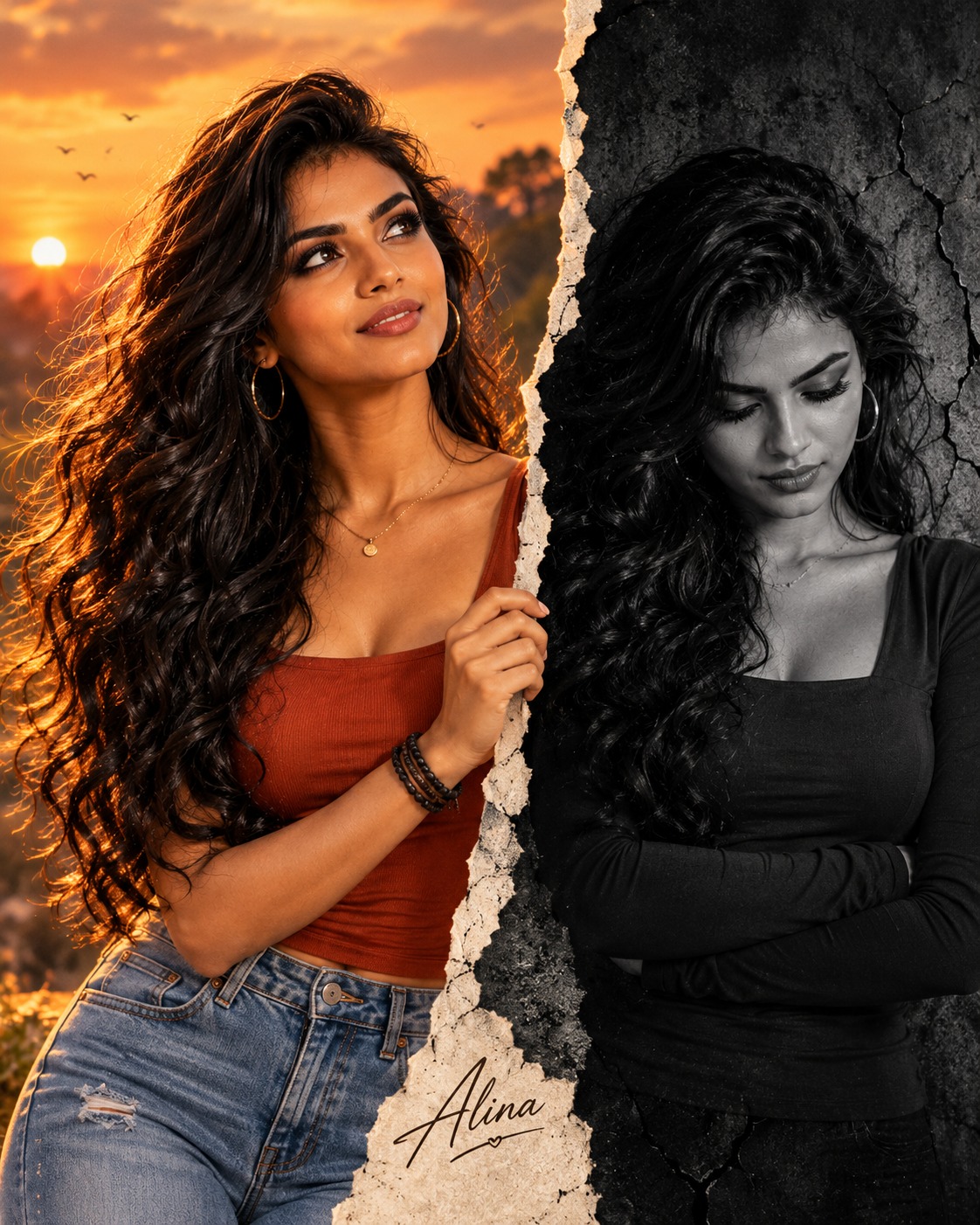
The Double Exposure Collage concept combines cinematic portrait photography, fine-art textures, and a striking contrast between two emotional expressions. The composition presents the same woman in two different visual states, bringing together a warm, hopeful portrait and a darker, introspective version. Instead of placing two ordinary photographs side by side, the design connects them through a dramatic torn-paper effect that becomes the central visual feature.
The main portrait occupies the left side of the composition. The woman is shown from the top of her head to her upper thighs, giving enough space to appreciate her expression, hairstyle, outfit, and hand position. Her torso faces mostly forward, while her head turns slightly toward the right. Her chin is gently raised, and her eyes look upward beyond the frame. A natural smile adds warmth to her expression, creating a feeling of openness, optimism, and quiet confidence.
Her facial expression is important because it establishes the emotional character of the warm side. Slightly raised cheeks, relaxed eyebrows, and a gentle smile make the portrait feel approachable rather than overly posed. The upward gaze introduces a sense of possibility, as though the woman is looking toward something beyond the scene. Natural facial proportions and realistic skin texture help maintain the photographic quality.
Her long, voluminous dark brown hair falls in loose waves over her shoulders and chest. Fine strands and softly windswept edges create movement around the silhouette. Auburn and golden highlights appear where the sunset light catches the outer waves. These warm details connect the hair with the landscape and help separate the woman from the background. The hairstyle adds softness and dimension without distracting from the face.
The outfit reinforces the warm, earthy palette. A burnt-orange or rust-colored sleeveless top creates a strong visual connection with the sunset. Its rounded neckline, relaxed fit, and natural fabric folds give it a believable everyday-fashion appearance. A slightly gathered hem adds a small styling detail around the waist. Faded blue denim jeans introduce another layer of texture through their waistband, front button, belt loops, pockets, stitching, and worn fabric.
Accessories remain subtle but meaningful. A delicate chain necklace with a small pendant adds a refined detail around the neckline, while dark bracelets introduce texture near the raised wrist. These accessories complement the clothing without overwhelming the composition. Their understated appearance keeps attention on the woman’s expression and the interaction with the torn paper.
The raised hand creates the strongest physical connection between the two visual worlds. Near chest or shoulder height, her fingers grip the ragged edge of the paper divider. The wrist, thumb, and fingers are positioned to suggest real contact with the material. Her opposite arm hangs naturally beside her hip, with the hand resting near the upper thigh. This contrast between the raised arm and relaxed arm gives the pose a natural sense of movement.
The second portrait occupies the right side. It depicts the same woman in a different emotional state, using a subdued grayscale treatment. Her head is bowed, her chin lowered toward her chest, and her gaze directed downward. Her lips are closed or nearly closed, while her shoulders curve slightly forward. Her arms cross over her torso, with one hand resting around the opposite upper arm. The pose feels more inward-looking and restrained than the open posture of the color portrait.
Her dark, wavy hair falls around the face and partially covers the forehead and cheek. Unlike the warm portrait, the hair is rendered in deeper, desaturated tones, with limited highlights and stronger shadow detail. The darker appearance helps the grayscale version blend into the charcoal background while preserving enough separation to keep the face recognizable.
The clothing on this side is a loose, dark long-sleeved top. Soft folds gather around the elbows and crossed forearms, adding realistic texture to the pose. The subdued wardrobe keeps the monochrome portrait visually quiet. Rather than introducing a competing color, it allows the expression, hair, and body language to carry the emotional weight.
The torn-paper transition is the visual centerpiece of the Double Exposure Collage. A broad, irregular tear descends diagonally through the composition, separating the sunset portrait from the grayscale version. Its jagged points, exposed fibers, peeling layers, and weathered ivory edges create the impression of a physical sheet of paper being pulled apart. Darker shadows beneath the torn edges give the divider depth and help it feel integrated with the photographs.
Small fragments and peeling pieces near the waist add detail without making the scene cluttered. The woman’s grip on the edge gives the transition a narrative quality. The paper is more than a decorative border: it visually separates two different moods while connecting them through the same subject. This interaction makes the composition feel like a conceptual fine-art poster rather than a conventional split-screen portrait.
The left background features a sunset landscape with a low golden sun near the horizon. Layered clouds in amber, peach, dusty pink, and muted blue-gray create a rich but controlled color range. Distant trees or vegetation form a dark line along the lower horizon, while small bird silhouettes add scale and a sense of openness. Atmospheric haze softens the distance, making the environment feel spacious and cinematic.
Strong golden-hour backlighting creates warm highlights around the woman’s hair, shoulders, and arm. Sun rays and subtle flare introduce luminosity, while gentle facial fill preserves detail in the skin. The light gives the rust-colored clothing additional richness and reinforces the hopeful atmosphere. Warm amber tones, earthy shadows, and soft sunset colors create a cohesive visual environment.
The right background uses dark charcoal-gray concrete or aged plaster. Fine branching cracks, peeling patches, rough grain, and uneven discoloration make the surface look weathered. The background remains cool and desaturated, with deeper shadows behind the hair and shoulders. Subtle highlights separate the woman’s face and crossed arms from the dark wall without making the grayscale side appear brightly illuminated.
Lighting is one of the most important aspects of the overall concept. The left side uses warm directional light, while the right side uses subdued cool illumination. This separation gives each portrait its own atmosphere. Golden highlights communicate openness and warmth, whereas the charcoal tones create a quieter, more reflective impression. The two treatments remain visually connected through realistic skin, hair, and fabric textures.
The color grading combines amber, rust, and golden highlights on the left with charcoal monochrome and muted gray tones on the right. Subtle film grain and restrained micro-contrast unify the photographs and the textured surroundings. Realistic paper fibers, denim stitching, concrete cracks, and individual hair strands contribute to the tactile quality of the composition.
The framing is vertical, with the main color portrait occupying a little more than half of the left side and the secondary portrait filling the right portion. This unequal distribution leaves enough space for the diagonal divider to remain prominent. The main subject’s upward gaze guides attention toward the brighter landscape, while the bowed portrait directs attention downward. These opposing directions reinforce the contrast between the two expressions.
The Double Exposure Collage style is suitable for conceptual photography posters, personal storytelling artwork, creative social media edits, cinematic portrait designs, fine-art prints, and editorial projects. Its emotional contrast can communicate change, reflection, personal growth, or the difference between an outward expression and a private state of mind. The concept does not need explanatory text because the expressions, lighting, and environments establish the visual narrative.
The design’s strongest quality is the relationship between realism and symbolism. The portraits retain believable photographic details, while the torn paper and contrasting backgrounds introduce a metaphorical layer. Warm sunset imagery creates openness, and the weathered monochrome surface suggests restraint and introspection. Together, they create a memorable visual composition built around two sides of the same person.
[[[
A. REFERENCE ANALYSIS
- Style: Photorealistic cinematic portrait collage, surreal double exposure, fine-art conceptual photography.
- Camera: Eye-level to slightly low-angle impression, medium portrait framing from head to upper thighs, vertical 2:3 composition.
- Main portrait: Positioned on the left, torso facing mostly forward, head turned slightly toward image-right, chin raised, eyes looking upward, warm genuine smile.
- Secondary portrait: Same woman on the right, head bowed, gaze downward, shoulders slightly rounded, arms crossed over the torso.
- Transition: A large, jagged diagonal torn-paper edge separates the two versions, with the main subject gripping the paper near chest height.
- Outfit: Burnt-orange sleeveless top, faded blue jeans, delicate pendant necklace, dark bracelets.
- Hair: Long, voluminous, wavy dark brown hair with auburn and golden highlights on the color side; darker, desaturated waves on the grayscale side.
- Lighting: Strong golden-hour backlight from the lower-left, warm rim lighting, sun flare and volumetric rays; cool, subdued illumination on the right.
- Background: Sunset sky, distant trees and birds on the left; cracked charcoal-gray concrete or aged plaster on the right.
- Color grading: Warm amber and rust on the left, cool charcoal monochrome on the right, subtle film grain and weathered textures.
- Mood: Hopeful, open expression contrasted with a withdrawn, introspective pose.
B. MASTER PROMPT
Photorealistic Cinematic Portrait Photography + Surreal Double-Exposure Collage + Split-Reality Visual Effect + Torn-Paper Transition + Fine-Art Concept Poster
Create a vertical 2:3 cinematic portrait collage featuring two visual versions of the same woman, separated by a large, irregularly torn paper surface. The left side is a warm, richly colored sunset portrait; the right side is a dark, desaturated grayscale portrait against cracked, weathered concrete. Preserve the contrast between the two moods and integrate both portraits through realistic layered compositing.
MAIN COLOR PORTRAIT — LEFT SIDE: Frame the woman from the top of her head to her upper thighs. Position her across the left 55–60% of the composition. Her torso faces generally toward the camera with a subtle natural shift of weight through the hips. Her head turns slightly toward image-right, chin gently raised, eyes looking upward and off-frame toward image-right. Give her a warm, natural smile with slightly visible upper teeth, softly raised cheeks, relaxed eyebrows, and realistic facial anatomy.
Her long, voluminous dark brown hair falls in loose waves over her shoulders and chest, with fine individual strands and a gently windswept silhouette. Add warm auburn and golden highlights along the outer waves, especially where the sunset backlight catches the hair.
Dress her in a burnt-orange or rust-colored sleeveless top with a rounded neckline, relaxed fit, realistic fabric texture, and natural folds around the waist. Slightly gather or tie the hem at one side. Pair it with faded blue denim jeans featuring a visible waistband, front button, belt loops, front pockets, fine stitching, and authentic worn patches. Add a delicate chain necklace with a small pendant and several dark beaded or cord bracelets around the raised wrist.
POSE AND PAPER INTERACTION: The arm on image-right bends upward toward the central dividing line. Her hand grips the ragged paper edge at approximately chest-to-shoulder height, with the thumb and fingers naturally curled around the torn material. Preserve believable finger anatomy, wrist alignment, and physical contact with the paper. Her opposite arm hangs relaxed beside her hip, with the hand near the upper thigh.
SECONDARY MONOCHROME PORTRAIT — RIGHT SIDE: Depict the same woman as a separate, enlarged grayscale portrait occupying approximately the right 40–45% of the frame. Show her from the head to the waist or upper thighs, with the lower body disappearing naturally behind the torn surface and dark background. Her torso turns slightly toward image-left. Her head bows forward, chin lowered toward her chest, eyes cast downward, and lips closed or nearly closed. Her shoulders are gently rounded forward. Both arms cross over her torso, with one hand resting around the opposite upper arm and the other forearm tucked across her body. Long, dark, wavy hair falls around her face and partially obscures her forehead and cheek.
Dress this version in a dark, loose-fitting long-sleeved top with softly gathered or pushed-up sleeves and natural folds around the elbows and crossed forearms. Render the entire secondary portrait in restrained grayscale, with cool charcoal-gray tonality, subtle facial highlights, deep hair shadows, and a subdued photographic finish. Keep her recognizable as the same woman while preserving the different head angle, expression, pose, and lighting.
TORN-PAPER TRANSITION: Create a broad, jagged tear beginning near the upper-right edge and descending diagonally toward the lower-center of the image. The torn edge should have irregular pointed contours, exposed fibrous paper layers, weathered ivory edges, and darker shadowed undersides. Add scattered paper fragments and small peeling pieces around the central waist area. The woman’s raised hand must visibly grip the edge, making the interaction convincing. Keep the tear between the two visual worlds, with the color portrait clearly readable on the left and the grayscale portrait integrated into the dark right side.
LEFT BACKGROUND — SUNSET LANDSCAPE: Build a softly detailed outdoor landscape with a bright golden sun positioned low near the left horizon. Add layered clouds in amber, peach, dusty pink, and muted blue-gray. Include a few small bird silhouettes in the open sky and dark distant trees or vegetation along the lower horizon. Use atmospheric perspective, subtle sunset haze, luminous sun rays, and a controlled warm glow. Let the backlight illuminate the woman’s outer hair strands, shoulder, arm, and face with golden rim highlights and amber light spill.
RIGHT BACKGROUND — WEATHERED SURFACE: Use a dark charcoal-gray concrete or aged plaster wall with fine branching cracks, peeling patches, rough grain, uneven discoloration, and distressed surface texture. Keep this region low-key and desaturated, with the deepest shadows behind the woman’s dark hair and shoulders. Allow subtle highlights to separate her face, hair, and crossed forearms from the background.
LIGHTING AND COLOR: Maintain strong warm-versus-cool separation. The left portrait receives golden-hour directional backlighting from the lower-left, soft facial fill, warm highlights, rich rust-orange clothing, and natural skin tones. The right portrait receives subdued, cool grayscale illumination with restrained contrast and soft facial shadows. Preserve the bright sunset, deep earthy shadows, muted teal-gray undertones in the darker areas, and subtle warm highlight bloom. Avoid flattening the tonal differences between the two halves.
TEXTURE AND FINISH: Realistic skin texture, fine hair strands, detailed denim stitching, natural fabric folds, fibrous torn-paper edges, cracked plaster, fragmented surface debris, subtle film grain, restrained micro-contrast, and carefully controlled edge definition. Use soft background depth and atmospheric blending without losing the key details of the woman’s hand, facial expression, or the torn edge.
COMPOSITION LOCK: Vertical 2:3 framing, medium crop on the main portrait, warm color portrait on the left, bowed monochrome portrait on the right, raised hand gripping the diagonal tear, low sun on the left horizon, cracked dark wall on the right. No added text, extra people, unrelated props, or unrequested changes. The finished image should feel like a sophisticated cinematic fine-art photograph expressing a contrast between a warm, hopeful exterior and a quiet, introspective inner state.
C. EDITABLE VARIABLES
- [USER IDENTITY]: One woman represented in both portraits.
- [CAMERA ANGLE]: Eye-level with a slight upward impression.
- [POSE & BODY GEOMETRY]: Left portrait upright with one hand gripping paper; right portrait with crossed arms and bowed head.
- [FACE DIRECTION & EXPRESSION]: Left looks upward to image-right and smiles; right looks downward with a subdued expression.
- [CAMERA & PERSPECTIVE]: Medium portrait, upper-thigh crop on the left; waist or upper-thigh crop on the right.
- [OUTFIT & ACCESSORIES]: Rust-orange sleeveless top, faded blue jeans, pendant necklace, dark bracelets; dark long-sleeved top on the monochrome portrait.
- [LIGHTING & SHADOWS]: Golden sunset backlighting on the left; cool, low-key grayscale lighting on the right.
- [COLOR & MOOD]: Warm amber and rust contrasted with charcoal monochrome.
- [TEXTURE & EFFECTS]: Torn paper, fragmented edges, cracked plaster, film grain, sun rays, subtle haze.
- [BACKGROUND & OBJECTS]: Sunset landscape on the left; distressed concrete wall on the right.
- [TEXT]: None.
- [ASPECT RATIO]: Vertical 2:3.
- [OBJECT CHANGE]: None.
- [POSE CHANGE]: None.
- [ADDITIONAL EDITS]: Preserve the split-reality visual metaphor and hand-to-paper contact.
- [NEGATIVE CONSTRAINTS]: No extra people, added text, incorrect hand anatomy, or unwanted global color changes.
D. NEGATIVE PROMPT
Different identities, inconsistent facial features, unrelated second woman, duplicated faces within one portrait, extra people, incorrect facial anatomy, artificial smile, closed eyes on color portrait, downward gaze on color portrait, smiling grayscale portrait, incorrect head direction, wrong arm positions, uncrossed arms on grayscale portrait, missing raised hand, hand not gripping paper, floating fingers,
malformed hands, extra fingers, broken wrists, impossible paper contact, incorrect outfit colors, missing necklace, missing bracelets, short hair, straight hair, plastic skin, excessive beauty retouching, over-smoothed skin, excessive sharpening, lost hair texture, flat lighting, overexposed sunset, missing sun, missing landscape, bright right-side background, colorful grayscale portrait, warm orange grading across the entire image,
excessive teal grading, oversaturated colors, excessive lens flare, exaggerated sun rays, heavy motion blur, unrealistic paper edges, smooth divider, missing paper fragments, clean undamaged wall, missing cracks, excessive debris, cluttered composition, additional text, watermark, incorrect crop, full-body framing, unwanted zoom, changed aspect ratio, cartoon rendering, generic fantasy effects.
E. RECONSTRUCTION BLUEPRINT
A vertical cinematic double-exposure portrait shows the same woman in two contrasting visual states, divided by a jagged, diagonally torn sheet of weathered paper. On the left, she stands against a sunset landscape, framed from head to upper thighs. Her long, wavy dark brown hair catches golden and auburn rim light. She wears a rust-orange sleeveless top, faded blue jeans, a delicate pendant necklace,
and dark bracelets. Her torso faces mostly forward while her head turns slightly right and her chin lifts; she smiles naturally and looks upward beyond the frame. Her raised hand grips the torn paper edge near chest height, while her opposite arm hangs beside her hip. A low golden sun, layered peach and blue-gray clouds, distant trees, and small bird silhouettes fill the left background.
On the right, a grayscale version of the same woman appears against a dark, cracked concrete wall. Her head is bowed, her gaze is directed downward, her long dark hair partly obscures her face, and her arms are folded across her torso. She wears a loose dark long-sleeved top. The right portrait remains cool, subdued, and monochromatic. The torn divider has pale fibrous edges, irregular pointed tears, peeling layers, and scattered fragments near the center. Warm sunset gold and rust contrast with charcoal gray, while realistic skin, hair, fabric, paper, and concrete textures maintain a cohesive fine-art photographic finish.
F. LIMITATIONS
The prompt describes the visual contrast without adding explanatory text or labels. Text-only prompting cannot guarantee exact identity consistency or perfectly realistic hand-to-paper contact.
The grayscale portrait’s lower body is largely obscured; the prompt keeps it cropped around the waist or upper thighs rather than inventing a full-body pose.
The right-side clothing is interpreted as a loose, dark long-sleeved top based on visible folds and neckline.
The precise paper material and wall substrate cannot be established from appearance alone.
]]]