
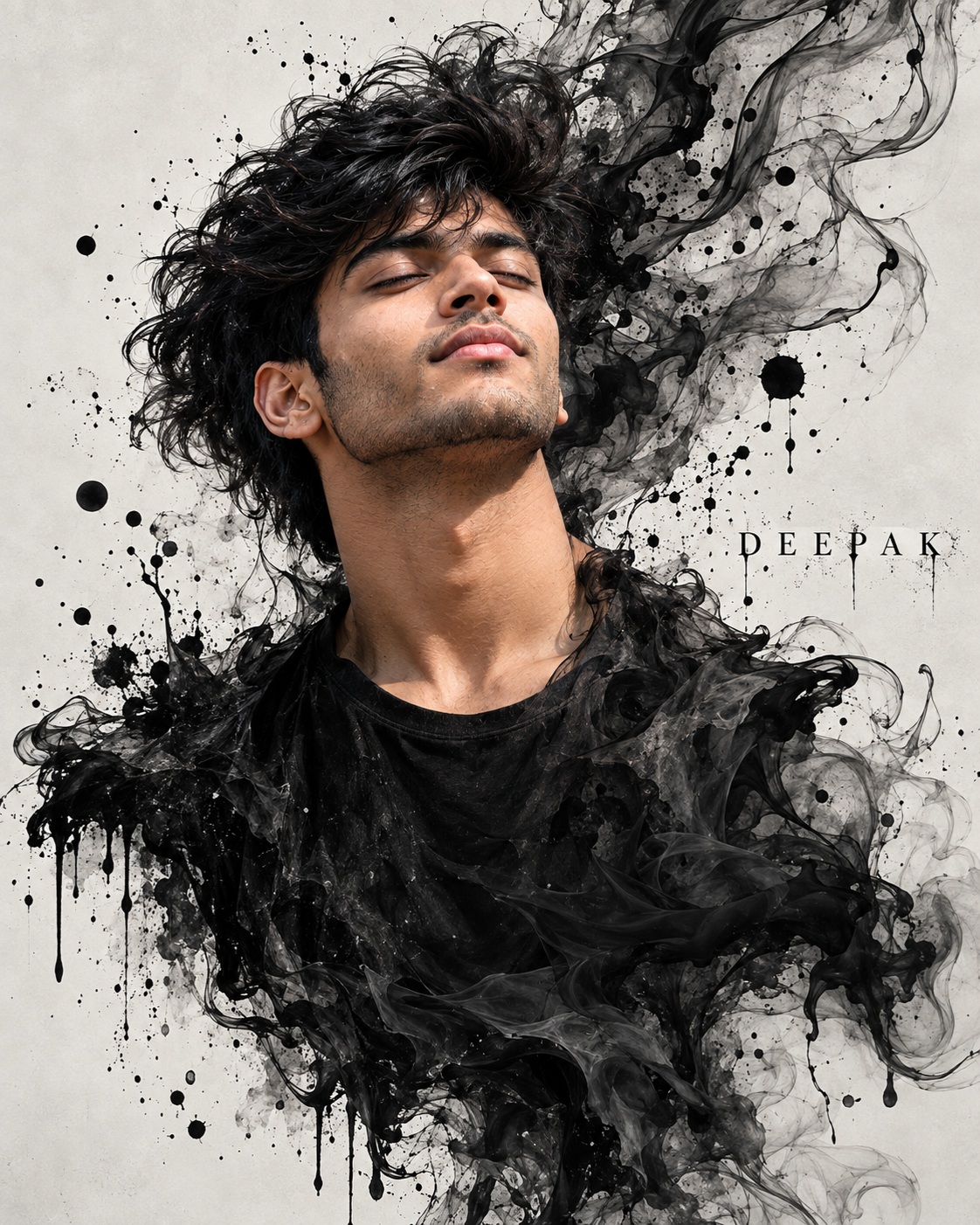
Surreal Ink Portrait
The concept presents a single male bust portrait inside a refined surreal fine-art composition. The subject is positioned slightly left of center within a tall vertical frame, surrounded by generous pale negative space. Rather than presenting a conventional studio headshot, the portrait appears to emerge from a transformation of black ink, smoke and fluid marks. The human figure remains recognizable and realistic while parts of the hair, shoulders and clothing gradually dissolve into abstract flowing forms.
The main subject is a male character shown from the upper torso upward. His body does not fill the entire frame in a conventional way. Instead, the figure has room around it, allowing the pale background and drifting ink particles to become part of the composition. This open arrangement gives the artwork an airy, gallery-like quality and prevents the portrait from feeling crowded.
The head position is one of the most important expressive details. The character tilts his head upward and toward the viewer’s left, with the chin raised and the neck naturally extended. His eyes are gently closed, and his lips are slightly parted. The expression is serene and introspective rather than cheerful or dramatic. The face appears to be caught in a quiet moment of reflection, giving the portrait an almost dreamlike emotional quality.
The facial identity is intended to remain recognizable while being naturally integrated into this particular pose. The face is not treated as a separate photographic element. Its structure, skin detail and subtle shading belong to the same fine-art portrait treatment as the rest of the composition. The upward angle and closed eyes create a soft, contemplative presence that becomes the emotional center of the design.
The hair is one of the strongest visual features. It is extremely thick, voluminous and wavy, with a loose, untamed silhouette. Individual strands spread outward and upward instead of staying neatly contained around the head. As the hair moves away from the face, it begins to transition into smoke-like ribbons and flowing black ink tendrils. This creates a visual bridge between the realistic human subject and the abstract artistic environment.
The transformation of the hair is deliberately organic. Some strands remain recognizable as hair, while others become thin curls, smoky wisps, liquid ribbons and fluid contours. The movement is especially noticeable toward the upper-right region, where the black forms expand into the surrounding negative space. This directional flow gives the otherwise still portrait a sense of movement.
Facial hair is kept subtle compared with the dramatic hairstyle. A thin moustache and short beard or stubble appear around the jaw and chin. The restrained facial-hair treatment keeps attention on the expression and hair transformation while still providing natural definition to the lower face.
The clothing is intentionally simple. The subject wears a plain black crew-neck shirt, allowing the complex ink transformation to remain the dominant artistic feature. The shirt begins as recognizable clothing around the shoulders and torso, then gradually dissolves into black smoke and liquid ink. This transition makes the clothing feel as though it is breaking apart into the same material that surrounds the hair.
The disintegration effect is the defining creative device. Black ink ribbons, translucent smoky wisps, curling tendrils, splash shapes and fluid contours emerge around the hair, neck, shoulders and lower torso. The effect is not presented as a random collection of decorative marks. It follows the form of the figure and creates a believable visual relationship between the human portrait and the abstract medium.
Small droplets and larger round ink splatters are scattered around the silhouette. These particles vary in size and density, with particularly visible activity around the hair and upper-right area. They make the transformation feel energetic while preserving the quiet mood of the subject. The contrast between a peaceful expression and dynamic ink movement is one of the most appealing aspects of the concept.
The background is minimal and pale. A soft gray or off-white field surrounds the subject without introducing scenery, architecture or additional objects. This simplicity is important because it gives the black ink enough visual authority. The background acts almost like a gallery paper surface, allowing the dark forms to remain clearly separated.
The pale background also creates strong tonal contrast. Black hair, shirt and ink shapes become the darkest elements in the frame, while the off-white space provides breathing room. Natural muted skin tones sit between these extremes, giving the face a realistic presence without disrupting the mostly monochrome character.
Lighting is soft and diffused rather than theatrical. Gentle facial shading reveals the contours of the nose, cheeks, jaw and neck without creating hard shadows. Subtle highlights keep the skin natural, while the bright background contributes to the ethereal quality. The result feels closer to controlled fine-art studio illumination than to an action-poster lighting setup.
The color language is deliberately restrained. Black, charcoal and pale gray form the primary palette, while the skin retains quiet natural tones. There is no strong colorful environment competing with the ink. This monochrome direction makes the fluid forms feel elegant and gives the portrait a sophisticated editorial character.
The artwork sits between realistic portraiture and painterly abstraction. The face and anatomy retain believable human qualities, while the surrounding hair and clothing transform into expressive ink and smoke. This combination gives the piece a surreal character without making it resemble a cartoon, conventional illustration or purely abstract artwork.
Composition is carefully controlled through the tall vertical frame. The subject remains slightly left of center, while the ink spreads into the upper-right and lower regions. This asymmetry creates visual movement and makes the negative space feel intentional. The portrait is not simply centered against a blank background; the surrounding flow creates a directional path for the viewer’s eye.
The large amount of negative space is an important design feature. It gives the dark ink shapes room to expand and makes the portrait feel more sophisticated. The empty areas also create a sense of calm, which balances the energetic movement of the smoke and splatter elements.
The camera feeling is intimate but restrained. The bust framing gives enough facial and upper-body detail to communicate identity while leaving room for the abstract transformation. The vertical crop supports the upward movement of the hair and the downward dissolution of the shirt.
The mood is calm, ethereal, mysterious and introspective. The closed eyes and raised chin suggest a private moment of thought, while the drifting ink creates a dreamlike atmosphere. The artwork feels emotional without relying on exaggerated facial expressions or dramatic environmental storytelling.
One of the most creative aspects is the contrast between stillness and motion. The face remains quiet and serene, but the hair, shirt and surrounding particles appear to move outward as fluid ink. This gives the composition a poetic quality and makes the transformation feel symbolic rather than merely decorative.
The ink can also be read as a metaphor for thought, emotion, memory or imagination. Because the figure appears to dissolve into flowing black forms, the design can communicate the idea of a person becoming part of an artistic medium. This gives the portrait a deeper editorial and conceptual quality.
The simple black shirt is particularly effective because it provides a natural starting point for the dissolution effect. Its solid silhouette contrasts with the loose smoke and ink around it. As the garment breaks apart visually, the transition becomes easy to understand and remains connected to the figure’s body.
The hair-to-ink transition is equally important. The dense black hair provides a strong realistic foundation, while individual strands become progressively more abstract. This makes the transformation feel gradual and organic instead of appearing as a separate graphic effect placed onto the portrait.
The particle distribution adds scale. Tiny droplets create fine detail near the silhouette, while larger circular splatters establish stronger graphic accents. Their placement around the head and upper-right area helps extend the visual energy beyond the boundaries of the face.
The concept has strong fine-art editorial potential. It can be used for artistic profile imagery, creative portfolios, introspective personal branding, music artwork, poetry-related graphics, conceptual portrait collections and social media posts that need a sophisticated visual identity.
It can also work for personal storytelling because the subject remains the emotional center. The abstract ink environment adds atmosphere without replacing the person. This makes the design suitable for creators who want their identity represented through a poetic and artistic visual language.
The restrained palette makes the concept adaptable to different presentation environments. It can feel elegant on a gallery-style page, dramatic in a social media feed or sophisticated as a printed portrait. The lack of busy scenery also allows the artwork to remain visually clear at different sizes.
The composition is particularly effective because every abstract element supports the human figure. Hair becomes smoke, the shirt becomes ink, and droplets expand the silhouette. Nothing needs to compete with the subject because the transformation itself is the subject’s visual story.
Natural anatomy remains important to the overall quality. The neck, jaw, shoulders and head proportions need to feel believable because the surreal effect depends on the contrast between realistic anatomy and abstract disintegration. If the human structure became exaggerated, the fine-art balance would be weakened.
The face therefore remains grounded in realism while the surrounding materials become increasingly fluid. This controlled transition is what makes the concept visually sophisticated. The portrait does not disappear completely into abstraction; it remains clearly human at the center.
The design also benefits from subtle tonal variation. The pale background can contain a delicate gradient, while the black ink ranges from dense charcoal areas to translucent wisps. This variation gives the monochrome palette depth and keeps the artwork from looking flat.
The ink textures can appear dense near the shoulders and lower torso, then become lighter and more transparent as they travel outward. This creates a sense of dispersion and helps preserve the main facial focus. The strongest visual detail remains around the person, while the outer wisps provide atmosphere.
The upper-right ink movement is especially useful for balancing the head position. Since the face turns upward and left, the flowing hair and smoke can move in the opposite visual direction, creating a dynamic counterbalance. This gives the vertical composition a subtle sense of tension and movement.
The artwork can appeal to viewers who enjoy surreal portraiture, monochrome fine art, fluid-ink aesthetics and expressive editorial design. It combines recognizable human emotion with an imaginative transformation, making it more memorable than a conventional portrait.
From a design perspective, the concept is successful because it uses a limited number of visual ideas very consistently. The pale background, black ink, natural skin, closed eyes, raised chin, flowing hair and dissolving shirt all belong to the same artistic language.
The final creative direction is a serene male bust portrait emerging from black ink and smoke against a pale gray background. The face remains realistic and introspective, while the hair and clothing dissolve into fluid ribbons, splatters and wisps. The result is elegant, mysterious and emotionally quiet.
For users, the benefit is a distinctive portrait concept that can communicate personality without relying on conventional scenery or elaborate props. The artwork focuses attention on the face while adding a strong conceptual layer through disintegration and fluid movement.
Overall, the prompt describes a sophisticated surreal portrait that balances realism with abstraction. Its defining features are the upward head tilt, closed eyes, calm expression, enormous textured hair, subtle facial hair, plain black shirt, fluid ink transformation, pale negative space and scattered black particles. Together, these details create a poetic visual identity that feels artistic, atmospheric and highly personal.
[[[
REFERENCE ANALYSIS
- Format: Vertical artistic portrait, approximately 9:16.
- Composition: Single male bust/upper-body portrait centered slightly left, with large negative space surrounding the figure. The body dissolves into flowing black ink/smoke elements.
- Pose: Head tilted upward and toward the viewer’s left, chin raised, neck elongated, eyes gently closed, lips slightly parted. Shoulders angled naturally. Preserve the exact head tilt, neck extension, facial angle and torso placement.
- Expression: Serene, introspective, almost dreamlike. Eyes closed, relaxed mouth, no smile.
- Hair: Extremely thick, voluminous, messy/wavy black hair flowing outward and upward, with individual strands transforming into smoke/ink tendrils toward the upper-right.
- Facial hair: Thin moustache and subtle short beard/stubble around the jaw and chin.
- Clothing: Simple black crew-neck shirt. The shirt itself gradually dissolves into abstract black ink/smoke around the shoulders and lower torso.
- Visual effect: Major defining element is the ink/smoke disintegration effect. Hair and clothing merge with swirling black tendrils, wisps, splashes and fluid-like ribbons.
- Background: Minimal pale gray/off-white background with soft atmospheric gradient. No scenery.
- Particles: Numerous tiny black ink droplets and larger round splatters scattered around the silhouette, especially around the hair and upper-right region.
- Lighting: Soft diffused studio-style illumination, bright background, subtle facial shading and gentle skin highlights. No harsh cinematic shadows.
- Color: Mostly monochrome black, charcoal and pale gray, with natural muted skin tones. High contrast between black hair/ink and light background.
- Style: Surreal digital portrait mixed with fluid-ink art, fine-art editorial aesthetic, realistic facial rendering combined with painterly/smoky abstraction.
- Mood: Calm, ethereal, artistic, mysterious and introspective.
- Framing: Preserve exact vertical framing, character scale, negative space and ink spread. Do not crop or recenter.
- Anatomy: Natural realistic anatomy, especially neck, jaw, shoulders and head proportions.
MASTER PROMPT
Use supplied ref image as master blueprint. Replace only ref character’s face with supplied user identity. COMPLETELY IGNORE the user’s original photo pose and body; force the user into the exact body/head pose, head tilt, neck position, shoulder angle, facial orientation and expression of the reference character. Maintain exact scale, proportion, crop, visibility. Preserve 1000% of all visual info including darkness, grading, mood, lighting, shadows, contrast, saturation, composition, environment, objects, background, ink/smoke effects, rendering, outfit, ref pose, facial expression, hairstyle silhouette, negative space and natural human anatomy. Output must look IDENTICAL to ref except face. Do NOT brighten, enhance, modify, change outfit, ref pose, or vibe.
Recreate the supplied reference as an ethereal surreal ink-and-smoke portrait. Preserve the exact vertical composition and the single male bust portrait emerging from a pale gray/off-white background.
Preserve the exact reference pose: head tilted upward and toward the viewer’s left, chin raised, neck elongated, eyes gently closed, lips slightly parted, relaxed facial muscles and serene expression. Completely ignore the user’s original pose and body posture.
Replace only the facial identity with the supplied user’s identity. Preserve the user’s unique facial characteristics while naturally adapting them to the reference’s exact upward-facing angle, closed-eye expression and soft lighting. Do not import the user’s original hairstyle, body, clothing or pose.
Preserve the exact large, wild, wavy black hairstyle, with voluminous curls and loose strands spreading outward. The hair must transition organically into black smoke, liquid ink tendrils and fine flowing strands, particularly extending toward the upper-right. Preserve the exact silhouette, density and direction of the hair/ink flow.
Preserve the exact thin moustache and subtle beard/stubble treatment as visible in the reference, rendered naturally within the artistic style.
Preserve the exact plain black crew-neck shirt, including its silhouette and gradual dissolution into flowing black ink around the shoulders and lower body. The garment must not become a different outfit.
Preserve the signature fluid-ink disintegration effect: black liquid ribbons, smoky wisps, translucent tendrils, dripping shapes, fine curling strands, splash particles and organic flowing contours emerging from the hair, neck, shoulders and shirt. Preserve the reference’s balance between realistic human portraiture and abstract ink transformation.
Preserve all black ink droplets and splatters, including tiny airborne particles and larger circular droplets around the silhouette. Do not add decorative particles in different locations or remove existing visual density.
Preserve the exact soft pale gray/off-white background, subtle gradient, clean negative space and delicate atmospheric quality. No scenery, architecture, objects or additional people.
Preserve the exact soft diffused lighting, natural skin tones, restrained contrast and gentle shadows. Do not introduce dramatic rim lighting, harsh shadows, orange grading or excessive saturation.
Maintain the exact surreal fine-art rendering: realistic skin and facial detail combined with painterly digital ink, smoke and fluid abstraction. Do not convert it into a conventional photograph, cartoon, anime, oil painting or generic AI portrait.
Maintain perfect natural anatomy: normal head size, realistic facial proportions, correctly structured jaw and neck, proportional shoulders, natural posture and no distorted limbs.
Reference = FINAL IMAGE. The reference is the base layer; only the user’s facial identity changes. Everything else remains locked at 1000%.
EDITABLE VARIABLES
- [USER IDENTITY]: Supplied user’s face/identity only; preserve unique facial traits.
- [OUTFIT]: Exact simple black crew-neck shirt with ink-dissolving effect.
- [TEXT]: None.
- [OBJECT/POSE/ADDITIONAL]: None. Preserve exact pose, ink effects, particles, background and composition.
NEGATIVE PROMPT
“identity loss, different face, original character identity, added person, removed person, user’s original pose, user’s original body, wrong head angle, wrong head tilt, wrong gaze, open eyes, wrong expression, smiling, exaggerated expression, lowered chin, forward-facing head, altered neck position, altered shoulder angle, different hairstyle, straight hair, short hair, clean hair, altered hair silhouette, missing ink hair, different beard, missing moustache, different outfit, colored clothing, redesigned shirt, missing ink dissolution, missing smoke, missing tendrils, missing splatters, missing particles, excessive particles, altered particle placement,
redesigned background, scenery, architecture, objects, extra elements, dark background, colorful background, harsh lighting, dramatic shadows, rim light, orange grading, excessive saturation, brightened skin, overexposure, photorealistic studio portrait, conventional photograph, anime, cartoon, 3D render, vector art, oil painting, watercolor, clean digital portrait, generic aesthetic, beautification, polished fashion portrait,
changed mood, changed vibe, changed composition, zoomed, enlarged, recentered, cropped, expanded frame, altered negative space, changed scale, altered ink flow, altered smoke direction, random splashes, reconstructed hidden areas, big head, small head, distorted face, stretched neck, disproportionate shoulders, unnatural anatomy, deformed facial features, extra limbs, distorted proportions, user’s original hairstyle, user’s original clothing, user’s original posture” ]]]