
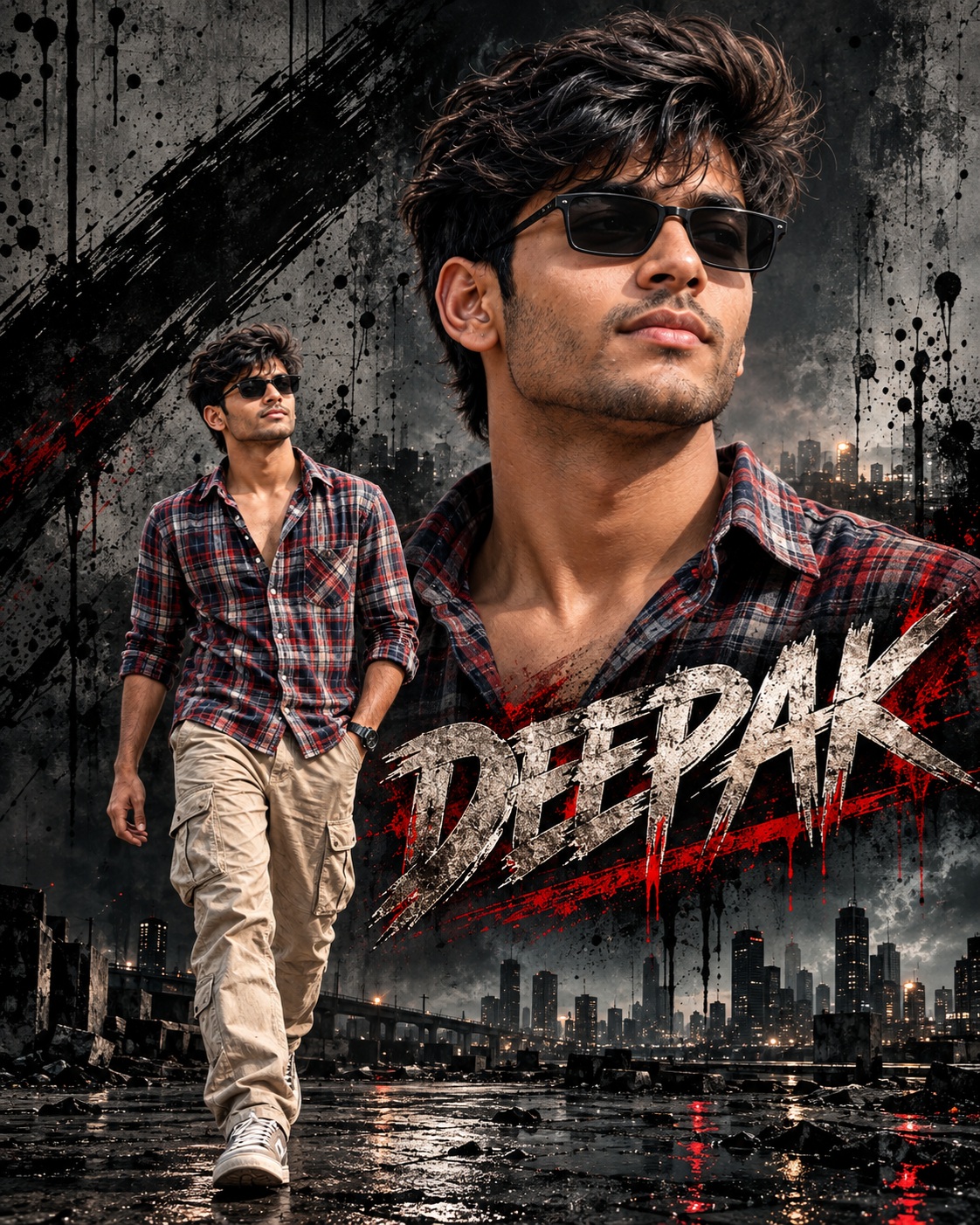
Cinematic Urban Character
The concept presents a highly stylized vertical male character composition built around two dramatically different scales. The main visual feature is a very large close-up of a male character occupying the upper-right and central area, combined with a much smaller full-body version of the same character walking through the lower-left foreground. This double-scale structure gives the design a strong cinematic identity and makes the character appear larger than life while still showing his complete appearance and body language.
The large character is shown through a tight head-and-upper-torso crop. His face is turned slightly toward the viewer’s right, and his gaze continues toward the right side of the frame rather than looking directly at the viewer. The expression is neutral, serious and confident. This restrained expression is important because it gives the character an understated sense of authority instead of a cheerful or exaggerated personality.
The face is visually supported by several recognizable styling details. Dark rectangular sunglasses cover the eyes and provide an immediate signature element. The beard and moustache are short to medium in length and have a neatly textured appearance. Together with the sunglasses, these details create a mature, mysterious and confident character identity.
The hairstyle is thick, voluminous and deliberately textured. The black hair is swept upward and backward, with loose strands falling naturally toward the forehead. Its slightly messy quality prevents the character from looking overly polished. The hair silhouette is particularly useful against the dark background because it provides a strong outline around the upper portrait.
The smaller full-body version of the character introduces movement into the composition. He is positioned left-of-center and walks toward the camera with one leg forward. One hand hangs naturally beside the body while the opposite hand remains inside the trouser pocket. The torso, shoulders, head direction and stride create a relaxed but confident walking posture.
The walking pose is an important storytelling element because it communicates personality without requiring an exaggerated facial expression. The character appears comfortable and self-assured while moving through the environment. The contrast between the enormous stationary close-up and the smaller walking figure gives the poster a sense of multiple cinematic moments existing within one composition.
The clothing provides a distinctive urban styling layer. The character wears a red, blue and gray plaid button-up shirt. The upper chest is partially open, while the sleeves are rolled toward the forearms. The plaid introduces controlled color into an otherwise dark composition, giving the character a recognizable clothing identity without making the poster bright.
The beige or khaki cargo trousers create a natural contrast beneath the plaid shirt. Multiple pockets, visible folds and the fabric’s slightly rugged appearance reinforce the practical urban styling. Gray and white casual sneakers complete the outfit, while a dark wristwatch adds a small but meaningful accessory detail.
The outfit is treated as part of the fixed character identity rather than a separate fashion concept. Its colors, condition, folds and overall appearance contribute to the established reference design. The subdued plaid pattern works particularly well against the charcoal environment because it provides color without overwhelming the composition.
The background is a dark industrial grunge environment. Concrete textures form the basic surface, while black paint splashes, rough marks, dripping shapes and distressed graphic details create a weathered atmosphere. A large sweeping black brush stroke appears toward the left side, adding a strong graphic movement behind the characters.
The background also contains a distant modern city skyline near the lower-right region. This architectural detail provides subtle urban context while remaining secondary to the main character. It suggests a city environment without turning the design into a conventional street photograph.
The ground beneath the walking figure is made from dark cracked concrete or asphalt. Wet reflective areas create subtle highlights, while scattered grunge textures and surface imperfections provide additional realism. These details help the walking figure feel physically connected to the environment rather than appearing as an isolated cutout.
Lighting is strongly cinematic and low-key. The face receives controlled warm highlights that reveal selected features, while the surrounding environment remains dominated by deep cool-gray shadows. This contrast creates a mysterious visual atmosphere and prevents the character from looking like a brightly illuminated studio subject.
The overall color palette is intentionally restrained. Black and charcoal dominate the composition, supported by dirty gray environmental tones. Beige and khaki appear in the trousers, while subdued red and blue are concentrated in the plaid shirt. Warm skin highlights provide contrast without changing the overall dark and desaturated character of the poster.
The lighting and color grading work together to establish the emotional direction. The design is serious, gritty and urban rather than cheerful or glossy. Deep blacks provide depth, controlled highlights establish facial definition, and muted colors preserve the rough cinematic atmosphere.
The artistic style combines photographic character rendering with graphic poster treatment. The faces and clothing retain a realistic photographic appearance, while the environment contains paint splashes, brush strokes, dripping marks and distressed textures. This combination creates a layered editorial surface that feels more like a cinematic campaign poster than a conventional portrait photograph.
The composition deliberately avoids symmetry. The large portrait dominates the upper-right and center, while the smaller walking character occupies the lower-left. Their unequal sizes create visual tension and guide the eye diagonally through the frame. This imbalance is intentional and gives the poster its distinctive character.
Scale is therefore one of the most important creative features. The large portrait should not be reduced to the same visual importance as the walking figure. Likewise, the walking figure should not be enlarged until both characters become equal. The relationship between the two scales is what creates the feeling of cinematic depth and character mythology.
Negative space also supports the composition. Dark areas around the subjects allow the faces and clothing to remain separated from the background. The black brush stroke and concrete texture occupy some of this space without making it feel crowded. The result is a dense but controlled vertical composition.
The face replacement aspect is centered on personal identity. The user’s recognizable facial features become part of the character while the established head angle, expression, sunglasses, hairstyle and visual treatment remain consistent with the reference concept. This creates a personalized character presentation rather than a generic male figure.
The full-body version reinforces that identity through body language and styling. The walking stride, pocket placement, arm position and torso angle create a recognizable physical presence. The character therefore communicates personality through both facial identity and movement.
Natural anatomy is another important visual quality. The head-to-body relationship remains proportionate, while hands, fingers, arms, legs and shoulders maintain realistic human structure. This is especially important because the walking figure is shown at a smaller scale and must still feel believable.
The wet ground adds a subtle cinematic reflection effect. Dark asphalt or concrete catches small areas of light, producing reflective patches beneath the character. These reflections create depth and make the environment feel physically present without becoming a major visual subject.
The overall mood is mysterious and confident. The sunglasses conceal the eyes, the off-frame gaze creates distance, and the neutral expression avoids excessive emotion. Combined with the relaxed walking posture, these elements give the character a quiet sense of authority.
The design can work well for social media artwork, personal branding, cinematic character graphics, fashion-inspired posters, music-related artwork, dramatic profile designs and urban-themed promotional content. Its tall composition is particularly suitable for platforms where vertical images dominate the screen.
The double-scale arrangement also creates a storytelling effect. The large face can be interpreted as a dominant character memory, identity layer or cinematic close-up, while the smaller figure appears to continue moving through the environment. The two views reinforce one another without becoming identical compositions.
The grunge textures add physical character to the poster. Concrete, paint, ink-like drips, brush marks and distressed surfaces make the background feel weathered and tactile. These elements prevent the design from becoming too clean and support the darker urban atmosphere.
The subdued plaid shirt introduces visual variation while remaining compatible with the environment. The red and blue tones are not highly saturated, allowing them to blend naturally with the dark grading. The khaki trousers add another muted tone, while the gray and white shoes provide a small amount of brightness near the bottom.
The composition is especially effective because it combines facial impact with full-body context. A standard close-up would communicate identity but not movement or complete styling. A standard full-body photograph would show the outfit but reduce the visual impact of the face. This concept combines both within a single poster.
The large portrait provides immediate recognition. Its tight crop, sunglasses, beard and textured hair create a powerful facial silhouette. The smaller figure then reveals the character’s complete styling and movement, allowing the viewer to understand more of the personality and physical presence.
The graphic environment creates a bridge between these two character scales. Paint marks and dark textures fill the background, while the city skyline and cracked ground establish physical space. The result feels like a carefully constructed cinematic world rather than two unrelated photographs placed together.
The concept also demonstrates how limited color can create a strong visual identity. Black and charcoal provide the foundation, muted beige provides balance, and restrained red and blue add character. Warm skin highlights create the necessary human contrast without breaking the dark mood.
The photographic treatment remains realistic while the graphic treatment remains expressive. Skin texture, clothing folds and hair detail preserve a believable character appearance, while grunge marks and distressed surfaces give the design its editorial personality.
The final visual direction is therefore a dark urban double-scale character poster. It features an oversized serious male close-up, a smaller walking figure, dark sunglasses, textured black hair, a short beard, a muted plaid shirt, cargo trousers, industrial concrete, city architecture, wet ground and controlled cinematic lighting.
The concept’s strongest quality is its deliberate contrast between scale and movement. The large portrait establishes presence, while the walking figure establishes action. The dark environment establishes mood, while the subdued clothing provides controlled color. Together these elements form a cohesive cinematic character identity.
The design is suitable for creators who want personal identity presented through a confident urban visual language. It combines portrait recognition, full-body styling and atmospheric graphic design in one composition. The result feels dramatic without becoming glossy, stylish without becoming overly polished, and detailed without losing its gritty character.
[[[
REFERENCE ANALYSIS
- Format: Vertical cinematic poster, approximately 2:3 portrait ratio.
- Composition: Highly layered double-scale portrait composition. A large close-up male portrait dominates the upper-right/center, while a smaller full-body version of the same character walks in the lower-left foreground.
- Main large portrait: Tight head-and-upper-torso crop, positioned toward the upper-right. Face turned slightly toward the viewer’s right, looking off-frame right. Neutral, confident, serious expression.
- Foreground character: Full-body walking pose, positioned left-of-center. Character walks toward the camera with one leg forward, one hand naturally down at the side and the other hand inside the trouser pocket. Preserve the exact walking stride, arm positions, hand placement, torso angle, head direction and body posture.
- Face/identity: Large portrait provides the primary facial identity region. Preserve the reference’s sunglasses, facial angle, beard, hairstyle silhouette and expression while replacing only facial identity.
- Hair: Thick, voluminous, messy textured black hair swept upward/backward with loose strands falling toward the forehead.
- Eyewear: Dark rectangular sunglasses with black frame, worn by both visible versions. Preserve exact shape, size, placement and dark lenses.
- Facial hair: Short-to-medium neatly textured dark beard and moustache.
- Outfit: Red/blue/gray plaid button-up shirt, partially open at the upper chest, sleeves rolled to approximately forearm length; beige/khaki cargo trousers with multiple pockets; gray/white casual sneakers; dark wristwatch. Exact outfit and condition are locked.
- Background: Dark industrial/grunge environment with concrete texture, black paint splashes, large sweeping black brush stroke on the left, dripping ink-like marks and a distant modern city skyline at the bottom-right.
- Ground: Cracked dark concrete/asphalt with wet reflective patches and scattered grunge texture.
- Lighting: Dramatic low-key cinematic lighting. Face has controlled warm highlights against a very dark, cool-gray environment. Deep blacks and strong shadow separation.
- Color palette: Predominantly charcoal/black, dirty gray, muted beige and subdued red/blue plaid. Warm skin highlights but overall dark, desaturated, gritty grading.
- Style: Photographic cinematic composite/poster aesthetic mixed with grunge graphic design and ink-splatter textures.
- Mood: Mysterious, confident, serious, gritty and urban. No cheerful or glossy treatment.
- Scale: The huge portrait and small walking figure have a deliberate size relationship. Do not normalize their scale or make the composition symmetrical.
- Typography: No meaningful visible typography requiring preservation.
- Anatomy: Natural realistic human anatomy and proportions. Head, hands, arms, legs and torso must remain correctly scaled.
MASTER PROMPT
Use supplied ref image as master blueprint. Replace only ref character’s face with supplied user identity. COMPLETELY IGNORE the user’s original photo pose and body; force the user into the exact body pose, hand placement, walking stride, posture, head angle and gaze of the reference character. Maintain exact scale, proportion, crop, visibility. Preserve 1000% of all visual info including darkness, grading, mood, lighting, shadows, contrast, saturation, composition, environment, objects, background, rendering, outfit (exact style/color/condition), ref pose (exact body position/hands/expression), vibe (exact emotional tone), and natural human anatomy (correct head-to-body ratio, proportional hands/limbs, no distortions). Output must look IDENTICAL to ref except face. Do NOT brighten, enhance, modify, change outfit, ref pose, or vibe.
Recreate the supplied reference as an exact cinematic urban double-portrait poster. Preserve the exact two-scale composition: the enormous close-up portrait occupying the upper-right/center and the much smaller full-body walking character in the lower-left. Preserve their exact relative size, position, overlap, depth and negative space.
For the large portrait, preserve the exact head orientation, three-quarter facial angle, off-frame gaze toward the viewer’s right, neutral/confident expression, sunglasses, beard silhouette, hairstyle silhouette, neck visibility and crop. Replace only the facial identity with the supplied user identity while retaining the reference’s exact pose and visual treatment.
For the small full-body character, COMPLETELY IGNORE the user’s original body and pose. Reconstruct the user into the reference character’s exact walking posture: same forward stride, same leg positions, same torso orientation, same shoulder placement, same lowered arm, same hand position and same opposite hand inserted into the trouser pocket. Preserve the exact head direction and sunglasses.
Preserve the exact black voluminous textured hairstyle, dark rectangular sunglasses, short full beard and moustache. Do not redesign or modernize any of these elements.
Preserve the exact red/blue/gray plaid button-up shirt, including its plaid pattern, open upper buttons, collar, rolled sleeves, wrinkles and natural fabric behavior. Preserve the exact beige/khaki cargo trousers, pocket placement, folds and condition. Preserve the exact gray/white sneakers, dark wristwatch and all visible accessories. Never change the outfit color, style, condition or accessories.
Preserve the exact dark industrial grunge background: concrete wall texture, large black diagonal brush stroke on the left, scattered black paint splatters, droplets, drips, distressed marks and the distant city skyline at the bottom-right. Do not add, remove, clean up or redesign any environmental element.
Preserve the exact cracked dark ground, wet reflective patches, puddle-like highlights, debris and grunge texture beneath the walking figure.
Preserve the exact low-key cinematic lighting and grading: deep charcoal blacks, dirty cool-gray environment, subdued red/blue clothing tones, restrained warm skin highlights, strong shadow depth and controlled contrast. Do not brighten the face, lift the blacks, increase saturation, add orange cinematic grading or make the image cleaner.
Preserve the exact gritty photographic-composite aesthetic, realistic skin texture, atmospheric depth, paint-splatter overlays and distressed poster treatment. Do not convert it into a clean studio portrait, fashion advertisement, illustration or generic cinematic poster.
Maintain natural human anatomy and proportions: normal head-to-body ratio, proportional hands, fingers, arms, legs and shoulders, realistic skeletal structure and believable walking mechanics.
Reference = FINAL IMAGE. The reference is the base layer; only the user’s facial identity is substituted. Everything else remains locked at 1000%.
EDITABLE VARIABLES
- [USER IDENTITY]: Supplied user’s face/identity only, preserving unique facial traits.
- [OUTFIT]: Exact reference outfit — red/blue/gray plaid shirt, rolled sleeves, beige cargo trousers, gray/white sneakers, dark wristwatch, exact condition.
- [TEXT]: None.
- [OBJECT/POSE/ADDITIONAL]: None. Preserve exact two-scale composition, walking pose, background, skyline and grunge elements.
NEGATIVE PROMPT
“identity loss, different face, original character, added/removed person, wrong character count, wrong scale relationship, wrong pose, wrong walking stride, wrong leg position, wrong hand placement, wrong arm position, user’s original pose, user’s original body, user’s original clothing, wrong head angle, wrong gaze, wrong expression, altered sunglasses, different sunglasses, missing sunglasses, redesigned hairstyle, different beard, changed beard density, changed outfit, different shirt, different plaid pattern, different shirt color, clean shirt, different trousers, missing cargo pockets, different shoes, missing watch, redesigned background,
missing skyline, altered skyline, missing paint splatters, missing brush stroke, clean background, added objects, removed objects, changed environment, altered ground, missing cracks, missing reflections, brighter image, lifted shadows, crushed facial detail, oversaturation, orange grading, warm color cast, vibrant colors, clean polished look, fashion editorial look, beauty enhancement, generic cinematic look, changed mood, changed vibe, changed lighting, altered shadows, altered grading, normalized scale, enlarged walking figure, reduced portrait,
centered composition, recentered, zoomed, expanded crop, different crop, altered negative space, symmetrical composition, photorealistic studio background, cartoon, anime, illustration, 3D render, distorted anatomy, big head, small hands, disproportionate limbs, deformed hands, extra fingers, extra limbs, stretched legs, unnatural walking posture, reconstructed hidden areas, altered clothing condition, modernized outfit, cleaner outfit, user’s original body posture, ignoring reference pose” ]]]