
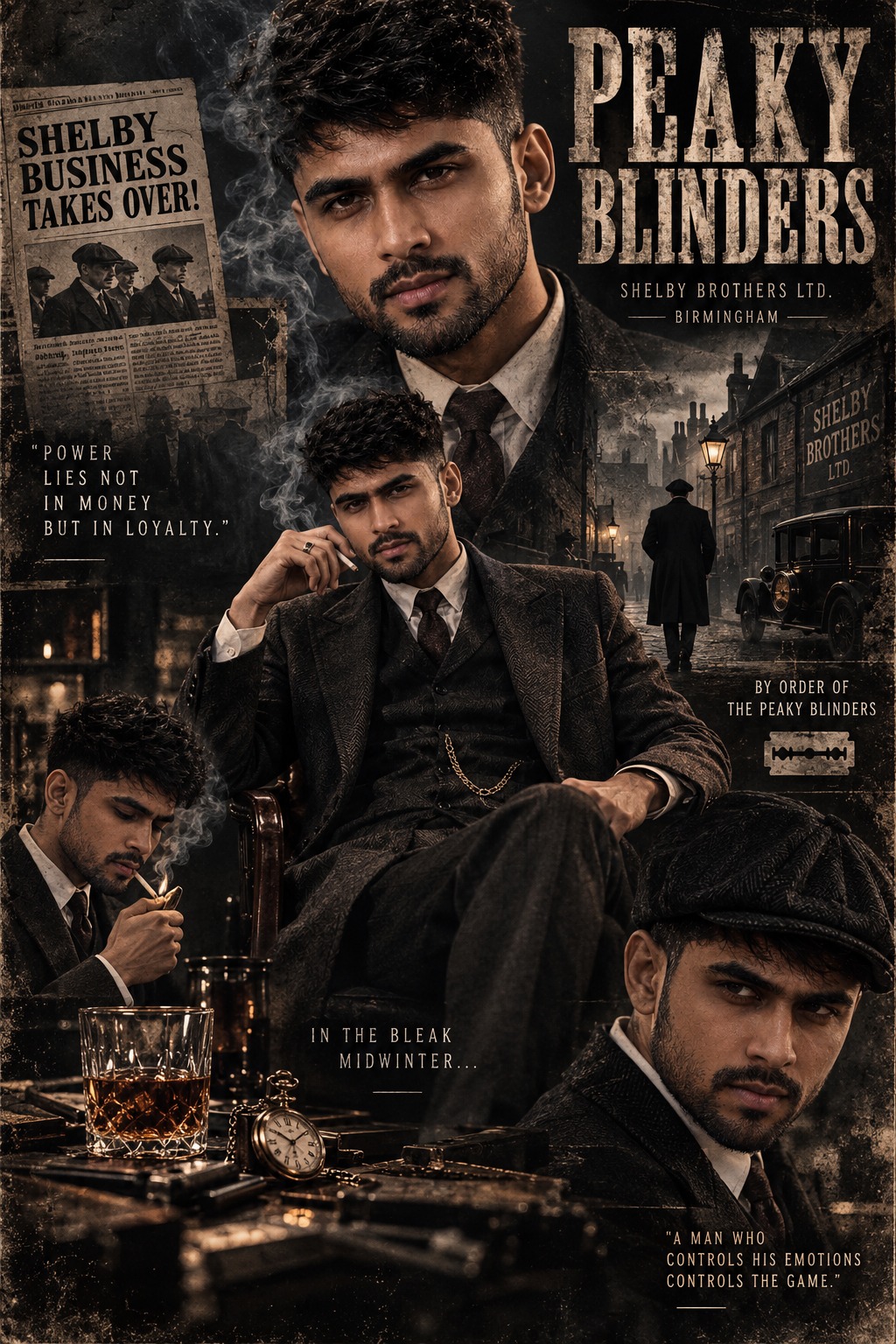
Dark Crime Collage
The central concept is a Dark Crime Collage built as a vertical cinematic period-drama poster. The composition is intentionally dense and layered, combining several appearances of one male character with newspaper fragments, distressed typography, environmental photography, smoke, period objects, and a dark Birmingham street setting. The overall visual language is deliberately restrained, gritty, desaturated, and atmospheric.
The main subject is a male character represented through several photographic appearances within the same poster. The identity is intended to remain consistent across the different panels while each appearance retains its own original pose, facial direction, crop, body visibility, and scale. The concept is therefore less like a collection of separate portraits and more like one character appearing across several connected moments.
The dominant seated figure occupies the central section. This is the main character panel and carries the strongest visual weight. The seated posture is preserved exactly, including the relationship between the hands, torso, chair, shoulders, head position, and surrounding negative space. The character is not presented as a conventional studio portrait; he remains embedded within the darker editorial collage.
The upper portrait extends prominently through the upper-center region. Its large scale creates a strong visual introduction to the character. The head direction, gaze, facial angle, hairstyle silhouette, clothing, and surrounding atmosphere remain connected to the original period composition.
A smoking figure appears toward the lower-left area. Smoke partially surrounds the character and contributes to the dark atmospheric quality. The smoking gesture becomes an important visual detail because it reinforces the historical crime-drama setting while also helping create a transition between the portrait and surrounding graphic elements.
The lower-right portrait provides another major facial appearance. It is large but partially cropped, maintaining the deliberate framing of the reference. This panel adds another perspective on the same character without changing the overall hierarchy of the composition.
A small distant walking figure appears within the lower section of the poster. Its intentionally reduced scale is important because it creates environmental depth. The character is seen moving through a dark Birmingham street, allowing the architecture, wet street atmosphere, smoke, and surrounding darkness to become part of the visual story.
The concept strongly depends on exact crop and visibility. Each character appearance has a defined amount of visible body, face, clothing, and surrounding environment. The composition is not intended to normalize these proportions. The variation in scale creates the cinematic rhythm of the poster.
Lighting is one of the most important characteristics of the Dark Crime Collage style. The exposure remains extremely low-key, with deep blacks and narrow areas of illumination. Faces receive only controlled light, while large parts of the environment remain submerged in darkness.
The lighting is not designed to make the subject brighter than the reference atmosphere. Instead, the character remains integrated into the surrounding shadows. Smoky areas catch subtle illumination, creating soft transitions between black areas and muted highlights.
The palette is close to monochrome. Black, charcoal, dirty gray, muted brown, and restrained warm tones create the complete visual foundation. The colors remain desaturated, giving the artwork a weathered historical character.
The lack of bright color is important because it shifts attention toward texture, contrast, composition, and atmosphere. The few restrained warm highlights can appear on faces, paper, environmental surfaces, or period objects without changing the overall dark character.
The Birmingham environment contributes strong historical atmosphere. Dark streets, old buildings, signage, smoke, wet surfaces, and industrial architecture create a sense of place. The setting is not merely decorative; it helps establish the period-drama identity of the composition.
Wet cobblestones provide subtle reflective texture within the dark street. They can catch narrow highlights while remaining mostly subdued. This helps create depth beneath the small walking figure and gives the lower portion of the poster environmental scale.
Newspaper clipping elements are another major component. They introduce an archival quality and connect the visual story to period journalism. Newspaper fragments, quotation blocks, typography panels, and aged paper surfaces become part of the surrounding collage.
The visible typography is intentionally treated as part of the locked visual design. Phrases such as “PEAKY BLINDERS,” “SHELBY BROTHERS LTD. BIRMINGHAM,” “SHELBY BUSINESS TAKES OVER!,” “BY ORDER OF THE PEAKY BLINDERS,” and “IN THE BLEAK MIDWINTER…” establish the period newspaper and crime-poster language within the reference composition.
These words function as visual and editorial elements of the source composition. Their typography, placement, scale, distressing, hierarchy, and muted brightness are treated as part of the overall poster design rather than as independent modern captions.
The whiskey glass adds another historical object. Its presence contributes to the period atmosphere while remaining secondary to the character. The pocket watch provides another small vintage detail, reinforcing the sense of period craftsmanship and time.
The razor motif contributes to the darker editorial identity of the poster. Along with newspaper fragments and old signage, it becomes a graphic symbol within the surrounding visual language.
The texture is intentionally weathered. Aged paper, distressed printing, film grain, smoky overlays, subtle vignette, scratches, and faded surfaces prevent the artwork from looking digitally pristine. These imperfections create the impression of a physical vintage poster or archival printed composition.
The Dark Crime Collage aesthetic therefore depends on controlled imperfection. The image should feel aged and atmospheric rather than polished and modern. Grain and paper texture become part of the visual identity.
The typography follows the same philosophy. Weathered lettering, period newspaper type, quotation blocks, and distressed print treatments belong naturally within the collage. The text does not feel like a clean digital overlay placed after the artwork.
The mood is dark, gritty, bleak, vintage, and atmospheric. There is a strong sense of midwinter melancholy created through smoke, shadow, cold-looking architecture, muted tones, and limited illumination.
The composition also uses negative space carefully. Deep black areas allow faces, typography, smoke, and selected props to emerge without requiring bright backgrounds. This gives the poster a restrained visual intensity.
The Dark Crime Collage concept is especially effective because the character and environment are treated as one visual system. The portraits establish identity, the street establishes place, the newspaper establishes period context, and the props establish character atmosphere.
The central figure remains the main human focus. Surrounding objects should support the character rather than overwhelm him. The poster works because each graphic element contributes to the same historical and cinematic world.
Identity continuity is another major strength. The same male identity appears across the upper portrait, seated center, smoking section, lower-right portrait, and distant walking figure. Although the appearance changes according to crop and perspective, the character remains recognizable.
The concept also preserves the original relationship between character and environment. The distant figure stays small, while the central portrait remains dominant. The upper portrait retains its large presence, and the supporting panels maintain their intended visual scale.
The design is therefore suitable for cinematic character posters, vintage-inspired personal artwork, historical editorial compositions, dark social-media graphics, themed profile artwork, event posters, and creative period-drama designs.
The visual concept can also be personalized when a user supplies identity information or explicitly requests additional edits. However, the underlying poster language remains based on the existing composition, including its darkness, typography, props, environment, and texture.
The overall benefit of this approach is that the character feels integrated into a complete visual world rather than placed over a generic background. The identity becomes part of the existing cinematic collage.
For designers, the composition provides a strong hierarchy. The central seated character provides the main anchor, the upper portrait provides scale, the lower-right portrait supplies another close character view, the smoking figure creates atmosphere, and the distant walker expands the environment.
The newspaper and typography panels fill surrounding negative space while contributing historical context. The whiskey glass, pocket watch, razor motif, smoke, and street details reinforce the period atmosphere.
The final visual impression is intentionally dark and restrained. It does not depend on vibrant color, excessive sharpness, bright lighting, or glossy digital effects. Its character comes from shadow, texture, period design, and controlled photographic detail.
The Dark Crime Collage style ultimately combines portrait photography, historical atmosphere, distressed editorial design, newspaper graphics, smoky environmental imagery, and vintage poster construction. The result is a dense but organized visual narrative.
Its strongest quality is consistency. The darkness, muted palette, smoky atmosphere, aged paper, typography, period objects, and character panels all belong to the same visual language.
[[[
REFERENCE ANALYSIS
- Format: Vertical cinematic collage/poster, approximately 2:3 portrait framing.
- Composition: Dense multi-panel character collage with a dominant seated central figure, a large upper portrait, smaller supporting portraits, newspaper clipping, typography blocks, street silhouette, whiskey glass, and pocket watch.
- Subject scale: Central seated character occupies the middle section and is relatively large; upper portrait extends prominently through the upper-center; lower-right portrait is large but partially cropped; distant walking figure is intentionally small.
- Crop & visibility: Preserve every crop exactly. No subject enlargement, repositioning, recentering, or additional visible body area.
- Pose: Preserve all original poses, head angles, gaze directions, seated posture, hand placement, smoking gestures, clothing silhouettes, and occlusions exactly.
- Lighting: Extremely low-key, dramatic side lighting with deep blacks, narrow highlights, subdued facial illumination, smoky atmospheric light, and strong shadow retention.
- Color: Desaturated near-monochrome palette dominated by black, charcoal, dirty gray, muted brown, and extremely restrained warm highlights.
- Mood: Dark, gritty, bleak, vintage crime-drama atmosphere. Heavy smoke, aged paper, shadow, and midwinter melancholy.
- Texture/style: Distressed cinematic poster treatment, photographic character rendering, grain, smoky overlays, aged-paper textures, subtle vignette, weathered typography, and vintage period-drama styling.
- Background/props: Preserve the Birmingham street environment, newspaper clipping, signage, smoke, whiskey glass, pocket watch, buildings, typography panels, razor motif, and all other visible elements exactly.
- Text: Preserve all meaningful reference typography, placement, scale, hierarchy, distressed treatment, and color. Existing visible text includes “PEAKY BLINDERS,” “SHELBY BROTHERS LTD. BIRMINGHAM,” “SHELBY BUSINESS TAKES OVER!,” “BY ORDER OF THE PEAKY BLINDERS,” “IN THE BLEAK MIDWINTER…,” and the quotation blocks.
- Overall rule: This is a locked reference composition. The reference itself is the final visual blueprint; only the character’s facial identity may change.
MASTER PROMPT
Use the supplied reference image as the master visual blueprint. Replace only the reference character with the supplied user identity. Maintain exact subject scale, screen-space proportion, cropping, and visibility. Preserve 1000% of all visual information including exact darkness levels, color grading, mood, atmosphere, lighting, shadows, contrast, saturation, composition, environment, objects, background, text, props, and artistic rendering. The output must look IDENTICAL to the reference image except for the character’s face being replaced with the user’s face. Do NOT brighten, enhance, or modify any aspect of the reference.
Recreate the supplied reference as an exactly preserved dark vintage crime-drama collage poster. Use [USER IDENTITY] only for the facial identity of the character/characters represented by the reference. Preserve the reference’s exact facial/head orientation, gaze direction, expression, hairstyle silhouette where it belongs to the reference, neck position, shoulders, torso, hands, fingers, clothing, posture, body proportions, occlusion, and screen-space placement. The user’s identity must be adapted into the reference’s existing visual language rather than changing the reference style.
Preserve the complete multi-panel collage arrangement exactly: the dominant upper portrait, the central seated figure, the smoking figure at lower-left, the large lower-right portrait, the distant full-body figure walking through the dark Birmingham street, and every surrounding graphic/text panel. Preserve every relative size, spacing, overlap, crop, and negative-space relationship.
Maintain the extremely dark low-key exposure of the reference. Keep deep crushed blacks, restrained highlights, smoky shadows, muted contrast transitions, desaturated charcoal tones, dirty gray and subtle brown undertones. Do not lift shadows or make the face brighter than the surrounding reference lighting. Match the original light direction, intensity, softness, rim light, reflected light, atmospheric smoke, and shadow structure exactly.
Preserve the exact vintage poster rendering: distressed photographic texture, subtle film grain, aged-paper surfaces, smoky overlays, weathered typography, period crime-drama visual treatment, dark vignette, gritty environmental texture, and subdued tonal range. Do not modernize, beautify, sharpen into a clean digital aesthetic, or make the image more cinematic than it already is.
Preserve all text exactly as shown in the reference, including its typography, wording, placement, scale, alignment, distressing, brightness, and hierarchy. Preserve the newspaper, signage, quotation panels, razor graphic, whiskey glass, pocket watch, buildings, smoke, shadows, and every other prop without alteration.
The final result must function like a Photoshop composite where the reference image is the base layer and only the character facial identity layer has been replaced. No new elements. No removed elements. No redesigned composition. No exposure correction. No color enhancement. No additional realism. No changed atmosphere. No changed scale. No changed crop. Reference = final image; only identity changes.
EDITABLE VARIABLES
- [USER IDENTITY]: Supplied user’s facial identity and unique facial characteristics, including natural asymmetry; adapted strictly to the reference’s existing rendering style.
- [OUTFIT]: Reference outfit — preserve exactly.
- [TEXT]: Reference text — preserve exactly; no new text unless explicitly requested.
- [OBJECT CHANGE]: None.
- [POSE CHANGE]: None — preserve reference pose exactly.
- [ADDITIONAL EDIT]: None unless explicitly specified by the user.
NEGATIVE PROMPT
“identity loss, different face, original character, added person, wrong pose, wrong angle, changed crop, changed composition, redesigned background, missing objects, added objects, altered environment, wrong lighting, brighter image, lifted shadows, lost darkness, changed color grading, oversaturation, orange grading, lost mood, lost atmosphere, unwanted realism, mixed styles, bad anatomy, extra limbs, altered text, normalized size, full body if not in reference, centered subject, zoomed, enlarged, recentered,
expanded framing, altered scale, reconstructed hidden areas, brightness increase, saturation increase, color change, mood change, background change, prop removal, prop addition, text removal, layout change, composition redesign, new elements, generic aesthetic, beautification, modernization, simplification, different style, different rendering, different palette, different lighting, different atmosphere, different energy, different emotional tone, enhanced colors, enhanced brightness, auto-corrected exposure, cinematic grading, vibrant colors, clean look, polished look” ]]]