
Romantic Vintage Collage
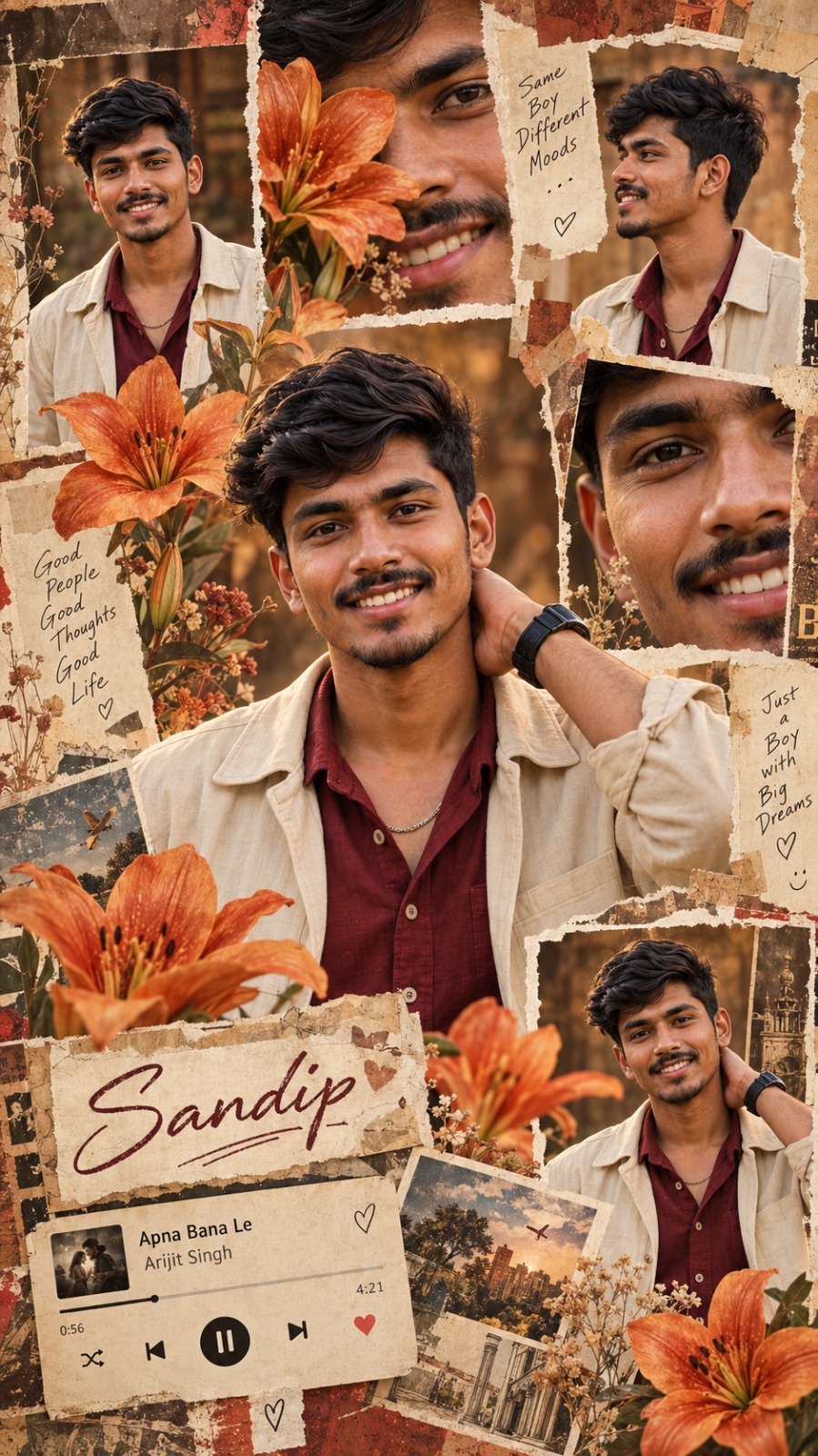
The central creative idea is a Romantic Vintage Collage built around one recognizable male identity appearing across multiple photographic panels. Instead of presenting one conventional portrait, the concept creates a layered visual story in which the same man appears from several viewpoints, distances, and crops. The result combines romantic editorial photography, vintage scrapbook design, personal memorabilia, floral decoration, handwritten notes, and warm paper textures into one unified vertical composition.
The main subject is a single male character, and identity continuity is one of the most important parts of the concept. The different panels are not intended to represent different people. They show the same individual through several photographic moments. His recognizable facial structure, eyes, eyebrows, nose, lips, jawline, skin characteristics, hairstyle, and natural facial asymmetry remain visually consistent across the collage.
The dominant central portrait provides the strongest connection with the viewer. It is a large chest-up composition in which the man looks directly toward the camera with a relaxed and subtle expression. One hand is positioned behind or near the neck, creating a casual pose with a slightly intimate editorial feeling. The central crop and scale establish the main visual hierarchy of the poster.
Around this main portrait, smaller panels provide additional views of the same person. The upper-left section contains a three-quarter portrait with a soft expression. This gives the viewer another perspective while maintaining the same identity and clothing language. Because it is smaller than the central image, it works as a supporting memory-like photograph.
The upper-center panel introduces an extreme facial close-up. The crop focuses strongly on facial features rather than the full body, creating intimacy and visual variation. A warm orange lily is positioned beside or across the face, combining the human portrait with the floral theme. The flower becomes both a decorative element and a framing device.
The upper-right section uses a side-profile portrait. The subject looks toward the side rather than directly at the viewer, creating a contrast with the dominant central image. This change in camera direction gives the collage a more editorial photographic character and prevents every panel from feeling visually repetitive.
Another extreme facial crop appears on the right side of the composition. The close framing around the eye, cheek, and lower facial area adds texture and visual rhythm. Because this panel is intentionally cropped tightly, it functions more like a photographic detail inside a scrapbook than a conventional portrait.
The lower-right section repeats the relaxed hand-behind-neck pose in a smaller portrait. This repetition creates visual continuity with the central image while also giving the composition a layered memory-board quality. The repeated gesture helps reinforce that every panel belongs to the same person.
Clothing is another important identity element. The subject wears a deep burgundy or maroon shirt beneath a light beige or cream jacket. The combination creates a warm contrast that fits naturally into the vintage palette. A subtle necklace or chain adds a small personal detail, while the dark wristwatch provides another recognizable accessory.
The burgundy shirt is particularly useful because it becomes one of the strongest color accents in the otherwise muted composition. It works alongside the orange flowers and brown paper tones without becoming overly bright. The cream jacket provides visual softness and helps separate the subject from darker photographic areas.
Large warm orange lilies are distributed throughout the collage. These flowers are not simply background decoration. They overlap selected photographic panels, frame portraits, and create a visual connection between different sections of the design. Their organic shapes contrast with the rectangular photographic panels and torn paper edges.
The floral elements also strengthen the romantic character of the Romantic Vintage Collage. Their warm orange color complements the burgundy clothing, sepia paper, muted cream surfaces, and brown photographic tones. The flowers introduce natural softness into a composition that otherwise contains many hard paper and image edges.
The scrapbook structure is built from multiple photographic panels, torn-paper pieces, layered fragments, handwritten notes, and small labels. These components create the impression of physical memories assembled onto a page. The uneven edges and overlapping layers are important because they prevent the design from feeling like a perfectly organized modern grid.
Paper texture contributes strongly to the overall atmosphere. Subtle grain, distressed edges, aged surfaces, faded tones, and imperfect printed areas create a nostalgic visual character. The collage should feel tactile, as if different photographs and notes have been collected and physically attached to an old memory board.
The color palette is warm and restrained. Burgundy, orange, cream, beige, muted brown, charcoal, and sepia-like tones work together throughout the design. The palette avoids cool blue grading and bright modern colors, allowing the composition to retain its romantic vintage identity.
Lighting is soft and warm. Golden indoor illumination creates gentle highlights on the face, clothing, flowers, and paper surfaces. Shadows remain controlled rather than harsh. This gives the photographs an intimate atmosphere while helping the different panels feel like parts of the same visual world.
The Romantic Vintage Collage style also uses cinematic depth without becoming a modern glossy poster. Background details can remain softly blurred, while selected facial areas and flowers receive stronger visual attention. This variation in focus helps create photographic depth and gives the collage a more sophisticated editorial quality.
Handwritten notes are an important graphic element. They make the design feel personal and emotional. Rather than appearing like standard digital typography, the notes can resemble handwriting on torn paper, giving the impression of personal memories, thoughts, or small messages collected over time.
The small music-player graphic adds another layer of storytelling. It connects the collage with the emotional association of music and memory. When a user supplies song information, the song title and artist can become part of this compact visual element while preserving its scrapbook appearance.
Personalization is therefore integrated into the design itself. A supplied name can appear as a handwritten scrapbook label or elegant editorial caption. A date can resemble a small vintage printed note. An occasion or title can become a heading. A quote or personal message can be placed on a torn paper fragment.
Song information can be connected to the music-player section, while a location can appear as a small documentary-style caption. Multiple details can be distributed across different paper pieces so the composition feels naturally assembled rather than filled with one large text block.
Exact user-provided wording is an important design feature. Names, dates, song titles, artist names, quotes, messages, and other supplied information belong to the personal story. They can be represented through the same cream, beige, muted brown, charcoal, and burgundy typography that already exists within the collage.
The composition is vertical and editorial. The large central portrait establishes the main focus, while the smaller panels create a surrounding rhythm. Flowers, paper fragments, notes, and the music-player element fill the negative spaces without overpowering the primary identity.
The Romantic Vintage Collage concept works particularly well for romantic memories, personal portraits, birthdays, anniversaries, relationship-themed designs, music-inspired posters, social-media artwork, and personalized keepsakes. Its combination of portrait photography and scrapbook elements makes it suitable for users who want something more emotional than a simple single-image portrait.
The design can also be adapted for personal branding when a softer editorial identity is preferred. The central portrait communicates the person clearly, while the surrounding photographs and handwritten details create additional personality and context.
The overall mood is warm, nostalgic, romantic, relaxed, and intimate. It does not depend on dramatic expressions or exaggerated poses. Instead, the emotion comes from soft facial expressions, close-up photography, flowers, personal notes, aged paper, and the feeling of collected memories.
The visual concept is especially effective because every component supports the same story. The repeated identity represents personal continuity, the flowers suggest warmth and romance, the torn paper represents memory, the handwritten notes suggest personal thoughts, and the music-player element connects the composition with emotional sound and nostalgia.
The final design language therefore feels like a carefully assembled visual diary. The central man remains the main character, but the surrounding materials create a world around him. This makes the artwork more expressive than a conventional portrait while still keeping the subject immediately recognizable.
For a designer or content creator, the Romantic Vintage Collage offers a flexible framework for combining multiple photographs into one cohesive poster. The reference-based panel arrangement gives the composition structure, while the paper layers and floral details create a handcrafted appearance.
For the user, the biggest benefit is personalization. The design can incorporate a name, date, occasion, quote, song, artist, location, and other supplied details without breaking the overall aesthetic. Each piece of information can become part of the scrapbook rather than appearing as a separate digital addition.
The warm vintage palette also makes the concept visually timeless. Burgundy and orange create emotional warmth, while cream and brown paper tones keep the composition soft. The photographic panels provide realism, and the distressed textures add personality.
In summary, the Romantic Vintage Collage concept is a multi-panel male portrait designed around identity continuity, warm romantic photography, orange lilies, vintage scrapbook textures, torn paper, handwritten details, and music-inspired personalization. The central portrait creates immediate visual focus, while the surrounding panels tell a richer story through different expressions, angles, crops, and decorative elements.
[[[
REFERENCE ANALYSIS
- Composition: Vertical romantic editorial collage with one male identity repeated across multiple photographic panels. The central portrait is the dominant element, surrounded by close-ups and smaller lifestyle portraits.
- Central portrait: Large chest-up portrait, looking directly toward camera with a soft, relaxed expression. One hand is placed behind/near the neck. Preserve the exact crop and scale.
- Top-left panel: Smaller three-quarter portrait of the same man, facing camera with a subtle smile.
- Top-center panel: Extreme facial close-up, with a flower positioned beside/overlapping the face.
- Top-right panel: Side-profile portrait looking toward the left.
- Middle-right panel: Extreme crop of the lower face/eye/cheek area.
- Bottom-right panel: Smaller portrait repeating the relaxed hand-behind-neck pose.
- Clothing: Burgundy/maroon shirt underneath a light beige/cream jacket, with a subtle chain and dark wristwatch.
- Floral elements: Large warm orange lilies placed throughout the collage, overlapping several panels.
- Graphic elements: Torn-paper edges, handwritten notes, small paper labels and a music-player interface near the lower-left.
- Color: Warm sepia/brown/orange palette with muted cream and burgundy.
- Lighting: Soft warm indoor golden lighting, subtle highlights and cinematic shadows.
- Style: Romantic scrapbook/editorial photography with vintage paper texture and layered photographic panels.
- Personalization: User can provide name, date, quote, song, message, occasion or other details. These should be incorporated into the same scrapbook/editorial aesthetic.
MASTER PROMPT
Use the supplied reference image as the master visual blueprint. Replace only the reference character with the supplied user identity. Maintain the exact subject scale, screen-space proportion, cropping, and visibility of every reference portrait; do not normalize, enlarge, or reframe. Preserve all other visual information, composition, environment, lighting, color, depth, atmosphere, objects, background and artistic rendering as faithfully as possible.
Reconstruct the reference as a vertical romantic vintage scrapbook/photo-collage poster containing multiple photographic appearances of the same [USER IDENTITY].
Preserve the exact number, placement, relative size, overlap and cropping of the reference panels. The same user identity must remain consistent across every appearance, while each individual panel retains its own reference pose and camera angle.
PORTRAIT ARRANGEMENT
Central portrait:
Preserve the dominant chest-up portrait. The subject looks toward the camera with a relaxed, subtle expression, one hand positioned behind/near the neck. Preserve the exact head angle, hand placement, shoulder position, crop and body visibility.
Top-left portrait:
Preserve the smaller three-quarter portrait facing toward camera with a soft expression. Maintain its original crop and relative size.
Top-center close-up:
Preserve the extreme facial crop. Keep the flower overlapping/positioned beside the face. Do not expand this into a normal portrait.
Top-right portrait:
Preserve the side-profile composition, with the subject looking sideways. Maintain the exact profile angle and visible body area.
Middle-right close-up:
Preserve the extreme crop of the face/eye/cheek/lower-face region. Do not reveal additional body or turn it into a standard portrait.
Bottom-right portrait:
Preserve the smaller repeated portrait with the relaxed hand-behind-neck pose and same clothing.
All appearances must clearly be the same [USER IDENTITY], with consistent facial structure, hairstyle and distinctive features.
CLOTHING & IDENTITY
Preserve the reference clothing: deep burgundy/maroon shirt beneath a light beige/cream jacket, subtle necklace/chain and dark wristwatch.
Preserve the user’s actual facial identity—face shape, eyes, eyebrows, nose, lips, jawline, skin characteristics and natural asymmetry—while matching the reference’s warm photographic rendering.
Do not paste a realistic face onto a different body. Reconstruct the complete identity naturally in each panel.
COLLAGE / GRAPHIC DESIGN
Preserve the warm orange lilies throughout the composition. Keep their approximate placement, scale, overlap and soft focus variations.
Preserve the torn-paper edges, layered photographic frames, handwritten notes and scrapbook fragments.
Preserve the lower-left music-player style graphic as part of the visual design. If the user supplies different song information, dynamically replace the relevant song metadata while keeping the same compact music-player aesthetic.
Maintain the warm vintage paper appearance with subtle grain and distressed edges.
LIVE USER TEXT / DETAILS
The user may provide any combination of:
- [USER NAME]
- [DATE]
- [OCCASION]
- [TITLE]
- [CUSTOM MESSAGE]
- [QUOTE]
- [SONG NAME]
- [ARTIST NAME]
- [LOCATION]
- [ADDITIONAL DETAILS]
At generation time, replace these variables with the exact values supplied by the user.
The supplied information must be integrated into the collage using the same visual language as the reference.
- Name: handwritten scrapbook label or elegant editorial text.
- Date: small handwritten/vintage printed date.
- Quote/message: handwritten note on torn paper or subtle printed collage fragment.
- Song name + artist: integrate into the existing music-player element using the same layout.
- Occasion/title: vintage editorial heading or handwritten label.
- Multiple details: distribute them naturally across paper scraps without cluttering the composition.
Use cream, beige, muted brown, charcoal and burgundy typography so it belongs naturally to the warm vintage palette.
Exact-text rule: reproduce every user-provided name, date, quote, song title, artist name and message exactly as supplied. Do not paraphrase, shorten, translate or invent information.
If the user provides no text/details, do not invent any.
Do not add creator names, usernames, watermarks or signatures unless explicitly requested.
The personalized text should appear as though it was physically printed, handwritten or pasted into the original scrapbook, not digitally placed over the finished image.
EDITABLE VARIABLES
- [USER IDENTITY]: Supplied user’s identity.
- [USER NAME]: User-provided name.
- [DATE]: User-provided date.
- [OCCASION]: User-provided occasion.
- [TITLE]: User-provided title.
- [CUSTOM MESSAGE]: User-provided message.
- [QUOTE]: User-provided quote.
- [SONG NAME]: User-provided song.
- [ARTIST NAME]: User-provided artist.
- [LOCATION]: User-provided location.
- [ADDITIONAL DETAILS]: Any other user-provided information.
- [OUTFIT]: Reference burgundy shirt + cream jacket unless explicitly changed.
- [TEXT STYLE]: Warm vintage scrapbook handwriting/editorial typography.
- [POSE CHANGE]: None unless explicitly requested.
- [OBJECT CHANGE]: None unless explicitly requested.
NEGATIVE PROMPT
identity loss, different person across panels, inconsistent face, generic face, original character remaining, added person, extra person, wrong number of portraits, missing portrait, duplicated panel, identical poses in every panel, wrong panel arrangement, changed panel size, changed crop, changed camera angle, normalized subject size, enlarged central subject, recentered composition, changed screen-space proportion, expanded close-up, revealed hidden body areas, wrong profile angle, wrong hand position, altered clothing,
missing burgundy shirt, missing cream jacket, missing watch, missing necklace, missing lilies, missing scrapbook layers, missing torn paper, missing music player, plain background, clean modern collage, cool blue grading, neon colors, excessive saturation, harsh flash, studio background, anime, cartoon, 3D render, glossy digital art, plastic skin, modern UI typography, modern text box, invented text, altered user text, misspelled name, wrong date, wrong song information, placeholder text, visible variable names, creator watermark, username, signature, unnecessary modifications. ]]]