
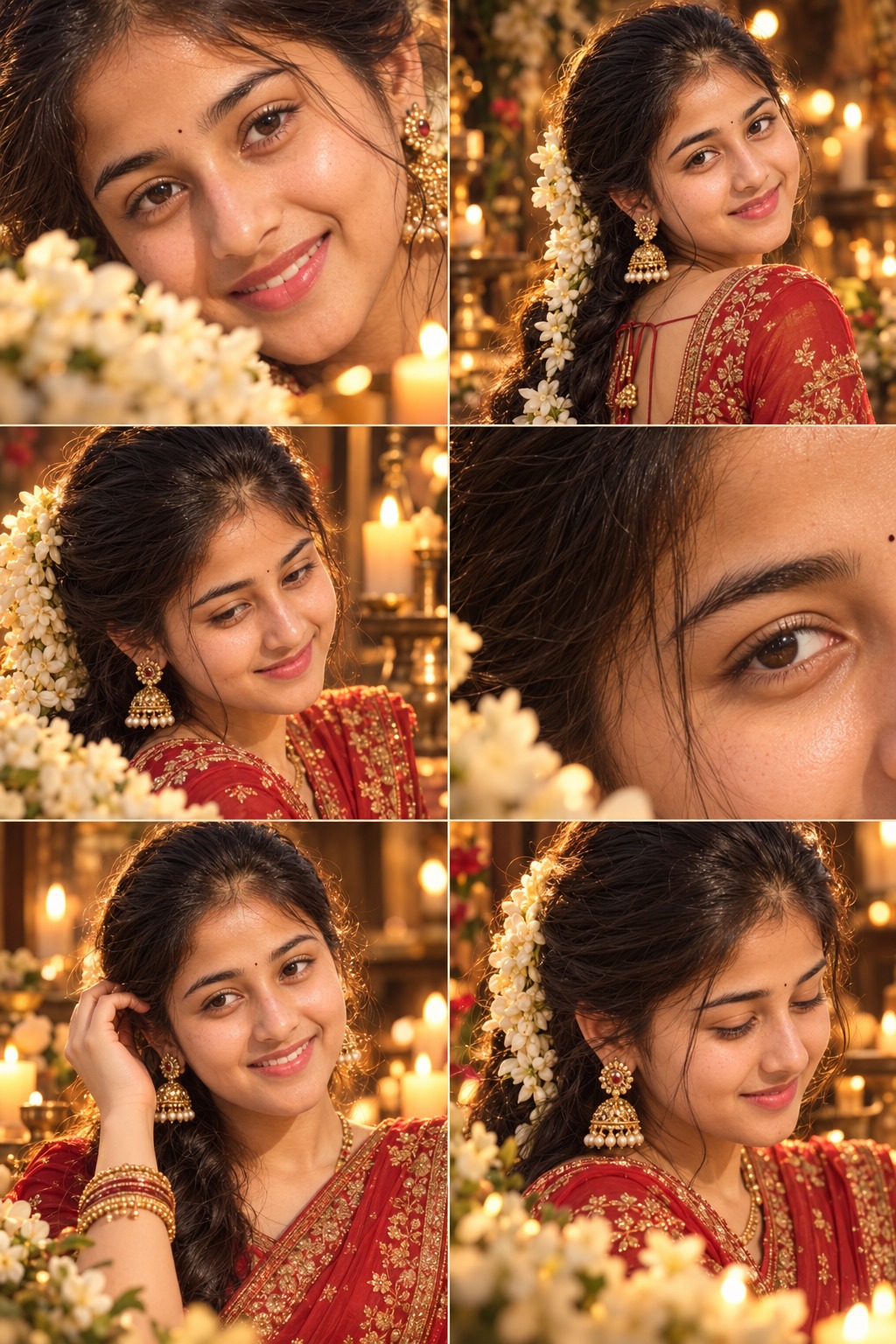
Cinematic Six Panel Collage
This concept is built around a carefully structured six-panel visual story featuring one female identity throughout the entire composition. The design is not a collection of unrelated photographs. It is a unified cinematic collage in which the same woman appears six times, with every panel showing a different crop, pose, expression, and level of facial visibility. The central creative challenge is maintaining identity consistency while preserving the individual photographic character of each frame.
The composition uses a vertical 2:3 format divided into six rectangular photographic panels. Each panel has a clean hard division and its own crop. The arrangement creates a modern editorial contact-sheet feeling while still retaining the warmth and intimacy of traditional Indian festive photography. The varied framing is important because some panels reveal a larger part of the face and upper body, while others become extremely tight facial details.
The first panel in the upper-left is an extreme close-up. The woman’s face occupies most of the available space, with the head subtly tilted and turned toward the camera. Only a limited portion of her face and hair is visible, making this panel feel intimate and observational. Small white flowers appear close to the lower-left foreground, providing a delicate contrast against the warm skin, dark hair and amber atmosphere.
The upper-right panel changes the visual rhythm by showing a three-quarter or over-the-shoulder view. The woman looks back toward the camera with a subtle, relaxed expression. Her long hair, large gold jhumka and red or orange sari become more visible here. This frame introduces more body context than the extreme close-up while preserving the same person and the same warm environment.
The middle-left panel presents another variation through a side or three-quarter profile. The woman’s eyes are lowered and her expression remains gentle. Loose hair strands frame the face, while the traditional earring, sari, flowers and candlelight contribute to the atmosphere. This panel feels quieter and more contemplative because the lowered gaze changes the emotional rhythm without changing the identity.
The middle-right panel is intentionally unusual because it returns to an extreme facial close-up. Primarily one eye, eyebrow, nose bridge, surrounding skin and loose hair are visible. The tight crop must remain tight. It should not be expanded into a conventional headshot because its purpose is to create visual variety within the six-frame arrangement.
The lower-left panel shows a more frontal or three-quarter view with a gentle smile. One hand touches the hair near the side of the head, allowing bangles, jewelry, earrings and sari details to become visible. This frame provides a more complete expression and adds natural hand-to-face interaction to the collage.
The lower-right panel presents a downward-looking three-quarter or profile view. The woman’s eyes are lowered, loose strands fall naturally across the face, and the large gold jhumka becomes a strong visual detail. The red or orange sari remains visible, while flowers and warm candlelight continue the visual connection with the other panels.
Across all six panels, the most important feature is the consistent identity of the same woman. Facial proportions, eyes, eyebrows, nose, lips, jawline, cheeks, natural asymmetry and distinctive characteristics remain recognizable. The concept specifically avoids treating each panel as a separate person. Instead, the six frames should feel like six moments from one continuous photographic session.
The hair styling supports this continuity. Long dark hair is loosely gathered or back-styled while deliberate loose strands frame the face. The hair should retain a natural texture rather than appearing overly controlled. This creates a soft romantic appearance and helps the woman’s identity remain recognizable even in the tighter crops.
Traditional Indian styling provides the cultural character of the composition. A small bindi gives the face a subtle central detail, while elaborate gold jhumka earrings provide strong decorative accents. Traditional jewelry and bangles appear where appropriate according to each crop. These accessories are not identical in visibility across the panels because the framing changes, which makes the collage feel photographic and natural.
The sari is another major visual anchor. A deep red or orange traditional sari with intricate gold embroidery creates a strong relationship with the amber candlelight. Ornamental borders, fabric folds, embroidered patterns and warm metallic highlights provide texture. The red-orange fabric also creates continuity between all six frames, allowing the viewer to immediately recognize that the same styling session is being represented.
Lighting is deliberately consistent across the entire collage. Warm candlelight creates honey-gold highlights on the woman’s skin, hair and jewelry. Deeper brown shadows remain in the background, giving the frames a rich intimate atmosphere. The lighting should feel soft and naturally diffused rather than like direct studio flash.
The background is an intimate festive interior. Candles, flowers and warm blurred objects provide context without competing with the face. Circular amber bokeh adds depth, while the shallow focus keeps distant details soft. The environment is therefore recognizable as a warm festive setting without becoming a detailed room photograph.
The color palette is intentionally narrow and harmonious. Amber, honey-gold, deep red, brown and warm natural skin tones dominate the visual language. These colors work together to create a luxurious but restrained atmosphere. The absence of cool blue lighting keeps the composition emotionally warm and supports the traditional styling.
The cinematic quality comes from several elements working together rather than from heavy effects. Shallow depth of field separates the subject from the background, soft filmic rendering keeps the skin natural, candle bokeh adds atmosphere, and warm contrast gives the frames a polished editorial appearance. The result is closer to premium cinematic photography than to an artificial poster effect.
The six-panel arrangement also creates an interesting visual rhythm. Extreme close-ups alternate with broader portraits, creating changes in scale as the viewer moves across the grid. One panel emphasizes an eye, another emphasizes a shoulder and earring, another emphasizes a lowered gaze, and another reveals a hand touching the hair. This variation makes the collage feel dynamic while remaining visually unified.
From a design perspective, the concept can be useful for fashion editorials, festive portrait collections, cultural lifestyle campaigns, personal branding, social media collages and cinematic photography presentations. It allows one identity to be explored through multiple expressions and crops without losing visual consistency.
The strongest creative benefit is the combination of identity continuity and framing variety. A single portrait can communicate one moment, but six carefully related frames can communicate a broader mood. This concept uses that principle to create a visual sequence that feels intimate, elegant and editorial.
The close-up panels are particularly effective for emphasizing facial details and jewelry. The broader panels provide context through sari texture, hand gestures, hair and background lighting. Together, these different levels of visibility give the collage a richer storytelling quality.
The flowers and candles are also important supporting motifs. Small flowers near some faces soften the composition, while candlelight supplies the repeated warm glow. Because the flowers and background remain softly blurred, they act as atmospheric framing rather than competing subjects.
The concept is intentionally free of typography. This allows the six photographic panels to function as the entire visual statement. Without large text, the viewer’s attention remains on identity, expression, traditional styling, lighting and the relationship between the six crops.
A major design consideration is preserving each panel’s original screen-space proportion. The extreme close-up should remain extreme, while the broader portraits should not become unnecessarily tight. Changing these relationships would reduce the contrast between panels and weaken the collage’s editorial structure.
The same principle applies to body visibility. Hidden areas should remain hidden when a panel is tightly cropped. Revealing additional shoulders, torso or face would change the intended photographic framing. The design depends on the fact that each frame reveals only what the reference composition calls for.
The emotional mood is warm, intimate, romantic and festive. The gentle smiles and lowered gazes avoid an overly dramatic presentation. Instead, the combination of candlelight, flowers, traditional clothing and soft expressions creates a quiet celebratory atmosphere.
This concept can also be useful for demonstrating how traditional Indian styling can be presented through a modern editorial layout. The sari, bindi, jhumkas and bangles provide cultural visual cues, while the six-panel structure creates a contemporary fashion-magazine feeling.
For personal creative use, the composition can showcase one identity from multiple visual perspectives. For fashion presentation, it can highlight embroidery and jewelry in separate frames. For festive content, the candlelit environment provides warmth and celebration. For social media, the vertical 2:3 format provides a strong portrait-oriented presentation.
Overall, the prompt describes a disciplined six-frame photographic collage rather than six independent portraits. The identity, wardrobe, lighting, environment and color palette connect every frame, while crop and pose differences provide visual variety. This balance between consistency and variation is the core creative idea behind the concept.
The finished visual language is elegant, cinematic, traditional and intimate. The warm amber environment supports the deep red sari, gold jewelry and natural skin tones. The varied crops create editorial energy, while the consistent identity gives the entire collage a coherent human story.
Candlelight, flowers and the blurred interior keep all six frames cohesive. The result is warm, romantic and editorial, with traditional Indian styling balanced by a contemporary collage structure. Cinematic Six Panel Collage suits festive fashion, personal branding, lifestyle features and cinematic social media presentation.
[[[
REFERENCE ANALYSIS
- Composition: Vertical 2:3 cinematic six-panel portrait collage, made from six rectangular photographic frames with clean hard divisions and slightly varied crops.
- Character count: The same single female identity appears in all six panels. Identity consistency across every panel is critical.
- Panel 1 — upper-left: Extreme close-up of the woman’s face, head tilted slightly downward/sideways toward camera. One eye and facial features dominate; white flowers are close to the lower-left foreground.
- Panel 2 — upper-right: Three-quarter/over-shoulder portrait. Woman looks back toward camera with a subtle smile. Red/orange traditional sari and large gold jhumka visible.
- Panel 3 — middle-left: Side-profile/three-quarter portrait with eyes lowered, soft smile, candlelight behind her and flowers near the lower-left.
- Panel 4 — middle-right: Extreme eye/face close-up, showing primarily one eye, eyebrow, nose bridge and surrounding hair/skin. Preserve this unusually tight crop.
- Panel 5 — lower-left: Front/three-quarter portrait with gentle smile, one hand touching hair near the side of the head, jewelry and bangles visible.
- Panel 6 — lower-right: Downward-looking three-quarter/profile portrait, eyes lowered, with large jhumka and red sari clearly visible.
- Hair: Long dark hair, loosely tied/back-styled with deliberate loose strands framing the face.
- Styling: Small bindi, elaborate traditional gold jhumka earrings, traditional jewelry and red/orange sari with ornate gold embroidery.
- Lighting: Consistent warm candlelit amber/golden illumination across all six frames, with soft highlights, deep warm shadows and circular candle bokeh.
- Environment: Intimate festive interior with candles, flowers and warm blurred background elements.
- Color: Dominantly amber, honey-gold, deep red, brown and warm skin tones.
- Style: High-end cinematic photography, shallow depth of field, soft filmic rendering and natural skin texture.
- Critical rule: The six panels must remain six different crops/poses of the same user, not six newly generated faces.
MASTER PROMPT
Use the supplied reference image as the master visual blueprint. Replace only the reference character with the supplied user identity. Maintain the exact subject scale, screen-space proportion, cropping, and visibility of the reference character;
do not normalize, enlarge, or reframe. Preserve all other visual information, composition, environment, lighting, color, depth, atmosphere, objects, background and artistic rendering as faithfully as possible.
Reconstruct the image as a vertical 2:3 six-panel cinematic portrait collage. Preserve the exact six rectangular panels, their dimensions, positions, hard dividing edges, individual crops and visual hierarchy. The image must contain six appearances of the same female identity [USER IDENTITY], with each panel retaining its own reference pose and framing.
Panel 1 — upper-left: Preserve the extreme close-up composition. The user’s face fills the panel in the same manner, with the head subtly tilted and turned toward camera. Preserve the exact eye placement, facial angle, loose hair strands and the cluster of small white flowers near the lower-left foreground. Do not reveal additional body area.
Panel 2 — upper-right: Preserve the three-quarter/over-shoulder composition. The user looks back toward camera with the same subtle, relaxed expression. Preserve the visible long hair, large gold jhumka, red/orange sari and warm candlelit background. Keep the same amount of shoulder and upper torso visible.
Panel 3 — middle-left: Preserve the side/three-quarter portrait with the user’s gaze lowered. Keep the same gentle expression, loose hair framing the face, large traditional earring, red sari, flowers and candles. Maintain the exact crop and visible body amount.
Panel 4 — middle-right: Preserve the extreme facial close-up exactly. Only the same limited facial region visible in the reference should be visible—primarily the eye, eyebrow, nose bridge, cheek/skin and surrounding loose hair. Do not expand this into a normal portrait. Preserve the flower edge and warm background blur.
Panel 5 — lower-left: Preserve the frontal/three-quarter smiling portrait. The user looks slightly toward the side with a soft natural smile while one hand touches the hair near the side of the head. Preserve visible bangles, necklace, earrings, sari and candle bokeh. Maintain the exact crop.
Panel 6 — lower-right: Preserve the downward-looking three-quarter/profile pose. The user’s eyes remain lowered, with loose strands across the face and the large gold jhumka prominently visible. Preserve the red/orange sari, floral foreground and warm candlelight. Do not change the amount of face or body visible.
In all six panels, preserve the user’s recognizable identity: facial proportions, eyes, eyebrows, nose, lips, jawline, cheeks, natural asymmetry, hair characteristics and distinctive features. The six images must unmistakably depict the same person, while retaining the individual pose and expression from each reference panel. Do not simply duplicate one generated portrait six times.
Preserve the hairstyle: long dark hair loosely gathered/back-styled with naturally falling strands around the face. Preserve the small bindi and traditional jewelry styling.
Preserve the deep red/orange traditional sari with intricate gold embroidery, including fabric folds, borders, ornamental patterns and warm metallic highlights. Preserve the elaborate traditional gold jhumka earrings, necklace and bangles wherever they are visible in each panel.
Maintain the same warm candlelit environment throughout the collage: glowing candles, soft circular amber bokeh, blurred flowers, dark warm interior and subtle festive atmosphere. Keep the background intentionally out of focus.
Match the reference lighting with soft amber/golden candlelight, warm highlights on the face and jewelry, gentle falloff into deep brown shadows, subtle backlighting around hair and soft atmospheric glow. Do not brighten the image or introduce cool studio lighting.
Preserve the palette of warm honey-gold, amber, deep red, brown and natural warm skin tones. Maintain cinematic contrast and restrained saturation.
The final result should look like the exact same six-panel cinematic portrait collage, with the original woman replaced by [USER IDENTITY] in every panel, while preserving every crop, pose, facial visibility, lighting condition, background element and visual relationship.
EDITABLE VARIABLES
- [USER IDENTITY]: Supplied user’s identity; identical recognizable person across all six panels.
- [OUTFIT]: Reference red/orange traditional sari with gold embroidery and traditional jewelry.
- [TEXT]: None.
- [OBJECT CHANGE]: None.
- [POSE CHANGE]: Preserve each of the six reference poses/crops individually.
- [ADDITIONAL EDIT]: None unless explicitly specified.
NEGATIVE PROMPT
different identity across panels, six different women, inconsistent face, identity loss, generic face, original woman remaining, added person, extra person, duplicated portrait, six identical poses, face swap, pasted face, artificial face, wrong facial proportions, wrong eye shape, wrong nose, wrong jawline, wrong hair,
wrong jewelry, wrong expression, wrong gaze, wrong pose, altered panel arrangement, missing panel, extra panel, merged panels, seamless single portrait, changed panel dimensions, changed crop, changed camera distance, enlarged subject, reduced subject, normalized framing, recentered composition, expanded hidden areas,
reconstructed hidden face, turning extreme close-up into normal portrait, altered screen-space proportion, missing flowers, missing candles, missing bokeh, changed background, sharp background, cool lighting, daylight, studio lighting, blue grading, orange-teal grading, excessive saturation, HDR, plastic skin,
excessive skin smoothing, anime, cartoon, illustration, 3D render, wrong sari, modern western clothing, missing embroidery, missing jhumka, missing bindi, missing bangles, flat lighting, harsh flash, lost shadows, lost candle glow, lost depth of field, unnecessary modifications. ]]]