
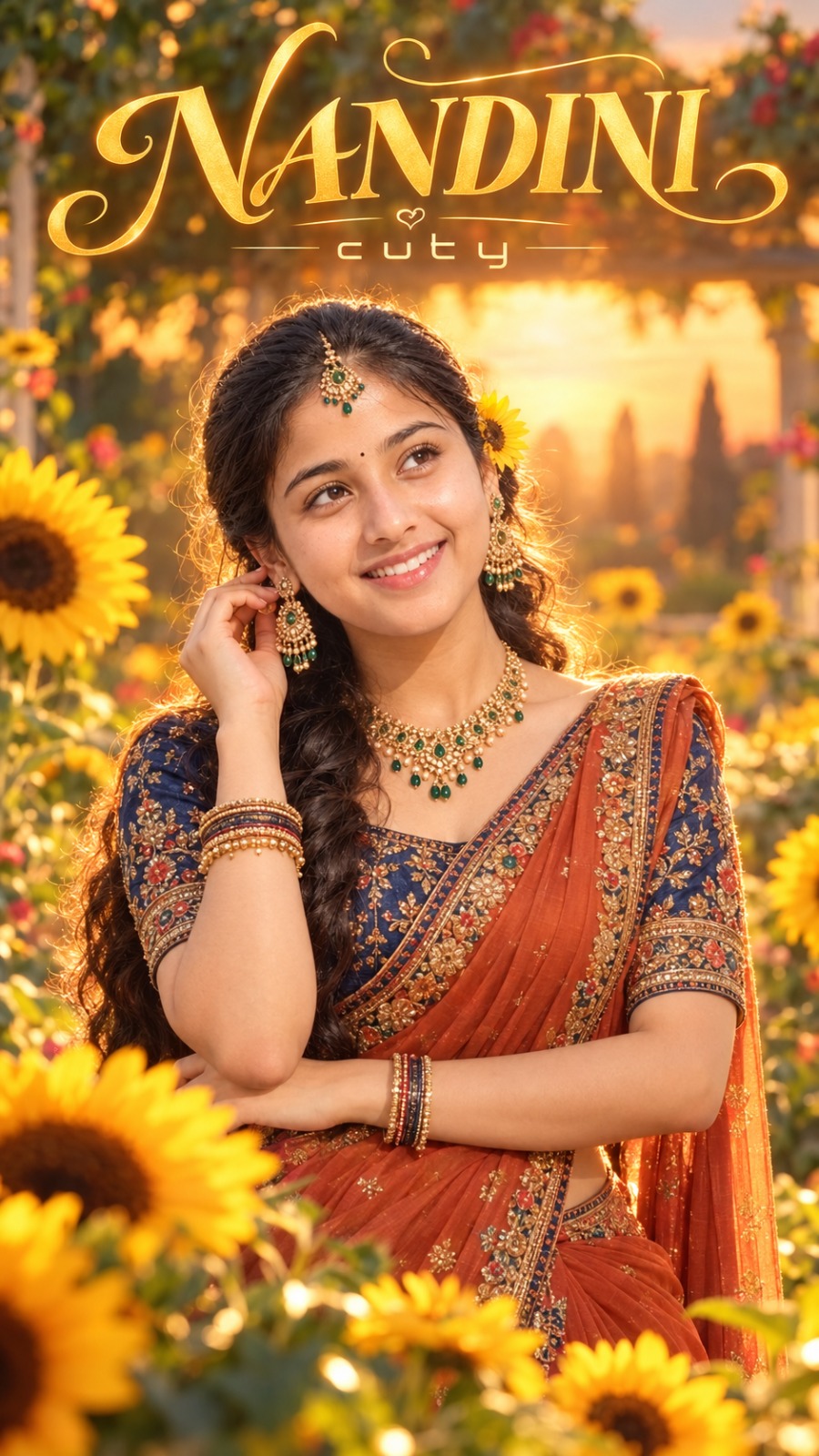
Golden Hour Sari Poster
This concept centers on a single female subject placed within a warm, dreamy Indian romantic setting. The woman is the clear visual focus, but the surrounding garden, sunlight, flowers, typography, and atmospheric depth are carefully designed to support her presence rather than compete with it. The composition is vertical and cinematic, with the subject occupying the lower-middle region while the upper portion provides generous space for the glowing garden and title treatment.
The subject is presented from the head down to below the waist. An important part of the concept is maintaining this exact amount of visible body rather than changing the framing. The sari continues toward the bottom of the composition, but large foreground sunflowers naturally cover portions of it. This creates a layered photographic effect and gives the poster a strong sense of depth. The woman should not appear too large, too small, or repositioned because her relationship with the background and flowers is central to the visual balance.
Her pose communicates relaxed happiness and romantic elegance. The body is turned in a graceful three-quarter orientation, while the face lifts gently toward the upper-left. Her bright smile gives the scene an emotionally open quality. One hand rises toward the ear and delicately touches the chandelier earring, while the opposite arm crosses naturally over the waist. This combination creates an elegant diagonal flow through the body and makes the pose feel spontaneous rather than rigid.
The facial presentation is equally important. The supplied identity is intended to remain recognizable through the facial structure, eyes, eyebrows, nose, lips, cheeks, jawline, natural asymmetry, and other distinctive characteristics. The reference concept does not call for a generic actress-like appearance. Instead, the identity should feel naturally integrated into the soft cinematic photography of the scene. The gentle upward gaze and smile are key emotional elements because they connect the subject visually with the warm sunlight behind her.
The hairstyle contributes significantly to the romantic character. Long dark wavy or curly hair flows behind the shoulders and down the back, with soft loose strands around the face. The hair is not treated as a rigidly arranged hairstyle; its movement and texture help create the feeling of a real outdoor moment. A small bright yellow sunflower is tucked beside the right side of the head. This tiny floral detail connects the subject directly with the larger sunflower environment and becomes an important visual accent.
Traditional Indian styling is another defining component. The black bindi provides a small central facial detail, while the maang tikka adds vertical ornamentation along the forehead. Large chandelier earrings create movement around the face, and the layered necklace introduces rich green gemstone details near the neckline. Together, these accessories establish a festive, elegant and culturally recognizable appearance without changing the dreamy cinematic character of the scene.
The clothing uses a particularly rich color relationship. The sari is a deep rust or copper-brown shade, producing warmth against the golden garden. Its translucent folds and natural draping provide softness and movement. The blouse is deep navy blue and heavily decorated with gold, copper, red and jewel-toned embroidery. The contrast between rust, navy and metallic ornamentation gives the clothing visual richness while remaining harmonious with the sunset palette.
The embroidery is not a minor decorative feature. Dense ornamental patterns appear across the blouse sleeves, sari borders and other visible areas. These details help create a premium traditional fashion feeling. The reference concept depends on the contrast between the highly detailed clothing and the soft, blurred environment. This allows the viewer to notice craftsmanship around the subject while the garden remains atmospheric.
The background is designed as a dreamy golden-orange garden during sunset. It should feel like an outdoor garden or park rather than a studio backdrop. Dark green foliage appears around the edges, while the center-right area contains a strong glowing sunlight source. The garden is intentionally defocused, creating circular bokeh and a soft visual haze. Distant flowers and foliage become impressionistic shapes, giving the background depth without taking attention away from the woman.
Sunflowers are distributed throughout the environment and form one of the strongest recurring motifs. Larger flowers appear around the left and right areas, while smaller blooms can be seen deeper within the garden. The lower foreground contains oversized yellow sunflowers that overlap the sari. Because these flowers are closer to the camera, they are softer and more blurred. This foreground layering creates a photographic depth effect and helps frame the woman naturally.
Lighting is one of the defining characteristics of the concept. A strong warm backlight sits behind the subject, creating a luminous white-golden rim around the hair, shoulders, arms and sari edges. Individual strands of hair can catch the sunlight, producing a delicate glowing outline. At the same time, the face and clothing remain warmly illuminated instead of becoming a dark silhouette. The balance between rim light and visible facial detail gives the scene its polished cinematic quality.
The color palette combines golden orange, sunflower yellow, deep green, rust, navy blue and warm natural skin tones. These colors are related closely enough to feel cohesive but varied enough to create visual separation. The golden background supports the romantic mood, the yellow flowers create repeated accents, the green foliage provides depth, and the rust-and-navy clothing gives the central figure a strong visual identity.
Typography is integrated into the poster rather than treated as an afterthought. The large decorative word “Anupama” occupies the upper region in a warm golden-yellow or creamy tone. Its elegant script adds a classic romantic film-poster character. Beneath it, “ARE VICKY” appears in smaller futuristic geometric lettering with a pale cream finish. The two lines create a clear hierarchy and remain separated from the woman’s head so the typography does not interfere with the facial area.
The overall visual style combines soft-focus photography, shallow depth of field, golden-hour illumination, floral framing and luminous compositing. It has the emotional language of an Indian romantic film poster while retaining the richness of traditional fashion photography. The softness is deliberate: the background, distant flowers and atmospheric highlights should blend smoothly, while the woman’s face, jewelry and important clothing details retain enough clarity to remain visually compelling.
The composition also depends heavily on depth. The upper background is distant and hazy, the woman occupies the primary middle layer, and the oversized flowers create a foreground layer. This three-level arrangement makes the poster feel more dimensional than a simple portrait placed over a background. The glowing sunlight behind the subject further separates her silhouette and creates a natural visual pathway toward the face.
The mood is warm, joyful, romantic, nostalgic and slightly magical. Nothing about the scene needs to feel dramatic or aggressive. Instead, the emotional impression comes from the smile, upward gaze, soft sunlight, flowers, traditional clothing and gentle atmosphere. The combination suggests a memorable romantic-film moment captured during a beautiful evening in a flowering garden.
From a design perspective, the concept is useful because it combines portrait identity, traditional fashion, floral storytelling, cinematic lighting and poster typography in one unified composition. It can work particularly well for romantic portraits, Indian cultural celebrations, personal poster designs, couple-themed visual campaigns where appropriate, festive fashion presentations, music-poster aesthetics, social media cover artwork, anniversary concepts and editorial-style personal branding.
The strongest creative benefit comes from the way the subject remains recognizable while the environment supplies the fantasy and emotion. The garden does not need to overpower the person. Instead, flowers, haze, sunlight and bokeh form a visual frame around her. The clothing and jewelry establish cultural elegance, while the upward gaze and smile provide the emotional story.
The negative details in the concept are equally meaningful from a design perspective because they protect the visual identity of the reference. The framing should not suddenly become a close-up, the subject should not be enlarged, and the background should not be replaced with a studio environment. The flowers, typography, sari, jewelry, sunflower in the hair, golden haze and rim light all contribute to the recognizable character of the finished poster.
The concept is therefore best understood as a carefully balanced romantic garden portrait rather than a simple sari photograph. Every major component has a role: the woman provides identity and emotion, the sari provides color and texture, jewelry provides cultural richness, flowers provide framing, sunlight provides atmosphere, bokeh provides depth, and typography provides the film-poster identity. Together they create a polished visual language that feels warm, elegant and cinematic.
[[[
REFERENCE ANALYSIS
- Composition: Vertical 9:16 cinematic romantic poster. One female subject dominates the lower-middle portion, while a large glowing garden/sunset background fills the upper half.
- Subject scale & visibility: Woman is shown from head to below the waist, with the lower sari continuing toward the bottom and partially disappearing behind foreground flowers. Preserve the exact scale and crop.
- Pose: Three-quarter pose, body slightly angled, face turned upward toward the upper-left. She has a bright gentle smile. One hand touches the earring near her right ear; the opposite arm crosses naturally over the waist.
- Identity styling: Traditional Indian appearance with bindi, maang tikka, ornate chandelier earrings and layered necklace. Long dark curly/wavy hair falls over the back and shoulder.
- Outfit: Rich rust/copper sari with a heavily embroidered dark navy-blue blouse. Sleeves and borders contain dense gold, copper and multicolor ornamental work.
- Background: Dreamy golden-orange garden/park at sunset, heavily blurred. Bright glowing sunlight/haze in the center-right, dark green foliage around the edges, multiple sunflowers distributed throughout.
- Foreground: Large vivid yellow sunflowers with dark centers overlap the lower edge and partially obscure the sari.
- Special floral detail: A small bright yellow sunflower is tucked into the woman’s hair near the right side of her head.
- Lighting: Strong warm backlight creating a bright white/golden halo/rim around the woman’s silhouette. Face and clothing remain warmly illuminated.
- Typography: At the top, large elegant decorative script reads “Anupama” in warm golden-yellow/cream. Beneath it is smaller futuristic geometric text “ARE VICKY” in pale cream.
- Style: Dreamy Indian romantic film-poster aesthetic, soft-focus photography, strong bokeh, golden-hour glow, floral framing and luminous compositing.
- Mood: Warm, joyful, romantic, nostalgic and magical.
MASTER PROMPT
Use the supplied reference image as the master visual blueprint. Replace only the reference character with the supplied user identity. Maintain the exact subject scale, screen-space proportion, cropping, and visibility of the reference character; do not normalize, enlarge, or reframe. Preserve all other visual information, composition, environment, lighting, color, depth, atmosphere, objects, background and artistic rendering as faithfully as possible.
Reconstruct the supplied reference as a vertical 9:16 dreamy golden-hour Indian romantic film poster. Preserve the exact camera distance, framing, subject placement and amount of body visible. The female character remains in the lower-middle of the frame, shown from head through below the waist, with the lower sari partially obscured by the foreground sunflowers. Do not expand the crop or reveal additional hidden body areas.
Replace only the woman’s identity with [USER IDENTITY]. Preserve the user’s recognizable facial structure, eyes, eyebrows, nose, lips, jawline, cheeks, natural asymmetry and distinctive features. Integrate the identity naturally into the reference’s soft cinematic photographic rendering. Do not paste a realistic face onto another character or create a generic actress-like face.
Preserve the exact pose: body in a graceful three-quarter orientation, shoulders and torso slightly angled, head tilted gently upward toward the upper-left, with a bright natural smile. One hand remains raised beside the ear, delicately touching the chandelier earring; the opposite arm remains crossed naturally over the waist. Preserve the exact hand, wrist, elbow and shoulder geometry.
Preserve the long dark wavy/curly hair, flowing behind the shoulders and down the back. Retain the soft loose strands framing the face. A small vivid yellow sunflower must remain tucked into the hair beside the right side of the head, in the same location and approximate size.
Preserve the traditional Indian styling: small black bindi, ornate central maang tikka, large traditional chandelier earrings and elaborate layered necklace with green gemstone details.
Preserve the exact clothing: a rich rust/copper-brown sari draped naturally across the torso, paired with a deep navy-blue heavily embroidered blouse. Maintain the dense gold, copper, red and jewel-toned embroidery across the sleeves, blouse and borders. Preserve the translucent sari folds, fabric texture, ornamental patterns and drape direction.
The background must remain a dreamy golden-orange garden at sunset, heavily defocused and atmospheric. Preserve the glowing bright central sunlight behind the woman, dark green foliage around the edges, warm amber haze and soft circular bokeh. Keep the impression of a garden rather than replacing it with a studio or generic background.
Preserve the numerous yellow sunflowers throughout the environment. Maintain the large sunflower at the left-middle, the flowers on the right side, distant smaller sunflowers and the oversized foreground blooms along the bottom. The foreground flowers must overlap the woman’s lower sari naturally and remain softer/blurred according to their proximity to the camera.
Create a strong warm backlight/rim light around the woman’s hair, shoulders, arms and sari edges, producing the distinctive glowing white-golden outline visible in the reference. Keep the face warmly illuminated and naturally detailed while retaining the atmospheric golden haze. Do not flatten the contrast or remove the luminous halo.
Preserve the exact typography treatment at the top. Behind the subject, retain the elegant decorative script “Anupama” in large warm golden-yellow/cream lettering, with subtle luminous highlights. Directly beneath it, preserve the smaller futuristic geometric text “ARE VICKY” in pale cream. Keep both text elements centered in the upper region and clearly separated from the woman’s head.
Maintain the reference’s golden orange, sunflower yellow, deep green, rust, navy and warm skin-tone palette, with soft cinematic bloom and restrained but rich saturation. Preserve the dreamy bokeh, atmospheric haze and shallow depth of field.
The final image must look like the same finished reference poster with only the original woman replaced by [USER IDENTITY]. Preserve the exact pose, clothing, sunflower placement, flowers, typography, background, lighting, color palette, crop and visual atmosphere. Do not redesign or modernize the poster.
EDITABLE VARIABLES
- [USER IDENTITY]: Supplied user’s identity; preserve recognizable facial structure and natural features.
- [OUTFIT]: Reference rust/copper sari + embroidered navy-blue blouse + traditional jewelry.
- [TEXT]: “Anupama” and “ARE VICKY” — preserve exactly unless explicitly changed.
- [OBJECT CHANGE]: None.
- [POSE CHANGE]: Reference pose — upward-left gaze, smile, one hand touching earring, opposite arm across waist.
- [ADDITIONAL EDIT]: None unless explicitly specified.
NEGATIVE PROMPT
identity loss, different face, generic face, original character remaining, added person, extra person, face swap, pasted face, artificial face, wrong facial proportions, wrong expression, wrong gaze, downward gaze, wrong head angle, wrong pose, altered hand position, malformed hands, extra fingers, changed body geometry, altered subject scale, enlarged subject, reduced subject, changed crop, changed camera distance, zoomed in, zoomed out, expanded framing, altered screen-space proportion, redesigned background, studio background, plain background, missing garden, missing sunlight, missing golden haze, missing sunflowers, missing foreground flowers, missing sunflower in hair, wrong flower color, altered floral placement, wrong sari,
missing embroidery, simplified embroidery, wrong jewelry, missing bindi, missing maang tikka, missing earrings, missing necklace, altered typography, missing Anupama text, missing ARE VICKY text, incorrect text, text over face, harsh lighting, flat lighting, lost rim light, lost glow, cool lighting, blue grading, orange-teal grading, excessive HDR, oversaturation, plastic skin, excessive smoothing, anime, cartoon, 3D render, illustration, sharp background, sharp foreground flowers, lost bokeh, lost haze, lost depth of field, altered mood, unnecessary modifications. ]]]