
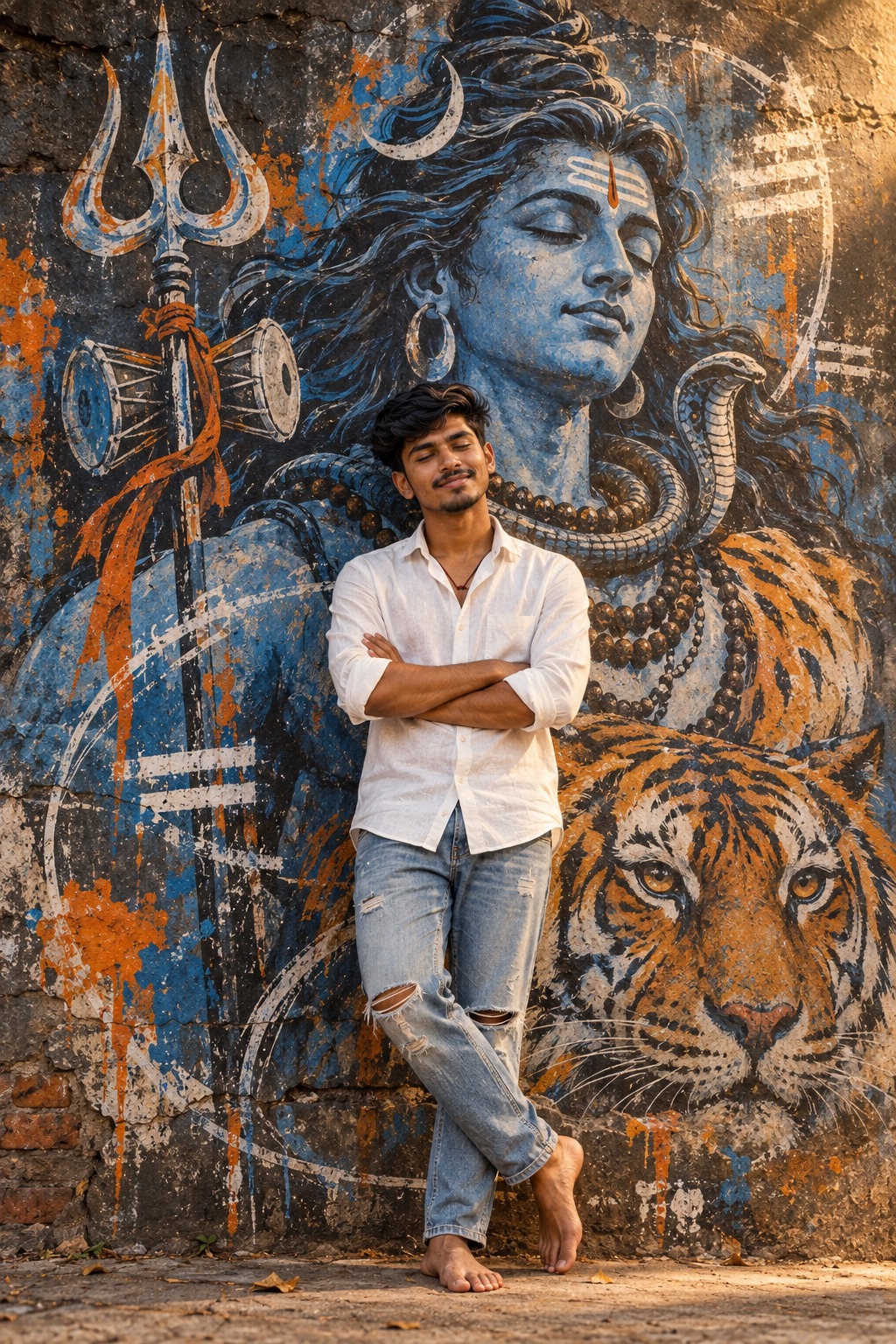
Shiva Street Art Portrait
The concept centers on a single male subject placed naturally in front of a large devotional street-art mural dedicated to Lord Shiva. The man is the photographic focal point, but the Shiva artwork occupies most of the background and gives the entire composition its identity. The relationship between the real human subject and the painted mural is especially important because the design is intended to feel like one carefully composed street photograph rather than a portrait placed over a separate background.
The male subject has a relaxed and peaceful presence. His eyes are closed and his facial expression is calm, creating a quiet devotional feeling without requiring an exaggerated emotional pose. The folded arms reinforce that relaxed confidence, while the crossed-leg stance introduces a casual street-photography quality. His body language is still and composed, allowing the enormous Shiva mural behind him to remain visually dominant.
The pose is highly specific. The subject stands in the central-lower region of the vertical frame with his arms folded across his chest. One leg crosses naturally in front of the other, creating a slightly leaning stance. The head angle, shoulder direction, arm placement, leg position and visible body area are treated as important parts of the composition. The prompt therefore describes a portrait where the person’s physical placement is closely connected to the surrounding mural rather than being treated as an independent studio pose.
The clothing contributes to the grounded street-photography character. The subject wears a loose white button-up shirt with rolled sleeves, light blue distressed jeans and no footwear. A simple necklace provides a small personal detail without competing with the mural. The contrast between the clean white shirt and weathered wall creates a strong visual separation, while the distressed denim naturally connects with the rough urban environment.
The facial treatment emphasizes recognizable personal identity. The concept pays attention to facial structure, eyes, eyebrows, nose, lips, jawline, cheeks, hair and natural asymmetry. This makes the subject feel like the actual person represented by the supplied identity rather than a generic male model. The intended appearance remains natural and photographic, with the face integrated into the lighting and perspective of the surrounding scene.
The background is one of the strongest elements. Instead of a plain wall, the setting is a weathered concrete and brick surface covered almost entirely by an elaborate blue-toned Shiva mural. The wall should retain visible age, cracks, chipped areas, rough pigment and uneven painted surfaces. These imperfections give the scene the character of authentic street art and prevent the background from looking overly polished or digitally manufactured.
The Shiva artwork is visually rich and symbolic. The mural includes a blue-skinned Shiva figure with a prominent topknot, crescent moon, trident, damaru, coiled snakes, layered bead details and tiger-skin elements. A large tiger face appears beneath the foreground subject, adding another powerful shape and warm color area to the lower mural. Together, these elements create a large vertical visual structure behind the man.
The mural is not intended to look like a separate realistic deity photograph. Its painted quality is central to the concept. Visible brushwork, rough pigment, chipped paint, irregular edges and layered colors help establish the feeling of hand-painted street art. The contrast between the photographic male subject and the painted Shiva figure becomes an important creative feature of the composition.
Graphic marks add another layer of personality. White chalk-like circular and curved forms appear across the wall, while orange, blue and white paint splashes and drips create scattered accents. These details make the background feel handmade and active. They also provide visual transitions between the darker wall, blue mural, human subject and warmer tiger elements.
The lighting is cinematic but believable. Warm directional illumination comes mainly from the upper-right area, producing gentle golden highlights across the man’s face, white shirt and legs. Parts of the wall remain deeper and more subdued, creating depth around the painted artwork. The lighting helps connect the real photographic subject with the mural so that both occupy the same believable environment.
The color palette is controlled rather than overly bright. Deep Shiva blue forms the dominant mural color, while charcoal gray appears throughout the aged wall. Muted orange and gold provide warmth through the tiger and scattered paint accents. White clothing and chalk markings create clean highlights, while denim blue connects the outfit to the mural palette. Natural warm skin tones keep the person visually human and prevent the blue environment from influencing the complexion.
The vertical 2:3 composition gives the scene a poster-like presence while retaining the character of a full-body street portrait. The man remains relatively small compared with the mural, which is important because the Shiva artwork is supposed to feel monumental. The composition therefore works through scale contrast: a calm human figure in the foreground against an enormous devotional artwork behind him.
The camera feeling is cinematic and observational rather than studio-based. The scene should feel as though the photographer discovered the subject standing naturally in front of an impressive painted wall. Depth comes from the physical relationship between the person, wall texture, mural layers and directional light. The result has the visual character of editorial street photography combined with devotional wall art.
Personalization is another major feature. The concept allows a user’s name, date, occasion, title, message, quote, location or additional details to become part of the wall artwork. These details are not intended to appear as modern digital captions. They belong inside the physical language of the mural through chalk, graffiti, brush lettering, stencil marks or distressed painted typography.
The personalized text is designed to look naturally attached to the wall. Short information can occupy a subtle open region, while longer wording can use an existing or visually appropriate painted area without interfering with the main Shiva figure, the person’s face, hands or body. This gives the design a handcrafted commemorative quality and makes the personalization feel connected to the environment.
The exact-text requirement is particularly important for names, dates, quotations and messages. Supplied information is treated as meaningful content rather than decorative filler. The concept also keeps the original mural clean when no personalized wording is supplied, avoiding unnecessary additions that could distract from the devotional composition.
The overall mood combines peace, devotion, confidence and urban authenticity. It is not a loud festival composition. Instead, the closed eyes, folded arms and relaxed stance create a reflective atmosphere, while the enormous Shiva mural provides spiritual scale and visual authority. The gritty wall and distressed marks keep the concept contemporary and connected to street culture.
The design can work well for personalized devotional portraits, Mahadev-themed social posts, spiritual commemorative artwork, festival graphics, profile visuals, wall-art-inspired posters, personalized celebration designs and dramatic editorial portraits. It can also suit occasions where a user’s name, date or message needs to become part of the artwork without looking like an added digital caption.
What makes the concept distinctive is the balance between photography and painting. The foreground remains photographic and human, while the background remains visibly hand-painted and symbolic. Neither element is supposed to completely overpower the other. The person provides identity and emotional focus, while Shiva provides scale, atmosphere, cultural context and visual depth.
The final creative language is therefore a combination of cinematic portrait photography, devotional symbolism, gritty urban texture, mural painting and personalized typography. The strongest visual impression comes from the calm male figure, the monumental blue Shiva artwork, the warm directional light and the imperfect physical character of the wall. Every supporting detail works toward making those elements feel like parts of one cohesive street-art portrait.
[[[
REFERENCE ANALYSIS
- Composition: Vertical 2:3 cinematic devotional street-art portrait. One male subject stands in the foreground, while a large Lord Shiva mural fills almost the entire background.
- Subject scale: The man occupies the central-lower portion, shown essentially full-body from head to bare feet. Preserve his exact size, placement, crop and stance.
- Pose: Relaxed standing pose with arms folded across the chest. One leg crosses in front of the other, creating a casual leaning stance. Eyes closed with a calm expression.
- Clothing: Loose white button-up shirt with sleeves rolled up, light blue distressed/ripped jeans, barefoot, simple necklace.
- Background: Weathered concrete/brick wall covered by a highly detailed blue-toned Shiva mural.
- Shiva mural: Large blue deity figure with topknot, crescent moon, trident, damaru, coiled snakes, rudraksha-like beads, tiger-skin element and a large tiger face. Preserve the mural as the dominant background artwork.
- Graphic treatment: White chalk-like circular/curved marks and orange/blue paint splashes layered across the wall.
- Lighting: Warm directional light from the upper/right side, with dramatic highlights on the subject and mural and deeper wall shadows.
- Color: Charcoal gray wall, deep blue Shiva, orange/gold tiger and paint accents, white clothing and muted denim.
- Style: Cinematic photographic portrait integrated naturally into a gritty hand-painted street-art mural.
- Personalization: User may provide name, date, quote, dedication, location, occasion or other details. These should be integrated into the mural/wall using the same gritty artistic language—not as a modern text overlay.
MASTER PROMPT
Use the supplied reference image as the master visual blueprint. Replace only the reference character with the supplied user identity. Maintain the exact subject scale, screen-space proportion, cropping, and visibility of the reference character; do not normalize, enlarge, or reframe. Preserve all other visual information, composition, environment, lighting, color, depth, atmosphere, objects, background and artistic rendering as faithfully as possible.
Reconstruct the reference as a vertical 2:3 cinematic street-art portrait. Preserve the exact composition, camera viewpoint, subject scale and full-body visibility.
Replace the foreground male identity with [USER IDENTITY]. Preserve the user’s recognizable facial structure, eyes, eyebrows, nose, lips, jawline, cheeks, hair, natural asymmetry and distinctive features. Integrate the user naturally into the photographic scene rather than creating a pasted face.
Preserve the exact foreground pose: the user stands in the same central-lower position with arms folded across the chest, eyes closed, calm expression and one leg crossed casually in front of the other. Preserve the exact head angle, shoulder orientation, arm geometry, leg position and amount of body visible.
Preserve the outfit: loose white button-up shirt with rolled sleeves, light blue distressed/ripped jeans, bare feet and simple necklace. Maintain realistic fabric folds, denim texture, ripped-knee details and natural proportions unless [OUTFIT] is explicitly supplied.
The entire background must remain the same weathered concrete/brick wall with the giant blue Shiva mural. Preserve the mural’s exact visual structure and details: blue-skinned Shiva, large topknot, crescent moon, trident on the left, damaru, coiled snakes, layered bead necklaces, tiger-skin garment and large tiger face beneath the foreground subject.
Preserve the mural’s hand-painted street-art character: visible brush strokes, rough pigment, wall cracks, chipped paint, uneven edges, layered blue/orange/white paint and weathered concrete texture.
Preserve the white chalk-like circular and curved markings across the wall and the scattered orange, blue and white paint splashes/drips. Do not clean up or modernize the mural.
LIVE USER TEXT / DETAILS
The user may provide any combination of:
- [USER NAME]
- [DATE]
- [OCCASION]
- [TITLE]
- [CUSTOM MESSAGE]
- [QUOTE]
- [LOCATION]
- [ADDITIONAL DETAILS]
These values must be dynamically inserted into the artwork only when supplied.
The text must look as though it was originally painted/written into the wall artwork. Use hand-painted graffiti, chalk lettering, stencil lettering, brush lettering or distressed mural typography, whichever best matches the supplied information and available wall area.
Do not add a clean digital text box, modern UI typography or floating caption.
If the user provides a short name/date, integrate it subtly into an appropriate wall region. If the user provides a longer quote/message, place it on an existing or naturally created painted/chalk area without covering the important Shiva mural, face, hands or body.
Exact-text rule: reproduce all user-provided names, dates, quotes and messages exactly as supplied. Do not paraphrase, shorten, autocorrect or invent information.
If no user text is supplied, do not invent any text. Keep the original mural and wall artwork unchanged.
The personalized text must visually belong to the same gritty devotional street-art aesthetic: distressed edges, imperfect paint/chalk texture, appropriate perspective, natural wall integration and matching lighting.
Preserve the original warm directional lighting: soft golden highlights on the user’s face, shirt and legs, stronger illumination toward the upper/right side, and deeper shadows across the wall. Keep the contrast between the real photographic subject and painted mural believable.
Maintain the reference palette of deep blue, charcoal gray, muted orange/gold, white and denim blue, with warm cinematic skin tones.
The final image should look like the original street-art portrait was created specifically for [USER IDENTITY] and the user’s supplied details, while keeping the Shiva mural, pose, clothing, framing, lighting and environment intact.
EDITABLE VARIABLES
- [USER IDENTITY]: Supplied user’s identity.
- [USER NAME]: User-provided name.
- [DATE]: User-provided date.
- [OCCASION]: User-provided occasion.
- [TITLE]: User-provided title.
- [CUSTOM MESSAGE]: User-provided message.
- [QUOTE]: User-provided quote.
- [LOCATION]: User-provided location.
- [ADDITIONAL DETAILS]: Any other supplied information.
- [OUTFIT]: Reference white shirt + distressed blue jeans unless explicitly changed.
- [TEXT STYLE]: Distressed mural/graffiti/chalk typography matching the wall.
- [POSE CHANGE]: None unless explicitly requested.
- [OBJECT CHANGE]: None unless explicitly requested.
NEGATIVE PROMPT
identity loss, different person, generic face, original person remaining, pasted face, face swap, artificial face, inconsistent identity, changed pose, arms unfolded, wrong leg position, standing differently, altered body scale, enlarged subject, reduced subject, changed crop, changed framing, changed camera distance, recentered subject, full-body expansion, missing feet, extra limbs, malformed hands, altered clothing, missing ripped jeans, missing white shirt, shoes added, redesigned background, missing Shiva mural, altered Shiva, different deity artwork, missing trident, missing snake, missing tiger, missing tiger face, missing damaru, missing crescent moon,
missing mural details, clean wall, modern wall, plain background, removed paint splashes, removed chalk markings, smooth concrete, photorealistic Shiva instead of mural, 3D deity, cartoon deity, anime, excessive saturation, neon colors, blue color cast on skin, harsh flash, flat lighting, excessive HDR, clean digital poster, modern text box, floating text, unrelated typography, invented name, invented date, invented quote, altered user text, misspelled user text, placeholder text, visible variable names, watermark, creator name, signature, username, unnecessary modifications. ]]]