
Diwali Portrait
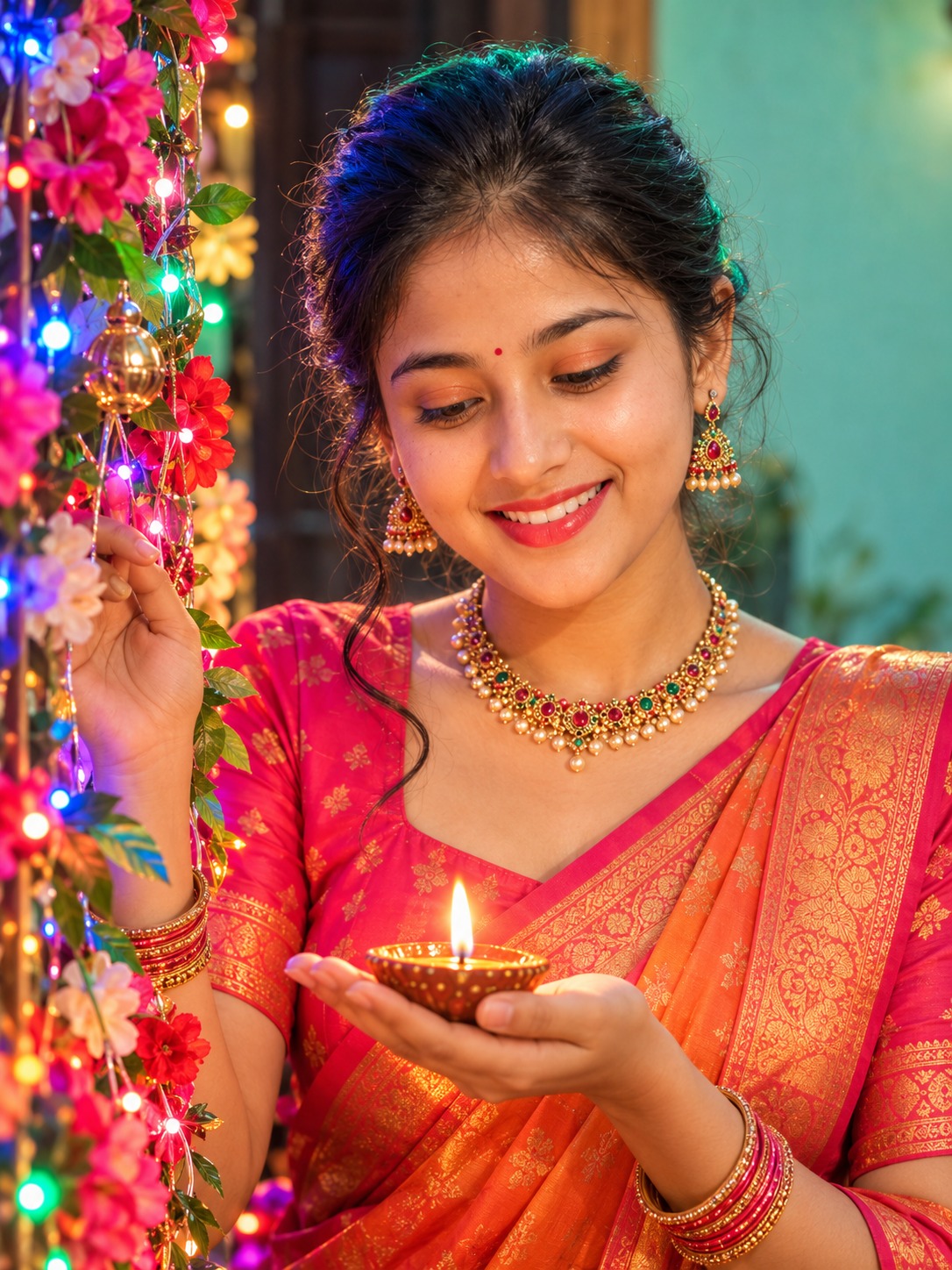
The Diwali Portrait concept celebrates the vibrant beauty of Indian festive photography through a combination of traditional clothing, expressive body language, colorful decorations, and dramatic mixed-temperature lighting. The central subject is an Indian woman dressed in coral-orange and pink attire with intricate gold details. She holds a small glowing diya in her open palm while looking down at its flame with a joyful smile. Around her, decorative flowers, colorful LEDs, and reflective ornaments create a lively festive environment. The composition brings together cultural elegance and contemporary cinematic photography.
The woman occupies the center-right portion of the vertical frame. Her head approaches the upper border, while her extended forearm and the diya create a strong focal point in the lower foreground. This asymmetrical arrangement leaves room for the colorful decorations along the left edge. The contrast between the decorated left side and the richly dressed subject on the right gives the composition a balanced, editorial appearance.
Her face communicates happiness and warmth. She lowers her head and turns it slightly toward the viewer’s left, directing both eyes toward the flame resting in her palm. Her smile reveals her upper teeth, creating a natural sense of celebration. Bright red lipstick, warm orange eyeshadow, defined eyebrows, and a small red bindi enhance her facial features without replacing her natural expression. The downward gaze is particularly important because it connects the woman’s attention directly to the diya.
The hairstyle adds elegance and character to the portrait. Her dark brown-to-black hair is arranged in a voluminous, swept-back updo. Smooth strands form the main silhouette, while loose curls frame the face and neck. A prominent S-shaped tendril along the viewer-left cheek provides a distinctive detail. Fine cyan and green highlights trace selected strands, reflecting the colorful decorative lighting around her. This creates visual separation between the dark hairstyle and the festive background.
The outfit combines vivid coral-pink, orange-pink, and gold tones. A short-sleeved blouse with a square neckline features tiny gold-colored woven motifs across the sleeves and bodice. A lustrous sari drape crosses the chest and falls over the viewer-right shoulder. Its elaborate gold border, reflective threads, and natural folds contribute to the luxurious appearance. Warm light reveals the fabric’s sheen and emphasizes the rich color of the traditional attire.
The jewelry is another prominent element. An ornate gold-toned necklace sits close to the base of the neck, featuring intricate decorative shapes and small accents in red, green, and pale colors. Matching dangling earrings frame the face and complement the necklace. Their metallic surfaces catch the orange illumination from the diya and the surrounding warm light. These details enrich the portrait while maintaining the visual importance of the woman’s expression and the lamp.
The body posture creates a clear relationship between the subject and the festive decorations. Her torso faces mostly forward with a slight turn toward the viewer’s left. One arm bends at the elbow, raising the hand beside the colorful ornaments near shoulder height. The fingers curl naturally near a thin decorative wire or stem. This hand introduces a graceful gesture that connects the woman visually to the illuminated arrangement along the left edge.
Her opposite arm extends diagonally forward and downward toward the viewer-left foreground. The palm faces upward and supports a small traditional diya. The fingers extend naturally with a slight curve, while the wrist follows a believable alignment. Because the hand is closer to the camera, it becomes an important foreground element. Its position brings the flame into the visual space between the viewer and the woman’s upper body, strengthening the sense of depth.
The diya is the emotional center of the composition. It rests securely on the open palm, with a small wick and a distinct teardrop-shaped flame. The flame has a bright yellow-white core surrounded by a soft orange glow. Its warm illumination creates localized highlights on the palm and nearby fingertips. The lamp remains visually separate from the colorful LEDs, making it clear that the warm light comes from the traditional oil lamp rather than the decorative background.
The festive decorations fill the left edge of the image. Artificial flowers, foliage, reflective ornaments, thin dark wires, and small LED points form a dense but visually varied arrangement. Saturated magenta, hot pink, violet, cyan, electric blue, green, and occasional red accents introduce a lively palette. Some lights have bright centers with soft colored halos, while others appear as blurred points farther from the focal plane. The arrangement feels layered and ornamental rather than perfectly symmetrical.
Lighting is a defining feature of this Diwali Portrait style. Warm orange illumination from the diya and nearby practical light sources highlights the face, neck, hands, jewelry, and sari. At the same time, cooler colored illumination from the decorations introduces magenta and violet reflections along the viewer-left cheek and selected areas of the hair. Cyan and green highlights trace the upper hairstyle and outer strands. The contrast between warm skin tones and cool decorative colors creates a rich cinematic effect.
The lighting is intentionally varied rather than uniform. The flame contributes a small upward-facing glow beneath the chin, while the surrounding warm illumination shapes the cheeks, forehead, and clothing. Colored LEDs add accents instead of replacing the natural appearance of the subject. Soft shadow transitions preserve facial depth, and controlled highlights keep the gold motifs, jewelry, and bright LED points visually distinct.
The background provides important environmental context. A pale aqua-green wall fills the upper-right area, adding a cool color field behind the woman’s head. A darker, defocused architectural section sits behind her shoulder, separating the silhouette from the wall. The left-side decorations extend vertically through the frame, creating a colorful border. Unlike a completely black studio backdrop, this setting retains the impression of a real festive space while keeping background details softly blurred.
The overall color grading emphasizes orange-cyan contrast, rich pinks, glowing gold, and deep shadows. Warm peach highlights complement the coral-orange clothing, while cyan, green, magenta, and violet accents make the decorations appear luminous. Saturation is high, but individual colors remain recognizable. The combination produces a celebratory visual identity that feels contemporary while preserving traditional Indian styling.
The photographic style is realistic and polished. Natural facial proportions, detailed hair strands, believable skin texture, reflective jewelry, silk-like fabric, and physically connected flame and lamp details contribute to the image’s photographic character. Selective focus keeps the woman’s face and diya prominent while allowing the decorations to soften gradually into the background. Gentle LED glow adds atmosphere without turning the scene into an artificial neon illustration.
The vertical 3:4 composition is suitable for portrait-oriented displays, festive social media posts, personalized wallpapers, greeting graphics, cultural photography collections, and fashion editorials. The subject’s face, upper body, jewelry, raised hand, and extended palm remain visible within a compact frame. The colorful left-side arrangement adds decorative interest, while the foreground lamp creates an immediate focal point.
This Diwali Portrait concept is particularly useful for creative projects that aim to express joy, tradition, and visual richness at the same time. The clothing and jewelry provide cultural detail, the smile communicates a celebratory mood, and the diya establishes a meaningful visual connection with the festival. The surrounding lights add a contemporary decorative style without removing the traditional character of the scene.
The strongest quality of the composition is the contrast between the warm flame and the colorful ambient lighting. The diya gives the portrait an intimate focal point, while cyan, green, magenta, and violet accents create depth around the hair and decorations. The woman’s downward gaze ties these elements together, ensuring that the image remains a coherent portrait rather than a collection of unrelated festive details.
Ultimately, the Diwali Portrait concept combines traditional Indian fashion, a joyful expression, intricate accessories, and colorful illumination in a polished photographic style. Its thoughtful framing and carefully layered lighting make it visually engaging, while the diya provides a clear symbol of celebration and warmth. The result is an elegant festive portrait concept suited to designers, photographers, portrait editors, and anyone exploring vibrant Indian cultural imagery.
[[[
A. REFERENCE ANALYSIS
- Camera: Vertical 3:4 portrait, medium close-up, slightly elevated viewpoint, mild three-quarter perspective.
- Composition: Woman positioned center-right; colorful festive decorations fill the left edge. Her head approaches the top border, while her extended hand and diya occupy the lower foreground.
- Pose: Torso faces mostly forward. One hand is raised beside the decorations, fingers curled around or near a thin wire. The opposite forearm extends diagonally toward the lower-left, palm facing upward and supporting a lit diya.
- Face: Head lowered and turned slightly toward the viewer’s left. Both eyes look down at the flame. She has a joyful, tooth-showing smile, red lipstick, orange eyeshadow, defined eyebrows, and a small red bindi.
- Hair: Voluminous, swept-back dark updo with loose curled tendrils, including a prominent S-shaped curl along the viewer-left cheek.
- Outfit: Coral-orange and pink traditional blouse with gold woven motifs, square neckline, and an orange-gold sari drape over the viewer-right shoulder.
- Jewelry: Elaborate gold-toned necklace with multicolored accents, matching dangling earrings, and intricate metallic detailing.
- Lighting: Mixed-temperature illumination—warm orange light from the diya and ambient sources, plus magenta, violet, cyan, and green light from the decorations.
- Background: Pale aqua-green wall in the upper-right, dark blurred architectural area behind the shoulder, and colorful festive lights and ornaments along the left.
- Style: Highly saturated festive portrait photography, polished skin rendering, fine hair details, soft LED glow, and strong warm-cool contrast.
B. MASTER PROMPT
Photorealistic Indian Festive Portrait Photography + Cinematic Diwali Portrait + Vibrant Editorial Photography + Highly Saturated Teal-and-Orange Color Grading + Magenta, Violet, Cyan, and Green Accent Lighting + Mixed-Temperature Practical Illumination + Colorful Festive LED Decorations + Warm Diya Flame Illumination + Natural Skin Texture + Polished Photographic Finish + Vertical 3:4 Composition.
CAMERA AND COMPOSITION: A vertical 3:4 medium-close portrait photographed from approximately face level or slightly above, with a gentle downward viewpoint toward the foreground palm. Use a natural short-telephoto portrait perspective, approximately 50–85 mm full-frame equivalent as an estimate. Frame the woman from the head through the upper torso, including both arms, the raised hand,
the open palm, and the small lit diya. Position her slightly right of center. Her voluminous hairstyle nearly reaches the top edge. A colorful decorative arrangement occupies the leftmost quarter to third of the image, extending vertically from the upper-left corner toward the lower-left foreground. Preserve the asymmetrical balance between the cool, colorful decorations on the left and the richly illuminated orange-gold outfit on the right.
FACE AND EXPRESSION: The woman faces mostly forward, with her head gently lowered and rotated slightly toward the viewer’s left. Her chin dips toward the diya. Both eyes are lowered naturally and directed toward the flame, with defined dark eyelashes and softly arched eyebrows. A small red traditional bindi or decorative tilak sits between the eyebrows. She wears warm orange eyeshadow, subtle eyeliner, and glossy bright-red lipstick. Her lips form a genuine, cheerful smile, slightly parted with the upper front teeth visible. Preserve natural facial proportions, softly illuminated cheeks, realistic skin texture, and a gentle warm expression. Do not turn her gaze toward the camera.
HAIRSTYLE: Dark brown-to-black hair styled in a voluminous, neatly swept-back updo or bun. The crown has smooth, carefully arranged strands with visible individual hair detail. Fine cyan and green highlights trace portions of the upper hair and outer edges. Several loose curled tendrils frame the face and neck, particularly a prominent S-shaped curl descending along the viewer-left side of the cheek. Include a few fine flyaway strands catching the colored light. Preserve the elegant swept-back silhouette and loose curls without converting the hairstyle into long, loose hair.
POSE AND HAND GEOMETRY: The woman’s torso is mostly front-facing with a slight angle toward the viewer’s left, and her upper body inclines gently toward the lamp. On the viewer-left, one arm bends at the elbow, bringing the hand upward beside the decorative lights near shoulder height. The fingers curl naturally inward around or immediately beside a thin dark decorative wire or stem. The hand is partly overlapped by the surrounding flowers and light wires, and the fingernails are painted red.
Her opposite arm emerges from beneath the sari drape on the viewer-right and extends diagonally forward and down toward the viewer-left foreground. The forearm is closer to the camera, creating a modest natural perspective enlargement. The palm faces upward and is held open, relatively flat, with the fingers extended toward the viewer’s left, close together and gently curved. A small lit diya rests securely on the palm, with its flame positioned near the center-left of the hand. Preserve realistic wrist alignment, natural finger lengths, plausible joints, and believable contact between the lamp and the palm. Do not merge the fingers or obscure the flame. The extended forearm and lower torso are cropped by the bottom edge.
TRADITIONAL OUTFIT: A vivid coral-pink and orange-pink traditional Indian blouse with a square or gently squared neckline and short sleeves. The blouse features small, intricate gold-colored woven motifs across the sleeves and bodice. A lustrous orange-pink sari or drape crosses the chest and falls over the viewer-right shoulder, with a richly patterned gold border and decorative woven designs. Preserve the silk-like sheen, realistic folds, reflective gold threads, and saturated coral-orange fabric tones. The viewer-right shoulder and sleeve carry strong warm golden highlights. Do not invent the unseen lower garment.
JEWELRY: An ornate gold-toned necklace sits closely around the base of the neck, featuring densely clustered floral or filigree-like elements and small red, green, and pale-colored gemstone accents. Matching dangling earrings have intricate decorative tiers and subtle red accents. The necklace is the dominant chest accessory. Warm light creates fine metallic specular highlights on the individual jewelry elements. Maintain realistic scale, detailed craftsmanship, and natural placement against the neckline. Avoid oversized or invented jewelry.
FOREGROUND DIYA: A small traditional oil lamp rests in the center-left area of the open palm, just below the woman’s chin and in front of her upper torso. Its exact material is not clearly established, so render it as a small, realistic traditional diya with a shallow lamp body and a visible wick. The flame has a bright yellow-white core surrounded by a warm orange glow, with a naturally tapered teardrop shape. Its light illuminates the palm and nearby fingertips, producing localized warm reflections along the skin. The flame must remain clearly visible, separate from the decorative LEDs, and physically connected to the lamp.
COLORFUL FESTIVE DECORATIONS: Along the viewer-left edge, create a vertically arranged cluster of colorful festive ornaments, artificial flowers, foliage, reflective decorative pieces, thin dark wires, and tiny LED light points. Include saturated hot pink, magenta, violet, cyan, electric blue, green, and occasional red accents. Some LEDs glow intensely with small near-white centers surrounded by colored halos. The decorative structure is partially cropped by the left edge and slightly softer in focus than the woman’s face. Thin dark wires curve irregularly between the lights. A few flower petals and reflective elements overlap the edge of the raised hand. Preserve a dense, colorful arrangement without making it a symmetrical garland or adding unrelated festival props.
LIGHTING AND COLOR EFFECTS: Combine warm orange illumination on the woman’s face, neck, hands, jewelry, and outfit with cool colored spill from the decorations on the viewer-left. The face receives soft directional warm illumination across the forehead, cheeks, nose, and lips, with a gentle warm glow beneath the chin. The diya contributes a localized upward-facing highlight on the palm and fingers.
The decorative LEDs produce pink-violet color spill along the viewer-left cheek and portions of the hair, while green and cyan highlights trace the upper hairstyle and outer strands. The gold jewelry and woven fabric reflect warm amber and orange light. Keep the lighting colorful and stylized, with soft shadow transitions rather than harsh flash illumination. Bright LED centers may approach white, but retain surrounding color and highlight detail. Apply localized bloom and subtle light diffusion around the brightest points without washing out the subject.
BACKGROUND: A softly illuminated pale aqua-green wall fills the upper-right background. Behind the viewer-right shoulder, include a darker, defocused rectangular architectural area that creates tonal separation. The left side is occupied by colorful festive decorations, with the farthest lights softened into luminous bokeh. Keep the background layered and softly blurred, while maintaining recognizable wall color and dark architectural shapes. Do not replace the setting with a black studio backdrop or a completely abstract neon environment.
FINAL IMAGE CHARACTER: Bright, richly saturated festive photography with strong orange-cyan contrast, vivid magenta and violet accents, golden jewelry reflections, warm peach skin highlights, glossy dark hair, detailed silk textures, selective focus on the face and diya, and soft background falloff. Preserve the joyful downward gaze, open-palm lamp presentation, raised hand beside the decorations, voluminous updo, prominent curled tendril, gold jewelry, coral-orange outfit, pale aqua-green wall, and colorful left-side lights. Maintain realistic anatomy, natural object contact, and the original vertical crop. No unrequested changes.
C. EDITABLE VARIABLES
[CAMERA ANGLE]
Slightly elevated, near-frontal three-quarter view
Locked
[POSE & BODY GEOMETRY]
One raised hand beside decorations; opposite palm extended upward holding the diya
Locked
[FACE DIRECTION & EXPRESSION]
Head lowered, gaze on flame, joyful tooth-showing smile
Locked
[OUTFIT & ACCESSORIES]
Coral-orange blouse and drape, gold motifs, ornate necklace and earrings
Locked
[LIGHTING & SHADOWS]
Warm diya glow mixed with cyan, green, magenta, and violet illumination
Locked
[BACKGROUND & OBJECTS]
Colorful left-side decorations, aqua-green wall, dark blurred area, single foreground diya
Locked
[COLOR & MOOD]
High saturation, orange-cyan contrast, celebratory festive atmosphere
Locked
[ASPECT RATIO]
Vertical 3:4
Locked
D. NEGATIVE PROMPT
Horizontal image, square crop, full-body framing, extreme close-up, overhead view, extreme low angle, direct eye contact, eyes looking upward, closed eyes, serious expression, exaggerated smile, changed head direction, hair worn loose instead of an updo, missing S-shaped curl, straight hair covering both eyes, missing bindi, altered makeup, pale or desaturated colors, monochrome grading, all-orange lighting, missing cyan and green highlights, missing magenta or violet accents, black
studio background, plain white background, missing decorative arrangement, decorations on the wrong side, perfectly symmetrical decorations, excessive neon effects, giant light sources, excessive bloom, blown-out face, flat frontal flash, harsh shadows, plastic skin, excessive smoothing, artificial sharpening, distorted face, unnatural perspective, missing raised hand, wrong hand holding the lamp, closed palm, palm facing downward, floating diya, lamp hovering above the skin, flame disconnected from wick, oversized flame,
multiple lamps, extra fingers, missing fingers, fused fingers, duplicated hands, broken wrists, implausible joints, distorted jewelry, missing necklace, oversized earrings, altered outfit, blue or green sari, plain fabric without gold motifs, excessive invented accessories, changed crop, excessive background sharpness, cartoon style, painterly illustration, CGI appearance, text, logo, watermark, unrequested objects or effects.
E. RECONSTRUCTION BLUEPRINT
Create a vivid, photorealistic vertical 3:4 portrait of a young Indian woman in traditional coral-orange, pink, and gold festive attire, standing beside a colorful arrangement of decorative flowers, ornaments, wires, and LEDs. Position her in the center-right of the frame, with the decorations occupying the left edge. Her dark hair is swept back into a voluminous updo, with fine green-cyan highlights and loose curled tendrils framing her face. Her head is lowered and turned slightly toward the viewer’s left, and her eyes look down at a small diya resting on her upward-facing palm. She smiles warmly, showing her upper teeth, with bright red lipstick, orange eyeshadow, defined eyelashes, and a small red bindi.
Her blouse has a square neckline, short sleeves, and intricate gold motifs. A lustrous orange-pink sari drape with a richly patterned gold border covers her viewer-right shoulder. An ornate gold-toned necklace with small multicolored accents and matching dangling earrings reflect the warm light.
Her viewer-left hand is raised beside the festive decorations, with naturally curled fingers near a thin dark wire. Her opposite arm extends diagonally forward toward the lower-left foreground, with the palm open and facing upward. A small burning oil lamp rests securely on the palm, its yellow-white flame surrounded by a localized amber glow.
The face and clothing receive soft, warm illumination, while magenta and violet light spill across the viewer-left side and green-cyan highlights trace the hair. Colorful LEDs glow along the left edge, some with soft near-white centers and blurred halos. The upper-right background is a pale aqua-green wall, while a darker blurred architectural area sits behind her shoulder. The image is brightly saturated, with realistic skin, hair, silk, jewelry, and flame detail, gentle background blur, and strong warm-cool color separation. Preserve the original pose, expression, composition, clothing, jewelry, lamp position, and colorful festive atmosphere.
F. LIMITATIONS
- The exact shape of the hairstyle’s bun, the decorative lamp body, and the individual flower and LED arrangement are partially obscured or cropped.
- The source of the colored illumination cannot be established with certainty; it may combine practical LEDs with color grading.
- The estimated 50–85 mm focal-length range is illustrative, not a verified camera setting.
- For closer reconstruction, reference-image conditioning and pose or inpainting controls may improve hand placement, facial angle, and the detailed arrangement of the decorations.
]]]