
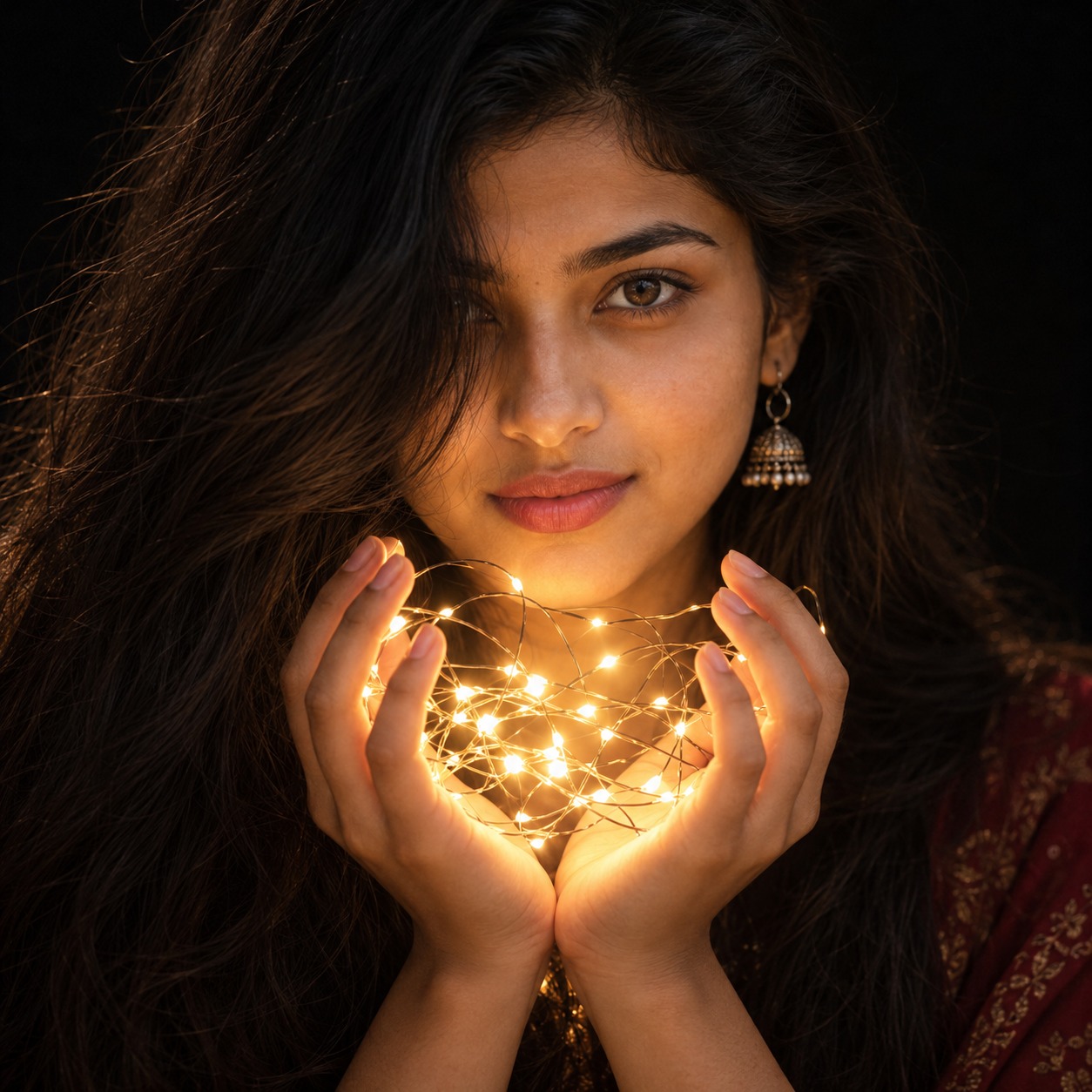
Fairy Light Portrait
The Fairy Light Portrait concept presents a mysterious, intimate, and visually expressive female portrait built around a small arrangement of glowing fairy lights. Its defining feature is the relationship between the woman’s face, her hands, and the delicate illuminated wires held beneath her chin. Instead of relying on a bright studio background or conventional portrait lighting, the composition uses darkness to make every visible detail feel intentional. The result is a cinematic photographic concept that combines realistic human features with a subtle sense of magic.
The main subject is a woman photographed in a tight, square composition. Her face occupies the upper-middle portion of the frame, while her hands and the illuminated object fill the space immediately below. This arrangement creates a clear visual hierarchy. The viewer first notices her visible eye, then follows the illuminated fingers and glowing wires toward the brightest point beneath her chin. The close framing also makes the portrait feel personal, as though the viewer is sharing a quiet moment with the subject.
The facial expression is restrained and natural. Her lips remain closed in a muted rose shade, and her head stays upright rather than leaning dramatically to one side. One visible eye looks directly toward the camera, creating a subtle connection with the viewer. Dark eyeliner gives the eye additional definition without requiring exaggerated makeup. The overall expression is neutral, thoughtful, and slightly mysterious. It does not depend on a broad smile or an exaggerated emotional gesture to communicate its mood.
The hairstyle is one of the most important visual elements. Long, dark brown-to-black hair falls loosely around the face, with a thicker section crossing diagonally over the viewer-left side. This placement conceals much of one eye while leaving the other eye visible. The asymmetry adds depth and gives the portrait a distinctive silhouette. Individual strands and soft warm highlights contribute to a natural photographic appearance, preventing the hair from looking like a solid, artificial shape.
The skin treatment emphasizes believable texture and controlled illumination. Warm highlights appear along the nose, cheeks, lips, chin, and selected areas of the fingers. These illuminated regions contrast with the darker forehead, hairline, and eye sockets. The intention is not to brighten every facial feature equally. Instead, the face emerges gradually from the surrounding darkness, creating depth while preserving the natural structure of the subject.
The hands establish the central gesture of the composition. Both forearms rise from the lower edge, bringing the hands beside the lower face. The palms turn inward, and the fingers extend upward with gentle curves toward one another. Together, they form an open, bowl-like enclosure. This shape communicates care, protection, curiosity, and quiet wonder. The hands do not completely close around the object, allowing the delicate wires and separate points of light to remain visible.
Natural hand anatomy is especially important to this concept. The fingers have individual spacing, realistic proportions, and believable bends. The wrists follow graceful angles, while small differences between the two hands prevent the gesture from looking mechanically mirrored. Because the hands occupy a prominent position close to the face, their shape contributes significantly to the overall elegance of the photograph.
Between the palms sits a delicate bundle of thin metallic wires carrying tiny warm-white lights. Several interconnected oval loops and circular curves create an intricate arrangement beneath the mouth. The wires extend toward both hands, overlap in selected areas, and form loose rounded arcs. Their irregularity gives the object a realistic handcrafted quality. It should feel like a physical string-light arrangement rather than a perfectly symmetrical geometric ornament.
The brightest concentration of lights sits directly beneath the chin. Individual LEDs remain visible along the wire paths, producing small points of warm illumination. Fine metallic reflections help distinguish the wires from the surrounding darkness. The central cluster serves as the visual anchor of the portrait, connecting the hands and face through a single source of light. The object feels delicate because the wires remain thin and the bulbs remain small.
Lighting is the defining characteristic of the Fairy Light Portrait style. The fairy lights act as the principal practical light source, positioned just below the mouth. Their illumination travels upward, reaching the fingertips, inner palms, chin, lower cheeks, lips, and nose. This upward direction creates a distinctive chiaroscuro effect, where bright illuminated areas emerge against deep shadows. The lighting feels dramatic without needing additional visible lamps or elaborate equipment.
The warm color temperature contributes strongly to the emotional atmosphere. Amber and warm-white highlights create a soft golden appearance, while the surrounding shadows remain deep brown and nearly black. Muted rose lips and a narrow glimpse of burgundy clothing introduce restrained color accents. These tones complement one another without overwhelming the face or the lights. The palette remains controlled, giving the portrait a sophisticated editorial quality.
The background is almost completely black. There are no identifiable rooms, outdoor scenery, decorative objects, or competing visual elements. This negative space helps separate the subject from the environment and concentrates attention on the face and illuminated hands. The dark surroundings also make the tiny light points appear brighter. Rather than functioning as an empty backdrop, the darkness becomes an active part of the visual design.
The clothing is intentionally understated. Only a small section of deep burgundy or maroon fabric appears near the lower-right edge, decorated with subtle gold-colored details. This limited glimpse introduces texture and warmth without distracting from the main subject. The garment is not meant to dominate the composition. Its purpose is to complement the amber lighting and provide a quiet connection between the clothing and the overall color palette.
The photographic style combines low-key portraiture, cinematic contrast, realistic textures, and magical realism. The human subject remains grounded in photographic detail, while the glowing wires introduce a slightly dreamlike quality. Fine image grain, selective highlights, shallow depth of field, and localized light bloom support the atmosphere. The optical glow remains restrained, allowing the individual bulbs, hair strands, skin texture, and metallic wire reflections to remain distinguishable.
Compositionally, the square format gives the portrait a compact, balanced appearance. The face occupies the upper section, and the hands create a natural frame around the illuminated object below. The centered light cluster connects both halves of the composition. Tight cropping removes unnecessary space while retaining the important relationship between the visible eye, the curved fingers, and the fairy lights. This arrangement works especially well when a portrait needs to remain recognizable and visually strong at smaller display sizes.
The camera perspective is nearly frontal and positioned around eye level. This choice maintains natural facial proportions and creates a direct relationship between the subject and the viewer. The close framing increases intimacy without requiring a wide-angle perspective. The shallow depth of field further supports the photographic feeling by keeping attention on the important facial features, fingers, and glowing details.
The concept is useful for profile portraits, artistic photography collections, dark editorial designs, social media posts, creative portfolios, personalized wallpapers, and atmospheric poster layouts. Its square composition adapts naturally to profile graphics and social platforms, while the warm illumination makes it suitable for themed photography collections and personal creative projects. It can also serve as a visual reference for designers exploring low-key lighting, practical light sources, and expressive hand positioning.
The appeal of this portrait comes from its careful balance between realism and mystery. The face provides a familiar human focal point, the hands create an expressive frame, and the tiny lights introduce visual interest without overwhelming the scene. Every major element supports the same mood. Dark surroundings, natural textures, selective illumination, and a restrained expression work together to produce an image concept that feels intimate, elegant, and cinematic.
Ultimately, the Fairy Light Portrait style is about making a small source of light carry the emotional weight of an entire composition. The illuminated wires are more than a decorative object: they organize the framing, influence the facial lighting, guide the viewer’s gaze, and establish the atmosphere. The result is a distinctive portrait concept that combines visual simplicity with rich detail, making it appealing to photography enthusiasts, digital artists, portrait editors, and anyone interested in mysterious warm-light aesthetics.
[[[
A. REFERENCE ANALYSIS
- Camera: Square 1:1 portrait, tight close-up, nearly frontal eye-level viewpoint, natural facial perspective.
- Pose: Both hands raised in front of the lower face, palms turned inward, fingers extended upward and gently curved toward each other.
- Face: Head upright, one visible eye looking directly at the camera, closed muted-rose lips, restrained neutral expression.
- Hair: Long, dark, loose hair falling diagonally across the viewer-left side of the face, concealing much of the left eye.
- Lighting: Tiny warm-white fairy lights act as the primary light source, illuminating the face and fingers from below. Forehead, outer hair, and background remain deeply shadowed.
- Object arrangement: Delicate metallic wires form overlapping circular loops between both hands, with the brightest concentration directly beneath the chin.
- Outfit: Partially visible deep burgundy fabric with scattered gold-colored decorative details at the lower-right edge.
- Color and mood: Warm amber highlights, dark brown and near-black shadows, muted rose lips, mysterious magical realism, pronounced low-key contrast.
B. MASTER PROMPT
Low-Key Cinematic Portrait Photography + Photorealistic Female Portrait + Dramatic Chiaroscuro Lighting + Practical Fairy-Light Illumination + Strong Underlighting + Warm Amber Color Temperature + Deep Crushed Black Shadows + High-Contrast Exposure + Intimate Mystical Atmosphere + Magical Realism + Square 1:1 Composition + Tight Medium Close-Up Framing + Nearly Frontal Eye-Level Camera Angle + Natural Facial Perspective + Centered Head-and-Hands Composition + Direct Eye Contact +
Upright Head Position + Neutral Restrained Facial Expression + Closed Muted Rose Lips + Dark Defined Eyeliner + Small Natural Eye Catchlight + Long Loose Dark Brown-to-Black Hair + Asymmetric Hair Placement + Thick Face-Framing Hair Section Falling Diagonally Across the Viewer-Left Side of the Face + Partially Obscured Viewer-Left Eye + Fine Individual Hair Strands + Subtle Warm Hair Highlights + Natural Skin Texture + Soft Facial Contouring + Warm Golden Highlights on Nose, Cheeks, Lips, and Chin + Deep Shadows Around the Forehead and Eye Sockets.
Both Forearms Rise From the Bottom Edge of the Frame, Bringing the Hands Up Beside the Lower Face. The Hand on the Viewer-Left Forms the Left Side of a Loose, Bowl-Shaped Enclosure, With the Palm Turned Inward Toward the Light Source, Fingers Pointing Upward, Slightly Separated, and Gently Curving Toward the Center. The Hand on the Viewer-Right Mirrors This Protective Gesture, With Its Palm Facing Inward, Fingers Raised and Softly Bent Toward the Opposite Hand. Preserve the Natural Asymmetry Between the Hands, Realistic Finger Lengths, Visible Finger Separation, Plausible Wrist Angles, and Graceful Curved Silhouettes. Neither Hand Fully Closes Over the Object; Leave Clear Openings Between the Fingers So the Wires and Individual Light Points Remain Visible.
A Delicate Bundle of Ultra-Thin, Flexible Metallic Fairy-Light Wires Occupies the Space Between Both Palms, Directly Beneath the Mouth and Chin. Arrange the wires into Several Interconnected, Overlapping Oval and Circular Loops, With Fine Curves Extending Laterally Toward Both Hands. A Bright, Dense Cluster of Tiny Warm-White LEDs Sits at the Horizontal Center, Below the Chin and Between the Inner Fingertips. Thin Wire Segments Radiate Outward From the Central Cluster,
Then Curl Into Loose Rounded Arcs and Return Across the Palm-Space. Preserve the Appearance of Tangled Yet Delicate Real Wires, With Individual Filaments Remaining Visually Distinguishable. The Loops Pass Through the Open Space Between the Fingers Rather Than Forming an Implausible Solid Sphere. Several Bulbs Glow Independently Along the Curved Wires, Creating Tiny Bright Pinpoints, Localized Halation, Fine Metallic Reflections, and Subtle Golden Light Spill. Keep the central light cluster unobstructed and clearly visible.
The Fairy Lights Are the Dominant Practical Light Source, Positioned Just Below the Mouth. Their Warm-White and Amber Glow Travels Upward, Illuminating the Fingertips, Inner Fingers, Palms, Chin, Lower Cheeks, Lips, Nose, and Part of the forehead. The Light Falls Off Rapidly Toward the Temples, Hairline, Outer Hands, and Background. Preserve Strong Directional Underlighting, Natural Soft Shadow Gradation, Concentrated Specular Highlights, Subtle Translucent Warm Light Along the Finger Edges, and a Small Catchlight in the Visible Eye. Keep the upper face partially concealed by hair and darkness. No broad frontal fill light.
The Background Is Almost Completely Black, With Extensive Dark Negative Space and No Identifiable Environmental Objects. The Face Occupies the Upper-Middle Portion of the Square Frame; Both Hands and the Interconnected Glowing Wire Loops Fill the Lower-Middle Portion. The Light Cluster Remains Centered Beneath the Chin. Crop the Lower Forearms at the Bottom Edge. Retain a Narrow, Partially Visible Area of Deep Burgundy or Maroon Fabric With Subtle Gold Embroidery or Reflective Embellishments Along the Lower-Right Edge.
Photographic Warm Brown, Amber, Burgundy, and Near-Black Palette + Selective Golden Saturation + Deep Shadow Density + Bright Warm-White Light Points + Subtle Optical Glow + Localized Light Bloom + Shallow Depth of Field + Strong Subject Separation + Fine Image Grain + Realistic Skin, Hair, Hand, Wire, and Fabric Textures + Natural Optical Light Falloff + Restrained Fairytale Mystery. Preserve the dark exposure, original composition, upward light direction, asymmetric hair, curved hand arrangement, and central wire-and-light geometry. No unrequested changes.
C. EDITABLE VARIABLES
[CAMERA ANGLE]
Nearly frontal, eye-level, close portrait
Locked
[POSE & BODY GEOMETRY]
Two upward-curving hands forming a protective bowl around the fairy lights
Locked
[FACE DIRECTION & EXPRESSION]
Direct visible-eye gaze, upright head, closed lips, neutral expression
Locked
[TEXTURE & EFFECTS]
Localized warm glow, delicate wire reflections, restrained halation
Locked
[LIGHTING & SHADOWS]
Warm upward illumination with deep, nearly black surroundings
Locked
[ASPECT RATIO]
1:1 square
Locked
[BACKGROUND & OUTFIT]
Near-black background; burgundy garment with gold detailing at lower right
Locked
D. NEGATIVE PROMPT
Bright background, visible room, environmental clutter, daylight, overhead lighting, flat frontal lighting, excessive fill light, cool blue lighting, neon colors, oversaturated skin, orange color cast across the entire image, lifted black levels, gray shadows, excessive exposure, excessive bloom, large lens flares, artificial magical particles, smoke, fog, glitter clouds, extra light sources, missing fairy lights, missing wire loops, solid glowing sphere, rigid geometric wire structure, disconnected wire fragments, excessively tangled opaque wires, thick cables,
oversized bulbs, obscured central light cluster, lights positioned away from the chin, hands lowered out of frame, hands touching the face unnaturally, closed fists, palms facing the camera, fingers all fused together, webbed fingers, extra fingers, missing fingers, duplicated hands, broken wrists, implausible finger joints, unnaturally long fingers, oversized hands, asymmetrical hand placement that loses the bowl shape, hair moved away from the viewer-left eye, fully exposed face, wrong gaze, exaggerated smile, open mouth, changed lip color,
beauty-filter skin, plastic skin, excessive smoothing, artificial sharpening, lost hair detail, changed hairstyle, changed clothing color, elaborate invented jewelry, prominent accessories, redesigned outfit, full-body framing, wide-angle facial distortion, overhead camera angle, extreme low angle, altered crop, non-square composition, excessive background blur artifacts, generic fantasy illustration, cartoon rendering, painterly skin, CGI appearance, artificial HDR, unrequested retouching, loss of natural shadow gradation, excessive noise, text, logos, watermarks.
E. RECONSTRUCTION BLUEPRINT
A square, photorealistic, low-key portrait of a woman facing the camera in near darkness. Her long dark hair falls loosely around her face, with a thick diagonal section concealing much of the eye on the viewer’s left. Her other eye looks directly into the lens, outlined by dark eyeliner, while her closed rose-colored lips remain neutral. Both forearms rise from the bottom corners, and the hands curve inward beside her lower face,
creating an open, protective bowl. The fingers are slightly separated and naturally bent toward the center. Inside the opening between the palms, thin metallic wires form overlapping oval loops and loose circular arcs, carrying tiny warm-white LEDs. The brightest cluster sits directly beneath the chin, with individual bulbs visible along the wires. Their amber-white light shines upward across the fingertips, palms, chin, lips, nose, and lower cheeks, leaving the forehead, hairline, outer face, and surrounding environment in deep shadow.
The wires reflect the light in fine, bright lines, and each LED produces a small localized halo. The composition remains centered, with the face in the upper half and the glowing object and hands below it. A narrow section of burgundy fabric with subtle gold embellishments appears at the lower-right edge. The background remains nearly black, with no additional objects, and the final photograph preserves the intimate, mysterious atmosphere, deep shadows, restrained warm palette, and realistic textures.
F. LIMITATIONS
- The exact number of LEDs and the full wire path are obscured by overlapping loops and fingers; the prompt describes their visible arrangement without imposing an unsupported exact count.
- The garment type and possible jewelry are uncertain, so their appearance remains understated.
- A text prompt can strongly guide the composition and hand geometry, but precise finger placement and intricate wire paths may still vary between image-generation attempts. Use reference-image conditioning or localized inpainting if exact placement is essential.
]]]