
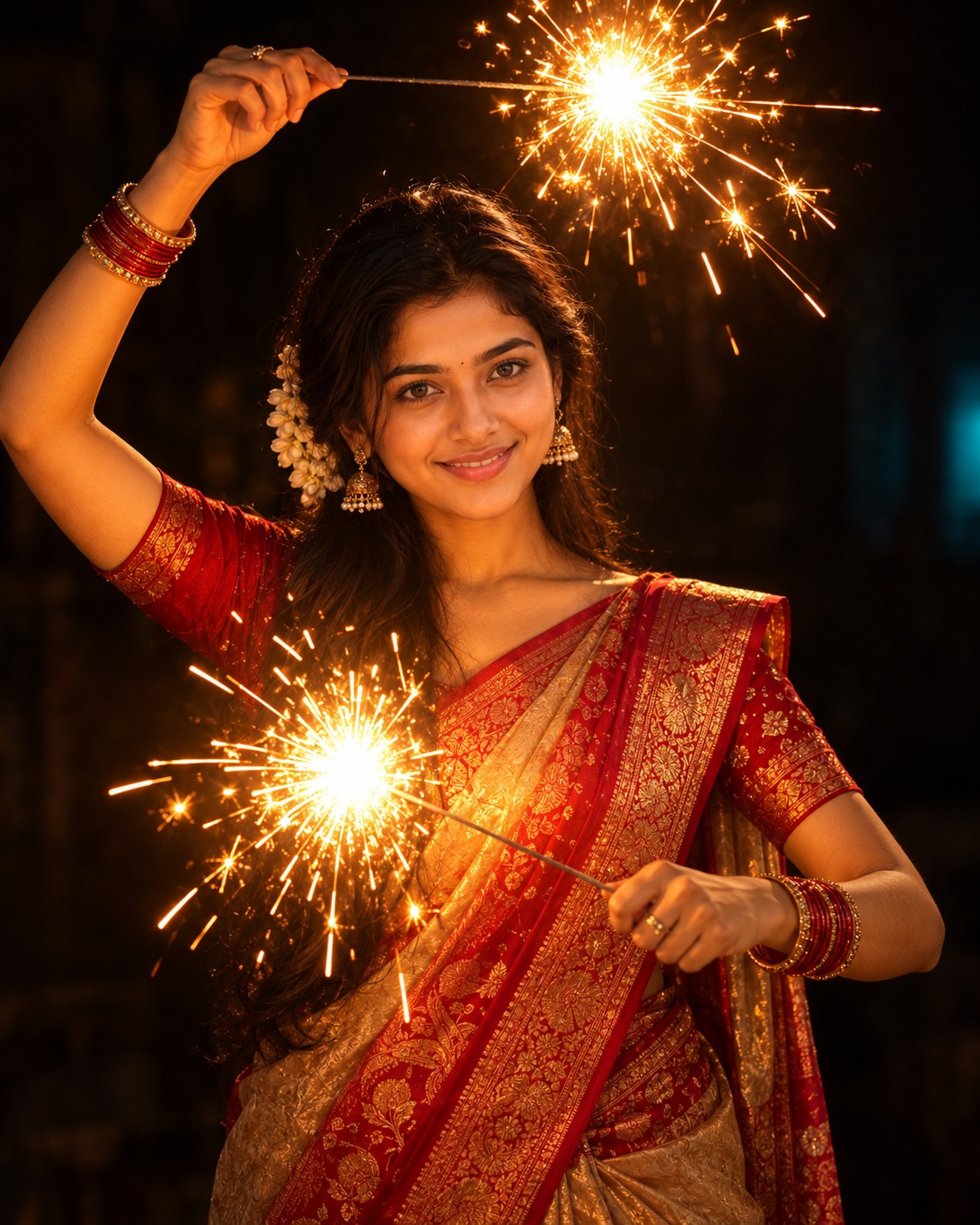
Festive Sparkler Portrait
The Festive Sparkler Portrait concept captures the excitement of a nighttime celebration through a traditional Indian outfit, a joyful expression, and the brilliant glow of two handheld sparklers. The visual style combines candid festive photography with dramatic lighting, rich warm colors, and a nearly black background. Instead of relying on elaborate decorations or a busy environment, the composition uses the sparklers as the central visual effects. Their intense light illuminates the woman and creates an energetic atmosphere that feels spontaneous, celebratory, and culturally familiar.
The woman stands in the center of the square composition, framed from her head to her waist or lower torso. This close framing makes her facial expression, clothing, jewelry, and hand positions easy to appreciate. Her body faces mostly forward with a subtle turn, while her head remains nearly upright. She looks directly at the camera with a broad, natural smile that shows her upper teeth. This expression communicates happiness and confidence, making the portrait feel like a genuine moment captured during a festive evening.
Her direct eye contact is an important part of the composition. It creates an immediate connection with the viewer and gives the photograph a friendly, inviting character. The open smile contrasts with the dark surroundings, helping her face become the main point of attention. Rather than presenting a formal studio pose, the concept emphasizes the lively feeling of someone enjoying a celebration while holding sparklers.
The arm arrangement gives the portrait its distinctive shape. Her left arm is raised above her head, with the elbow bent and the hand positioned in the upper-left area of the frame. This hand holds the upper sparkler, whose thin stem extends approximately horizontally toward the upper-center or right side. The raised arm introduces a strong diagonal movement and creates space around the woman’s face. It also makes the upper sparkler appear like a bright crown of light above her head.
Her right arm extends diagonally outward and downward toward the lower-right edge. The elbow is bent, and the hand holds the second sparkler across the lower part of her chest and abdomen. This lower position creates a contrasting diagonal line beneath the face. The two arms form an asymmetrical but balanced arrangement, making the composition feel active rather than rigid. The careful relationship between the hands, wrists, and sparklers is essential to the overall visual design.
The traditional outfit is built around a deep-red and pale-gold sari paired with a fitted red short-sleeved blouse. The red sections provide a rich foundation, while the pale-gold fabric introduces warmth and visual contrast. A broad red border crosses the torso diagonally, creating a strong line that complements the direction of the lower arm. The sari’s draping, fabric folds, woven motifs, and subtle metallic sheen give the clothing a detailed and authentic appearance.
The contrast between red and gold also connects the outfit with the color of the sparks. The deep-red fabric echoes the warm intensity of the celebration, while the pale-gold sections reflect the yellow-orange light. This relationship makes the clothing feel integrated with the environment instead of appearing separate from it. The sari remains visually prominent even where the light fades into shadow, allowing the traditional garment to contribute to the portrait’s identity.
Accessories provide additional detail around the face, wrists, and hands. Stacked metallic bangles decorate both wrists, reflecting the sparkler light in small bright highlights. Rings add detail to the hand holding the lower sparkler, while earrings frame the face. A small bindi introduces a traditional facial accent, and pale flowers tucked behind the right side of the hair create a delicate contrast against the darker hair and background.
These accessories are important because they help communicate the festive Indian styling without requiring extra decorations in the background. The bangles are particularly effective under warm light, as their reflective surfaces catch tiny highlights and reinforce the lively feeling of the scene. The earrings and bindi keep the face visually connected to the traditional outfit, while the flowers soften the overall appearance with a subtle decorative detail.
The two sparklers are the defining visual features. The upper sparkler sits above and slightly to the right of the woman’s head. Its brilliant yellow-white center produces sharp trails of light radiating upward, sideways, and diagonally outward. The second sparkler appears in front of the lower chest and abdomen, with its stem crossing the sari toward the lower-right hand. Its bright core creates another cluster of fine sparks, including several longer streaks that extend away from the center.
The different positions of the sparklers create a layered composition. The upper light draws attention toward the raised arm and the top of the portrait, while the lower light emphasizes the sari and the woman’s lower torso. Their diagonal relationship introduces movement and helps the square frame feel dynamic. The bright cores, sharp trails, and scattered points of light contrast with the dark background, giving the scene a strong visual rhythm.
Lighting is central to the character of this concept. The sparklers act as visible practical light sources, producing intense yellow-white highlights surrounded by amber-orange halos. Warm light spills across the forehead, cheeks, nose, chin, arms, jewelry, and sari. The upper sparkler contributes illumination around the upper face and raised arm, while the lower sparkler adds warmth across the lower face, chest, and fabric.
The highlights are intentionally strong. Small areas near the sparkler cores may appear almost white because of their intensity, while the surrounding glow takes on fiery orange and golden tones. This creates a realistic sense of brightness and gives the sparks their energetic appearance. The surrounding shadows remain deep, especially around the hair, beneath the arms, along the torso, and throughout the background. The contrast between illuminated areas and darkness gives the portrait its dramatic nighttime quality.
The color palette combines rich amber, fiery orange, golden yellow, deep red, pale gold, and near-black shadows. A faint cool blue-green area at the far right introduces a subtle contrast against the dominant warm tones. This small cool detail helps the background feel photographic rather than completely uniform, while remaining secondary to the main subject. The restrained color variation keeps the visual attention on the woman and the sparklers.
The background is almost entirely black, with indistinct details and no prominent scenery. This simplicity allows the spark trails to stand out clearly and prevents buildings, decorations, or other people from competing with the main subject. The dark negative space also makes the woman’s sari appear richer and the warm highlights more intense. The overall setting feels like a nighttime celebration captured in a candid moment.
The square one-to-one framing supports social media presentation and compact portrait displays. The woman remains centered, with her face in the upper-middle region, the raised hand and upper sparkler near the top, and the second sparkler crossing the lower torso. The limited headroom helps the composition feel close and energetic. Both hands remain visually important because they establish the relationship between the subject and the light sources.
Realistic details help preserve the photographic character. Natural skin texture, defined eyeliner, individual hair strands, visible woven patterns, reflective bangles, and rings give the image a sense of material quality. The spark trails should remain sharp enough to convey their movement, while the surrounding glow creates a softer atmospheric effect. Subtle digital noise and a slightly hazy finish contribute to the impression of a real nighttime photograph rather than a perfectly clean studio image.
The overall mood is cheerful, festive, and energetic. The woman’s smile establishes the emotional center, while the bright sparklers add movement and excitement. The red-and-gold sari connects the scene to traditional Indian celebrations, making the concept especially suitable for festival memories, festive portraits, cultural social media posts, and personalized greeting artwork.
Another strength of this concept is the balance between traditional styling and dramatic photographic effects. The sari, bangles, bindi, earrings, and hair flowers provide cultural detail, while the black background, intense light sources, and high contrast create a modern editorial appearance. These elements complement each other without requiring a crowded scene or elaborate props.
The concept can be useful for Diwali-themed portrait collections, festive profile pictures, celebration posters, personal keepsakes, digital invitations, and traditional fashion photography. It also offers visual inspiration for designers working with warm color palettes, practical light effects, and nighttime portrait composition. The combination of joyful expression and sparkling light gives the style an immediate sense of celebration.
Ultimately, the Festive Sparkler Portrait concept is defined by the connection between expression, clothing, light, and movement. The centered pose creates a clear focal point, the asymmetric arms add energy, and the two sparklers illuminate the traditional outfit with warm reflections. The near-black background keeps the scene focused, while the rich colors and realistic textures create a memorable festive atmosphere. Every element supports the same purpose: presenting a joyful traditional portrait that feels vivid, personal, and visually engaging.
[[[
REFERENCE ANALYSIS
- Composition: Square 1:1 nighttime portrait, woman centered, framed from head to waist/lower torso.
- Pose: Left arm raised above her head holding the upper sparkler; right arm extended diagonally toward the lower-right, holding the second sparkler across her torso.
- Expression: Direct eye contact, broad natural smile showing upper teeth, cheerful festive mood.
- Outfit: Traditional deep-red and pale-gold sari, fitted red short-sleeved blouse, broad diagonal red border, and detailed woven fabric.
- Accessories: Metallic bangles stacked on both wrists, rings, earrings, small bindi, and pale flowers tucked behind the right side of her hair.
- Lighting: Two sparklers serve as the primary light sources. Intense yellow-white cores create amber-orange highlights on the face, arms, jewelry, and sari.
- Color grading: Rich amber, fiery orange, deep red, golden yellow, near-black shadows, and a faint cool blue-green area at the right edge.
- Background: Almost completely black, with indistinct details and no prominent scenery.
- Effects: Bright clipped sparkler cores, sharp radiating spark trails, amber bloom, veiling glare, warm light spill, and subtle digital noise.
- Style: Candid Indian festive portrait photography, dramatic practical lighting, natural facial details, and high contrast.
MASTER PROMPT
Use supplied ref image as master blueprint. Replace only the reference character’s face with the supplied user identity. COMPLETELY IGNORE the user’s original photo pose and body; force the user into the exact body pose, hand placement, and posture of the reference character. Maintain exact scale, proportion, crop, visibility.
Maintain exact reference preservation. Preserve 1000% of all visual information, including darkness, grading, mood, lighting, shadows, contrast, saturation, composition, environment, objects, background, text, props, rendering, outfit (exact style, color, and condition), reference pose (exact body position, hand placement, and expression), vibe (exact emotional tone), and natural human anatomy (correct head-to-body ratio, proportional hands and limbs, no distortions). Output must look IDENTICAL to the reference except face swap. Do NOT brighten, enhance, modify, change outfit, reference pose, or vibe.
IDENTITY LOCK: Replace only the woman’s facial identity with the supplied user’s face. Preserve the user’s recognizable facial structure, eyes, nose, lips, skin tone, and distinctive features. Naturally adapt the face to the reference’s direct eye contact, broad cheerful smile, head angle, and strong amber sparkler illumination. Maintain realistic facial proportions and natural skin texture. Do not transfer the user’s original hairstyle, body, clothing, pose, or background.
POSE LOCK: Reproduce the exact centered standing pose. The woman’s torso faces mostly forward with a subtle turn. Her head remains nearly upright, chin approximately level, eyes looking directly at the camera, and mouth in a broad natural smile showing the upper teeth. Her left arm is raised above her head, elbow bent, with her hand in the upper-left quadrant holding a thin sparkler stem that extends nearly horizontally toward the upper-center/right.
Her right arm extends outward and downward toward the lower-right edge, elbow bent, holding the second sparkler across the front of her lower chest and abdomen. Preserve the exact asymmetric arm arrangement, wrist angles, finger grips, and natural anatomical proportions. Do not swap the hands or sparkler positions.
OUTFIT LOCK: Preserve the original deep-red and pale-gold traditional Indian sari, fitted red short-sleeved blouse, broad red diagonal border, and original draping across the torso. Retain the original fabric folds, woven motifs, subtle metallic sheen, and color variations. Keep the stacked metallic bangles on both wrists, rings on the lower-right hand, decorative earrings, small forehead bindi, and pale flowers tucked behind the right side of the head. Do not redesign, recolor, remove, or add accessories.
SPARKLER LOCK: Preserve exactly two handheld sparklers. The upper sparkler remains above and slightly to the right of the woman’s head, with its stem held by the raised left hand and extending approximately horizontally. Its brilliant yellow-white core produces sharp radial sparks pointing upward, sideways, and diagonally outward. The second sparkler remains in front of the lower chest and abdomen, slightly left of center, with its stem crossing the sari toward the lower-right hand. Its intense white-yellow core produces fine, radiating sparks and several longer streaks. Preserve both sparkler cores, their relative size and placement, the diagonal relationship between them, and the original spark-trail patterns.
LIGHTING LOCK: Use the two sparklers as the visible practical light sources. Preserve intense yellow-white clipped highlights at their centers, broad amber-orange halos, warm light spill, and localized illumination across the forehead, cheeks, nose, chin, arms, jewelry, and sari. The upper sparkler illuminates the upper face and raised arm; the lower sparkler casts warm light over the lower face, chest, and sari. Maintain deep shadows around the head, beneath the arms, along the torso, and throughout the background. Do not replace the practical lighting with studio lighting or evenly illuminate the entire image.
COLOR AND MOOD LOCK: Retain the strong amber-orange cast, fiery golden highlights, rich deep-red fabric, pale-gold sari section, near-black background, and faint cool blue-green region at the far right. Preserve the original high contrast, warm saturation, localized overexposure, subtle digital noise, and slightly hazy photographic finish. Do not neutralize the warm tones, brighten the shadows, apply a new color grade, or reduce the sparkler bloom. Keep the joyful, candid, celebratory mood unchanged.
BACKGROUND AND FRAMING LOCK: Preserve the square 1:1 composition, original camera viewpoint, natural perspective, centered subject, and original crop. Keep the raised hand in the upper-left quadrant, upper sparkler near the top-center/right, face near the upper-middle, lower sparkler in front of the lower-center torso, and right hand near the right edge. Maintain the original limited headroom and dark negative space. Preserve the faint cool-toned patch at the right edge and indistinct background details. Do not zoom, recenter, expand the canvas, alter the crop, or add scenery.
DETAIL AND ANATOMY LOCK: Maintain realistic facial features, natural skin texture, defined eyeliner, fine hair strands, detailed flowers, woven sari patterns, reflective metallic bangles, rings, and anatomically correct hands. Preserve the original spark trails, bright cores, amber bloom, optical glare, and localized overexposure. Avoid artificial facial brightness or excessive skin smoothing. Keep natural head-to-body proportions, correct finger count, realistic wrist angles, and anatomically proportional arms.
The final image must look IDENTICAL to the reference except for the facial identity replacement. Preserve the exact two-sparkler arrangement, arm positions, direct gaze, broad smile, red-and-gold sari, jewelry, flowers, warm lighting, near-black background, square crop, and festive nighttime atmosphere. Do not add people, decorative lights, scenery, props, or visual elements absent from the reference.
EDITABLE VARIABLES
- [USER IDENTITY]: Supplied user’s facial identity and distinctive features.
- [OUTFIT]: Exact red-and-pale-gold sari, red blouse, bangles, rings, earrings, bindi, and hair flowers.
- [TEXT]: None.
- [OBJECT CHANGE]: None — preserve both sparklers.
- [POSE CHANGE]: None — preserve the exact arm positions, hand assignments, direct gaze, and smile.
- [ADDITIONAL EDIT]: Face replacement only.
NEGATIVE PROMPT
identity loss, wrong face, original character face, different facial features, user’s original pose, changed body posture, wrong arm positions, swapped hands, swapped sparklers, missing sparkler, extra sparkler, incorrect sparkler placement, altered spark trails, missing sparks, weak sparkler glow, dim sparkler cores, reduced bloom, removed overexposure, artificial studio lighting, evenly lit background, bright background, lifted shadows, neutral color grading, reduced amber cast, changed sari, different outfit, altered sari drape, changed blouse color, missing bangles, missing rings, missing earrings, missing bindi, missing flowers, added jewelry,
extra fingers, missing fingers, deformed hands, distorted wrists, unnatural arms, oversized head, tiny hands, disproportionate limbs, unnatural body proportions, altered facial expression, closed-mouth smile, looking away from camera, changed gaze, changed camera angle, changed crop, rectangular composition, zoomed image, recentered subject, expanded canvas, added people, decorative lights, flowers in background, buildings, scenery, props, artificial glow, excessive beauty retouching, plastic skin, excessive sharpening, oversaturated skin, altered atmosphere, different photographic style. ]]]