
Indian Wedding Portrait
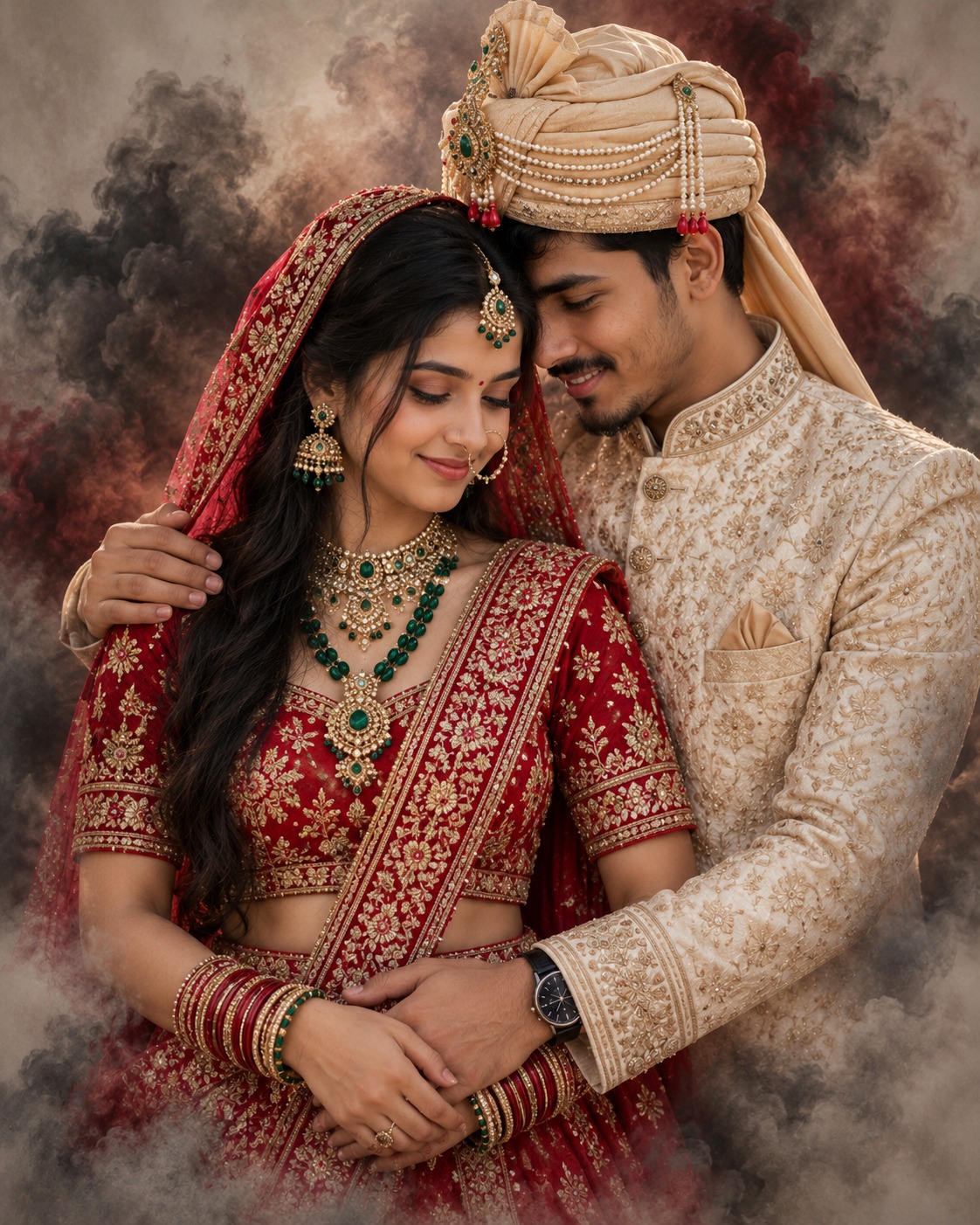
The Indian wedding portrait concept focuses on the intimate connection between a bride and groom dressed in elaborate traditional wedding clothing. It presents a romantic moment in which the couple stands close together, creating a sense of trust, affection, and emotional warmth. Rather than relying on dramatic gestures or exaggerated expressions, the composition communicates its story through subtle body language, carefully positioned hands, gentle head movements, and the natural closeness of the two people. Every major visual element contributes to the feeling of a timeless Indian wedding photograph.
The bride occupies the left side of the composition, while the groom stands slightly behind her on the right. This arrangement creates a balanced visual relationship between the two subjects. Their bodies remain close, and their overlapping positions make the embrace feel natural and personal. The bride’s upright posture gives her a graceful appearance, while the groom’s inward lean creates a protective and affectionate presence. Their placement also helps the viewer understand the emotional connection immediately, without needing additional objects or visual storytelling elements.
The bride’s head is tilted gently downward and toward the groom. Her lowered eyes and subtle smile communicate calmness, modesty, and quiet happiness. Her expression is intentionally restrained rather than theatrical. This small facial detail is important because it gives the portrait an authentic wedding-day atmosphere. The lowered gaze also directs attention toward the couple’s connection, making the interaction feel private despite the formal presentation of their clothing and jewelry.
The groom’s head angles downward toward the bride’s hairline. Their foreheads touch or remain extremely close, creating the central emotional feature of the portrait. This gesture represents affection, companionship, and a shared moment of tenderness. His posture follows the bride’s head angle, forming a gentle diagonal relationship between their faces. Together, these details give the composition a recognizable romantic character without requiring a kiss, a broad smile, or an exaggerated pose.
The couple’s hands are equally important to the overall design. One of the groom’s hands rests naturally on the bride’s outer shoulder, with the fingers spread over the red fabric. His other arm wraps around her waist, bringing his forearm across the lower front of her abdomen. Their hands overlap near the center of the frame, adding another point of connection between the two figures. The bride’s colorful bangles and the groom’s embroidered cuff make this area visually rich. These small details also help the viewer appreciate the craftsmanship of the clothing and accessories.
The bride’s outfit is built around a rich crimson-red bridal ensemble. The deep red fabric creates a strong focal point against the lighter background and the groom’s ivory clothing. Gold and silver-toned floral embroidery covers the garment, producing intricate patterns that suggest traditional craftsmanship and luxurious wedding attire. The short embroidered sleeves, decorated neckline, and broad diagonal border create several layers of texture. The red veil behind her head completes the bridal appearance and visually connects her clothing to the darker burgundy tones in the surrounding atmosphere.
The embroidery is not merely decorative. It creates depth across the fabric, helping the garment appear dimensional rather than flat. Metallic threadwork catches the available light in small areas, while the deeper red sections retain the richness of the original color. The combination of fine patterns and broad embroidered borders provides visual variety without disrupting the overall harmony of the outfit. The traditional styling makes the portrait suitable for wedding memories, bridal editorials, anniversary artwork, and culturally inspired photography collections.
The bride’s jewelry adds another layer of detail. Antique-gold necklaces sit in multiple layers around her neck, with darker green bead strands and central pendants introducing a rich emerald accent. Ornate earrings frame the sides of her face, while the forehead ornament draws attention toward the center of her hairline. A red bindi adds a familiar traditional detail, and the nose ring with its fine connecting chain contributes to the elaborate bridal styling. Colorful bangles complete the ensemble by introducing smaller areas of red, green, gold, and other decorative tones around the hands.
These accessories work together as a coordinated collection rather than separate focal points. The gold establishes warmth, the green gemstones create contrast, and the red details connect the jewelry to the bridal outfit. Reflections on the metallic surfaces provide a realistic sense of material quality. The jewelry is detailed enough to enrich the composition while remaining subordinate to the couple’s faces and their intimate pose.
The groom wears a warm ivory and cream sherwani with intricate floral embroidery across its surface. Its high embroidered collar gives the upper body a formal, structured appearance. Broad decorative cuffs, a light pocket square, and a dark wristwatch introduce smaller details that make the outfit feel complete. The soft cream color complements the bride’s vivid red ensemble and provides a visual balance between the two subjects. The groom’s clothing feels luxurious without competing with the bride’s jewelry and veil.
His champagne-beige turban is another defining feature. Multiple horizontal folds create a layered fabric structure, while the gathered ornament at the front provides a decorative center. A green jeweled accessory adds a subtle color connection with the bride’s necklace details. Pearl-like hanging ornaments and red tassels bring additional texture and movement to the turban. Trailing fabric behind the head adds depth to the silhouette and makes the headwear appear substantial and carefully arranged.
The background is intentionally restrained. A pale beige-gray surface surrounds the couple, providing enough contrast to separate the light sherwani from the environment. Around the outer edges, layered clouds of charcoal-gray, warm brown, gray, and muted burgundy create a soft smoky frame. The darker smoke is concentrated behind the heads and shoulders, while the edges fade gradually into a lighter neutral tone. This arrangement helps keep attention on the central figures without introducing a recognizable location that could distract from the wedding scene.
The smoke has a soft, atmospheric quality rather than the hard edges of a solid graphic border. Semi-transparent layers, wispy edges, and gradual changes in density give the background a sense of depth. Some of the lower clothing and outer arms disappear partially into the smoky surroundings. This creates a feathered transition between the subjects and the background, helping the portrait feel like a carefully composed fine-art photograph.
Lighting plays a major role in maintaining the realism of the scene. Soft, diffused frontal illumination reveals the bride’s facial features and the groom’s expression without creating harsh shadows. Gentle highlights on the jewelry reveal its reflective surfaces, while subtle shadows beneath the turban add depth to the groom’s headwear. The light also helps distinguish embroidered patterns, silk folds, and layered fabrics. The overall effect remains balanced and natural rather than excessively bright or artificially glowing.
The color palette combines vivid bridal red with warm ivory, champagne beige, antique gold, emerald green, charcoal gray, and muted burgundy. Each color serves a specific purpose. Red provides the strongest focal point, ivory establishes balance, gold adds richness, and green introduces controlled contrast. The smoky background connects the warmer colors with darker neutral tones. Because the palette is carefully coordinated, the portrait feels luxurious without becoming visually chaotic.
The camera composition uses a vertical two-to-three portrait format with a predominantly frontal viewpoint and a medium-close crop. The bride remains slightly left of center, and the groom occupies the space immediately behind her on the right. Their heads sit in the upper-middle region, while their overlapping hands remain below the center. This distribution creates a clear visual path from their faces to their embrace and then to the embroidery and accessories. The framing preserves the intimacy of the pose without requiring a full-body view.
Selective focus contributes to the fine-art photography aesthetic. The couple remains the sharpest part of the composition, allowing facial details, embroidery, and jewelry to remain prominent. The smoke is softer, which separates the subjects from their surroundings and creates atmospheric depth. Natural skin texture, defined hair strands, realistic beard detail, and controlled reflections help maintain a photographic appearance. The overall presentation emphasizes authentic materials and human proportions rather than exaggerated retouching.
A major characteristic of this concept is the consistency of its visual elements. The original head angles, body positions, hand placement, outfit details, lighting direction, color relationships, background smoke, and framing all contribute to a unified scene. When facial identity is adapted to the composition, the face needs to appear naturally integrated with the established angle, expression, and illumination. This preserves the relationship between the subjects and the visual details that give the photograph its distinctive character.
The concept is especially useful for people who appreciate traditional Indian wedding styling presented through polished editorial photography. It can serve as inspiration for bridal portrait collections, wedding albums, romantic couple artwork, anniversary keepsakes, engagement displays, personalized gifts, and social media posts. The composition also suits wedding photography portfolios and visual mood boards focused on traditional clothing, elaborate jewelry, and atmospheric portraiture.
Another benefit is the balance between cultural detail and emotional storytelling. The elaborate outfits communicate celebration and tradition, while the close embrace creates a personal connection. Neither element overwhelms the other. The bride and groom remain the heart of the composition, and their clothing, accessories, and surroundings support their story. This combination gives the portrait a timeless quality that can appeal to viewers who prefer elegant wedding imagery over highly stylized or heavily decorated designs.
Overall, this Indian wedding portrait concept combines traditional bridal fashion, realistic textures, a romantic embrace, refined lighting, and a smoky neutral background. Its visual strength comes from the relationship between the subjects and the precision of the details surrounding them. From the bride’s crimson embroidered outfit to the groom’s champagne turban, every element reinforces the same atmosphere of intimacy, elegance, and celebration. The result is a cohesive fine-art wedding aesthetic designed to preserve the emotional importance of the couple while showcasing the richness of Indian wedding traditions.
[[[
REFERENCE ANALYSIS
- Composition: Vertical 2:3 Indian wedding portrait, medium-close framing, bride on the left and groom behind her on the right.
- Bride’s pose: Standing upright, head tilted downward toward the groom, lowered gaze, subtle smile, arms positioned near her abdomen.
- Groom’s pose: Leaning inward with his forehead touching or nearly touching the bride’s hairline. One hand rests on her shoulder; the other arm wraps around her waist, with their hands overlapping near her abdomen.
- Outfit lock: Rich crimson-red embroidered bridal outfit and red veil, ornate cream-and-gold sherwani, champagne-beige layered turban, embroidered cuffs and dark wristwatch.
- Jewelry: Elaborate antique-gold bridal jewelry, green gemstones, layered necklaces, forehead ornament, earrings, nose-ring chain, colorful bangles, and the groom’s pearl-like turban ornaments with red tassels.
- Lighting: Soft frontal illumination, gentle facial highlights, subtle shadows beneath the turban, and controlled reflections on jewelry.
- Color grading: Warm beige and champagne tones, vivid bridal red, emerald-green accents, antique gold, and restrained charcoal shadows.
- Background and effects: Pale beige-gray background surrounded by layered charcoal, gray, warm-brown, and muted-burgundy smoke. Feathered edges partially obscure the lower body.
- Style: Photorealistic fine-art wedding photography, detailed fabric embroidery, natural skin texture, selective focus, and romantic editorial composition.
- Critical preservation: Maintain the exact embrace, head angles, outfit, jewelry, lighting, smoky border, subject placement, and original image proportions. Only the supplied user’s facial identity should change.
MASTER PROMPT
Use the supplied reference image as the master blueprint. Replace only the reference characters’ facial identities with the supplied user identities, using the user’s face or faces according to the corresponding subject positions. COMPLETELY IGNORE the user’s original photo pose and body; force the user into the exact body pose, hand placement, and posture of the reference character. Maintain exact scale, proportion, crop, visibility.
1000% REFERENCE PRESERVATION — FACE REPLACEMENT ONLY.
Recreate the reference image as faithfully as possible, preserving all original visual information, including darkness, grading, mood, lighting, shadows, contrast, saturation, composition, environment, objects, background, text, props, rendering style, outfit (exact style, color, and condition), reference pose (exact body position, hand placement, head angles, and expression), vibe (exact emotional tone), and natural human anatomy (correct head-to-body ratio, proportional hands and limbs, no distortions). Output must look IDENTICAL to the reference except for the face swap. Do NOT brighten, enhance, modify, change the outfit, reference pose, or vibe.
POSE AND COMPOSITION LOCK: Preserve the bride standing slightly left of center and the groom immediately behind her on the right. Keep both subjects in the original compact embrace. The bride’s torso remains upright and mostly front-facing, her head tilted downward and inward toward the groom, eyes lowered, with a subtle, composed smile. The groom leans his head downward and inward,
maintaining the exact forehead-to-hairline contact or near-contact shown in the reference. His upper hand rests across the bride’s outer shoulder, with fingers naturally spread over the red fabric. His other arm wraps around her waist, with his forearm crossing the lower front of her abdomen. Preserve the overlapping hands, partially obscured fingers, colorful bangles, and embroidered cuff in their original positions. Do not invent new hand gestures or reconstruct hidden anatomy unnecessarily.
IDENTITY LOCK: Use the supplied user face as the identity source. Preserve the user’s recognizable facial structure, natural facial proportions, eye shape, nose, lips, skin tone, and distinctive features. Adapt the face naturally to the reference character’s head angle, expression, lighting, and artistic treatment. Maintain realistic head-to-body proportions. Do not copy the user’s original body, clothing, posture, or background. Do not alter the reference characters’ body shapes or enlarge the head.
EXACT BRIDAL OUTFIT: Preserve the original rich crimson-red bridal blouse and draped garment, densely decorated with gold and silver-toned floral embroidery, short embroidered sleeves, the broad ornate diagonal border, layered embroidered neckline, and red veil behind the bride’s head. Retain the original layered gold-toned necklaces with dark-green bead strands, central pendants, ornate earrings, forehead ornament, red bindi, nose ring with fine chain, and colorful bangles. Do not simplify, remove, redesign, or recolor any garment or accessory.
EXACT GROOM OUTFIT: Preserve the original warm ivory and cream sherwani with intricate all-over floral embroidery, high embroidered collar, ornate broad cuffs, light pocket square, and dark wristwatch. Maintain the champagne-beige turban with its precise layered horizontal folds, gathered front ornament, green jeweled accessory, hanging pearl-like ornaments, red tassels, and trailing fabric behind the head. Preserve every visible fabric fold, embroidery pattern, accessory, and color relationship.
LIGHTING AND COLOR LOCK: Maintain the original soft, diffused frontal lighting, gentle highlights across the bride’s face and jewelry, subtle shadows beneath the groom’s turban, and natural shadow gradation. Retain the original warm-neutral color grading, vivid crimson bridal red, champagne-beige fabric, warm ivory clothing, antique gold, emerald-green accents, charcoal-gray shadows, and muted burgundy tones. Do not apply automatic exposure correction, artificial glow, extra vibrance, or a new cinematic color grade. Keep the face naturally integrated into the existing light and shadows without brightening it independently.
SMOKE AND BACKGROUND LOCK: Preserve the plain pale beige-gray background and the irregular cloud-like smoke frame surrounding the couple. Keep the dense charcoal-gray, warm-brown, and muted-burgundy smoke behind their heads and shoulders, gradually fading into pale neutral gray-beige at the perimeter. Maintain the original soft, layered, semi-transparent smoke, wispy gray edges, atmospheric haze, feathered vignette, and partial concealment of the lower clothing and outer arms. Do not remove, brighten, reposition, sharpen excessively, or redesign the smoke.
CAMERA AND FRAMING LOCK: Maintain the original vertical 2:3 portrait, predominantly frontal camera viewpoint, natural three-quarter body perspective, medium-close crop, original headroom, subject scale, and negative space. Keep the bride on the left, groom on the right, heads in the upper-middle region, and overlapping hands below the center. Preserve the exact visible boundaries and smoke-obscured areas. Do not zoom, recenter, expand the canvas, change the viewpoint, or reveal hidden legs, feet, or clothing.
DETAIL AND RENDERING LOCK: Preserve high-detail facial integration, natural skin texture, defined beard hairs, fine hair strands, metallic jewelry reflections, green gemstone details, pearl-like beads, intricate embroidery, layered silk and brocade textures, and realistic hands. Keep the subjects sharply rendered and the smoke softer than the couple. Preserve the reference’s polished fine-art Indian wedding photography aesthetic without beautification, stylization changes, or excessive retouching.
The final image must reproduce the reference as closely as possible, with the same romantic forehead-to-forehead pose, restrained expressions, original outfits, jewelry, smoke, lighting, color palette, and framing. No added people, removed objects, new decorations, text, logos, props, or background changes. Change only the requested facial identity while preserving natural anatomy and every other visible reference detail.
EDITABLE VARIABLES
- [USER IDENTITY]: Supplied user’s face; preserve recognizable facial features and natural proportions.
- [OUTFIT]: Exact original red bridal ensemble and cream embroidered sherwani, including all accessories.
- [TEXT]: None. Preserve any meaningful text if present in a source.
- [OBJECT CHANGE]: None.
- [POSE CHANGE]: None. Reference pose is locked.
- [ADDITIONAL EDIT]: Face replacement only.
NEGATIVE PROMPT
identity loss, wrong identity, different face, original character face, user’s original body pose, user’s original posture, wrong head angle, changed gaze, changed expression, altered embrace, incorrect forehead contact, wrong hand placement, missing hand on shoulder, incorrect arm around waist, separated overlapping hands, extra fingers, missing fingers, deformed hands, bad anatomy, unnatural body proportions, oversized head, tiny hands, disproportionate limbs, distorted face, altered body shape, different outfit, changed clothing color, changed embroidery, missing jewelry, redesigned turban, altered fabric folds, cleaner or newer outfit, missing watch, removed accessories, altered smoke, missing smoke, brighter background, lifted shadows,
changed lighting, changed color grading, oversaturation, orange color cast, excessive glow, auto-corrected exposure, beautification, plastic skin, excessive smoothing, unwanted photorealism shift, mixed art styles, altered crop, zoomed image, recentered subjects, enlarged subjects, expanded canvas, changed camera angle, reconstructed hidden areas, added legs or feet, new background, extra people, removed people, added props, flowers, text, logos, watermark, simplified embroidery, lost fine details, changed emotional tone, generic romantic aesthetic, modernized clothing, polished replacement outfit, different composition, different rendering, unnatural face integration. ]]]