
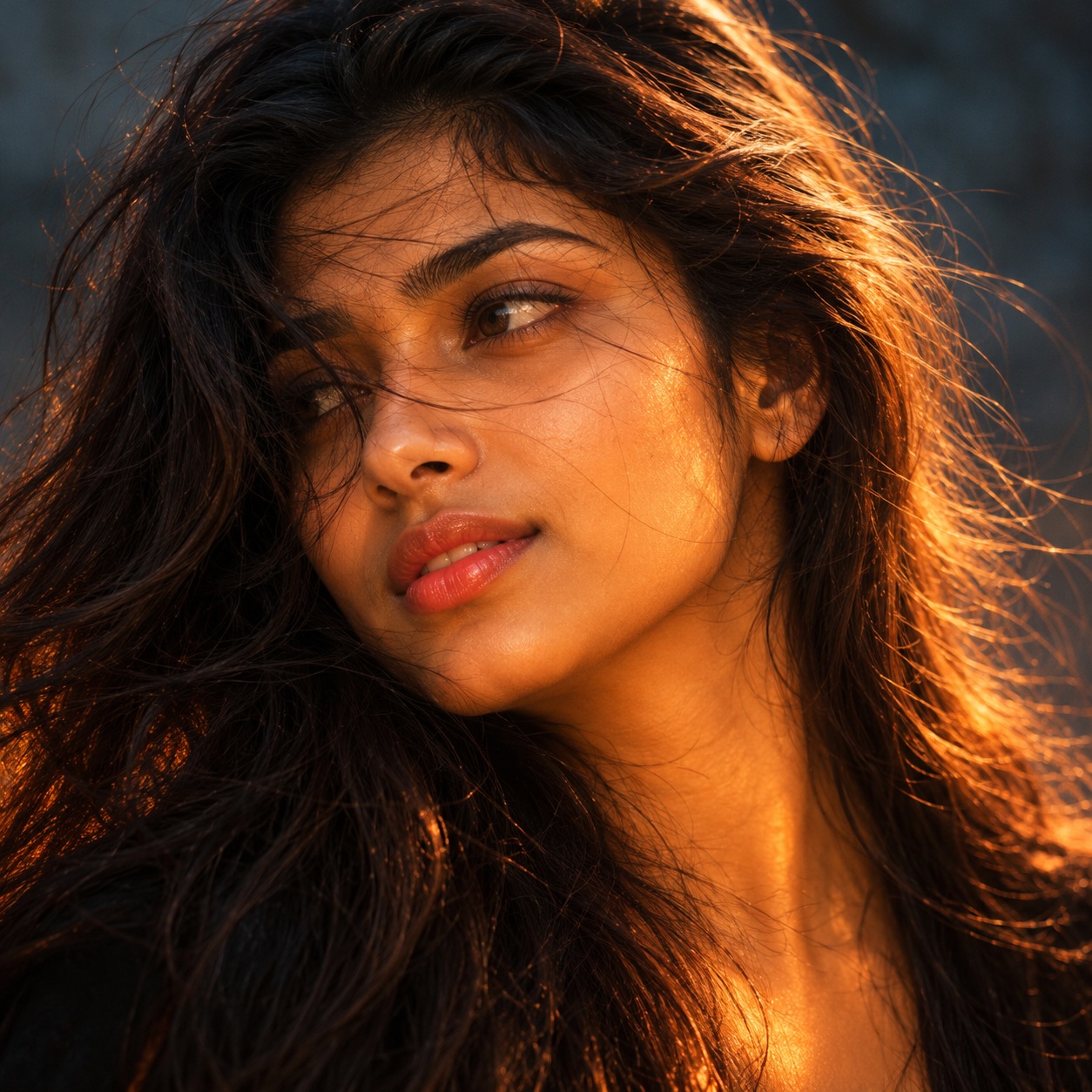
Cinematic Dark Portrait
The Cinematic Dark Portrait concept combines dramatic beauty photography, intimate facial framing, and rich warm lighting to create a visually striking portrait. The entire composition is built around the face, with dark, untamed hair, expressive eyes, glossy lips, and a powerful contrast between amber illumination and deep shadows. Rather than presenting a conventional, evenly lit beauty photograph, this style embraces darkness, asymmetry, and carefully controlled highlights to create a sophisticated editorial appearance.
The main subject is a woman photographed at extremely close range. Her face occupies most of the frame, making the smallest details important to the overall visual effect. The viewer’s attention is drawn toward the visible eye, the bridge of the nose, the lips, and the illuminated areas of the cheek and chin. This tight framing gives the portrait an intimate quality, as though the viewer is observing a quiet, unguarded moment rather than a conventional posed photograph.
When a personal reference photograph is available, facial identity is an important part of the concept. The natural face shape, eyes, eyebrows, nose, lips, jawline, cheekbones, and skin tone contribute to the subject’s recognizable appearance. The dramatic lighting and partial hair coverage become part of the photographic styling rather than reasons to redesign the face. The intended result is a portrait in which the individual remains recognizable while the lighting, framing, and atmosphere provide a distinctly artistic character.
The head is tilted diagonally toward the left side of the composition, creating an asymmetrical silhouette. Her face turns in the same general direction, presenting a three-quarter view instead of a perfectly frontal position. The chin is slightly raised, revealing part of the underside of the jaw and the elongated line of the neck. This angle adds sculptural definition to the face and allows the shadows to move naturally across the visible features.
The expression is restrained and serious. One eye remains more visible than the other, with the far eye partly concealed by strands of hair and shadow. The visible eye looks sideways rather than directly at the camera. A tiny catchlight adds life to the eye, while the lowered intensity of the expression contributes to the mysterious atmosphere. The lips are slightly parted, revealing only a small glimpse of the upper teeth. Their rich reddish-orange or crimson color provides a vivid focal point against the surrounding darkness.
Hair plays an unusually important role in this Cinematic Dark Portrait. It is thick, voluminous, and naturally tousled, with shades ranging from deep brown to nearly black. Loose strands cross the forehead and partially cover the eye, nose, and cheek. Some strands appear sharply defined where the light catches them, while others remain softly blurred in the foreground. This layered arrangement gives the composition a sense of depth and makes the face feel integrated into the overall visual design.
The hair is not intended to look perfectly arranged or carefully combed. Its irregular shape creates a spontaneous, editorial quality. Fine flyaway strands extend beyond the crown, forming delicate lines against the cooler background. Copper and reddish-brown highlights appear along selected strands, introducing warmth without turning the entire hairstyle orange. These small details help distinguish the illuminated hair from the charcoal shadows surrounding it.
Lighting establishes the signature character of the portrait. A strong amber-orange light comes from the front-right side of the composition, crossing the face at an oblique angle. It illuminates selected areas of the forehead, visible eye region, nose, cheek, lips, chin, and neck. The light creates a sculptural pattern in which some facial features glow warmly while others disappear into darkness.
The opposite side of the face falls into deep charcoal-brown and near-black shadow. This contrast is known as chiaroscuro, a visual approach that uses the relationship between light and darkness to create depth and drama. In this portrait, the shadow is not merely an absence of detail. It becomes an active compositional element, helping define the facial silhouette and emphasizing the limited areas of illumination.
The lighting also interacts with the hair. Individual strands catch bright copper reflections, while thicker sections remain almost completely dark. Hair crossing the face creates irregular shadows that add graphic interest to the forehead and upper cheek. A concentrated highlight along the chin and neck creates continuity between the illuminated facial features and the darker lower portion of the frame. These details make the light feel directional and intentional rather than uniformly applied.
Color grading creates another important layer of the concept. Fiery amber, burnt orange, and copper dominate the illuminated areas. The lips introduce a deeper crimson-red accent, while charcoal-black shadows establish a rich dark foundation. In contrast, the background uses muted blue-gray or teal-gray tones. This warm-versus-cool relationship helps the face stand out without requiring a bright or complicated backdrop.
The background remains deliberately minimal. It is softly blurred, with subtle tonal variations rather than recognizable objects or elaborate scenery. A slightly lighter blue-gray area around the hair silhouette provides separation between the subject and the surrounding darkness. Because the background contains little visual information, the viewer can concentrate on the face, hair, expression, and lighting. The understated setting also makes the portrait suitable for editorial layouts and artistic profile photography.
Skin texture is treated with a natural photographic approach. Subtle pores, tonal variations, and realistic surface detail help preserve the character of the face. The illuminated cheek and chin may show a gentle sheen, while the lips feature controlled glossy highlights. The intended finish is polished but not excessively retouched. Plastic-looking skin, exaggerated shine, and heavy smoothing would weaken the realism that makes this style appealing.
The optical treatment adds softness without sacrificing essential detail. Selective focus places particular emphasis on the visible eye, nose, and lips, while the foreground hair creates additional layers of depth. The background remains softly defocused. Gentle diffusion and subtle highlight halation soften the brightest amber areas, producing an atmospheric, film-inspired quality. Fine natural grain can contribute texture, provided it remains restrained and does not obscure the facial features.
The vertical 9:16 composition reinforces the intimate character of the image. The head approaches the upper and side edges, and the face occupies almost the entire available space. The visible eye sits around the upper-middle region, the nose occupies the central area, and the lips fall slightly below it. The chin transitions into the narrow illuminated neck and nearly black shoulders. This arrangement creates a strong visual path through the face while preserving the irregular outline of the hair.
The signature is an optional graphic element. The reference concept includes a small, pale cursive name near the lower-right corner. That detail can be retained when reproducing the original graphic, replaced with a supplied name, or omitted for a clean portrait. Its delicate scale keeps the signature secondary to the subject. Additional text, logos, or decorative elements are unnecessary because the composition already contains strong visual character.
The creative purpose of this Cinematic Dark Portrait is to communicate emotion through photography rather than elaborate storytelling. The sideways gaze suggests introspection, the partially concealed face creates intrigue, and the warm light introduces intensity. The dark background and rich shadows give the portrait a luxurious, cinematic atmosphere, while the natural facial details maintain a believable human presence.
This visual style can be used for fashion editorials, beauty photography portfolios, artistic profile pictures, dramatic social media portraits, music-inspired visual identities, and personal photography collections. Its tight crop makes it particularly effective when the face is intended to dominate a layout. The restrained background also provides flexibility for editorial design, where the portrait may appear alongside typography or other carefully selected visual elements.
Ultimately, the strength of the concept comes from balance. The orange light is intense but localized, the shadows are deep but purposeful, and the hair obscures the face without eliminating its essential expression. The cool background prevents the warm tones from becoming overwhelming. Each element contributes to a cohesive photographic style that feels intimate, mysterious, elegant, and professionally composed.
[[[
A. REFERENCE ANALYSIS
- Style: Photorealistic fine-art beauty photography, cinematic low-key portraiture, dark romantic editorial aesthetic.
- Camera: Extreme close-up, near eye-level with a subtle low-angle impression, three-quarter facial view.
- Pose: Head tilted diagonally toward image-left, face turned toward image-left, chin slightly raised, neck extending into darkness.
- Face: One eye partially visible through the hair, sideways gaze, tiny bright catchlight, slightly parted lips with a hint of upper teeth.
- Hair: Thick, messy dark brown to nearly black hair, voluminous crown, loose strands crossing the forehead, eye, nose and cheek; copper-orange highlights.
- Lighting: Intense directional amber-orange light from image-right/front, dramatic chiaroscuro, deep charcoal shadows on the opposite side.
- Background: Minimal, blurred blue-gray backdrop with no identifiable objects.
- Effects: Soft-focus diffusion, subtle highlight halation, natural film-like texture, shallow depth of field and strong foreground hair layering.
- Composition: Vertical 9:16 portrait, face filling most of the frame, tight head-and-neck crop, asymmetrical framing.
- Color palette: Fiery amber, copper, burnt orange, crimson lips, charcoal-black shadows and cool teal-gray background.
- Text: Small pale cursive “Gina” signature near the lower-right corner. Replace it with a user-provided name if desired.
B. MASTER PROMPT — COPY READY
Photorealistic Fine-Art Portrait Photography, Cinematic Moody Portraiture, Dramatic Low-Key Beauty Photography, Intimate Editorial Photography, Dark Romantic Aesthetic, Analog Cinema Still Look, Professional Portrait Photography, Natural Photographic Realism, Highly Detailed Facial Rendering.
[USER IDENTITY — IDENTITY PRESERVATION LOCK] Use the user’s uploaded photograph as the identity source, if provided. Preserve the recognizable facial identity, natural face shape, eyes, eyebrows, nose, lips, jawline, cheekbones, skin tone, and distinctive facial characteristics. Reconstruct the reference’s head angle, partial hair occlusion, sideways gaze, slightly raised chin, expression, lighting and shadows around the user’s identity without creating a pasted-on face. Do not mix identities, substitute a generic face, excessively beautify, or alter recognizable features. If no identity photo is provided, create a naturally realistic portrait subject.
[CAMERA ANGLE & PERSPECTIVE] Extreme close-up beauty portrait, vertical 9:16 composition, camera positioned near face level with a subtle upward-looking perspective. Nearly frontal camera placement with the subject’s face rotated into a three-quarter view toward image-left. Tight facial perspective, natural facial proportions, intimate camera distance, approximately 50–85 mm full-frame equivalent portrait-lens appearance (estimated, not a fixed specification). The face occupies nearly the entire frame width and most of its height. Include the head, complete facial area, chin, neck and only a small portion of the shoulders.
[POSE & HEAD GEOMETRY] The head is tilted diagonally toward image-left, while the face turns toward image-left in a three-quarter orientation. The chin is slightly elevated, revealing the underside of the chin and part of the neck. Keep the neck elongated and descending into the dark lower portion of the frame. The shoulders remain mostly concealed by deep shadows. No arms or hands are visible. Preserve the still, intimate, asymmetrical pose without introducing additional body parts or changing the crop.
[FACE DIRECTION & EXPRESSION] The nose points toward image-left. One eye is more visible than the other, with the far eye substantially obscured by loose hair and shadow. The visible eye looks sideways toward image-left rather than directly at the camera. Maintain a naturally open eyelid and a tiny, sharp catchlight in the visible eye. Keep the eyebrows partly hidden beneath hair strands. The lips are slightly parted, revealing a small portion of the upper teeth. Use a relaxed, serious, understated expression with full-looking glossy lips in a rich reddish-orange or crimson tone. Preserve natural facial proportions, realistic nose contours and the sculptural light-and-shadow pattern.
[HAIR & FOREGROUND OCCLUSION] Thick, voluminous, tousled dark brown to nearly black hair, with an irregular silhouette and loose, wind-swept styling. Let dense hair cover much of the forehead. Multiple fine strands sweep diagonally across the forehead and partially conceal the eyes, bridge of the nose and upper cheek. Allow individual curved strands to cross the illuminated face at different depths. Include a few fine flyaway hairs extending above the crown against the cool background. Add restrained copper, reddish-brown and fiery orange highlights only where the directional light catches individual strands. Maintain realistic hair density, separation, translucency at illuminated edges and soft focus on selected foreground strands. Do not comb the hair neatly or make the face fully unobstructed.
[LIGHTING & SHADOWS] Use one dominant directional warm amber-orange light source from the image-right/front side, crossing the face at an oblique angle. Create intense orange illumination across selected areas of the forehead, visible eye region, nose bridge, nose tip, cheek, lips, chin and neck. Let strands of hair cast irregular, graphic shadows across the forehead and upper face.
Add a bright but natural catchlight to the visible eye, warm specular reflections on the glossy lips and a concentrated golden highlight along the lower chin and neck. The opposite side of the face, far eye, hair mass and shoulders fall into deep charcoal-brown and near-black shadow. Preserve strong light falloff and dramatic chiaroscuro. Introduce soft rim illumination along a few hair edges without creating an artificial halo. Do not flatten the contrast with uniform fill light.
[COLOR GRADING & TONAL SEPARATION] Intense burnt-orange and amber highlights, fiery copper hair reflections, warm reddish-brown midtones, deep crimson-orange lips, matte charcoal-black shadows and a desaturated blue-gray or teal-gray background. Maintain a strong warm-versus-cool color-temperature contrast. Keep the orange light localized to the illuminated skin, lips, neck and selected hair strands rather than applying an indiscriminate orange filter to the entire image. Preserve natural tonal transitions, restrained saturation in the shadows, smooth highlight roll-off and cinematic color separation.
[SKIN & FACIAL TEXTURE] Realistic skin with natural tonal variation, subtle pores and fine facial detail where visible. Warm subsurface scattering in the illuminated cheek and chin, soft natural skin sheen, gentle highlight diffusion and restrained editorial retouching. Preserve facial structure and skin texture. Lips should have a glossy finish with small, controlled specular highlights and saturated reddish-orange color. Avoid plastic skin, heavy smoothing, artificial facial contouring or exaggerated shine.
[FOCUS & OPTICAL EFFECTS] Shallow depth of field, selective facial focus, strongest detail around the visible eye, nose and lips, and layered focus across foreground hair strands. Soft background blur, subtle optical diffusion, restrained highlight bloom, delicate halation around intense orange highlights, gentle cinematic softness and fine natural film-like grain. Maintain readable individual hair strands despite the soft rendering. Keep the image moody and tactile, not excessively blurred, digitally sharpened or artificially crisp. No strong lens-flare streaks or exaggerated chromatic aberration.
[BACKGROUND & CLOTHING] A minimalist, softly blurred, muted blue-gray studio-like background with faint tonal gradients and no recognizable objects. The background remains subdued and cool, with a slightly lighter gray-blue area around the upper hair silhouette. The subject wears an extremely dark, understated top or garment that merges into the lower shadows; the exact garment design remains indistinct. Do not invent visible collars, patterns, jewelry or accessories.
[COMPOSITION & FRAMING] Portrait orientation, 9:16 aspect ratio. Extreme close-up with the hair approaching the top and side edges. Keep the face large and centrally dominant, while allowing the illuminated facial features to sit slightly asymmetrically across the middle and lower-middle areas. Place the visible eye in the upper-middle region, the nose near the central area and the glossy lips slightly below it. The chin sits in the lower-middle region, transitioning into a narrow illuminated neck and nearly black shoulders. Preserve negative space only as a narrow blue-gray strip around the irregular hair silhouette. Strong diagonal lines formed by the tilted head, crossing hair and shadow boundaries create the visual structure.
[SIGNATURE / TEXT] Preserve the small pale cursive signature reading “Gina” near the lower-right side only when explicitly requested to reproduce the original graphic. If a different name is supplied, replace only the signature with that exact name in delicate, elegant handwritten script, positioned near the lower-right area and scaled subtly. If no name is provided and a clean portrait is requested, omit the signature. Do not add any other text, watermark or logo.
[FINAL RENDERING LOCK] Photorealistic cinematic beauty portrait, intense warm directional light, cool muted background, deep low-key shadows, tousled hair covering part of the face, sideways gaze, slightly raised chin, glossy parted lips, selective focus and asymmetrical composition. Preserve the darkness, softness, color contrast and foreground hair occlusion. Do not brighten the image globally, remove intentional shadows, beautify the subject, or introduce unrequested visual changes.
C. EDITABLE VARIABLES
| Variable | Current setting |
|---|---|
| User identity | User’s photo, if supplied |
| Camera angle | Close, near eye-level, slight low-angle impression — locked |
| Head pose | Tilted toward image-left — locked |
| Facial expression | Serious, relaxed, slightly parted lips — locked |
| Eye direction | Sideways toward image-left — locked |
| Hair | Messy, voluminous, dark, face-obscuring — locked |
| Lighting | Directional amber-orange, deep shadows — locked |
| Color palette | Amber, copper, crimson, charcoal, teal-gray — locked |
| Background | Minimal, cool blue-gray — locked |
| Aspect ratio | Vertical 9:16 — locked |
| Signature | “Gina” only for faithful reproduction; otherwise user-specified name or none |
D. NEGATIVE PROMPT
Wrong identity, generic face, mixed identities, duplicated facial features, altered face shape, excessive beautification, plastic skin, waxy skin, excessive smoothing, artificial skin texture, wrong head tilt, straight upright head, fully frontal face, incorrect three-quarter angle, direct eye contact, both eyes fully exposed, missing eye catchlight, exaggerated wide-open eyes, closed mouth, broad smile, excessive visible teeth, matte lips, pale lips, incorrect lip color, neatly combed hair, slicked-back hair, perfectly symmetrical hairstyle, hair removed from face, hair covering the entire face, missing flyaway strands, unnatural hair clumps,
orange light applied uniformly everywhere, flat frontal lighting, brightened shadows, loss of chiaroscuro, washed-out highlights, overexposed skin, crushed facial detail, excessive HDR, excessive bloom, strong lens flare, oversharpening, heavy denoising, excessive film grain, cartoon, anime, illustration, CGI, artificial glamour retouching, visible hands, extra limbs, unnecessary jewelry, invented clothing details, bright background, detailed background objects, wrong aspect ratio, wide landscape framing, full-body framing, changed crop, excessive headroom, altered composition, missing cool shadows, oversaturated background, random text, unwanted logos, watermarks, or signatures.
E. RECONSTRUCTION BLUEPRINT
Create a vertical 9:16, photorealistic cinematic beauty portrait framed extremely close to the subject’s face. The head is tilted diagonally toward image-left, with the face turned in a three-quarter direction toward image-left and the chin slightly raised. Thick, messy, near-black hair forms a voluminous silhouette around the head, with loose curved strands falling across the forehead, partially obscuring the visible eye and sweeping over the nose and cheek. A small catchlight appears in the exposed eye, which gazes sideways rather than directly at the viewer. The glossy crimson-orange lips remain slightly parted, revealing a small glimpse of the upper teeth.
Intense directional amber-orange light from the image-right/front illuminates portions of the forehead, eye, nose, cheek, lips, chin and neck. Individual strands catch fiery copper highlights, while the opposite side of the face and most of the hair disappear into deep charcoal-black shadows. The neck descends into a nearly black lower frame. A muted, softly blurred blue-gray background creates a cool contrast with the warm skin highlights. Restrained optical diffusion, delicate highlight halation, selective facial focus, fine film-like grain and natural skin texture establish an intimate, mysterious editorial atmosphere. Maintain the asymmetrical framing, layered foreground hair, dramatic shadow falloff and dark romantic mood.
F. LIMITATIONS
- The far eye, complete hairstyle, garment details and exact lighting source are not fully visible in the reference.
- Lens and aperture estimates are approximate; they cannot be established from the image alone.
- If the signature is required, specify whether to retain “Gina,” replace it with your own name, or omit it.
- Identity preservation depends on the quality of the supplied identity image and the capabilities of the image model. Text prompts alone cannot guarantee exact facial identity or pixel-perfect reconstruction. ]]]