
Golden Jasmine Portrait
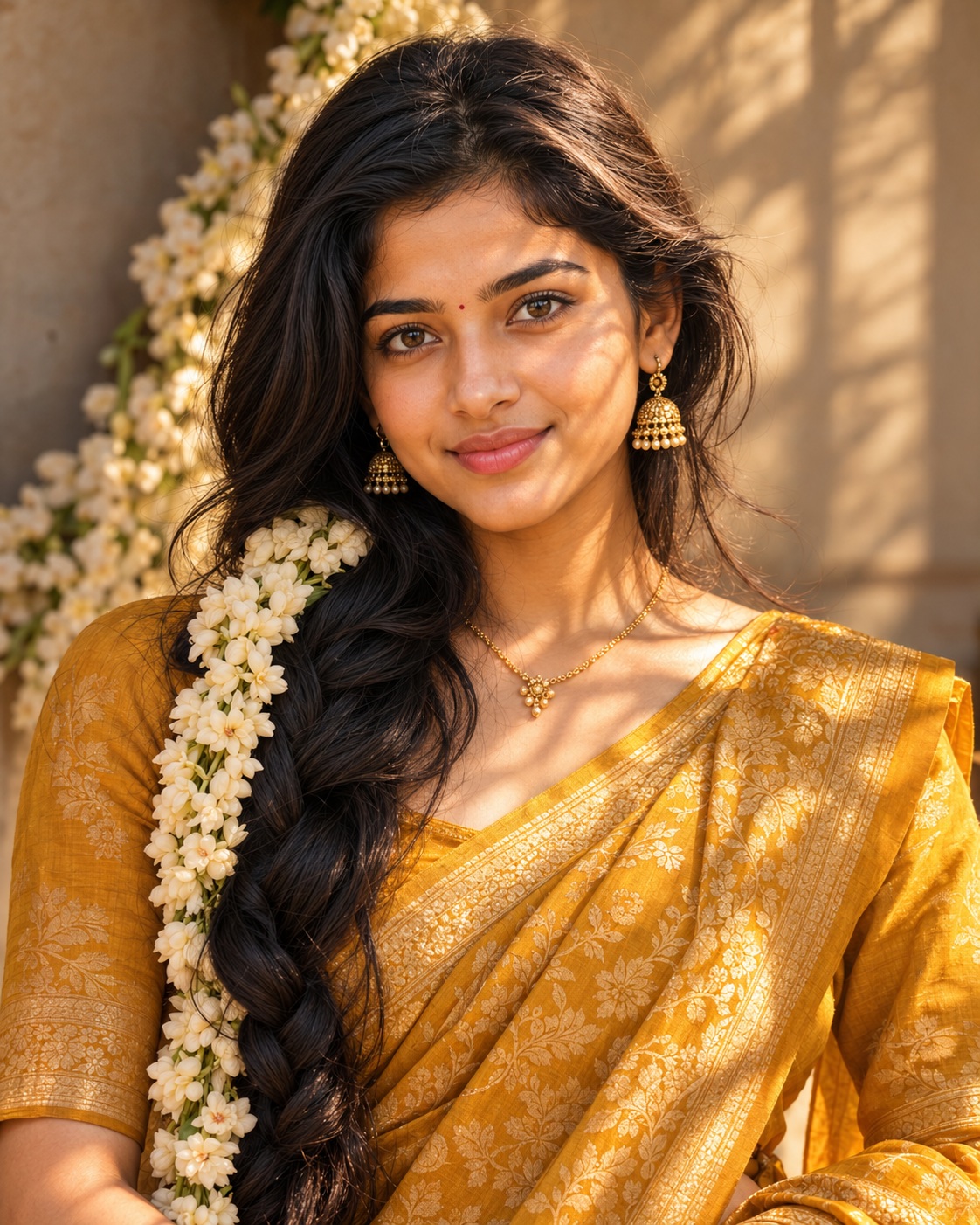
The Golden Jasmine Portrait is a close-up traditional portrait built around warmth, intimacy, natural beauty, and carefully preserved cultural styling. The composition concentrates attention on the woman’s face and upper torso, creating a tightly framed photograph where facial identity, hair decoration, saree texture, jewelry, and patterned light all become highly visible. Instead of using a wide environment, the concept keeps the background understated so the subject remains the unmistakable center of attention.
The main subject is a woman presented in a graceful, traditional appearance. Her face occupies a significant portion of the frame, while the upper torso provides enough space to reveal the saree and necklace. The close framing creates a personal and intimate feeling. Because the portrait is tightly composed, small details such as the bindi, earring, jasmine flowers, facial texture, woven fabric, and light pattern become important visual features.
The head position is carefully controlled. The woman has a subtle head tilt or angle toward the camera, while her shoulders remain naturally angled. Her gaze is calm and direct, creating a quiet connection with the viewer. The pose does not feel theatrical or exaggerated. Instead, it has the softness of a traditional portrait photographed in a naturally composed moment.
The Golden Jasmine Portrait places strong emphasis on preserving the established head angle, shoulder position, gaze, framing, and overall posture. The supplied identity contributes the person’s unique facial characteristics, while the reference establishes how that identity appears within the composition. This makes the portrait feel consistent and deliberate rather than allowing the original source photograph to determine the final pose.
Facial identity is especially important because the image is a close-up. The eyes, nose, lips, jawline, cheeks, and overall face width should retain natural proportions. The face should not appear artificially reshaped, narrowed, widened, enlarged, or reduced. The identity should remain recognizable while fitting naturally into the established photographic perspective.
The lighting is one of the most distinctive characteristics of the Golden Jasmine Portrait. Strong patterned sunlight and shadow fall naturally across the face and neck. This creates a beautiful interplay between illumination and shade, giving the portrait depth without requiring dramatic studio lighting. The light pattern becomes part of the visual design rather than simply illuminating the subject evenly.
The patterned sunlight is particularly important because it gives the close-up an organic photographic quality. It creates highlights and shadows across the facial structure while maintaining natural dimensionality. The effect should remain soft enough to preserve skin detail and should never look like an artificial graphic overlay. The light and shadow should appear physically connected to the environment.
The hair is another major visual feature. The woman has long black hair arranged into a thick side braid. The braid extends prominently alongside the subject and becomes an important part of the portrait silhouette. Its dark tone creates strong contrast with the golden saree and pale jasmine flowers.
The braid is heavily decorated with white jasmine flowers. The flowers create a beautiful visual transition between the deep black hair and the warm golden clothing. Their creamy white appearance adds freshness and brightness to the composition. Because the flowers are abundant, they become one of the signature details of the Golden Jasmine Portrait.
The jasmine arrangement should retain its natural texture and density. Individual flowers and clusters contribute visual richness without looking artificial. The contrast between delicate white petals, dark braided hair, and warm gold fabric creates a balanced traditional palette. The flowers also add a subtle sense of celebration and cultural elegance.
The saree is a rich mustard or golden-yellow color and carries intricate woven floral or brocade detailing. This fabric is not simply a flat yellow surface. Its texture, woven motifs, border, folds, and material quality are important parts of the visual identity. The saree provides the main warm color foundation for the Golden Jasmine Portrait.
The golden fabric works especially well with the warm lighting. Highlights can reveal the woven structure and make the material appear dimensional, while shadows between folds preserve depth. The enhanced color treatment should make the saree richer and more radiant without turning it into a metallic or artificial surface.
The saree’s golden border adds another layer of refinement. It reinforces the traditional appearance and provides subtle visual structure around the clothing. Together, the mustard base, woven motifs, and border create a sophisticated textile appearance that complements the jewelry and jasmine flowers.
Accessories are intentionally simple and traditional. A small red bindi provides a compact but strong color accent near the center of the face. A traditional gold jhumka earring adds cultural character and a small reflective highlight. A delicate gold necklace appears around the upper neck, providing another warm metallic detail without overwhelming the composition.
The accessories work because they are restrained. The Golden Jasmine Portrait does not depend on excessive jewelry or elaborate decoration. The combination of bindi, earring, and necklace is enough to communicate traditional elegance while allowing the face, braid, flowers, and saree to remain visually dominant.
The background is a warm beige neutral tone. This understated environment provides a soft foundation for the richer colors of the subject. Floral elements appear behind the hair, connecting the background with the jasmine decoration while adding subtle depth. The background should remain gentle and atmospheric rather than becoming a competing focal point.
The warm beige background also helps preserve the intimate character of the portrait. It does not introduce distracting architecture, scenery, or unrelated objects. Instead, it acts as a quiet visual field that allows the black hair, white flowers, golden saree, and natural skin tones to stand out clearly.
The color palette is predominantly warm. Golden yellow, mustard, natural brown skin tones, creamy white flowers, deep black hair, and beige surroundings work together to create a harmonious composition. The palette feels traditional without appearing dated, and the restrained background allows the richer subject colors to remain visually prominent.
The requested vibrance enhancement gives the Golden Jasmine Portrait a more luminous finish. The golden saree becomes deeper and more radiant, the jasmine flowers remain clean and bright, the black hair gains richer depth, and the warm skin tones retain their natural character. The goal is greater color richness rather than a dramatic change of style.
This enhancement should resemble professional photographic color grading. The Golden Jasmine Portrait should not become neon, excessively orange, artificially glossy, or aggressively saturated. The warm palette should remain believable. Increasing color depth and subtle micro-contrast allows the image to feel more polished while preserving the softness of the original reference.
Skin tone is particularly important because the face is the primary focal point. The natural brown warmth of the skin should remain visible without being pushed toward orange. The color enhancement should support facial realism rather than competing with it. Fine skin texture should remain present, giving the portrait a genuine photographic quality.
The patterned sunlight should also remain intact after the color treatment. It should not be washed out by increased brightness or replaced by flat illumination. The relationship between light and shadow is a major part of the Golden Jasmine Portrait’s visual character. Preserving that pattern helps maintain depth and authenticity.
The photograph has a warm, tactile texture. Fine photographic detail in the skin, saree, flowers, braid, and jewelry contributes to the sense of realism. The image should not look excessively smoothed or beautified. Natural texture gives the close-up more personality and prevents it from becoming a generic polished portrait.
The composition is tightly framed, so every element has a specific role. The face is the primary focal point, the braid and jasmine flowers create a strong side structure, the saree occupies the lower visual field, and the background provides gentle separation. The necklace and earring add small points of detail. This hierarchy keeps the image visually organized despite its close framing.
The Golden Jasmine Portrait is especially effective because its visual story comes from contrast. Dark hair contrasts with white flowers. Golden fabric contrasts with natural brown skin. Red bindi details contrast with the warm yellow palette. Soft beige background tones separate the subject from the surrounding environment. Patterned sunlight introduces another layer of contrast through light and shadow.
The mood remains soft, elegant, intimate, and natural. The portrait does not need a dramatic expression or cinematic darkness. Its beauty comes from subtle styling, traditional details, warm color, gentle background treatment, and authentic facial presence. The overall feeling is quiet confidence combined with cultural grace.
The traditional appearance also gives the Golden Jasmine Portrait strong cultural relevance. The jasmine-adorned braid, bindi, jhumka, necklace, and saree work together to create a recognizable traditional aesthetic. These elements are presented in a refined photographic manner rather than as exaggerated costume details.
The concept is suitable for traditional portrait photography, cultural social media content, festive posts, personal profile imagery, wedding-related portrait collections, Bengali or Indian traditional styling, fashion editorials, festival greetings, and elegant close-up photography. Its tight composition makes it particularly useful when the goal is to highlight facial identity and traditional styling simultaneously.
The Golden Jasmine Portrait also works well for digital publishing because the close-up framing creates immediate visual focus. The face and jasmine flowers can remain recognizable even when displayed at smaller sizes, while the golden saree and warm palette provide strong color presence. The enhanced vibrance gives the portrait additional visual impact without compromising its natural character.
The strongest aspect of the concept is its balance. The saree is richly detailed but not overwhelming. The jasmine flowers are abundant but remain delicate. The lighting is noticeable but natural. The jewelry is traditional but restrained. The colors are vibrant but not artificial. The face is prominent but remains naturally proportioned.
Overall, the Golden Jasmine Portrait describes a carefully controlled traditional close-up where identity, patterned sunlight, jasmine-adorned braid, golden brocade saree, minimal jewelry, and warm neutral surroundings work together. Its visual character comes from intimate framing and fine detail rather than from excessive effects.
The final creative impression should be warm, graceful, traditional, photographic, and luminous. The Golden Jasmine Portrait should retain the original softness and natural atmosphere while making the colors noticeably richer. Golden fabric should appear more radiant, jasmine should remain creamy and fresh, black hair should have deep definition, and the skin should remain naturally warm.
The result is a portrait concept that combines cultural styling with a sophisticated photographic finish. Every element has a clear purpose: the face provides identity, the patterned sunlight creates depth, the braid provides structure, jasmine flowers add softness, the golden saree provides warmth, jewelry adds tradition, and the beige background maintains intimacy. Together, these details create a visually coherent Golden Jasmine Portrait.
[[[
REFERENCE ANALYSIS
- Composition: Vertical close-up portrait, face and upper torso dominant, tightly framed.
- Pose: Head slightly tilted/angled toward camera, shoulders naturally angled, calm direct gaze.
- Face lighting: Strong patterned sunlight/shadow falling naturally across the face and neck.
- Hair: Long black hair arranged into a thick side braid, decorated heavily with white jasmine flowers.
- Outfit: Rich mustard/golden-yellow saree with intricate woven floral/brocade texture and golden border.
- Accessories: Small red bindi, traditional gold jhumka earring, delicate gold necklace.
- Background: Warm beige neutral background with soft floral elements behind the hair.
- Color: Warm golden/yellow palette, natural brown skin tones, creamy white flowers, deep black hair.
- Vibe: Soft, elegant, traditional, intimate and natural.
- Finish: Warm photographic texture with detailed skin, fabric and flowers. Vibrance should be enhanced while retaining the warm natural character.
MASTER PROMPT
Use supplied ref image as master blueprint. Replace only the reference character’s face with the supplied user identity. COMPLETELY IGNORE the user’s original photo pose and body; force the user into the exact head position, head tilt, shoulder angle, posture, gaze and framing of the reference character. Maintain exact scale, crop, composition and visibility.
Preserve 1000% of the reference visual information: exact close-up framing, face-to-camera angle, patterned sunlight/shadow across the face and neck, hairstyle, thick side braid, jasmine flower arrangement, saree draping, jewelry, background, floral elements, lighting direction, shadow pattern, depth, texture, color grading and photographic character.
Preserve the exact mustard/golden-yellow saree, including its intricate woven floral/brocade pattern, border, fabric texture, color and condition. Preserve the exact long black braided hairstyle decorated with abundant white jasmine flowers. Preserve the red bindi, gold necklace and traditional gold earring exactly as shown.
CRITICAL IDENTITY & ANATOMY LOCK: Replace only the facial identity with the supplied user identity. Preserve the user’s unique facial characteristics naturally, without beautification or facial reshaping. Maintain realistic facial proportions, natural eyes, nose, lips, jawline and face width. Do not enlarge or shrink the head. Do not make the face artificially thinner, wider, smoother or younger.
CRITICAL COLOR/VIBRANCE: Increase saturation and vibrance enough to give the image a distinctive rich, warm luminous glow. Make the golden saree richer and more radiant, keep the jasmine flowers clean and luminous, deepen the black hair and maintain warm natural skin tones. Increase color depth and micro-contrast subtly so every photo has a premium natural sparkle and visual richness. Preserve the original warm beige background and golden color palette. Do not make colors neon, oversaturated, orange, plastic or artificial. Do not wash out the shadows or alter the beautiful patterned sunlight on the face.
Maintain the reference’s exact soft photographic texture and natural skin detail. No excessive smoothing, beauty filters or artificial skin glow.
Output must look IDENTICAL to the reference except for the face and the explicitly requested saturation/vibrance enhancement.
EDITABLE VARIABLES
- [USER IDENTITY]: User’s face and unique facial traits only.
- [POSE]: Exact reference head angle, tilt, gaze and shoulder position.
- [OUTFIT]: Exact mustard/golden brocade saree and draping.
- [HAIR]: Exact long black side braid with white jasmine flowers.
- [ACCESSORIES]: Exact bindi, gold earring and necklace.
- [COLOR]: Increased saturation + vibrance + rich warm color depth + subtle luminous glow.
- [TEXT]: None unless explicitly specified.
NEGATIVE PROMPT
“identity loss, different face, original character, user’s original pose, user’s original head angle, different gaze, different hairstyle, loose hair, different braid, missing jasmine flowers, fewer flowers, different saree, different saree color, altered saree pattern, missing jewelry, changed bindi, redesigned background, changed lighting, lost patterned sunlight, flat lighting, harsh artificial lighting, cool color grading, dull colors, low saturation, low vibrance, washed-out gold, grey colors, neon colors, excessive saturation, orange skin, artificial skin,
plastic skin, beauty filter, excessive smoothing, face reshaping, altered facial proportions, oversized head, tiny head, elongated face, shortened face, changed jawline, different eyes, different nose, different lips, changed expression, altered crop, zoomed, recentered, different framing, changed camera angle, excessive HDR, artificial glow, overexposure, lifted shadows, lost texture, generic aesthetic, modernization, simplified fabric, lost embroidery, lost flowers, lost hair texture, different mood, different style, different background” ]]]