
Durga Saree Portrait
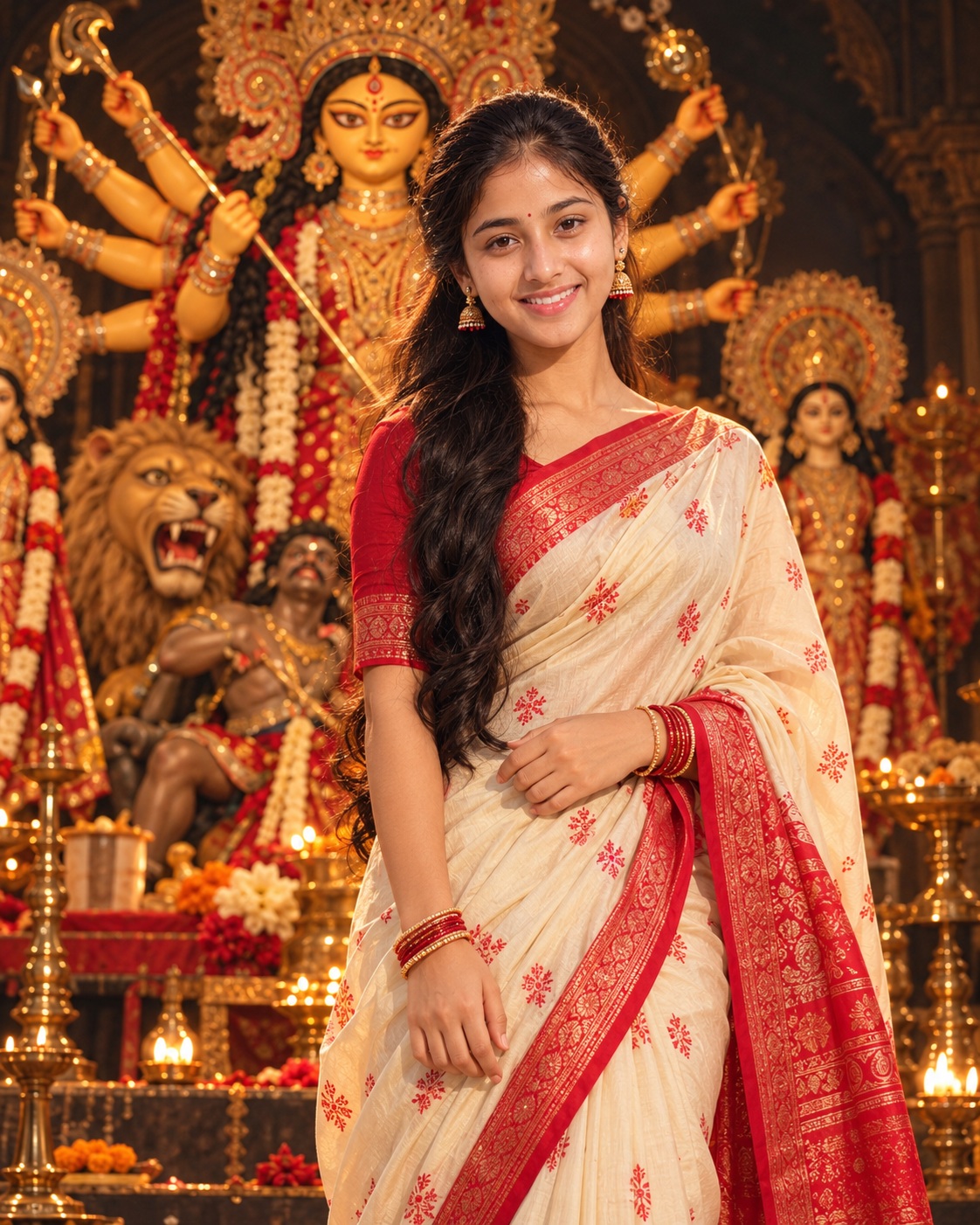
The Durga Saree Portrait is built around an elegant woman placed within a deeply devotional Durga Puja environment. The visual concept combines traditional Bengali styling, a richly decorated Durga idol, warm low-key lighting, flowing hair, an ivory saree with strong red details, and an intimate photographic atmosphere. The composition is carefully structured so that the woman remains the principal human subject while the large Durga idol directly behind her establishes the spiritual and cultural setting.
The main subject is shown in a vertical portrait composition with medium-to-full-body visibility. She is positioned slightly to the right of center rather than standing perfectly on the central axis. This creates a more sophisticated editorial balance while allowing the large idol behind her to remain clearly visible. The relationship between the subject and idol is important because the background is not merely decorative; it establishes the devotional context of the entire Durga Saree Portrait.
Her pose has an elegant, relaxed quality. The body is slightly turned, creating a gentle diagonal through the shoulders and torso. Her head turns back toward the camera, allowing the face to remain clearly visible while retaining the graceful angle of the body. One hand gathers the saree naturally near the waist, while the other arm falls comfortably downward. This arrangement gives the subject a refined traditional posture without making the image feel stiff or overly posed.
The facial identity is treated as a specific personal element within the established reference. The supplied user’s facial traits are intended to replace the reference character’s face while the established lighting, perspective, expression, head angle, and visual environment remain consistent. The face should feel like it naturally belongs to the scene rather than appearing brighter, sharper, or more polished than the rest of the photograph.
The outfit is one of the strongest elements of the Durga Saree Portrait. The woman wears a cream or ivory saree featuring a rich red border, red woven motifs, and a prominent red pallu or border treatment. The draping is traditional and elegant, with the fabric falling naturally around the body. The saree’s texture, folds, motifs, borders, and overall condition are treated as established visual characteristics rather than elements that should be redesigned.
The contrast between ivory and deep red gives the clothing a powerful visual identity. The cream fabric provides a soft luminous surface in the warm lighting, while the red details create strong focal accents. These colors also connect naturally with the devotional atmosphere, where warm reds, golds, dark shadows, and earthy tones create a sophisticated festive palette.
The hair is long, dark, voluminous, and naturally flowing. It frames the woman’s face while extending behind her body, contributing to the overall silhouette. The flowing hair introduces softness and movement against the more structured devotional background. It also helps maintain the traditional yet sophisticated appearance of the subject.
Accessories are intentionally restrained. Minimal traditional earrings, a bindi, and bangles or bracelets provide cultural detail without overwhelming the saree or face. The jewelry contributes small reflective highlights, especially when warm light catches its surfaces. Because the accessories remain relatively minimal, the portrait maintains an elegant rather than heavily ornamented character.
The Durga idol is a major visual anchor. It appears directly behind the subject with multiple arms and traditional decorative elements. Its scale gives the background visual authority and establishes an immediate devotional connection. Additional idols appear toward the lower sides, adding layers of cultural detail and helping the environment feel like a complete Durga Puja setting rather than a single isolated statue.
The background contains substantial visual information. Decorative elements, architectural details, side idols, props, atmospheric particles, shadows, and surrounding structures contribute to the environment. However, the background remains softer than the subject, allowing the woman and her clothing to remain the strongest points of attention. This separation creates depth without removing the richness of the devotional setting.
Lighting is deliberately warm and low-key. The scene does not depend on bright exposure. Instead, gentle highlights illuminate the woman’s face and saree while deeper shadows remain visible throughout the environment. This produces an intimate devotional atmosphere. The dark background gives the cream saree a natural luminous quality and allows the red accents to become especially noticeable.
The color treatment adds another layer of sophistication. The original dark warm palette is retained while saturation and vibrance are increased subtly but clearly. Cream fabric becomes richer and more dimensional, deep red becomes more luxurious, gold details become more radiant, and warm skin tones gain healthy depth. The result should have a refined luminous glow without losing the intimate darkness of the reference.
The color enhancement is intentionally controlled. The Durga Saree Portrait should not become neon, excessively HDR, plastic, or artificially glossy. Deep blacks should remain deep, background shadows should not be lifted unnecessarily, and the warm low-key character should remain intact. The goal is a richer photograph, not a completely different grading style.
Warm brown and gold tones provide the foundation of the scene. Muted green-black areas appear in the background, helping create separation from the cream saree. Deep red accents then provide visual energy. This combination creates a mature, sophisticated palette that feels appropriate for a traditional devotional portrait while still having a polished contemporary photographic quality.
The composition is also important because the subject’s slight right-of-center placement creates visual tension and balance. The large idol fills the background behind her, while the additional side idols and decorative details occupy lower portions of the frame. The negative space, depth, and camera angle all contribute to the feeling that the woman is genuinely standing inside the devotional environment.
The camera feel is photographic rather than theatrical. The scene has a medium-to-full-body portrait quality with soft background separation and subtle grain. The viewer should be able to appreciate the complete silhouette, saree draping, hand position, flowing hair, and surrounding idol environment. The perspective should remain natural and should not make the body appear compressed or distorted.
Body proportions are especially important in this concept. The woman should retain a naturally tall adult appearance with realistic head-to-body proportions, natural torso length, proportionate arms and legs, appropriate shoulder width, and correctly scaled hands. The composition should accommodate the body naturally rather than shortening or compressing the figure to fit the frame.
This natural proportion requirement gives the Durga Saree Portrait a more convincing photographic presence. The subject should not appear squat, bulky, artificially elongated, or unnaturally thin. Her posture should remain graceful and realistic. The saree should follow the actual structure of the body, preserving believable folds and fabric tension around the waist, arms, and legs.
The facial expression and gaze should work with the elegant pose. The head turns toward the camera while the body remains slightly angled, creating a subtle sense of movement and awareness. This gives the portrait a more sophisticated visual character than a completely front-facing pose. The expression should remain compatible with the warm devotional atmosphere rather than becoming excessively dramatic.
Fine photographic grain adds texture and helps unify the image. Atmospheric particles in the background contribute to the sense of depth and warmth. These details should remain subtle, giving the Durga Saree Portrait a tactile photographic finish without making the image look deliberately distressed or excessively grainy.
The devotional setting gives the portrait emotional depth. The Durga idol represents the central cultural context, while the woman’s traditional attire and posture reinforce the connection to Bengali celebration. The combination creates a feeling of reverence, grace, cultural pride, and festive intimacy.
The Durga Saree Portrait can be useful for Durga Puja portraits, Bengali festival photography, traditional fashion posts, devotional social media content, cultural portrait collections, festive greeting designs, personal celebration artwork, and premium vertical portrait presentations. Its combination of traditional styling and refined photographic treatment makes it versatile for both personal and editorial use.
The design is particularly effective because the clothing and environment share a complementary palette. The ivory saree catches the warm light, red borders connect with the festive setting, gold accessories echo the devotional decorations, and dark surroundings provide contrast. The result feels visually unified rather than assembled from unrelated elements.
The portrait also benefits from restraint. There is no need for excessive jewelry, bright studio lighting, modern clothing, artificial background decoration, or unrelated props. The Durga idol, saree, hair, jewelry, lighting, and atmospheric environment already provide enough visual information to create a complete story.
Overall, the Durga Saree Portrait describes a sophisticated devotional portrait where identity, traditional clothing, elegant body language, Durga imagery, warm low-key lighting, and controlled color richness work together. Its visual strength comes from preserving the established scene while making the reds, creams, golds, and warm tones richer and more luminous. The dark background remains important because it gives the brighter elements room to breathe.
The final impression should be elegant, devotional, warm, culturally grounded, and photographic. The woman should appear naturally integrated with the Durga environment, maintaining believable anatomy and a graceful traditional silhouette. The richer color treatment should enhance the existing beauty of the scene rather than replacing its character.
[[[
REFERENCE ANALYSIS
- Composition: Vertical portrait, medium/full-body framing, subject positioned slightly right of center.
- Pose: Elegant standing pose, body slightly turned, shoulders angled, head turned toward camera, one hand gathering the saree near waist and the other naturally lowered.
- Outfit: Cream/ivory saree with red border, red woven motifs, rich red pallu/border, traditional elegant draping.
- Hair: Long, voluminous, naturally flowing dark hair framing and extending behind the body.
- Accessories: Minimal traditional earrings, bindi, bangles/bracelets.
- Background: Large Durga idol directly behind subject with multiple arms and traditional decorative elements; additional idols visible toward lower sides.
- Lighting: Warm, low-key, intimate devotional lighting with soft highlights on face and saree.
- Color: Deep warm brown, gold, muted green-black background, cream/ivory saree and rich red accents.
- Mood: Elegant, devotional, sophisticated, slightly cinematic but still natural.
- Texture: Fine photographic grain and atmospheric particles; soft background separation.
- Vibrance: Colors should be enhanced enough to create a rich luminous glow, especially the red, gold and cream tones, while retaining the dark warm character of the reference.
MASTER PROMPT
Use supplied ref image as master blueprint. Replace only the reference character’s face with the supplied user identity. COMPLETELY IGNORE the user’s original photo pose and body; force the user into the exact body pose, hand placement, posture, shoulder angle, head angle and gaze of the reference character. Maintain exact scale, proportion, crop, framing and visibility.
Preserve 1000% of the reference image’s visual information: exact Durga idol, multiple arms, decorative backdrop, side idols, background architecture, props, particles, shadows, atmosphere, camera angle, depth of field, composition, negative space, lighting direction, contrast, black levels, warm low-key mood and photographic texture.
Preserve the exact reference outfit: cream/ivory saree, red border, red woven motifs, red pallu, exact draping, fabric texture and condition. Preserve the long flowing dark hair, traditional accessories, bindi and overall silhouette. Do not redesign, modernize, clean up or change the saree.
CRITICAL NATURAL BODY PROPORTION LOCK: Keep the user naturally tall and realistically proportioned. Do not make the body short, compressed, squat, bulky or widened. Maintain a natural adult head-to-body ratio, realistic torso length, naturally proportioned legs and arms, correct shoulder width, realistic hands and fingers. Never enlarge the head or shorten the body to fit the frame. Preserve the reference’s exact framing while maintaining natural human anatomy.
COLOR & VIBRANCE: Increase saturation and vibrance subtly but clearly so the final image has a distinctive rich, luminous festive glow. Enhance the cream saree, deep red borders, gold jewelry, warm skin tones and Durga decorations with richer color depth and elegant radiance. Add refined color separation and a premium natural glow without making the image neon, overly HDR, plastic or artificial. Keep the original dark, warm, low-key atmosphere intact. Do not lift the shadows or wash out the deep background.
Render the supplied user’s face naturally within the reference’s exact lighting, perspective and color environment. Preserve the user’s unique facial identity only; do not copy the user’s body, clothing or pose.
Output must look IDENTICAL to the reference except for the face and the explicitly requested saturation/vibrance enhancement.
EDITABLE VARIABLES
- [USER IDENTITY]: User’s face and unique facial traits only.
- [BODY/HEIGHT]: Natural tall appearance, realistic adult anatomy and proportions.
- [OUTFIT]: Exact cream/ivory saree with red border and motifs, exact draping and condition.
- [COLOR]: Increased saturation + vibrance + rich color depth + subtle luminous glow.
- [POSE]: Exact reference pose, hand placement, shoulder angle and head position.
- [BACKGROUND]: Exact Durga idol, side idols and devotional environment.
- [TEXT]: None unless explicitly specified.
NEGATIVE PROMPT
“identity loss, different face, original character, user’s original pose, user’s original body posture, changed pose, different hand placement, different head angle, short-looking body, squat body, compressed body, bulky body, widened body, shortened legs, short torso, oversized head, tiny body, disproportionate anatomy, distorted limbs, deformed hands, extra fingers, changed saree, different saree color, modern outfit, altered saree draping, missing jewelry, redesigned Durga idol, changed background, removed side idols, added objects, altered lighting,
bright background, lifted shadows, washed-out blacks, flat colors, low saturation, low vibrance, dull image, neon colors, excessive saturation, artificial HDR, plastic skin, orange skin, excessive glow, overexposure, changed mood, different color grading, cool grading, bright cinematic look, generic beauty enhancement, excessive smoothing, altered composition, zoomed, recentered, changed crop, different camera angle, artificial body elongation, unnatural thinness, big head, small hands, user’s body, user’s original clothing, user’s original pose” ]]]