
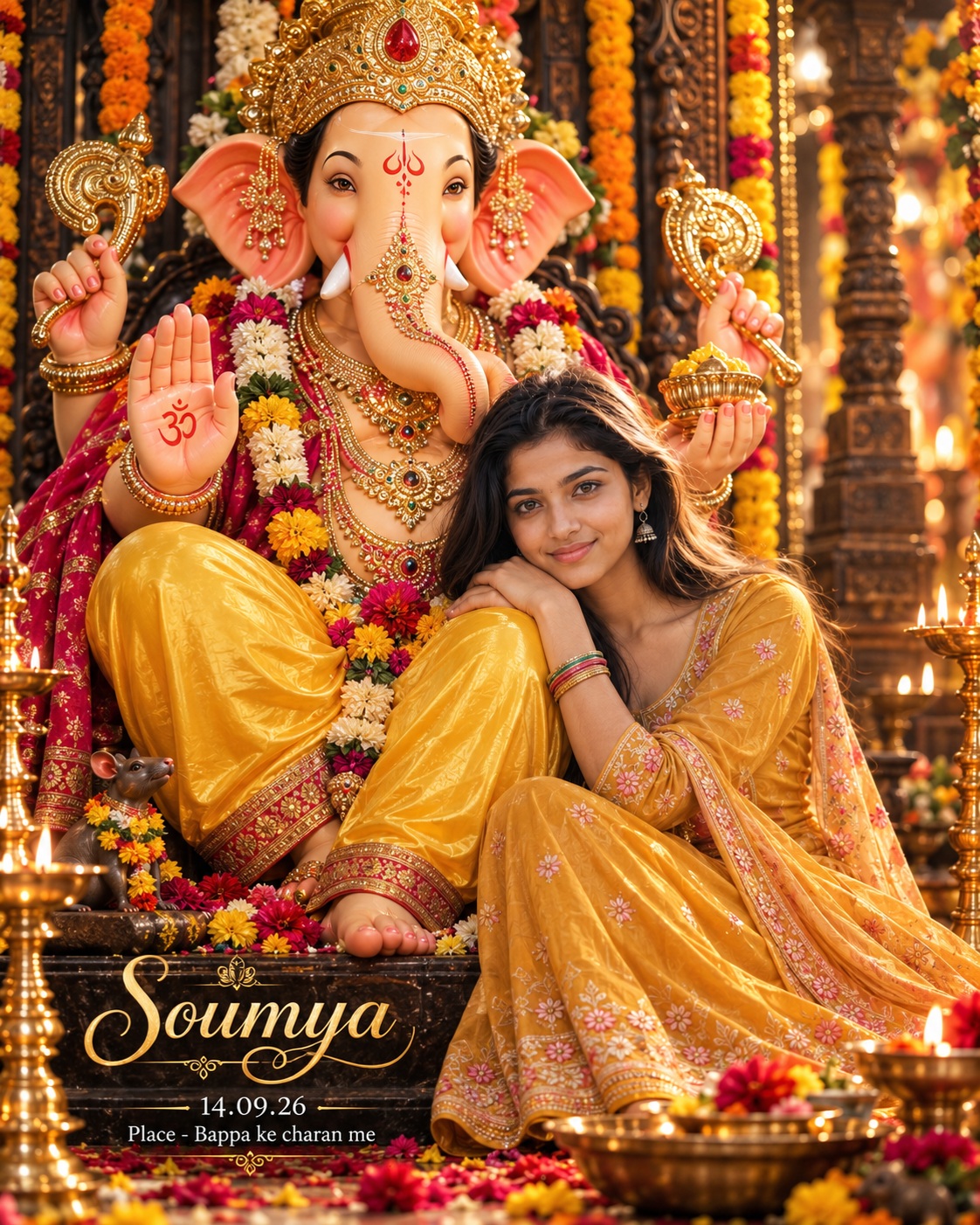
Realistic Ganesh Darshan
This concept centers on a single male devotee sharing an intimate Ganesh Darshan moment with a majestic Lord Ganesha idol. The devotee is not treated as a separate studio portrait placed into a temple scene. Instead, his presence is visually integrated into the devotional setting, with the relationship between the person and the idol becoming the emotional heart of the composition. The idol remains the dominant visual subject, while the man occupies the lower-right foreground in a supporting but meaningful position.
The person’s appearance is governed by the supplied person reference only where identity matters. His recognizable facial structure, natural build or body thickness, and original skin tone are preserved so that the finished portrait still feels like the same individual. Important facial characteristics include the forehead, brows, eyes, nose, lips, jaw, cheeks, hairline, facial hair when present, natural asymmetry, and small identifying marks. The skin is intended to retain believable pores, fine texture, tonal variation, and natural under-eye structure rather than appearing retouched into a generic fashion model. The goal is recognition with realism, not beautification.
The face carries a calm devotional emotion. The expression is peaceful, respectful, and emotionally connected, with a gentle softness in the eyes. A broad or exaggerated smile is not part of the concept. The expression is subtle enough to feel like a genuine Darshan moment, while the body remains in the exact seated devotional arrangement established by the main reference.
Pose is one of the most important visual anchors. The main reference determines the seated position, torso direction, head angle, legs, knees, arms, hands, and overall body orientation. This means the person’s original stance in a source photograph is not the visual guide for the final composition. The reference pose is instead adapted naturally to the person’s own anatomy. This creates a convincing sense that the individual is physically present in the same moment rather than simply having a face placed over another body.
The physical relationship between devotee and idol is also important. The man remains in the lower-right foreground and leans naturally against the seated form of Ganesha. That contact needs to feel believable, with appropriate body weight, perspective, spacing, and gravity. The neck, shoulders, elbows, wrists, hands, fingers, knees, and legs all need to connect naturally. Hands retain realistic joints, nails, spacing, and texture. The devotee’s hands never merge with the deity’s hands, and the divine figure retains its own symbolic hand positions.
Lord Ganesha is presented as a richly handcrafted festival idol with a warm peach or terracotta devotional complexion. The crown is highly ornate, with fine gold ornamentation and red gemstone accents. Earrings, layered necklaces, armlets, bangles, garlands, and other traditional details contribute to the sense of craftsmanship. The raised blessing hand remains clearly visible, including the devotional ॐ marking on the palm. The other hands retain their traditional symbolic objects and positions. The trunk, crown, facial features, and ornaments should remain coherent and carefully detailed rather than becoming decorative abstractions.
The clothing of the deity adds much of the visual richness. A luxurious golden-yellow dhoti has visible folds, woven structure, ornate borders, and a believable fabric sheen. A deep pink or magenta embroidered shawl creates a strong contrast against the gold. Flower garlands fall naturally under gravity, while marigold tones and complementary floral colors add freshness. The human devotee wears a tasteful traditional or casual festive outfit suited to Ganesh Darshan, unless a specific outfit preference is supplied separately. His clothing should fit his body naturally and remain visually distinct from the idol’s garments.
The environment is designed as an authentic decorated Ganesh Chaturthi setting rather than a generic temple background. A large carved throne surrounds Ganesha and provides architectural depth. Flowers, lamps, vessels, ornamental surfaces, drapery, and carefully placed devotional decorations create a dense but controlled festival atmosphere. Foreground elements help establish depth, while distant warm practical lights produce natural bokeh. The background remains detailed enough to communicate the setting without competing with the main subjects.
The scene uses a rich warm palette built around golden yellow, amber, orange, deep red, magenta, pink, and dark carved brown or black. Gold surfaces should appear luminous and premium, with believable metallic reflections instead of flat yellow coloring. Fabric should show folds and embroidery, flowers should retain petal-level detail, and carved surfaces should show texture. The person’s natural skin tone stays faithful to the source rather than being pushed into an overall orange grade. This separation between human skin, idol skin, gold, fabric, and background helps the portrait remain believable.
Lighting supports the devotional mood through warm golden festival illumination, soft frontal fill, subtle highlights across metallic ornaments, gentle shadow depth, and practical lamp or bokeh lights behind the subjects. The result has cinematic depth but remains photographic. It should feel like a professionally captured festival portrait with a controlled dynamic range, crisp natural focus, realistic depth of field, and fine surface detail. The scene is not intended to resemble a painting, cartoon, anime artwork, plastic 3D render, or artificial illustration.
Composition follows a vertical portrait format with the Ganesh idol centered and dominant. The crown sits prominently near the upper center, the blessing hand is visible toward the left, and the devotee occupies the lower-right area. The full visual hierarchy gives the deity the greatest presence while preserving enough of the throne, lower decorative area, and surrounding festival elements to make the setting feel complete. Important lower details and visible feet are retained where they exist in the reference, avoiding arbitrary crops that weaken the original composition.
Typography is deliberately restrained. If no custom text is supplied, there is no added text at all. Naturally existing devotional markings that physically belong to the idol, such as the ॐ symbol on the raised palm, remain part of the devotional design. If a user supplies a name or other custom wording, only that exact wording is used, with spelling, capitalization, punctuation, language, and spacing preserved. The supplied wording appears only once and stays subordinate to the portrait. It does not cover either face, the crown, or important decorative details.
This concept is especially useful for personal Ganesh Darshan portraits, Ganesh Chaturthi memories, festive social posts, devotional profile artwork, family celebration records, and premium festival keepsakes. It can also serve as a visual direction for commemorative portraits where personal identity needs to remain authentic while the environment carries a strong cultural and devotional character. The emphasis on natural skin, realistic anatomy, handcrafted ornamentation, controlled lighting, and reference-led composition makes the concept feel intimate, polished, and culturally grounded.
Overall, the creative idea is a balanced meeting of personal identity and devotional grandeur. The man should look unmistakably like himself, while the main reference continues to control the pose, framing, lighting, palette, scene structure, and visual hierarchy. Ganesha remains the spiritual focal point, and the devotee’s calm presence communicates respect, closeness, and emotional connection. Every small detail—from gold filigree and flower petals to fabric folds, carved textures, hand anatomy, and warm background lights—supports the impression of a real, carefully photographed Ganesh Darshan celebration.
[[[
1. Main Goal & Event Context
- Create a high-end devotional Ganesh Darshan portrait based on the Main Reference.
- Reconstruct the complete visual composition, devotional atmosphere, idol styling, camera framing, lighting, colors, props, and scene density from the Main Reference.
- The Person/User Reference is used ONLY for the person’s facial identity, body thickness/build, and exact natural skin tone.
- The final result must look like a professionally photographed Ganesh Chaturthi / Ganesh Darshan moment, not like a generic AI-generated temple image.
- If the user supplies a name/text, integrate it only according to the typography rules below.
- If no text is supplied, generate ZERO text apart from naturally existing devotional markings that are part of the recreated Ganesh idol design.
2. Pose Source Hierarchy Lock
- POSE = MAIN REFERENCE ONLY.
- The person’s sitting position, torso angle, leg position, knee position, arm placement, hand placement, head angle, and overall body orientation must come from the Main Reference.
- STRICTLY FORBID copying the pose from the User/Person Source photograph.
- If the User Source person is standing, but the Main Reference person is sitting, the final person MUST be sitting exactly according to the Main Reference.
- Recreate the reference pose naturally on the user’s body.
- Do not allow the User Source’s original stance to override the Main Reference.
3. Pose-Emotion Harmony Lock
- Preserve the Main Reference’s relaxed seated devotional pose.
- Facial micro-expression may be adapted naturally to the devotional event.
- Expression: peaceful, emotionally connected, respectful, calm devotional feeling, with a subtle natural softness in the eyes.
- Do not create an exaggerated smile.
- Do not change the body pose merely to make the expression appear natural.
- Keep the exact reference body positioning while adapting only facial micro-expression.
4. Natural Anatomy & Proportional Blending Lock
- Preserve realistic human anatomy throughout.
- Head, neck, shoulders, arms, elbows, wrists, hands, fingers, knees and legs must connect naturally.
- The head must sit naturally on the neck.
- NO pasted-head appearance.
- NO twisted neck.
- Maintain correct shoulder alignment and realistic body weight distribution.
- The person leaning against the Ganesh idol must have believable contact and gravity.
- Do not distort the body to fit the idol.
- Maintain realistic perspective between person and idol.
5. Medium & Style Adaptation Lock
- Medium: photorealistic devotional photography.
- Preserve the Main Reference’s realistic photographic appearance.
- The Ganesh idol must look like a real, highly detailed handcrafted festival idol.
- Skin must retain realistic pores, subtle texture and natural tonal variation.
- Gold ornaments must have physically believable metallic reflections.
- Fabric must show realistic woven texture, folds and embroidery.
- Do not turn the scene into painting, cartoon, anime, CGI, plastic 3D, or artificial illustration.
- Identity must remain recognizable within the photorealistic medium.
6. Event, Outfit & Vibe Supremacy Lock
- Event: Ganesh Darshan / Ganesh Chaturthi devotional celebration.
- Overall vibe: sacred, warm, intimate, peaceful, festive and emotionally devotional.
- Outfit must naturally fit the devotional environment.
- For the male person, use a simple tasteful traditional/casual festive outfit appropriate for Ganesh Darshan, unless the User provides a specific outfit requirement.
- Do not copy clothing from the User Source photograph unless explicitly requested.
- Clothing must fit the person’s body naturally.
- Ganesh idol styling must remain richly traditional and devotional.
- Environment must feel like an authentic decorated Ganesh Darshan setting.
7. Multi-Person Identity & Gender Mapping Lock
- Main human subject: male → male.
- If a User/Person Reference is provided, preserve that exact male identity.
- Never introduce female facial characteristics.
- Never blend the person’s face with the Ganesh idol.
- Ganesh remains a divine idol/entity, not a human identity replacement.
- If additional people are later supplied, maintain strict one-to-one identity mapping.
- Every person must remain visually distinct.
8. Strict Facial & Skin Tone Preservation Lock
- Preserve the User/Person Reference’s exact recognizable facial identity.
- Preserve:
- exact face shape
- forehead proportions
- eyebrows
- eyes
- nose
- lips
- jawline
- cheek structure
- hairline
- facial hair, if present
- unique facial marks
- natural skin texture
- Preserve the person’s exact original skin tone.
- NEVER darken, tan, bleach, over-warm or artificially lighten the person’s skin.
- Do not beautify the face into a generic model.
- Do not make the face younger or older unless specifically requested.
- Preserve authentic facial asymmetry.
9. Micro-Detail & Calendar/Prop Marking Lock
- Reproduce the Main Reference’s tiny visual details wherever applicable:
- Ganesh crown ornamentation
- red gemstone details
- gold filigree
- earrings
- necklaces
- armlets
- bangles
- flower garlands
- red/pink drapery
- yellow/golden dhoti
- decorative throne
- carved background
- flowers
- lamps
- devotional decorations
- foreground plants and vessels
- Preserve the Ganesh idol’s forehead/trunk devotional markings.
- Preserve the ॐ marking on the raised palm as a visual devotional symbol.
- Do not accidentally remove important small decorative elements.
- Do not invent unrelated props.
10. Zero Text Copying & User Text Injection Lock
- NEVER copy actual written words from the Main Reference as promotional text.
- Existing devotional symbols/markings that are physically part of the idol, such as the ॐ marking, may remain as part of the recreated artwork.
- If the user provides custom text, use only that exact text.
- Do not invent names.
- Do not add captions, quotes, slogans, dates, hashtags, watermarks or greetings unless supplied by the user.
- If no custom text is supplied: ZERO added text.
11. Exact Text Style & Size Replication Lock
- If custom user text is supplied and a typography reference is available:
- replicate the reference’s font character
- weight
- color
- texture
- glow
- shadow
- stroke
- spacing
- alignment
- relative size
- Text must remain subordinate to the devotional portrait.
- Never make text disproportionately large.
- Do not cover the face, Ganesh crown or important devotional details.
12. ONE TEXT ONE Place & Layout Lock
- User-provided name must appear ONLY ONCE.
- Keep it in one clean continuous line unless the Main Reference specifically uses a multi-line typography structure.
- Maintain the reference text-to-image ratio.
- Never place giant text over the person’s face.
- Never place giant text over Ganesh’s face.
- Do not scatter the same name around the image.
- Preserve clean negative space around typography.
13. Typography Letter Content Lock
- Render user-supplied letters exactly.
- Preserve:
- spelling
- capitalization
- punctuation
- language
- diacritics
- spacing
- Never hallucinate additional words.
- Never substitute letters.
- Never create jumbled or pseudo-text.
- No hidden or decorative extra words.
14. Visual Vibe, Color & Mood Lock
- Reproduce the Main Reference’s rich warm devotional color grading.
- Dominant visual palette:
- rich golden yellow
- warm orange
- deep red
- magenta/pink
- dark carved brown/black background
- warm amber highlights
- Maintain strong but tasteful saturation.
- Gold must look luminous and premium.
- Preserve warm temple/festival ambience.
- Use rich contrast without crushing shadow details.
- Avoid dull gray colors.
- Avoid cold blue cinematic grading.
- Maintain the spiritual aura of the scene.
15. Micro-Details & Crop
- Preserve the Main Reference’s vertical portrait composition.
- Keep the approximate full framing and subject scale.
- Ganesh occupies the dominant upper and central background.
- Human subject occupies the lower-right foreground.
- Keep the idol’s crown fully prominent.
- Preserve visible feet and lower decorative area where present.
- Do not arbitrarily crop away important elements.
- Maintain the reference’s visual hierarchy.
- Keep realistic depth between foreground person and background idol.
16. Identity, Raw Skin & Anti-Fake
- User’s face must remain unmistakably the same person.
- No generic handsome-face replacement.
- No face morphing.
- No face blending with Ganesh.
- No excessive skin smoothing.
- Retain realistic pores and subtle texture.
- Preserve natural under-eye structure.
- Preserve natural hair texture.
- Avoid beauty-filter appearance.
- Avoid waxy/plastic skin.
- Identity preservation has priority over beautification.
17. Hand-Prop & Natural Anatomy
- Human hands must remain anatomically correct.
- Fingers must have realistic:
- length
- joints
- nails
- spacing
- skin texture
- Preserve the reference’s interaction between the person’s body and Ganesh idol.
- The Ganesh idol’s hands must retain their correct symbolic positions.
- Preserve the raised blessing hand.
- Preserve the hands holding the traditional decorative objects/weapons.
- Do not merge human hands with idol hands.
- No extra fingers.
- No missing fingers.
- No fused fingers.
18. Outfit Fit, Drape & Wrap
- Ganesh’s outfit:
- luxurious golden-yellow dhoti
- realistic folds
- rich fabric sheen
- ornate golden borders
- natural draping around the seated legs
- Ganesh’s pink/magenta shawl/drape must remain richly embroidered and naturally folded.
- Flower garlands must hang naturally according to gravity.
- Human clothing must be event-appropriate and naturally fitted.
- Never wrap trousers or pants like a saree/dhoti unless explicitly requested.
- Never introduce random modern logos or graphics.
- Clothing must not become fused with the idol.
19. Selective Color & Tone Mapping
- Keep skin tone faithful to the User Source.
- Keep Ganesh idol skin in the reference’s warm peach/terracotta devotional tone.
- Gold ornaments: luminous antique-gold appearance.
- Flowers: rich marigold orange/yellow and complementary floral tones.
- Drapery: deep pink/magenta/red.
- Background: dark warm carved wood/ornamental tones.
- Preserve natural tonal separation between human skin, idol skin, gold and fabric.
- No global orange filter that destroys skin accuracy.
20. No Random Logos & Clean Text
- No brand logos.
- No social-media watermark.
- No AI watermark.
- No random signatures.
- No random usernames.
- No random dates.
- No random devotional quotes.
- No unauthorized text anywhere.
- Existing physical decorative symbols must look naturally printed/painted onto the relevant surface.
21. Perfect Spelling & Text Rendering
- If user text is provided:
- spell it exactly
- preserve exact language
- preserve exact capitalization
- preserve exact punctuation
- No typos.
- No duplicate letters.
- No broken glyphs.
- No unreadable pseudo-writing.
- No accidental extra words.
22. Opacity, Layering & Ghost
- Maintain realistic depth layering:
- foreground human
- Ganesh idol
- throne/carving
- lamps and decorations
- distant warm bokeh
- Background lights must have natural falloff.
- Do not create artificial transparent ghosts.
- No duplicated translucent person.
- No accidental double exposure unless explicitly requested.
23. Duplicate Mapping & Pose Variety
- No duplicated human subject.
- No duplicate face.
- No duplicate limbs.
- No repeated Ganesh idol.
- If the Main Reference contains multiple copies/poses, reproduce their exact structural arrangement.
- If only one person is present, keep exactly one person.
- Never add extra people merely to fill the scene.
24. Professional Quality Boost
- Premium professional photography.
- Ultra-clean facial detail.
- High dynamic range.
- Crisp but natural focus.
- Realistic depth of field.
- Detailed metallic reflections.
- Detailed textile texture.
- Detailed flower petals.
- Realistic carved throne texture.
- Natural skin microtexture.
- High-end devotional portrait finish.
- No cheap stock-photo appearance.
- No obvious generative artifacts.
25. Body Visibility & Scene Density
- Keep the human body visibility consistent with the Main Reference.
- Person remains in the lower-right foreground, leaning naturally against Ganesh’s seated form.
- Ganesh remains the dominant devotional subject.
- Do not enlarge the human until he becomes larger than the idol.
- Preserve the balanced visual relationship between devotee and deity.
- Keep the throne and surrounding decorations sufficiently visible to establish the setting.
- Do not overcrowd the scene with unnecessary objects.
26. Composition/Camera & Lighting
- Camera: vertical portrait photography.
- Framing: medium/full environmental devotional portrait.
- Perspective: natural eye-level/slightly elevated photographic perspective matching the reference.
- Composition:
- Ganesh centered
- crown near upper center
- devotee positioned lower-right
- idol’s blessing hand visible on left
- large carved throne surrounding the deity
- Lighting:
- warm golden festival illumination
- soft frontal fill
- subtle highlights on gold ornaments
- warm practical lamp/bokeh lights in background
- gentle shadow depth
- realistic skin illumination
- Keep the background softly detailed rather than completely blurred.
- Maintain cinematic depth without losing devotional realism.
27. Quality Lock & User Customization
- MAIN REFERENCE controls: pose, head angle, composition, camera, medium, style, lighting, color palette, environment structure and visual hierarchy.
- USER/PERSON REFERENCE controls ONLY: facial identity, body thickness/build and exact natural skin tone.
- EVENT controls: outfit, devotional vibe, environment appropriateness and emotional micro-expression.
- User may provide:
- person photo
- additional person photos
- name
- custom text
- event
- outfit preference
- language
- If user provides no custom text, add no text.
- If user provides a custom event, adapt outfit/environment/vibe to that event while preserving the Main Reference’s pose and composition logic.
- Never let user-provided pose override the Main Reference pose.
28. Bad Output Mistakes & Negative Prompt
ABSOLUTELY BLOCK:
- wrong identity
- generic face
- face paste
- face blending
- plastic skin
- overly smooth skin
- darkened skin tone
- altered skin tone
- wrong facial features
- changed face shape
- twisted neck
- unnatural neck angle
- broken neck
- disconnected head
- pasted head
- distorted face
- forced smile
- stretched mouth
- unnatural expression
- squinted eyes
- disproportionate body
- stretched limbs
- broken anatomy
- bad hands
- extra fingers
- missing fingers
- fused fingers
- hulk hands
- wrong gender
- gender swap
- duplicated person
- duplicate face
- duplicate limbs
- wrong outfit
- random modern clothing
- incorrect traditional drape
- wrong dhoti construction
- clothing fusion
- wrong Ganesh anatomy
- distorted trunk
- distorted crown
- missing ornaments
- missing garlands
- missing devotional markings
- missing ॐ marking on palm
- wrong color grade
- dull colors
- low saturation
- flat lighting
- cold lighting
- overexposure
- crushed shadows
- random logos
- watermarks
- unauthorized text
- copied reference text
- hallucinated names
- hardcoded names
- spelling mistakes
- typos
- jumbled letters
- giant text
- duplicate text
- multi-line text when not present in reference
- giant central person
- wrong composition
- user-source pose
- user-source stance
- user-source hand placement
- standing pose when Main Reference requires sitting
- copying user’s clothing
- artificial CGI appearance
- cartoon appearance
- anime appearance
- painting appearance
- wrong medium
- amateur quality
- low-resolution details
- AI artifacts
- unnatural lighting
- fake depth
- random people
- random props
- fake temple architecture
- excessive blur
- excessive HDR
- over-beautification
- FACE BLENDING WITH GANESH
- EVENT MISMATCH
- MISSING MICRO-DETAILS
- NEVER compromise Main Reference pose, composition or identity preservation for any other instruction. ]]]