
Realistic Ganesha Portrait
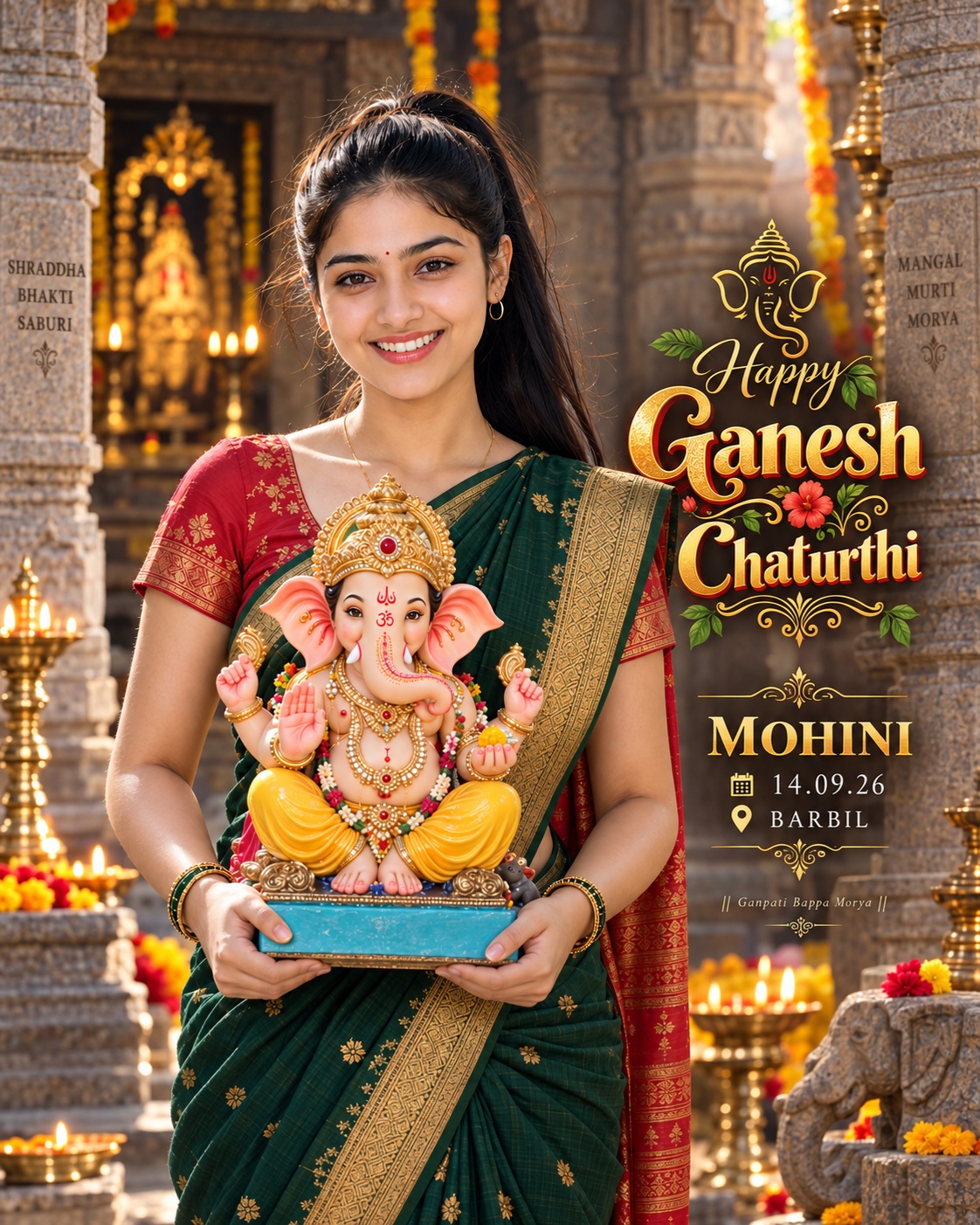
This concept presents a deeply traditional Indian devotional portrait centered on a young woman respectfully holding a Lord Ganesha idol inside an old stone temple or heritage shrine. The overall visual idea is intimate, graceful, culturally rooted, and photographic rather than theatrical. The woman and the idol are treated as the two most important elements of the composition, while the surrounding temple architecture provides the historical and spiritual character of the scene.
The main subject is a single young woman. Her identity is intended to remain faithful to the supplied female source whenever one is available. The concept places strong importance on recognizing her as the same person rather than presenting an unrelated generic face. Her natural facial structure, eyes, eyebrows, nose, lips, cheeks, jawline, forehead, hairline, subtle asymmetries, and other recognizable characteristics are treated as meaningful parts of her appearance. This makes the portrait feel personal and authentic rather than like a standardized studio beauty photograph.
Her expression is gentle and natural. The reference establishes a soft smile that communicates respect, happiness, calmness, and devotion without becoming exaggerated. Her head is positioned with a slight natural angle toward the camera, giving the portrait a relaxed human quality. The facial expression is important because the scene is not intended to feel dramatic or theatrical; it should feel like a genuine moment of reverence inside a traditional place of worship.
The body language is equally important. The woman stands upright with relaxed shoulders while facing the camera. Her arms extend naturally forward around the Ganesha idol. One hand supports the left side or lower area of the idol base, while the other supports the opposite underside of the turquoise platform. This interaction makes the idol feel physically present and genuinely held. The hands, wrists, elbows, fingers, and shoulders therefore contribute significantly to the believability of the portrait.
The hand placement is particularly detailed. The fingers should appear to wrap naturally around the correct edges of the base rather than simply appearing beside it. Anatomical relationships between knuckles, wrists, forearms, and the supporting platform are part of the visual storytelling. The woman’s hands are not merely decorative elements; they establish the physical connection between the subject and the devotional object.
The outfit is distinctly traditional and visually rich. The woman wears a Maharashtrian-style green saree with a broad beige-gold border containing repeating traditional motifs. The red blouse provides a strong complementary contrast against the deep green fabric. A red pallu is visible behind or along her left side. The saree is expected to retain its recognizable construction, including its pleats, folds, border width, decorative details, fabric weight, and natural tension created by her posture and arm position.
The clothing contributes strongly to the cultural identity of the portrait. The green saree creates a deep, elegant foundation, while the red blouse and pallu introduce festive warmth. The gold or beige border connects visually with the jewellery and the ornate details of the Ganesha idol. The combination is traditional without becoming excessively stylized or costume-like.
The jewellery is another important layer of detail. Golden ornaments should remain clearly visible and physically believable, complementing the traditional clothing. Jewellery should have realistic metallic surfaces, small decorative forms, and appropriate interaction with the light. It should enhance the woman’s appearance without becoming more prominent than her face or the idol.
Lord Ganesha is presented as a highly detailed devotional idol. The idol has a pink or peach-toned elephant face and body, large ears, a curved trunk, an ornate golden crown, red decorative markings, jewellery, multiple arms, and a yellow dhoti. The seated posture and detailed pedestal are important parts of its identity. The turquoise-blue rectangular platform at the bottom creates a distinctive visual accent and gives the idol a clear physical foundation.
The idol’s small details help communicate craftsmanship. Crown ornamentation, painted markings, jewellery, folds in the yellow clothing, decorative patterns, carved surfaces, and small flower-like details should all contribute to the impression of a carefully crafted religious statue. The idol should feel solid and tangible, with believable materials rather than looking like a computer-generated object.
The old temple environment establishes the setting. Muted brown-grey stone surfaces, heritage architectural elements, weathered textures, and subdued background forms create an atmosphere associated with an established shrine or historic place of worship. The architecture should remain visible enough to tell the story of the location, while staying softer than the main subjects.
The scene has a devotional and festive emotional quality. It feels respectful, warm, traditional, peaceful, and celebratory at the same time. The woman is not portrayed as a fashion model posing independently of the setting. Instead, her posture, clothing, expression, and relationship with Ganesha make the temple environment an essential part of the portrait.
Lighting is intended to remain natural and photographic. Soft directional illumination creates gentle highlights across the woman’s face, jewellery, saree, and idol while allowing subtle shadows to preserve dimensionality. The lighting should not turn the scene into an artificial golden fantasy. Instead, it should resemble believable illumination within an old temple environment.
Color relationships are carefully balanced. The deep green saree is one of the strongest visual anchors. Red from the blouse and pallu provides contrast, while beige-gold fabric borders and jewellery add warmth. The bright yellow Ganesha clothing creates another focal color, and the turquoise platform introduces a distinctive cool accent. Pink and peach tones on the idol provide additional separation from the muted stone surroundings.
The woman’s original skin tone is visually independent from the surrounding palette. It should retain the natural tone associated with her source identity instead of being artificially darkened, lightened, warmed, cooled, tanned, or whitened to match the temple or clothing. Natural pores, subtle facial texture, realistic lips, authentic eyes, and small facial asymmetries help preserve the feeling of a genuine photographed person.
The composition is vertical and portrait-oriented. The woman occupies approximately the same amount of the frame as in the reference, with her upper body and face clearly visible. The Ganesha idol remains prominent in front of her torso, while the temple architecture provides sufficient visual context around both subjects. The lower portion of the saree enters the frame naturally without revealing unnecessary hidden body areas.
The camera feeling is close to a professional DSLR portrait captured at approximately eye level or near eye level. The subjects remain sharply defined, while the background architecture has a naturally softer appearance. The depth of field is moderate enough to establish separation without completely removing the temple from the story. This balance keeps the photograph realistic and immersive.
The overall visual quality is intended to feel premium and professionally photographed. Fabric should show convincing weave and folds, jewellery should show believable metallic surfaces, stone should retain tactile texture, and skin should preserve natural detail. Facial rendering should feel photographic rather than painted, illustrated, cartoon-like, or artificially polished.
A major creative purpose of the concept is to combine personal identity with devotional storytelling. The woman remains the recognizable human presence, while Ganesha provides the spiritual focus and the temple establishes cultural context. Together, these elements create a portrait suitable for festive memories, devotional celebrations, family keepsakes, cultural posts, religious occasions, traditional portrait collections, and personal social-media artwork.
The restrained typography approach is also deliberate. The reference may contain a photographer watermark, but that credit is excluded from the requested visual concept. Any personal name, date, year, greeting, dedication, or other custom wording belongs only in the designated area and only when the user supplies it. If no custom information is supplied, the composition remains completely text-free.
This makes the design adaptable without disturbing its visual hierarchy. The woman’s face should remain important, the Ganesha idol should remain clearly readable, and the temple should retain enough presence to communicate place and atmosphere. Text, when supplied, should support the composition instead of covering important facial, idol, or architectural details.
The concept also emphasizes physical realism. The woman’s body thickness follows the natural proportions of her source while the pose follows the main reference. Her shoulders, arms, wrists, torso, and hands should remain anatomically coherent. The idol should have one consistent physical position, and there should be no duplicate people, duplicate idols, floating hands, repeated jewellery, or unexplained layered subjects.
The result described by this concept is therefore more than a simple traditional portrait. It combines identity, clothing, devotional symbolism, architecture, color, lighting, body language, craftsmanship, and photographic atmosphere into one coherent scene. Every major element supports the same story: a young Indian woman standing respectfully inside a heritage temple while holding a beautifully detailed Ganesha idol close to her.
For practical use, this style can work especially well for Ganesh Chaturthi memories, devotional portraits, temple visits, traditional family photography, festive greetings, cultural celebrations, personal profile artwork, commemorative posters, and heritage-themed portrait collections. Its strongest quality is the balance between personal realism and spiritual atmosphere. The scene feels culturally specific without becoming visually excessive.
The combination of deep green, red, gold, yellow, turquoise, pink, and muted stone creates a naturally rich palette. Because the background is comparatively subdued, the woman’s clothing and Ganesha idol receive visual priority. This helps the viewer immediately understand both the subject and the devotional purpose of the portrait.
The final creative impression should remain warm, respectful, authentic, and photographic. It should feel like a carefully captured moment in a real heritage shrine, with the woman naturally connected to the idol and environment. The reference controls the visual arrangement, while the woman’s source identity provides her personal facial and physical character. The result is designed to preserve the emotional simplicity of a devotional photograph while giving every visible element a polished professional finish.
[[[
1. Main Goal & Scenario
Reconstruct the supplied MAIN REFERENCE image as a highly realistic, professional Indian devotional portrait of a young woman standing inside an old stone temple/heritage shrine while respectfully holding a Lord Ganesha idol in both hands. The MAIN REFERENCE controls the entire composition, pose, clothing, idol, background, lighting, framing, colors, camera perspective, proportions, atmosphere, and visual storytelling. The PERSON SOURCE, if supplied, controls ONLY the woman’s facial identity, body thickness, and exact original skin tone.
2. Multi-Person Identity & Gender Mapping Lock
There is one primary female subject. If a female PERSON SOURCE is supplied, use that exact female identity only. Never replace her identity with a generic face, never blend another person’s facial features, and never change her gender. Preserve the source identity independently from the MAIN REFERENCE.
3. Strict Facial & Skin Tone Preservation Lock
Preserve the EXACT facial identity from the PERSON SOURCE: facial structure, eyes, eyebrows, nose, lips, cheeks, jawline, forehead, natural asymmetry, hairline and all recognizable features. Preserve the EXACT original skin tone from the PERSON SOURCE without darkening, tanning, whitening, beautifying, warming, cooling, or changing it to match the reference lighting. Maintain realistic pores and natural facial texture.
4. Micro-Detail & Calendar/Prop Marking Lock
Replicate every visible micro-detail from the MAIN REFERENCE. The Ganesha idol must remain highly detailed: pink/peach-toned elephant face and body, large ears, curved trunk, ornate golden crown, red decorative markings, jewellery, multiple arms, yellow dhoti, seated posture, detailed pedestal/base and turquoise-blue rectangular bottom platform. Preserve every tiny ornament, carving, decorative pattern, flower-like detail, painted marking and surface texture visible on the idol. Preserve the exact state and position of every prop. If the user’s later-provided information contains a date/year or other marking intended for the composition, render it exactly as instructed without inventing additional dates or symbols.
5. Identity Mapping & Face Scale
The woman’s face must remain naturally integrated into the body at the same approximate facial scale and perspective as the MAIN REFERENCE. Do not enlarge the face, shrink it, stretch it, beautify it, or turn it into a generic fashion-model face. Identity must remain unmistakably faithful to the PERSON SOURCE while the overall visual appearance follows the MAIN REFERENCE.
6. Pose Source Lock
Use 100% of the MAIN REFERENCE pose, never the pose from the PERSON SOURCE. The woman stands upright facing the camera with a gentle natural smile and relaxed shoulders. Her head is slightly angled naturally toward the camera. Both arms extend forward around the Ganesha idol: one hand supports the left side/base area and the other supports the right/front underside of the turquoise platform. Reproduce the exact elbow positions, wrist angles, finger placement, hand orientation, shoulder height and body posture shown in the reference. Do not normalize or redesign the pose.
7. Typography Letter Content Lock
The MAIN REFERENCE contains a photographer watermark, but DO NOT reproduce the watermark or photographer credit. It is not part of the requested final design. No other text should be copied from the reference. Any name, date, year, greeting, dedication or other text must come ONLY from the user’s final input at the bottom of this prompt.
8. ONE TEXT ONE PLACE Lock
User-provided custom text must appear only in the specifically intended text area. Never duplicate the name, date, year or other information elsewhere. Never add random captions, slogans, photographer credits, signatures, watermarks or decorative words.
9. Exact Text Style & Size Replication Lock
If the user later supplies text, integrate it naturally into the composition without overpowering the woman or Ganesha idol. Keep text proportionate to the image and visually subordinate to the main devotional portrait unless the user explicitly specifies otherwise. Never create giant central typography.
10. Direct Text Injection Command
Render the exact user-provided text with perfect spelling and exact characters:
NAME: use only the user’s supplied name.
DATE: use only the user’s supplied date.
YEAR: use only the user’s supplied year.
OTHER TEXT: use only additional text explicitly supplied by the user.
Do not invent, modify, translate, abbreviate, repeat or hallucinate any user-provided information.
11. No Giant Central Figure Lock
Do not enlarge the woman into an oversized central figure that covers the Ganesha idol or changes the reference composition. Preserve the same visual hierarchy: woman’s upper body and face clearly visible, Ganesha idol prominently visible in front of her torso, and sufficient temple architecture visible around them.
12. Vibe, Color & Mood Lock
Preserve the exact emotional atmosphere of the MAIN REFERENCE: devotional, graceful, festive, traditional, warm yet natural, respectful and photographic. Preserve the strong contrast between the deep green saree, red blouse/pallu, golden jewellery, yellow Ganesha clothing and muted stone temple background. Do not convert the image into a dark cinematic poster, artificial golden fantasy scene, oversaturated neon image, or completely different color grade.
13. Micro-Details & Crop
Maintain the exact portrait crop and vertical framing of the MAIN REFERENCE. Keep the woman’s lower saree naturally entering the bottom frame in the same manner. Preserve the partial/background elements at the same relative positions. Do not unnecessarily reveal hidden body areas or alter the crop. Maintain exact headroom, side margins and subject placement.
14. Identity, Raw Skin & Anti-Fake
The woman’s face must look like a real photographed person, not an AI-generated beauty face. Preserve natural pores, subtle skin texture, realistic facial lines, natural lip texture, authentic eyes and small asymmetries. No plastic skin, excessive retouching, artificial facial symmetry, porcelain complexion or beauty-filter effect.
15. Hand-Prop & Neck-Head Alignment
Reproduce the precise interaction between the woman and Ganesha idol. Her hands must physically and naturally grip/support the turquoise base. Fingers must wrap around the correct edges with anatomically correct knuckles and joints. No floating hands, fused fingers or impossible grip. Maintain natural neck-to-head alignment and the same head tilt as the reference.
16. Body Proportion & Limb Scaling
Preserve the woman’s natural body thickness from the PERSON SOURCE while following the MAIN REFERENCE pose and framing. Keep shoulders, arms, wrists, elbows, torso and hands realistically proportioned. Prevent oversized forearms, tiny wrists, Hulk-like hands, excessively thin limbs or distorted anatomy.
17. Outfit Fit, Drape & Wrap
Reproduce the MAIN REFERENCE outfit exactly in visual design and construction: traditional Maharashtrian-style green saree with gold/beige broad border and repeating traditional decorative motifs, red blouse with matching traditional patterned detailing, and visible red pallu behind/along the woman’s left side. Preserve the exact saree drape direction, pleat density, border width, folds, fabric weight, embroidery/pattern placement and natural tension created by her arms. Do not turn the saree into another regional style or change the drape.
18. Selective Color & Tone Mapping
Maintain the reference’s selective color relationships: rich deep green saree, vivid red blouse/pallu, beige-gold saree border, golden jewellery, bright yellow Ganesha dhoti, turquoise-blue idol platform, pink/peach idol body and subdued brown-grey stone surroundings. Keep skin tone exactly from the PERSON SOURCE rather than recoloring it to fit these tones.
19. No Random Logos & Clean Text
Remove the visible “Yash Shelar Photography” watermark from the reference. Do not replace it with another photographer name, logo, brand, watermark or signature. No random logos anywhere in the final image.
20. Perfect Spelling & Text Rendering
Every user-supplied character must be rendered accurately. No spelling mistakes, missing letters, extra letters, malformed numbers, reversed characters, jumbled text or invented words. If no custom text is supplied, render NO TEXT.
21. Text Ratio & Style Lock
Keep all custom text visually proportional to the MAIN REFERENCE composition. Text must never dominate the woman’s face or Ganesha idol. Never automatically apply 3D gold lettering, giant poster typography, glowing text, metallic effects or oversized decorative fonts unless explicitly requested by the user.
22. Opacity, Layering & Ghost
No unnecessary ghosting, duplicate people, translucent figures or artificial layered subjects. The woman and Ganesha idol must be solid, naturally photographed subjects. Preserve realistic depth separation between foreground subject and background architecture.
23. Duplicate Mapping & Pose Variety
Do not create duplicate copies of the woman, duplicate Ganesha idols, duplicate hands or duplicate jewellery. There must be exactly one primary woman and one primary Ganesha idol corresponding to the MAIN REFERENCE. Never repeat the face or subject elsewhere in the image.
24. Professional Quality Boost
Create a premium professional DSLR-style photograph with extremely realistic facial detail, natural skin texture, sharp subject rendering, realistic fabric texture, detailed jewellery, clean edges, physically believable materials and high dynamic range. Preserve photographic realism rather than illustration or CGI appearance.
25. Body Visibility & Scene Density
Maintain the same amount of visible body and saree as the MAIN REFERENCE. The woman should occupy approximately the same percentage of the frame. The Ganesha idol must remain clearly visible from crown to base without being hidden by the woman’s body. Background architecture should remain visible but softly subordinate to the subjects.
26. Composition/Camera & Lighting
Use the MAIN REFERENCE’s vertical portrait composition and camera perspective. Reproduce the natural eye-level/near-eye-level photographic viewpoint, centered subject placement and shallow-to-moderate depth of field. Keep the woman and Ganesha idol sharply detailed while the old stone temple architecture falls into a naturally softer background. Preserve the reference’s soft directional illumination, realistic facial highlights, subtle shadows and gentle background falloff. No artificial studio lighting that changes the scene.
27. Quality Lock & User Customization
Final output must look like a real high-end photograph captured in the same environment and moment as the MAIN REFERENCE. Preserve identity, exact skin tone, pose, outfit, idol, hand interaction, jewellery, architecture, crop, color palette, lighting and atmosphere. The only user-customizable text is the information supplied at the end of this prompt. Never invent missing information.
28. Bad Output Mistakes & Negative Prompt
NEGATIVE PROMPT — BLOCK: wrong identity, generic face, face paste, face blending, mixed identity, wrong gender, female identity alteration, artificial beauty face, plastic skin, smooth skin, porcelain skin, altered skin tone, darkened skin, tanned skin, whitened skin, wrong pose, copied PERSON SOURCE pose, normalized pose, changed head tilt, broken neck, bad anatomy, distorted body, oversized arms, Hulk hands, tiny hands, malformed fingers, fused fingers, extra fingers, missing fingers, floating hands, impossible grip, duplicated woman,
duplicate face, duplicate Ganesha idol, extra arms on woman, wrong outfit, wrong saree drape, wrong saree wrap, saree redesign, modern clothing, incorrect blouse, missing red pallu, missing saree border, missing motifs, missing jewellery, missing Ganesha details, incorrect Ganesha anatomy, incorrect idol colors, missing crown, missing yellow dhoti, missing turquoise platform, altered temple architecture, modern background, fantasy background, studio background, wrong crop, wrong framing, giant central figure, giant text, oversized text, 3D gold text, random typography, unauthorized text, copied watermark, photographer credit,
random logo, signature, watermark, spelling mistakes, typos, jumbled letters, incorrect numbers, duplicated text, text in multiple places, hallucinated name, hardcoded name, invented date, invented year, altered user text, low detail, low resolution, blurry face, blurry idol, excessive HDR, oversharpening, plastic CGI, cartoon, illustration, painting, artificial golden color grade, dark color grade, dull colors, flat lighting, wrong vibe, missing micro-details, missing jewellery details, missing fabric texture, missing stone texture, AI artifacts, unnatural fingers, unnatural eyes, asymmetrical facial distortion, face deformation, unrealistic skin, amateur photography.
USER CUSTOM INPUT — ADD ONLY WHAT THE USER PROVIDES
NAME: [USER WILL PROVIDE]
DATE: [USER WILL PROVIDE]
YEAR: [USER WILL PROVIDE]
OTHER TEXT / DETAILS: [USER WILL PROVIDE]
IMPORTANT: Use the above information exactly as supplied. If any field is left empty, do not invent anything. ]]]
https://prompt.mahantababu.com/