
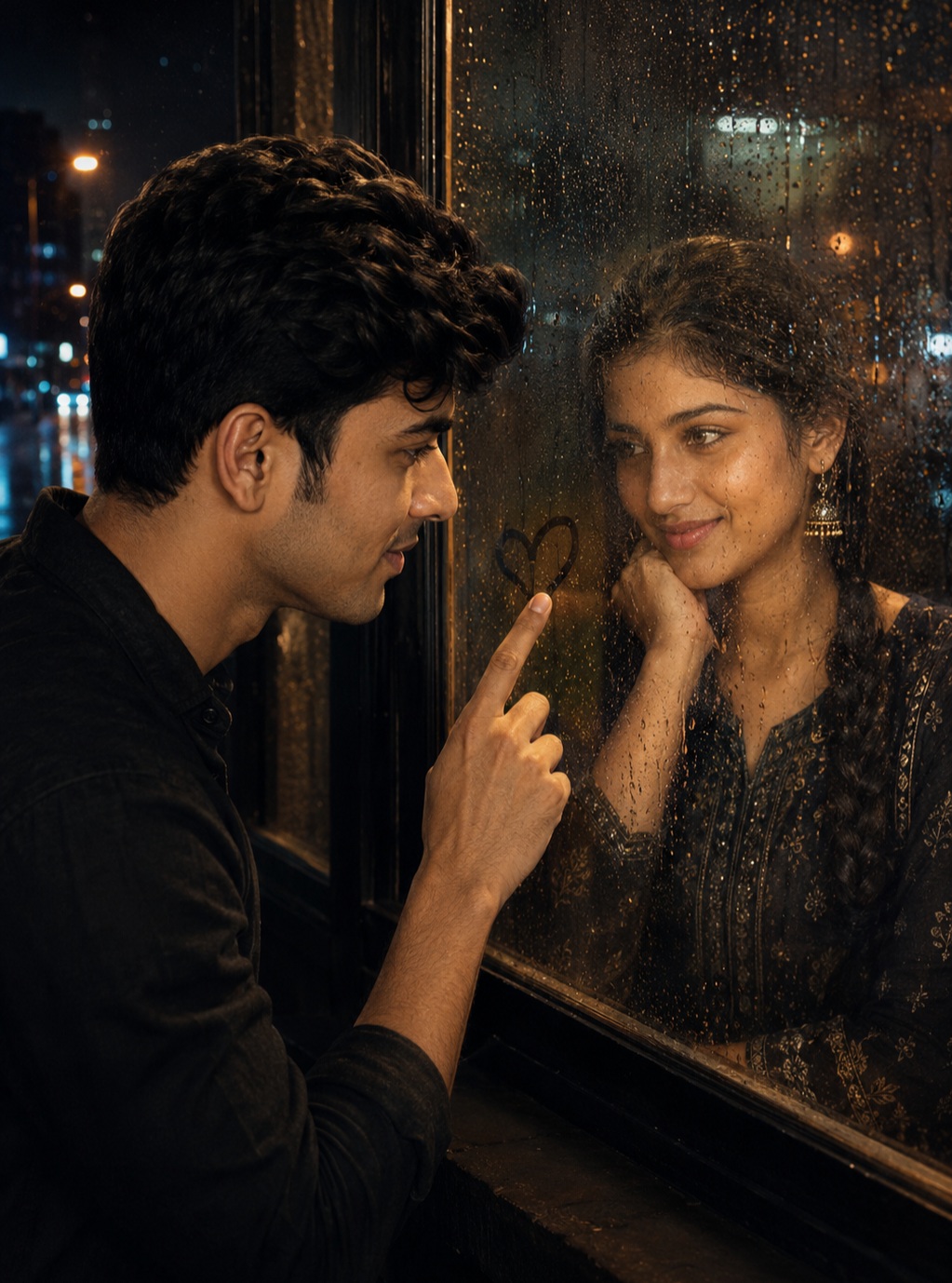
Rainy Glass Romance
Rainy Glass Romance presents an intimate cinematic portrait centered on a young couple separated by a rain-covered glass window at night. The emotional strength of the concept comes from physical separation combined with visual closeness. The man is positioned on one side of the glass while the woman remains on the opposite side, allowing their faces and expressions to communicate a quiet romantic moment without requiring dialogue or written words. The glass becomes an important storytelling element because it separates them physically while simultaneously bringing their expressions, gestures, reflections, and attention together within the same frame.
The main subjects are a man and a woman, with each person occupying a clearly defined area of the composition. The man appears toward the left and lower foreground, while the woman occupies the right side behind the wet glass. Their positioning creates a natural visual conversation across the window. The scene is not designed around a conventional posed couple portrait. Instead, it captures an emotionally charged instant in which the two people are close enough to connect visually but remain separated by a transparent physical surface.
Identity is treated as a central photographic characteristic. The faces should retain recognizable facial structure, natural proportions, authentic skin texture, hairstyle character, and realistic facial scale. The concept emphasizes real human features rather than an idealized or overly polished appearance. Natural pores, subtle skin variation, small imperfections, facial hair detail where present, eye structure, lips, nose shape, jawline, and facial contours contribute to the believable character of the portrait. The faces should feel like real people photographed in difficult nighttime conditions rather than digitally manufactured characters.
The pose and interaction are especially important. The man leans toward the glass and looks directly at the woman. His raised index finger touches the wet surface near a small heart drawn on the glass. This simple gesture carries much of the emotional meaning of the scene. The woman looks back at him with a soft smile, creating a quiet sense of affection and recognition. Her hand rests naturally near her chin, adding another layer of gentle body language. The interaction feels spontaneous and personal rather than theatrical.
The small heart is an important physical detail. It is not treated as typography, a logo, or decorative lettering. It belongs naturally to the environment because it has been drawn directly onto the fogged or rain-covered glass. Its imperfect hand-drawn quality gives the scene an intimate human touch. The heart should remain small and subtle, positioned near the man’s fingertip, without becoming a dominant graphic element. The surrounding glass should still contain much more visual information through droplets, condensation, reflections, and soft distortion.
The wardrobe supports the grounded cinematic feeling. The man wears a dark black casual shirt with natural folds and a slightly worn fabric character. The clothing should feel practical and believable within a rainy urban-night environment rather than overly styled. The woman wears a dark patterned traditional-style outfit with visible fabric texture and ornamental earrings. The wardrobe contributes contrast and personality while remaining subdued enough to keep the faces, glass, and interaction as the primary visual focus.
The rainy glass is one of the most important environmental elements. Individual droplets should remain visible across the surface, with different sizes, shapes, and levels of focus. Some droplets can catch warm street illumination while others reflect cooler ambient tones. Condensation and moisture create mild optical distortion, especially around the woman’s face. This distortion should remain physically believable. The woman should look like a real person behind glass rather than a transparent or ghost-like figure. The glass creates separation through refraction, reflection, moisture, and softness.
The lighting establishes the emotional atmosphere. Warm amber and orange practical lights appear around the nighttime environment, creating small glowing highlights and reflections. These warmer tones contrast with cool blue-green reflections on the wet glass. Deep blacks and charcoal clothing provide a strong foundation for the composition, while muted skin highlights keep the faces visible without flattening the darkness. This mixture of warm and cool illumination creates the visual tension associated with cinematic rainy-night photography.
The background is intentionally atmospheric rather than descriptive. Blurred nighttime city lights and wet street reflections create soft bokeh behind the subjects. The urban environment should remain recognizable as a night setting without competing with the couple. Reflections can appear through the glass and around the edges of the frame, creating additional layers of depth. The background is therefore less about specific architecture and more about establishing a believable city-at-night emotional environment.
The color palette combines deep black, charcoal, muted skin tones, warm amber, subtle orange, cool blue-green, and delicate golden reflections. The contrast should be cinematic but controlled. Facial detail must remain visible within the darker portions of the scene. Shadows should feel deep without becoming empty blocks, while highlights should glow naturally without becoming harsh or overexposed. The overall color treatment should feel sophisticated and atmospheric rather than heavily stylized.
Camera composition is vertical and closely framed. The camera sits approximately at eye level, allowing the viewer to experience the interaction almost directly. The shallow depth of field separates important facial and hand details from the surrounding city lights. The man’s upper body occupies a strong foreground position, while the woman’s face and upper body remain visible through the wet glass. This creates a layered photographic composition in which foreground, glass surface, subject, and background all contribute to depth.
The visual density is carefully controlled. The composition should not become too empty because the rain droplets, reflections, window geometry, city lights, clothing textures, and facial details provide important secondary information. At the same time, the frame should not become crowded with unnecessary objects or people. Exactly one man and one woman form the emotional center. The dark urban environment and wet window surround them without introducing unrelated visual distractions.
The neck, head, arms, hands, and fingers require natural anatomical alignment. The man’s raised index finger should visibly meet the glass near the heart, with believable knuckles, joints, nail detail, wrist positioning, and arm structure. His posture should naturally support the gesture. The woman’s head, neck, hand, and chin relationship should also remain anatomically comfortable. These small physical details matter because the emotional realism of the scene depends on the interaction looking physically possible.
The concept deliberately contains no added typography. There is no title, name, caption, signature, logo, watermark, or decorative lettering. The only visible graphic-like mark is the small physical heart on the glass. This keeps the composition entirely photographic and allows the emotional relationship between the subjects to carry the story. The absence of text also makes the scene feel more like a captured cinematic moment than a promotional poster.
The mood is romantic, nostalgic, dreamy, intimate, and slightly melancholic. Rain naturally adds emotional softness, while the glass introduces a sense of longing and separation. The man’s gesture and the woman’s gentle smile prevent the scene from becoming purely sad. Instead, the mood exists somewhere between affection and distance. Warm lights suggest emotional comfort, while cool reflections and deep shadows create a quiet sense of nighttime solitude.
The overall creative purpose is to portray a believable romantic memory through environmental storytelling. Rather than relying on dramatic gestures, the concept uses a fingertip, a small heart, a soft smile, rain, glass, reflections, and eye contact. These details make the scene feel personal. The viewer can understand the relationship without seeing any written explanation. The window becomes a visual metaphor for distance while the shared gaze communicates connection.
The professional finish depends on realistic low-light photography, accurate reflections, detailed rain droplets, natural fabric texture, authentic skin, subtle film grain, and controlled cinematic color grading. The image should feel captured through a real camera under difficult nighttime lighting. Facial features remain sharp enough to communicate identity, while the surrounding environment becomes softer through depth of field and atmospheric moisture. The balance between clarity and softness is one of the defining qualities of the concept.
This style can be used for romantic portrait artwork, couple photography, anniversary visuals, relationship memories, cinematic social media posts, personalized gifts, music-inspired visual concepts, engagement-themed portraits, or emotional storytelling photography. It can also appeal to photographers and designers who want a cinematic scene that communicates emotion without relying on text. The combination of rain, glass, warm lights, and intimate eye contact gives the concept a timeless romantic quality.
The most important characteristic is restraint. The scene does not need extra people, dramatic graphics, artificial effects, or exaggerated expressions. Its impact comes from preserving the natural relationship between the two subjects and the environment around them. Rain droplets, glass reflections, warm bokeh, dark clothing, facial expressions, and the small heart all work together as believable parts of one nighttime moment.
Rainy Glass Romance therefore describes a carefully controlled photographic concept in which identity, pose, wardrobe, environment, lighting, crop, and emotional interaction work as one coherent composition. The result is designed to feel intimate and cinematic while retaining natural human detail. Every major element supports the same idea: two people separated by glass, connected through a quiet look, a fingertip, a small heart, and the atmosphere of a rainy city night.
[[[
1. Main Goal & Scenario
Reconstruct the Main Reference as a photorealistic cinematic romantic night scene: a young couple separated by a rain-covered glass window, creating an intimate emotional moment. No added text or name anywhere.
2. Identity Mapping & Face Scale
Use the PERSON SOURCE only for exact facial identity and natural body thickness. Preserve authentic facial proportions, features, skin texture, hairstyle character, and face scale.
3. Pose Source Lock
Copy 100% of the MAIN REFERENCE pose and interaction: the man outside the glass leaning toward the woman, looking directly at her; his raised index finger touching/drawing on the wet glass; the woman on the opposite side looking back at him with a soft smile. Never copy pose from PERSON SOURCE.
4. Typography Letter Content Lock
No typography, no name, no title, no lettering, no captions. Preserve only the small heart drawn on the glass because it is a physical scene element, not added typography.
5. ONE TEXT ONE PLACE Lock
No written name or text. Do not introduce any additional lettering anywhere in the image.
6. Exact Text Style & Size Replication Lock
Not applicable — zero added text. Do not create decorative typography, cinematic titles, watermarks, or signatures.
7. Direct Text Injection Command
Do not inject any name or text. The only visible graphic mark should remain the naturally hand-drawn heart on the fogged/rain-covered glass.
8. No Giant Central Figure Lock
Absolutely no oversized central person. Preserve the original intimate two-person framing, with both figures occupying their respective sides of the composition.
9. Vibe, Color & Mood Lock
Replicate the exact moody romantic rainy-night atmosphere: intimate, nostalgic, dreamy, slightly melancholic, warm amber highlights against deep black shadows, cool reflections in the rainy glass, cinematic urban-night ambience.
10. Micro-Details & Crop
Preserve the exact vertical portrait crop, head positions, hair silhouettes, glass droplets, reflections, background bokeh, window frame geometry, finger placement, heart position, partial body visibility, and subtle facial expressions.
11. Identity, Raw Skin & Anti-Fake
Faces must retain realistic pores, natural skin variation, tiny imperfections, facial hair detail, authentic eyes, and realistic wet-night illumination. No plastic skin, beauty-filter effect, face replacement appearance, or artificial smoothing.
12. Hand-Prop & Neck-Head Alignment
The man’s raised index finger must precisely touch the glass near the small heart. Preserve realistic knuckles, finger joints, nails, wrist angle, arm anatomy, and natural neck/head alignment. The woman rests her hand naturally near her chin.
13. Body Proportion & Limb Scaling
Keep realistic human anatomy and natural body thickness from PERSON SOURCE while strictly following the MAIN REFERENCE positioning. No oversized hands, elongated fingers, distorted shoulders, or unnatural limbs.
14. Outfit Fit, Drape & Wrap
Recreate the MAIN REFERENCE wardrobe exactly in visual character: the man in a dark black casual shirt with natural folds and slightly worn texture; the woman in a dark patterned traditional-style outfit with visible fabric texture and ornamental earrings. Preserve exact fit and drape without redesigning the clothing.
15. Selective Color & Tone Mapping
Use deep blacks, charcoal clothing, warm amber/orange street illumination, muted skin highlights, cool blue-green reflections, and subtle golden reflections through the wet glass. Maintain strong cinematic contrast without crushing facial detail.
16. No Random Logos & Clean Text
No logos, watermarks, signatures, brands, captions, UI elements, or fabricated lettering anywhere.
17. Perfect Spelling & Text Rendering
No added text means no spelling or typography generation. The naturally drawn heart must remain a simple imperfect hand-drawn mark.
18. Text Ratio & Style Lock
ZERO added typography. Do not transform the heart into text, a logo, or decorative lettering.
19. Opacity, Layering & Ghost
The woman must appear naturally behind the rain-covered glass with realistic optical distortion, condensation, droplets, reflections, and slight diffusion. Preserve the physical separation created by the glass without making her look like a transparent ghost.
20. Duplicate Mapping & Pose Variety
No duplicate people, no cloned faces, no repeated figures. Exactly one man and one woman, positioned on opposite sides of the glass as shown.
21. Professional Quality Boost
Ultra-photorealistic professional photography, cinematic dynamic range, realistic low-light exposure, physically accurate reflections, detailed rain droplets, natural skin, sharp facial features, realistic fabric texture, subtle film grain, premium color grading.
22. Body Visibility & Scene Density
Maintain the same visual density and framing: man’s upper body dominates the left/lower foreground, woman’s upper body and face occupy the right side behind the glass, with enough dark urban environment and rainy-window detail surrounding them.
23. Composition/Camera & Lighting
Vertical portrait composition matching the reference exactly. Camera positioned close to the couple at approximately eye level, with shallow cinematic depth of field. Left background contains blurred nighttime city lights and wet street reflections. Warm practical lights illuminate the scene while the rainy glass catches cool reflections and highlights.
24. Quality Lock & User Customization
Use the PERSON SOURCE strictly for face identity + body thickness and MAIN REFERENCE strictly for composition, pose, wardrobe, environment, lighting, color, crop, interaction, and mood. Make no unauthorized creative substitutions. No name/text customization.
25. Bad Output Mistakes & Negative Prompt
NEGATIVE: wrong identity, generic face, face paste, plastic skin, smooth skin, beauty filter, wrong pose, copied PERSON SOURCE pose, normalized pose, broken neck, bad anatomy, bad hands, hulk hands, malformed fingers, extra fingers, wrong outfit, altered clothing, wrong color grade, dull colors, excessive warm grading, flat lighting, random logos, watermarks, signatures, unauthorized text, names, captions, giant typography,
duplicate text, hallucinated lettering, giant central figure, duplicate people, cloned faces, transparent solid ghost, incorrect glass separation, missing rain droplets, missing heart, incorrect heart position, dry glass, fake reflections, overexposed highlights, crushed facial detail, excessive blur, artificial bokeh, cartoon appearance, CGI look, AI artifacts, low detail, low density, wrong vibe, wrong composition, wrong crop, unauthorized changes. ]]]
” https://prompt.mahantababu.com/