
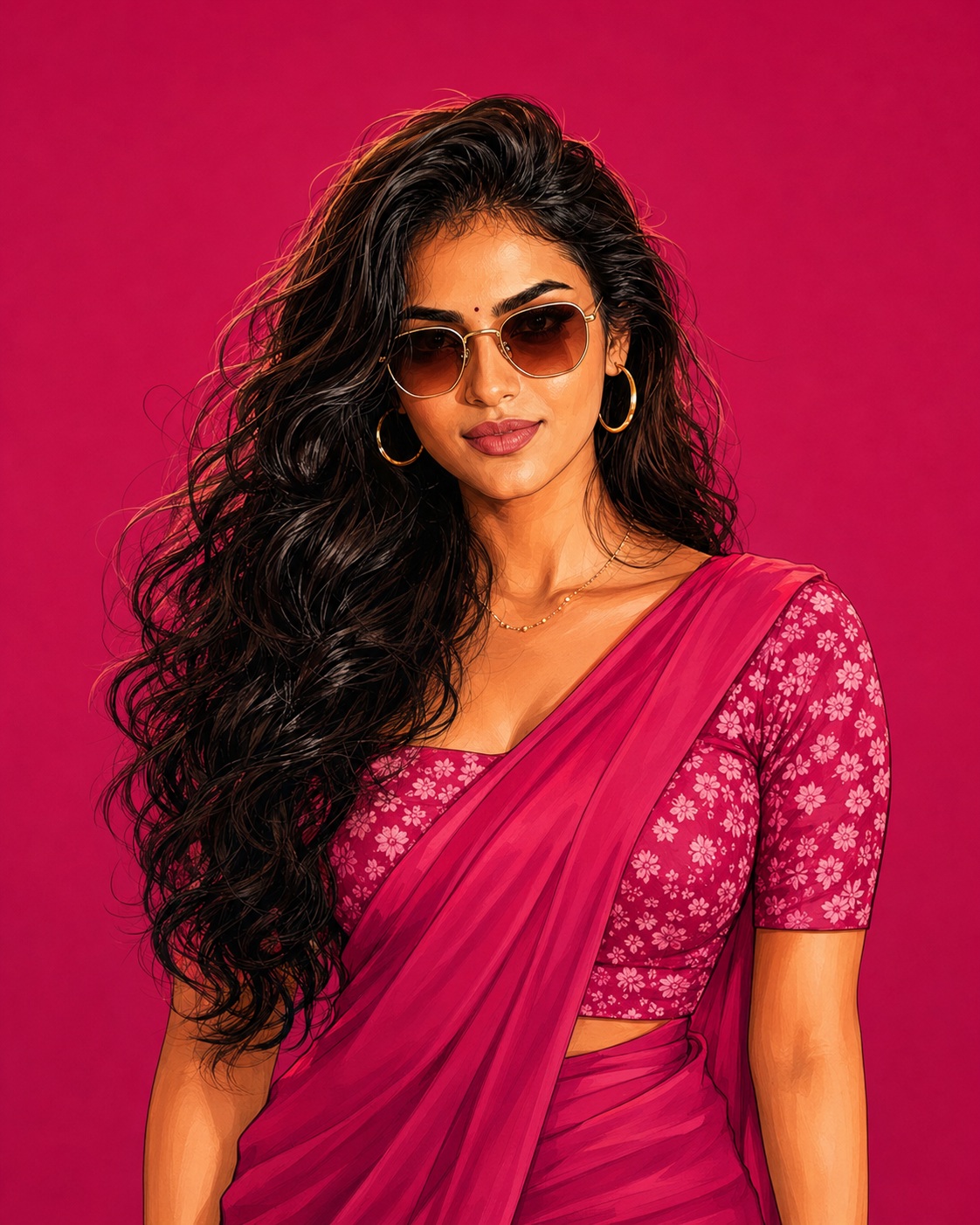
Magenta Saree Portrait
This prompt describes a premium stylized digital illustration centered on a single woman presented in an elegant three-quarter portrait composition. The creative direction combines recognizable personal identity with a polished editorial illustration aesthetic, using a powerful magenta color environment as the visual foundation. The overall impression is cheerful, feminine, glamorous, sophisticated, and fashion-focused, with the sari, floral blouse, accessories, hairstyle, and expressive face working together as the main visual story.
The woman is the only human subject in the composition. Her position, body rotation, head angle, shoulder orientation, torso placement, arm position, crop, and camera perspective are carefully tied to the main reference. The composition is not intended to become a new pose or a freely interpreted fashion portrait. Its strength comes from preserving the existing arrangement and translating it into a refined digital illustration.
Identity is a major priority. The facial structure, eyes, nose, lips, jawline, skin tone, hairstyle characteristics, and facial proportions should remain recognizable. The separate person source contributes identity and natural body thickness, while the main reference controls the visual composition and pose. This distinction allows the finished portrait to retain the personality of the subject without changing the intended body language.
The expression contributes strongly to the mood. The woman has a cheerful and elegant presence, with a recognizable smile and carefully preserved lip shape. The face should not be transformed into a generic fashion illustration. Natural facial asymmetry remains part of the character, while painterly rendering adds refinement and visual polish.
The sunglasses are an important styling feature. They sit precisely across the eyes with a thin metallic frame, brown lenses, bridge, and side arms. Their position is closely connected to the head angle and facial structure. Because they occupy a prominent area of the face, even small changes could alter the personality of the portrait, so the accessory remains visually consistent with the reference.
The small bindi adds a subtle traditional detail to the styling. It works together with the earrings and necklace to establish a refined Indian fashion character. The accessories are intentionally elegant rather than excessive. Their metallic tones provide small highlights against the dominant magenta palette.
The hairstyle is another important identity feature. Hair volume, loose strands, and the long ponytail placement are carefully preserved. The hair creates a strong silhouette around the head and shoulders, while warm brown highlights can provide dimensional separation from darker sections. The hairstyle contributes both to recognition and to the overall feminine editorial quality.
The sari is the primary fashion element. It uses a rich magenta or pink palette that harmonizes with the background while maintaining enough tonal variation to keep the fabric readable. Traditional draping direction, flowing pleats, folds, and layered fabric are important visual details. The sari should feel elegant and naturally arranged rather than stiff or simplified.
The blouse provides a contrasting pattern within the monochromatic color family. It is a fitted short-sleeve blouse decorated with dense small pale-pink floral motifs. The floral pattern should remain delicate and controlled. It should not become oversized or visually dominant. These small flowers add texture and sophistication while preserving the clean editorial character.
Fabric rendering is an important part of the illustration. The sari needs convincing folds and drape, with darker magenta shadows describing the depth of the fabric. Highlights can gently follow the pleats and curved surfaces. The blouse should retain its fitted structure and floral pattern without losing the clarity of the underlying garment.
The background is intentionally minimal. A solid saturated deep-magenta field fills the surrounding space. There are no scenery elements, furniture, decorative objects, patterns, or environmental distractions. This simplicity makes the portrait immediately recognizable and creates a strong fashion-editorial presentation.
The background color is also part of the subject’s visual identity within the composition. The rich magenta environment connects with the sari, creating a coordinated color story. At the same time, warm natural skin tones provide the necessary contrast so that the face remains visually prominent.
The color palette is carefully controlled. Deep saturated magenta dominates the background. The sari uses coordinated pink and magenta tones with slightly darker fold shadows. The blouse carries lighter floral motifs. Skin is rendered with warm peach and orange undertones, while hair uses deep brown-black with subtle warmer highlights. Gold and metallic accessory tones provide small accents.
This limited palette gives the portrait a cohesive and memorable appearance. Rather than introducing many unrelated colors, the concept uses tonal variation within a small group of related hues. The result is sophisticated and fashion-oriented.
The illustration treatment combines crisp controlled linework with painterly shading. Edges should remain clean enough to define the silhouette, hair, jewelry, clothing, and facial features. At the same time, subtle tonal transitions create depth across the face, neck, blouse, and sari. This balance keeps the artwork polished without becoming either flat or excessively photorealistic.
Skin rendering is intentionally controlled. The portrait retains natural facial planes, subtle texture, and authentic asymmetry, but the surface is interpreted through a refined illustrated treatment. The goal is an elegant painted appearance rather than plastic smoothing or a conventional photographic conversion.
Lighting is soft and even, similar to a controlled studio portrait interpreted through illustration. Gentle shading defines the cheeks, nose, jawline, neck, and clothing. The lighting should not introduce dramatic environmental shadows because the clean background and fashion styling depend on visual clarity.
Composition is vertical and closely aligned with the main reference. The woman remains centrally positioned with the same three-quarter orientation and generous surrounding negative space. The crop remains consistent with the reference, ensuring that the portrait does not become unnecessarily enlarged.
The pose communicates relaxed confidence. The body rotation, shoulders, head tilt, arm placement, and facial expression create a natural fashion-editorial attitude. The subject does not need additional scenery or props because the sari, accessories, expression, and color palette already provide enough visual information.
The prompt specifically prevents duplicate figures, ghost silhouettes, repeated body parts, transparent overlays, random jewelry, logos, watermarks, signatures, and unrelated graphic elements. This ensures that the composition remains a single clean portrait.
The absence of typography is also intentional. No personal name, caption, title, signature, label, or decorative lettering should appear. The uninterrupted magenta background functions as negative space and reinforces the minimalist fashion presentation.
The concept is especially useful for digital fashion portraits, cultural fashion artwork, social media profile visuals, editorial illustrations, personal branding, festive portrait designs, creative portfolios, and modern sari-focused artwork. The strong color identity also makes the portrait visually recognizable at a glance.
The design purpose is to combine traditional Indian fashion with contemporary digital illustration. The sari provides cultural elegance, the floral blouse introduces delicate pattern detail, the sunglasses add modern styling, and the saturated magenta environment creates a bold editorial identity.
The strongest visual relationship is between the woman’s warm skin tones and the surrounding cool-to-warm magenta family. This color contrast keeps the face readable while allowing the clothing and background to feel connected. The result is visually cohesive without becoming monochromatic in a flat way.
The overall mood is cheerful, feminine, polished, glamorous, and confident. It does not rely on dramatic scenery or complex effects. Instead, the portrait achieves its impact through identity, styling, expression, color, fabric detail, and controlled illustration quality.
Every major component supports the same artistic direction. The face provides personality, the sunglasses provide contemporary fashion character, the bindi and jewelry provide cultural detail, the sari provides the dominant fashion structure, the floral blouse adds texture, and the magenta background provides a bold editorial stage.
This makes the concept particularly effective for a premium digital portrait where simplicity is part of the visual sophistication. The absence of scenery allows the viewer to focus immediately on the woman and the details of her styling.
Overall, the prompt represents a carefully controlled fusion of feminine portraiture, Indian sari fashion, contemporary accessories, and polished digital painting. Its goal is a clean, memorable, high-end illustrated portrait that preserves the recognizable identity and reference composition while emphasizing color, elegance, and editorial presentation.
[[[
1. Main Goal & Scenario
Reconstruct the MAIN REFERENCE as a premium stylized digital illustration portrait, preserving its exact feminine portrait composition, three-quarter body orientation, facial expression, sari styling, hairstyle, accessories, magenta background, and polished editorial illustration aesthetic.
2. Identity Mapping & Face Scale
Use the PERSON SOURCE only for exact face identity and natural body thickness. Preserve recognizable facial structure, eyes, nose, lips, jawline, skin tone, hair characteristics, and facial proportions without altering identity.
3. Pose Source Lock
100% LOCK the MAIN REFERENCE pose, head angle, shoulder orientation, torso position, arm placement, body rotation, crop, and camera perspective. NEVER copy pose information from the PERSON SOURCE.
4. Typography Letter Content Lock
NO NAME OR PERSONAL TEXT is required. Keep the portrait completely free of added typography.
5. ONE TEXT ONE PLACE Lock
NO TEXT anywhere. Do not add names, captions, signatures, labels, logos, or decorative lettering.
6. Exact Text Style & Size Replication Lock
Not applicable because the requested output contains no text.
7. Direct Text Injection Command
Do not inject any text. Preserve the clean uninterrupted magenta background.
8. No Giant Central Figure Lock
Maintain the exact subject scale and framing of the MAIN REFERENCE. Do not enlarge the woman beyond the original crop or remove the surrounding negative space.
9. Vibe, Color & Mood Lock
Replicate the exact cheerful, elegant, feminine, glamorous illustrated mood. Preserve the intense deep-magenta/pink background and coordinated magenta sari palette with warm skin tones and subtle floral detailing.
10. Micro-Details & Crop
Preserve the exact hair volume and loose strands, long ponytail placement, sunglasses position, small bindi, earrings, necklace, smile, lip shape, sari folds, floral blouse pattern, sleeve length, arm crop, and bottom-edge framing.
11. Identity, Raw Skin & Anti-Fake
Preserve exact facial identity without plastic beautification. Translate natural facial texture into sophisticated painterly illustration detail while retaining authentic facial asymmetry and recognizable features.
12. Hand-Prop & Neck-Head Alignment
Preserve the sunglasses precisely across the eyes, including thin metallic frame, brown lenses, bridge, and side arms. Maintain correct neck-to-head anatomy, natural shoulder transition, and the exact reference head tilt.
13. Body Proportion & Limb Scaling
Use MAIN REFERENCE for pose and limb geometry, PERSON SOURCE only for body thickness. Preserve realistic head-to-body ratio, shoulder width, arm thickness, neck size, and natural anatomy.
14. Outfit Fit, Drape & Wrap
Reproduce the MAIN REFERENCE outfit exactly: rich magenta/pink sari with elegant flowing pleats and drape, paired with a fitted short-sleeve floral blouse featuring dense small pale-pink floral motifs. Preserve the sari’s traditional draping direction, fabric folds, sleeve cut, and neckline.
15. Selective Color & Tone Mapping
Background: solid saturated deep magenta.
Sari: coordinated rich pink/magenta with slightly darker fold shadows.
Blouse: pink/magenta floral pattern with lighter flower motifs.
Skin: warm natural peach/orange tones.
Hair: deep brown-black with warm brown highlights.
Accessories: subtle gold/metallic tones.
16. No Random Logos & Clean Text
No logos, watermarks, signatures, branding, symbols, or unrelated graphic elements.
17. Perfect Spelling & Text Rendering
No text is permitted, so no accidental lettering should appear.
18. Text Ratio & Style Lock
No text. Preserve the large clean negative-space background exactly as the reference rather than filling it with typography.
19. Opacity, Layering & Ghost
One solid primary subject only. No ghosting, transparency, duplicate silhouettes, overlays, or secondary figures.
20. Duplicate Mapping & Pose Variety
Exactly one woman in exactly one pose matching the MAIN REFERENCE. No duplicate portraits, mirrored figures, or repeated body parts.
21. Professional Quality Boost
Premium high-end digital illustration, sophisticated painterly rendering, crisp controlled linework, detailed hair strands, realistic fabric folds, elegant facial modeling, clean edges, rich tonal depth, polished editorial portrait finish.
22. Body Visibility & Scene Density
Maintain the same upper-body/three-quarter portrait visibility and crop. Keep the background completely minimal and uncluttered with no scenery or additional objects.
23. Composition/Camera & Lighting
Vertical portrait composition matching the MAIN REFERENCE aspect ratio exactly. Subject positioned centrally with the same three-quarter orientation and generous magenta negative space. Soft even studio-style illustrated lighting with subtle facial and clothing shading.
24. Quality Lock & User Customization
Faithfully reconstruct the MAIN REFERENCE using the PERSON SOURCE only for identity and body thickness. Preserve the exact pose, facial expression, hairstyle, sari, blouse pattern, accessories, color palette, background, framing, and illustration style. No name or text should be added.
25. Bad Output Mistakes & Negative Prompt
BLOCK: wrong identity, generic face, face paste, plastic skin, beautified face, wrong pose, copied PERSON SOURCE pose, normalized pose, broken neck, bad anatomy, bad hands, extra fingers, missing fingers, hulk hands, distorted face, wrong head tilt, wrong crop, wrong sunglasses, missing sunglasses, wrong bindi, missing bindi, wrong earrings, missing earrings, wrong necklace, wrong hairstyle, short hair, wrong sari, incorrect sari wrap, saree drape error, wrong blouse, missing floral pattern, giant floral pattern, wrong colors,
orange background, red background, dull magenta, wrong skin tone, photorealistic conversion, generic cartoon face, random jewelry, random logos, watermark, signature, unauthorized text, hallucinated names, hardcoded names, duplicate person, ghost figure, extra limbs, distorted fingers, cluttered background, scenery, objects, flat lighting, muddy shadows, low detail, blurry artwork, amateur illustration, AI artifacts, WRONG VIBE, WRONG COLOR PALETTE, altered aspect ratio, excessive saturation, inconsistent illustration style. ]]]
” https://prompt.mahantababu.com/