
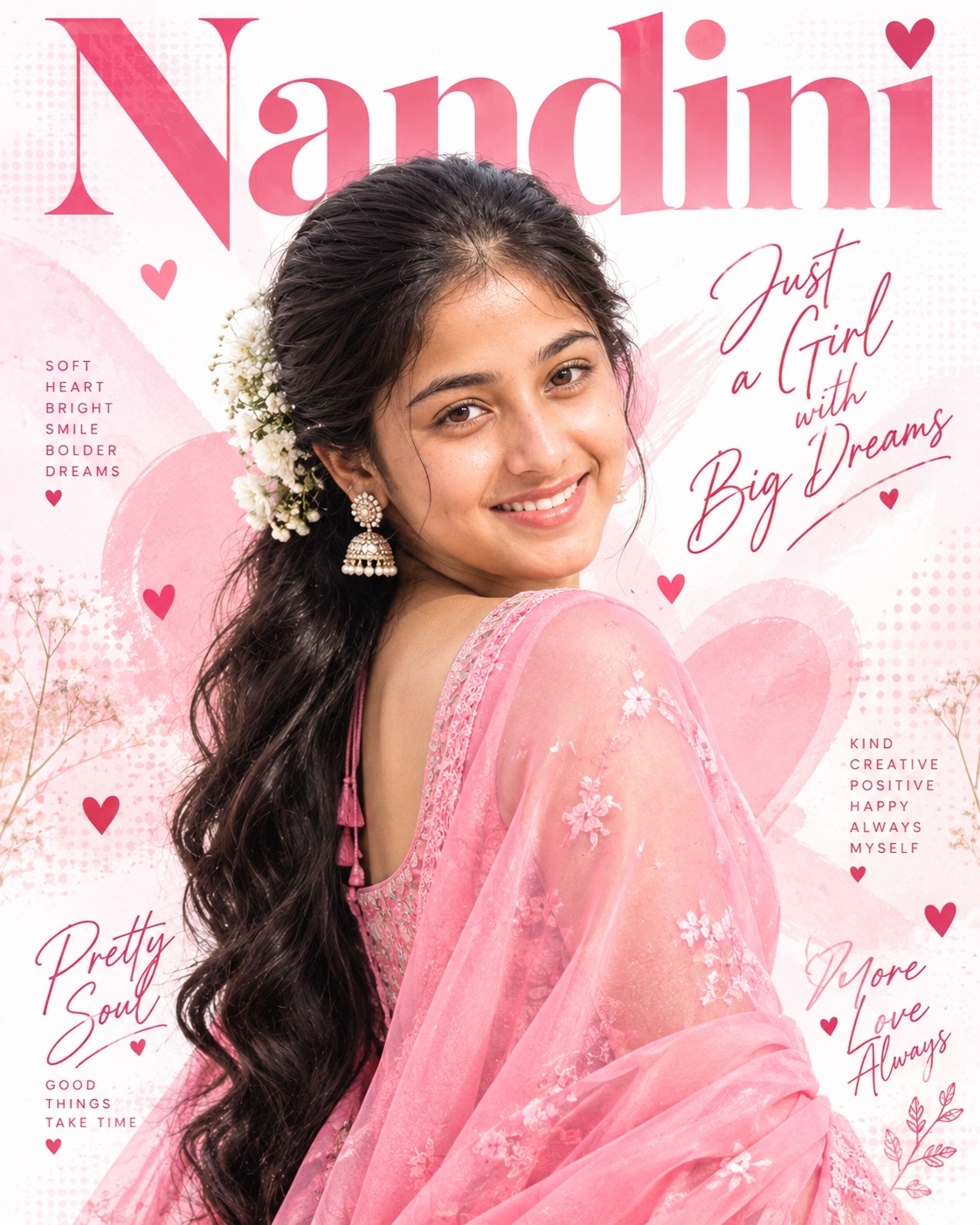
Romantic Pink Portrait
The concept presents a single adult woman as the central visual subject in a polished romantic Indian fashion-editorial poster. Rather than treating the source as a simple portrait photograph, the composition combines a carefully posed female figure with magazine-style typography, blush-pink graphic forms, romantic symbols, and generous white space. The overall presentation is bright, delicate, feminine, and visually organized, with the woman remaining the strongest human focal point.
The subject is positioned slightly to the right of the vertical center while still occupying the main central region of the square artwork. Her scale is deliberately preserved from the reference, allowing substantial negative space to remain visible around her. This is important because the surrounding white and pink space is part of the design rather than empty background. The composition should therefore feel like a finished fashion magazine poster rather than a conventional portrait cropped tightly around the face.
The pose gives the concept much of its personality. The woman’s torso is turned mostly away from the camera, angled toward the right, while her head rotates back over her shoulder toward the viewer. This creates an elegant three-quarter facial presentation while retaining the graceful line of the back, shoulder, and upper body. The gentle smile and relaxed expression make the pose feel affectionate and approachable rather than dramatic or formal.
The head turn is especially significant because it creates a contrast between body direction and facial attention. Her body moves visually toward the right while her face returns toward the viewer. This produces a natural fashion-editorial gesture that can communicate softness, confidence, romance, and elegance simultaneously. The neck angle, shoulder line, head position, and torso direction are all part of the intended visual geometry.
The identity is designed to come from the supplied person rather than from the source woman’s facial appearance. Recognizable facial structure, proportions, distinctive features, natural asymmetries, and other identifying characteristics remain important. At the same time, the supplied identity is interpreted inside the reference composition rather than allowing the source photograph to dictate the pose, framing, scale, or camera arrangement.
The hair forms a major visual element. Long, voluminous dark hair cascades downward along the back and left side of the body, creating a strong flowing silhouette. The hairstyle contributes both movement and femininity to the composition. A decorative white floral hair accessory adds a traditional detail that contrasts beautifully against the dark hair while connecting with the light background.
Dangling earrings provide another delicate styling element. They add a subtle vertical accent around the face and support the traditional Indian fashion character of the design. These details are intentionally refined rather than oversized, keeping attention on the woman’s expression and overall silhouette.
The clothing is a flowing pink traditional sari-like garment with soft folds and a light, graceful fabric appearance. Pink is the dominant clothing color and connects directly with the surrounding blush-pink graphics. The garment should feel elegant and fluid, with its draping following the body naturally. The shoulder coverage, folds, fabric direction, and silhouette contribute to the fashion-editorial character.
The color relationship between clothing, background, and decorative graphics is one of the strongest features. The woman wears pink against a predominantly white environment, while pale blush shapes provide a soft transition behind her. Rose-pink and red accents then add definition through typography and heart motifs. This produces a carefully controlled palette rather than a visually chaotic collection of colors.
The background is intentionally bright and spacious. White negative space dominates the base while broad blush-pink sweeping shapes move behind the subject. These forms provide visual depth without creating a literal environment. They function more like magazine design elements, allowing the woman’s silhouette to remain clearly separated from the background.
Typography is an important part of the poster structure. Large cropped pink headline lettering appears near the top, creating an immediate magazine-cover impression. Script-style romantic lettering appears around the upper-right and lower areas, while smaller decorative text blocks occupy side regions. The typography contributes to the hierarchy of the artwork and makes the composition feel designed rather than simply photographed.
Small hearts and romantic symbols reinforce the emotional theme. Red and pink heart icons are scattered around the composition, but they remain decorative rather than overwhelming. Tiny floral motifs, dotted halftone textures, ornamental lines, and subtle graphic details add visual richness while preserving the clean white foundation.
The halftone textures introduce a light print-inspired character. Small dots and faint ornamental patterns can appear within or around the pink areas, creating a subtle connection to magazine printing and contemporary poster design. These details should remain delicate so they do not compete with the woman.
Lighting is high-key, soft, and flattering. The woman’s skin retains a warm natural complexion, while the hair remains dark and glossy. Shadows are gentle rather than dramatic. The visual treatment avoids heavy contrast and instead uses soft transitions that complement the romantic mood. The result should feel luminous, fresh, and polished.
The overall art direction combines Indian fashion, romantic magazine design, contemporary poster composition, and soft photographic beauty styling. It does not rely on fantasy effects, heavy illustration, gritty textures, or dark cinematic grading. Its appeal comes from elegance, simplicity, color harmony, typography, and the carefully arranged relationship between the woman and the surrounding graphic space.
The composition also has a strong editorial purpose. It can be suited to romantic fashion posters, traditional Indian portrait artwork, social media cover designs, festive fashion graphics, personal profile artwork, magazine-inspired creative projects, wedding-related visual concepts, and feminine lifestyle presentations. The clean background also provides room for personalized text without making the artwork feel overcrowded.
One of the most useful features of the concept is its ability to combine identity with a recognizable design language. The supplied person remains visually important, but the surrounding poster system establishes the final mood. This means the person’s original photograph does not need to have the same pose or composition as the reference. The identity is interpreted into the established editorial arrangement.
The design purpose is therefore broader than creating a pretty portrait. It creates a complete visual composition in which subject placement, pose, hairstyle, traditional clothing, typography, hearts, color, lighting, and negative space work together. Each element supports the same romantic Indian fashion direction.
The finished concept is intended to feel polished and premium while remaining warm and accessible. The combination of white space, pink tones, natural skin, dark flowing hair, traditional styling, and delicate graphic decoration creates a youthful magazine-cover atmosphere. The gentle smile and over-the-shoulder pose provide emotional connection without making the scene overly dramatic.
The strongest defining characteristics are the square format, carefully controlled subject scale, over-the-shoulder pose, long dark hair, white floral accessory, dangling earrings, flowing pink traditional garment, high-key lighting, white background, blush-pink shapes, romantic typography, hearts, halftone textures, and Indian fashion-editorial atmosphere. Together, these elements create a cohesive visual identity.
The concept ultimately describes a graceful female fashion portrait transformed into a romantic poster composition. It balances personal identity with a carefully preserved reference structure, allowing the subject to remain recognizable while becoming part of a polished magazine-style design. The result is soft, feminine, colorful, spacious, and visually expressive without losing the disciplined structure of the original composition.
[[[
REFERENCE ANALYSIS
- Format/composition: Square romantic magazine/poster-style portrait. A young woman occupies the central vertical area, shown from approximately the upper head to below the waist, with generous white/pink negative space and typography surrounding her.
- Subject placement/scale: The woman is centered slightly right of the vertical midpoint. Her head sits around the upper-middle portion; her long hair extends down the left side of her body. Preserve this exact scale and framing rather than turning it into a conventional centered portrait.
- Pose: She is turned mostly away from the camera, with her torso angled toward the right while her head turns back over her shoulder toward the viewer. Her face is three-quarter/front-facing relative to the camera, with a gentle smile and direct/near-direct gaze. Preserve the exact shoulder, neck, head-turn, and torso geometry.
- Appearance: Long, voluminous dark hair cascading down her back, with a decorative white floral hair accessory on the left side. Feminine traditional styling with dangling earrings and a soft, natural facial expression.
- Clothing: Flowing pink traditional garment/sari-like drape with soft folds and translucent/light fabric qualities. Pink dominates the character silhouette.
- Graphic design: White background with pale blush-pink sweeping shapes behind the woman. Large cropped pink headline typography across the top. Script-style romantic typography appears around the upper-right and lower portions. Smaller decorative text blocks are positioned on both sides.
- Decorative elements: Multiple small red/pink heart icons, scattered heart shapes, tiny floral/romantic motifs, dotted halftone textures, and faint ornamental linework.
- Color/lighting: Bright, soft, high-key presentation dominated by white, blush pink, rose pink, and red accents. The woman has warm natural skin tones and dark brown/black hair. Lighting is soft and flattering without harsh shadows.
- Mood/style: Romantic, feminine, youthful magazine-cover aesthetic with a polished Indian fashion/editorial feel. Preserve the typography-driven poster composition and its light, affectionate visual atmosphere.
- Identity replacement: If replacing the woman with [USER IDENTITY], use the supplied identity while reconstructing that person into the exact reference pose, scale, hairstyle arrangement, clothing silhouette, expression, and framing. The identity photo must not dictate the final composition.
MASTER PROMPT
Use the supplied reference image as the master visual blueprint. Replace only the reference character with the supplied user identity. Maintain the exact subject scale, screen-space proportion, cropping, and visibility of the reference character; do not normalize, enlarge, or reframe. Preserve all other visual information, composition, environment, lighting, color, depth, atmosphere, objects, background and artistic rendering as faithfully as possible.
Reconstruct the supplied reference as the same square romantic Indian fashion/editorial poster. Replace the original female character with [USER IDENTITY], preserving the user’s recognizable facial structure, proportions, distinctive features, natural asymmetry, and identity, while rendering her naturally within the reference’s soft polished photographic aesthetic.
The user must occupy exactly the same position and screen-space proportion as the reference woman. Preserve the same amount of body visible, the same head placement, the same distance from all image edges, and the same negative space around her. Do not enlarge, shrink, recenter, zoom, or redesign the composition.
Recreate the exact pose: the woman’s torso and shoulders are oriented mostly away from the camera, with her upper body turned toward the right side while her head rotates back over her shoulder toward the viewer. Preserve the same head tilt, neck angle, shoulder line, facial direction, gentle smile, and overall relaxed posture. Do not use the pose from the user’s identity photograph.
Preserve the long flowing dark-hair silhouette cascading down the back and along the left side of the body, including the decorative white floral hair ornament and dangling earrings. If [USER IDENTITY] has different hair, adapt the user’s identity into the reference hairstyle arrangement rather than allowing the source photograph to alter the reference silhouette.
Preserve the flowing pink traditional garment/sari-like outfit, its draping, folds, shoulder coverage, fabric weight, and overall silhouette. [OUTFIT] defaults to the reference clothing unless explicitly changed. Do not introduce modern clothing or a different fashion silhouette.
Maintain the reference’s bright white background, broad pale-pink sweeping shapes behind the subject, soft pink graphic overlays, subtle halftone/dot textures, faint ornamental patterns, and romantic decorative composition. Preserve the large cropped pink headline typography at the top, the handwritten/script-style lettering around the upper-right and lower portions, the small text blocks on the left and right, and the scattered pink/red heart motifs. [TEXT] should only modify text when explicitly supplied; otherwise preserve meaningful reference text and its placement/style.
Match the original high-key lighting, soft skin rendering, warm natural complexion, dark glossy hair, pink garment, white negative space, blush-pink graphics, and small saturated red/pink accents. Keep the image clean, bright, delicate, and romantic. Do not introduce dramatic shadows, dark cinematic grading, excessive contrast, orange tones, or unrelated colors.
Preserve the exact typography-driven poster layout, decorative density, spacing, background graphics, and visual hierarchy. The result should appear as the same original poster with its original woman replaced by [USER IDENTITY], not a newly designed poster inspired by it.
EDITABLE VARIABLES
- [USER IDENTITY]: Supplied user’s identity; preserve recognizable facial structure, proportions, features, hair characteristics, and natural asymmetries.
- [OUTFIT]: Reference pink traditional sari-like garment; change only if explicitly requested.
- [TEXT]: Preserve reference text unless the user supplies replacement wording.
- [OBJECT CHANGE]: None.
- [POSE CHANGE]: Reference pose — torso turned away/rightward with head turned back over shoulder toward camera.
- [ADDITIONAL EDIT]: None unless explicitly specified.
NEGATIVE PROMPT
identity loss, different face, wrong facial structure, original woman remaining, added person, extra person, face swap, pasted face, wrong ethnicity or identity, wrong pose, frontal body pose, facing completely forward, head facing wrong direction, wrong head tilt, wrong shoulder angle, wrong torso orientation, changed crop, changed composition, enlarged subject, reduced subject, centered differently, zoomed in, zoomed out,
altered screen-space proportion, expanded framing, full body, missing lower body visibility, altered negative space, redesigned poster, changed typography layout, missing headline, missing script text, missing decorative text, missing hearts, missing floral ornament, missing earrings, altered hair silhouette, short hair, different clothing, different garment color, dark clothing, dark background, dramatic lighting, harsh shadows, cinematic grading, orange grading, oversaturation, desaturated image, dark mood, gritty style, anime,
illustration, watercolor, painting, surreal elements, extra objects, removed objects, altered background, missing pink graphics, missing halftone texture, missing romantic motifs, generic fashion portrait, generic magazine cover, beauty retouching that changes identity, facial reshaping, unnecessary modifications. ]]]