
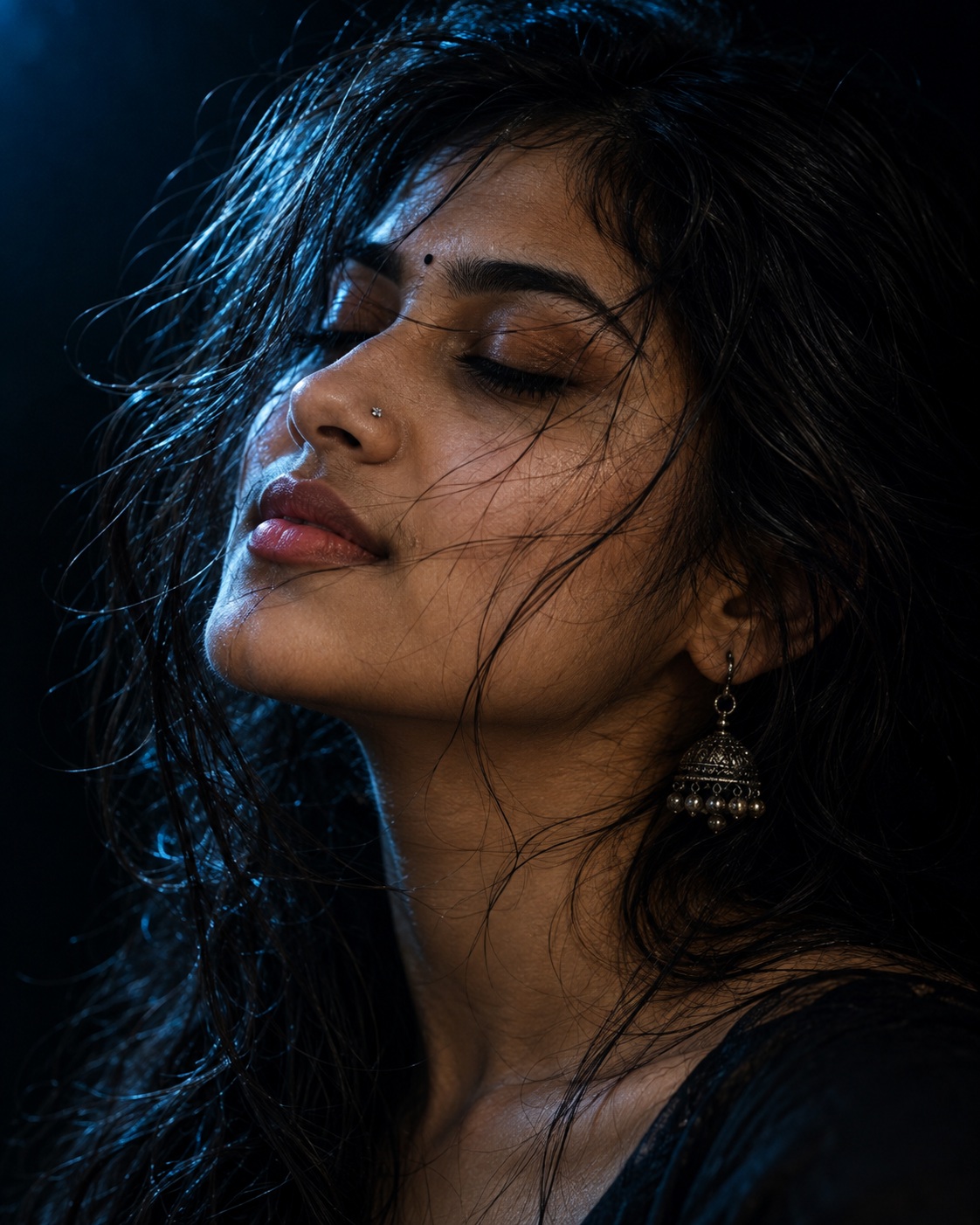
Moody Cinematic Woman
The concept presents a single woman through an extremely intimate cinematic close-up. The portrait is designed around the face, with the head, a small portion of the neck and a limited area of the shoulder filling almost the entire vertical frame. There is very little visible environment, allowing the facial expression, hair texture, jewelry and controlled lighting to become the central visual elements.
The framing is deliberately tight and immersive. Instead of showing the complete upper body or a recognizable location, the composition concentrates almost entirely on the woman’s facial presence. This creates a private, introspective feeling, as though the viewer is witnessing a quiet moment rather than observing a conventional posed photograph.
The woman is positioned in a strong side-profile or three-quarter profile facing toward the left side of the frame. Her head is slightly tilted upward, with the chin subtly raised. The neck follows the same natural direction as the head, creating an elegant continuous line from the jaw into the shoulder area.
Her eyes are completely closed. This is one of the most important emotional characteristics of the concept because the closed eyes remove direct visual interaction and instead make the expression feel inward and contemplative. The lips remain gently parted, creating a relaxed facial position rather than a smile or dramatic expression.
The overall expression is serene, quiet and emotionally soft. There is no exaggerated happiness or visible tension. The face communicates peace, melancholy and introspection through very small details such as the relaxed mouth, closed eyelids and upward head position.
The facial identity remains the personal focal point. The user’s recognizable facial characteristics are intended to be integrated naturally into the established profile angle and expression. The identity does not stand apart from the photographic treatment; it becomes part of the same low-key cinematic rendering.
The hair provides one of the strongest textural elements. It is dark, slightly wet and naturally messy, with loose strands escaping around the face. Instead of being arranged into a perfectly controlled hairstyle, the hair has irregular flyaways and individual strands that cross different areas of the face.
Some strands move across the forehead, while others pass near the eyelid, cheek and lips. These loose strands create a delicate sense of physical realism. They also add visual depth because certain strands catch small amounts of the available blue light while others disappear into the dark background.
The wet or slightly damp quality of the hair is important to the mood. It gives the hairstyle a heavier, more natural texture and allows individual strands to appear darker and more defined. The hair therefore becomes part of the atmosphere rather than simply a decorative styling element.
The small black bindi is another important facial detail. It provides a subtle traditional element while remaining visually understated. Because the overall image is dark, the bindi contributes to the identity of the woman without becoming a bright graphic feature.
A tiny nose stud adds another delicate point of detail. Its small scale works well with the extreme close-up because the viewer can notice it without allowing it to dominate the composition. Together, the bindi and nose stud introduce traditional character into an otherwise highly cinematic visual treatment.
The eyebrows remain dark and natural. They help define the eye region despite the closed eyelids. The lips are softly shaped and naturally textured rather than heavily stylized. The face retains realistic skin detail, allowing pores and subtle tonal variation to remain visible.
The jewelry is limited but distinctive. A traditional dark metallic jhumka-style earring is visible on the right side of the frame. Its hanging details provide a small decorative movement against the otherwise dark silhouette of the hair.
The earring contributes cultural identity without turning the portrait into a heavily ornamented traditional fashion image. Its dark metallic appearance fits naturally within the restrained color palette and low-key lighting.
Lighting is the defining technical characteristic of the composition. The portrait uses extremely low-key illumination, meaning most of the frame remains dark while carefully selected areas of the face receive subtle light.
A cool cyan-blue rim or edge light enters from the upper-left side. This light gently traces portions of the forehead, hair, nose and cheek, creating a narrow highlight against the surrounding darkness. The blue illumination provides separation without becoming a bright neon effect.
Most of the face remains within deep shadow. This is important because the darkness is not simply an empty background; it becomes part of the facial modeling. The shadowed areas create depth and make the illuminated edges feel more significant.
Warm or natural skin tones remain visible underneath the cool highlights. This balance prevents the face from becoming monochromatically blue. The skin continues to feel human and photographic while the cool rim illumination introduces the atmospheric cinematic character.
The lighting therefore creates a subtle contrast between natural skin and cool blue accents. The result is not brightly colored. Instead, the blue exists as a restrained highlight within an otherwise near-black visual environment.
The background is almost completely black and featureless. There is no visible scenery, architecture, room or identifiable location. This absence of environmental information makes the face feel isolated and intensifies the intimate mood.
The black background also allows the dark hair to merge naturally with the surroundings. Some strands become visible only where they catch the cool edge light. This creates a layered silhouette in which portions of the hair disappear while selected strands remain sharply readable.
The color palette is deliberately desaturated. Near-black and deep charcoal dominate the frame, with muted natural skin tones providing the primary human color. Restrained cyan-blue highlights appear around selected edges and surfaces.
There is no need for bright color, warm orange grading or saturated cinematic effects. The visual identity depends on restraint. The darker the surrounding environment remains, the more meaningful each small highlight becomes.
The photographic treatment is highly realistic. Natural skin pores, subtle facial texture, fine eyelashes, individual hair strands and realistic lip texture are important parts of the visual language. These details prevent the close-up from feeling artificial or overly polished.
Shallow depth of field reinforces the intimacy. The face remains the primary readable region, while elements outside the most important focal areas can soften naturally. This creates a photographic sense of proximity and helps isolate the subject from the black surroundings.
The composition uses very little negative space, but the darkness around the head effectively creates visual breathing room. The absence of visible scenery keeps the viewer’s attention concentrated on the woman’s facial structure and expression.
The head angle also contributes to the emotional story. The upward tilt can suggest contemplation, surrender, peace or quiet reflection. Because the eyes are closed, the viewer receives no direct gaze, making the moment feel private and inward.
The gently parted lips add a subtle sense of vulnerability. They keep the expression relaxed rather than theatrical. Combined with the closed eyes and raised chin, they produce a calm emotional tension.
The face is therefore neither smiling nor visibly distressed. Its emotional strength comes from restraint. The portrait communicates mood through posture, lighting, shadow and texture instead of exaggerated facial expression.
The dark hair crossing the face creates another emotional layer. Loose strands partially interrupt the facial silhouette, making the portrait feel spontaneous and natural. They also prevent the extreme close-up from becoming too clean or symmetrical.
The composition has a strong editorial quality, but it avoids the polished appearance of a fashion campaign. The lighting is too dark and the environment too minimal for conventional glamour. Instead, the image feels closer to a cinematic character study.
The traditional details also contribute to the character. The bindi, nose stud and jhumka provide subtle cultural cues without overwhelming the mood. These details become especially effective because they are illuminated only enough to remain naturally visible.
The visual balance between traditional styling and modern cinematic photography is one of the strongest aspects of the concept. The subject can feel culturally recognizable while still existing inside a contemporary low-key photographic language.
The portrait can be useful for personal profile artwork, artistic social media imagery, cinematic character studies, music-inspired visuals, emotional portrait collections and sophisticated editorial projects. Its extreme crop makes it particularly effective when facial expression and atmosphere need to carry the entire composition.
The restrained palette also makes the concept visually memorable. Instead of relying on many colors, it establishes a strong identity through black, charcoal, muted skin and cool cyan-blue accents. This limited palette helps the portrait feel cohesive.
The lighting can create an almost nocturnal impression without showing an actual night environment. The black background provides the darkness, while the blue edge light suggests a cool surrounding atmosphere. The result feels cinematic without needing a visible location.
The hair and skin textures provide the tactile realism. Fine pores, small flyaways and subtle facial surfaces keep the close-up believable. The viewer can perceive the physical presence of the woman even though the environment is almost completely absent.
The earring provides a small contrasting texture. Its dark metallic structure can catch minimal highlights, creating tiny points of visual interest near the side of the face. This prevents the jewelry from disappearing completely into the shadow.
The bindi and nose stud serve a similar purpose. They are small details that help personalize the face and create continuity with the traditional styling. Their restrained appearance ensures that the portrait remains primarily facial and cinematic.
The crop around the neck and shoulder is carefully limited. Only a small amount of the shoulder remains visible, preserving the extreme close-up character. This makes the face appear larger and more immediate than in a conventional chest-up portrait.
Natural anatomy remains essential because the crop exposes the relationships between the jaw, nose, neck and shoulder. A distorted neck or exaggerated facial proportions would immediately weaken the realism of the composition.
The jaw and neck relationship is therefore kept believable. The upward head position naturally elongates the neck without stretching it unnaturally. The shoulder remains proportionate and provides just enough structure to complete the portrait.
The photographic mood is peaceful but melancholic. There is a sense of quiet emotion rather than sadness expressed through tears or obvious distress. The darkness, closed eyes and restrained expression allow the viewer to interpret the emotion personally.
The visual concept also benefits from its simplicity. There are no props, scenery or decorative effects competing with the subject. Every important detail belongs to the face, hair, jewelry or lighting.
The black background acts almost like a void around the character. This creates a sense of isolation and gives the portrait a timeless quality. Without a recognizable environment, the viewer focuses entirely on the emotional presence of the woman.
The cool blue rim light provides the main graphic accent. It gives the silhouette a subtle luminous edge while maintaining the dark character of the image. The light should feel physically plausible rather than artificially painted onto the face.
The restrained highlights around the forehead, nose and cheek help describe the facial planes. These highlights are not bright enough to flatten the shadows. Instead, they provide just enough information for the face to remain dimensional.
The skin texture is deliberately natural. Fine pores and small tonal variations communicate realistic human surface detail. The concept avoids excessive smoothing because overly perfect skin would weaken the intimate photographic character.
The hair texture is equally important. Individual wet strands should remain distinguishable where light touches them, while darker sections merge into the surrounding background. This produces a convincing relationship between hair and darkness.
The emotional tone is suitable for sophisticated personal artwork because it does not depend on a specific story. The viewer can interpret the closed eyes and upward face as peaceful, reflective, romantic, melancholic or simply contemplative.
The extreme close-up also makes the concept suitable for portrait-focused presentation. Unlike a scene-based composition, it does not require a large canvas of environmental information. The face itself becomes the entire visual narrative.
The traditional accessories add a quiet cultural layer. The jhumka, bindi and nose stud make the character distinctive while preserving the modern cinematic photographic approach. This balance can appeal to users seeking both cultural identity and contemporary visual mood.
The overall design purpose is to create an emotionally powerful portrait through restraint. Darkness replaces scenery, blue light replaces colorful effects, and subtle expression replaces exaggerated emotion. The result is sophisticated because the composition relies on a small number of carefully controlled elements.
The concept can also be used as a visual study of light and shadow. The cool edge highlight, deep facial shadow and near-black background create a strong example of how minimal illumination can produce depth and atmosphere.
For personal branding, the style can communicate mystery, confidence and artistic sensitivity. For editorial work, it can communicate elegance and introspection. For social media, the extreme close-up can immediately capture attention through facial detail and dramatic contrast.
The strongest quality is the relationship between the human face and darkness. The face is recognizable, but much of it disappears into shadow. This creates visual tension between what is revealed and what remains hidden.
The loose hair reinforces that tension. Some strands are clearly illuminated, while others disappear into the background. The resulting silhouette feels organic, imperfect and intimate rather than carefully arranged.
The final creative direction is therefore an extremely tight cinematic female close-up with a serene upward-facing profile, closed eyes, gently parted lips, wet dark hair, subtle traditional facial details, a dark jhumka and cool blue edge lighting against a nearly black background.
[[[
REFERENCE ANALYSIS
- Format: Vertical close-up cinematic portrait, approximately 3:4.
- Composition: Extreme close-up of a woman’s face and upper neck/shoulder area. Face occupies almost the entire frame, with very little background.
- Pose: Strong side-profile/three-quarter profile facing toward the left side of the frame. Head slightly tilted upward, eyes closed, lips gently parted. Preserve the exact head angle, chin position, neck angle and facial orientation.
- Expression: Serene, introspective, quiet and emotionally soft. Eyes fully closed, relaxed lips, no smile.
- Hair: Dark, slightly wet/messy hair with loose strands crossing the forehead, eyes, cheek and lips. Preserve the exact loose-strand placement and natural flyaway texture.
- Facial details: Small black bindi above the eyebrow area, tiny nose stud, dark eyebrows, softly defined lips and subtle natural skin texture.
- Jewelry: Traditional dark metallic jhumka-style earring visible on the right side of the frame. Preserve exact size, shape and placement.
- Lighting: Extremely low-key cinematic lighting. Strong cool blue rim/highlight from the upper-left/left side, while most of the face falls into deep shadow. Subtle warm/natural skin highlights remain visible.
- Color grade: Near-black background, deep charcoal shadows, muted natural skin tones and restrained cool cyan-blue highlights. Dark, moody, desaturated.
- Background: Almost completely black, seamless and indistinct. No scenery or visible environment.
- Style: High-end cinematic photography with realistic skin pores, fine hair detail, shallow depth of field and dramatic low-key portrait lighting.
- Mood: Intimate, mysterious, melancholic, peaceful and contemplative.
- Framing: Very tight crop around face, neck and a small shoulder region. Preserve exact scale and crop.
- Text/sign: Existing bottom watermark/handle is not to be reproduced. Keep that area clean.
- Anatomy: Natural facial proportions, realistic nose/jaw/neck relationship and no distortion.
MASTER PROMPT
Use supplied ref image as master blueprint. Replace only ref character’s face with supplied user identity. COMPLETELY IGNORE the user’s original photo pose and body; force the user into the exact body/head pose, head angle, neck position, facial orientation, gaze and expression of the reference character. Maintain exact scale, proportion, crop, visibility. Preserve 1000% of all visual info including darkness, grading, mood, lighting, shadows, contrast, saturation, composition, environment, objects, background, rendering, outfit/accessories, ref pose, exact facial expression, hair placement, jewelry, and natural human anatomy. Output must look IDENTICAL to ref except face. Do NOT brighten, enhance, modify, change outfit, ref pose, lighting or vibe.
Recreate the supplied reference as an intimate, extremely dark cinematic close-up portrait.
Preserve the exact extreme close-up framing. The woman’s face must occupy essentially the same amount of the frame, with the same visible portion of the neck and shoulder and the same minimal black negative space.
Preserve the exact pose: strong side-profile/three-quarter profile facing toward the left side of the frame, head slightly tilted upward, chin raised subtly, eyes completely closed and lips gently parted. Completely ignore the user’s original pose, body and facial orientation.
Replace ONLY the facial identity with the supplied user’s identity. Preserve the user’s unique facial characteristics while naturally adapting them to the reference’s exact profile angle, closed-eye expression and lighting. Do not copy the user’s original hairstyle, body pose or clothing.
Preserve the exact dark, slightly wet/messy hair, including individual loose strands crossing the forehead, eyelid, cheek, mouth area and neck. Preserve the natural flyaways and irregular strand placement. Hair must remain dark and partially merge into the black background.
Preserve the exact facial details: small black bindi, tiny nose stud, dark natural eyebrows, softly defined lips and realistic skin texture. Preserve the visible traditional dark metallic jhumka earring on the right side of the frame, including its intricate hanging details and exact placement.
Preserve the exact low-key lighting: cool cyan-blue rim/highlight entering from the upper-left edge, subtle highlights along the forehead, nose, cheek and hair, with the majority of the face fading naturally into deep shadow. Do not brighten the face or lift the black levels.
Preserve the exact dark color grade: near-black background, charcoal shadows, restrained natural skin tones and subtle cool blue highlights. No orange cinematic grading, no vibrant colors, no excessive saturation and no artificial beauty lighting.
Preserve realistic photographic details: natural skin pores, fine facial texture, individual hair strands, realistic eyelashes, subtle lip texture and physically believable shadow transitions. Maintain shallow depth of field and the intimate cinematic photographic quality.
The background must remain almost completely black and featureless, with no scenery, objects, patterns or added environment.
TEXT/SIGNATURE RULE: Do not reproduce the visible social-media handle/watermark or any other signature from the reference. Keep the lower area clean and free of text. If the user later supplies a name and explicitly asks to add it, add only that supplied name as an optional separate element.
Maintain perfect natural anatomy: realistic head-to-neck ratio, natural nose and jaw proportions, normal facial feature spacing, no enlarged head, distorted nose, stretched jaw or deformed neck.
Reference = FINAL IMAGE. The reference is the base layer; only the user’s facial identity changes. Everything else remains locked at 1000%.
EDITABLE VARIABLES
- [USER IDENTITY]: Supplied user’s face/identity only.
- [OUTFIT]: Preserve the minimally visible dark clothing/shoulder area exactly as reference.
- [TEXT]: None by default. Remove/omit the reference watermark.
- [USER NAME — OPTIONAL]: User may provide a name later; add only if explicitly requested.
- [OBJECT/POSE/ADDITIONAL]: None. Preserve exact pose, hair strands, earring, lighting and composition.
NEGATIVE PROMPT
“identity loss, different face, original character identity, user’s original pose, user’s original body, wrong profile angle, wrong head angle, wrong head tilt, wrong gaze, open eyes, different expression, smiling, exaggerated emotion, lowered chin, forward-facing portrait, altered neck position, altered crop, different hairstyle, clean hair, dry hair, short hair, missing loose strands, missing hair across face, different hair placement, missing bindi, missing nose stud, missing earring, different earring, redesigned jewelry, different clothing,
altered shoulder, bright background, visible scenery, objects, redesigned background, gray background, colorful background, bright face, lifted shadows, crushed skin detail, excessive exposure, vibrant colors, oversaturation, orange grading, warm cinematic grading, blue neon lighting, excessive blue, artificial beauty lighting, glamour retouching, smooth plastic skin, excessive skin smoothing, generic portrait, fashion editorial, studio portrait, anime, cartoon, illustration, 3D render, digital painting, altered composition, zoomed,
recentered, enlarged, expanded crop, changed scale, changed negative space, altered lighting direction, altered shadow pattern, changed mood, changed vibe, reconstructed hidden areas, distorted anatomy, big head, small head, distorted nose, distorted jaw, stretched neck, malformed lips, unnatural facial proportions, watermark, social media handle, signature, artist mark, logo, random text, fixed name, unwanted lettering” ]]]