
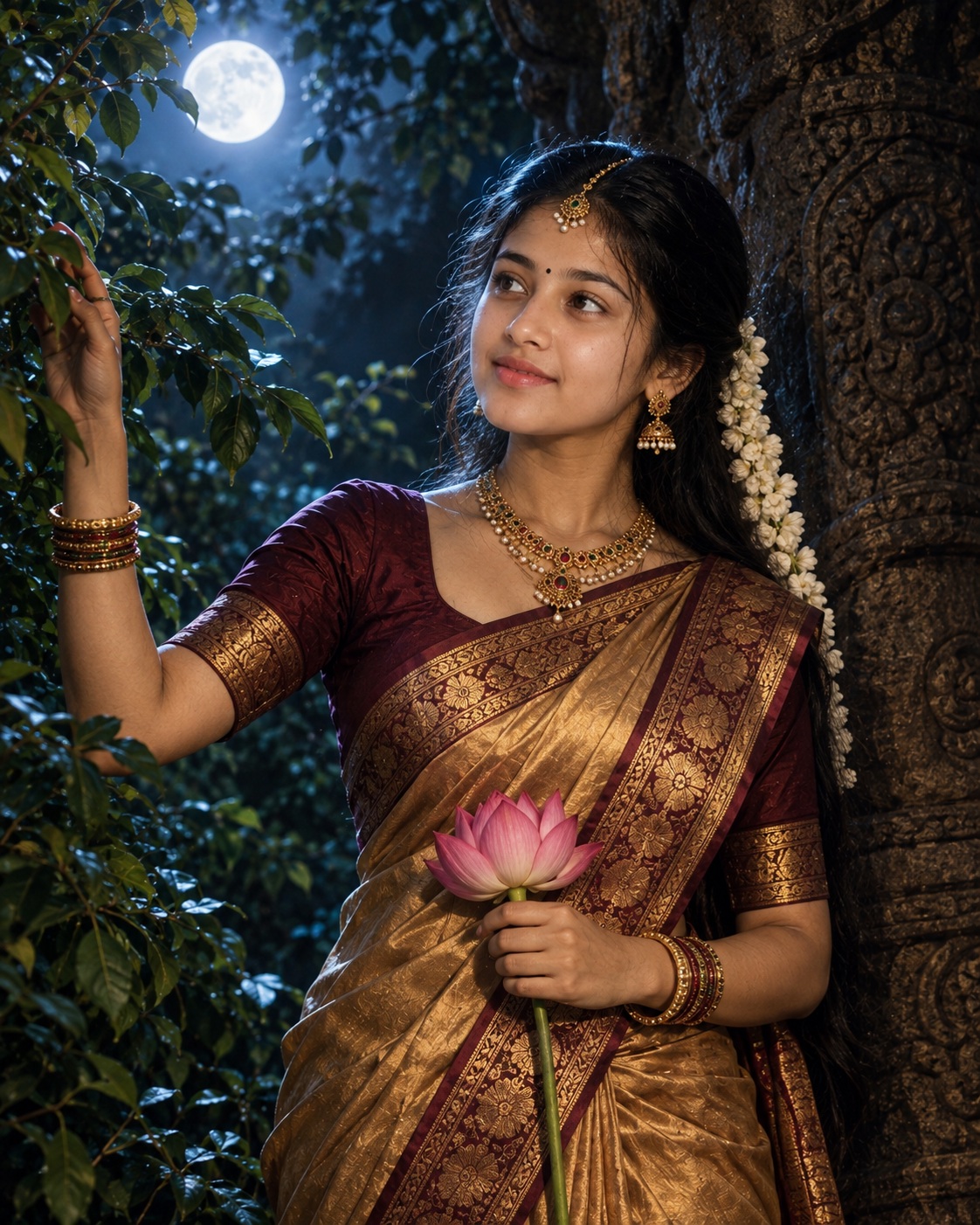
Moonlit Sari Portrait
The concept centers on a single woman presented in a highly cinematic traditional portrait surrounded by a lush nighttime garden. The woman is the clear visual hero, but the surrounding environment plays an equally important supporting role. Instead of using a simple studio background, the composition places her beside an enormous intricately carved tree, surrounded by dense foliage and illuminated by a bright full moon. This gives the portrait a strong period-fantasy quality while retaining the visual realism of high-end photography.
The subject is positioned centrally within a tall vertical composition. Her body extends from the lower portion of the frame toward the upper-middle, allowing the viewer to appreciate both her traditional styling and the dramatic environment around her. The framing is designed to preserve the relationship between the woman’s figure, the tree trunk, the moon, and the foliage. The vertical format gives the portrait a graceful, almost theatrical presence and allows the sari to remain visually important.
Her body language is calm and elegant. The torso is angled naturally while the head turns toward the viewer’s left. Her gaze travels upward and toward the moonlit foliage, creating a contemplative connection between the woman and her environment. One arm reaches outward toward the leaves on the left side, with the hand gently touching or approaching the foliage. The opposite hand holds a long-stemmed pink lotus close to the waist. These two gestures create a beautiful visual balance between the natural surroundings and the traditional floral prop.
The expression remains serene and understated. There is no exaggerated smile or dramatic facial emotion. The woman appears thoughtful, peaceful, and quietly confident. Her upward gaze gives the portrait an almost poetic feeling, as if she has paused within the garden to observe the moonlight. This restrained expression is important because the surrounding environment already provides visual drama through darkness, foliage, moonlight, and the monumental tree.
The hairstyle is long, dark, and traditionally styled. The hair is parted around the center and flows smoothly around the face and down the back and right side of the body. A long white jasmine gajra is attached along the right side of the hair. The jasmine creates a bright organic contrast against the dark hair and nighttime environment. It also reinforces the traditional Indian character of the portrait without making the styling feel overly decorative.
Traditional jewelry is carefully integrated into the visual design. A small bindi provides a delicate facial accent, while a central maang-tikka adds a formal traditional detail to the forehead. Ornate gold earrings frame the face, and a layered traditional gold necklace follows the neckline. Multiple gold bangles decorate both wrists. These accessories help connect the woman’s appearance to classical Indian fashion while also catching the warm light that falls across the subject.
The outfit is one of the strongest visual elements. The blouse is a rich deep maroon or burgundy shade with metallic-gold borders around the sleeves. This deep color provides a strong contrast against the golden-bronze sari. The sari itself has a luxurious silk appearance, with visible sheen, carefully structured folds, and a wide dark maroon and gold embroidered border. The combination of bronze, antique gold, and burgundy creates a regal palette that works particularly well against the cool nighttime surroundings.
The sari is not simply clothing in this composition; it also becomes part of the visual movement. The flowing drape creates long vertical and diagonal lines through the lower half of the portrait. The embroidered border introduces additional structure and helps guide the viewer’s eye through the composition. The glossy fabric catches warm illumination, creating subtle highlights across the folds. This makes the garment appear rich without requiring excessively bright colors.
The pink lotus serves as the primary natural prop. It is held vertically near the waist, with a long green stem extending downward. The flower’s soft pink petals provide a controlled color accent against the bronze sari and dark forest. The lotus also reinforces the traditional and poetic quality of the scene. Its position near the center-lower portion of the composition gives the viewer another clear focal point after the woman’s face.
The environment is deliberately atmospheric. Dense dark-green foliage fills the left side and continues into the background. Leaves and branches create layers of depth, with some elements closer to the viewer and others fading into soft focus. This creates a natural frame around the woman. The large tree on the right provides a strong architectural anchor and gives the composition an almost monumental quality.
The tree trunk is especially distinctive because it contains intricate carved or ornamental details. Its dark surface appears aged and richly textured, making it feel almost like part of an elaborate fantasy palace or historical garden. The carvings provide visual complexity without introducing unrelated objects. Because the trunk occupies a large portion of the right background, it balances the foliage on the left and gives the portrait a strong asymmetrical composition.
The full moon is positioned in the upper-left background, visible through the leaves. It becomes an important source of cool illumination and a major atmospheric element. The moon is not merely a decorative circle in the background; it establishes the nighttime setting and creates a visual relationship with the woman’s upward gaze. This connection between the moon and the subject helps the composition feel intentional and emotionally unified.
Lighting is based on a sophisticated combination of cool and warm sources. Cool-white moonlight comes from the upper-left and creates a subtle rim or backlight around the hair, leaves, and surrounding forms. At the same time, warmer illumination reaches the woman’s face, jewelry, and golden sari. This contrast between cool environmental light and warm subject light gives the portrait depth and cinematic richness.
The color palette is carefully controlled. Deep forest greens dominate the foliage, while black and cool blue-gray tones establish the nighttime atmosphere. Warm gold and bronze appear across the sari and jewelry, with deep burgundy defining the blouse and sari border. The pink lotus introduces a gentle floral accent, while the white jasmine creates a bright but natural highlight. Together these colors produce a sophisticated traditional palette rather than a highly saturated fantasy scene.
The photographic treatment emphasizes realism. Natural skin texture, detailed fabric, metallic jewelry reflections, botanical surfaces, and atmospheric haze all contribute to a believable photographic appearance. The shallow depth of field keeps the woman visually dominant while allowing the background to remain rich and recognizable. This balance prevents the environment from becoming either distracting or completely invisible.
The scene has a romantic and mystical character without becoming theatrical. The moon, jasmine, lotus, silk sari, carved tree, and nighttime foliage work together to create an elegant visual story. The mood can be described as serene, regal, traditional, contemplative, and slightly dreamlike. The woman appears connected to the natural environment rather than simply placed inside it.
The composition also benefits from carefully controlled negative space. The moonlit foliage creates open areas around the upper-left portion, while the dark tree occupies the right. The subject bridges these two contrasting areas. This gives the image visual stability while maintaining a sense of movement through the reaching arm, flowing sari, upward gaze, and vertical lotus stem.
The face remains important even though the composition is not an extreme close-up. The facial identity is intended to be adapted naturally to the reference orientation and expression. The concept prioritizes the supplied person’s recognizable facial characteristics while keeping the reference’s head angle, gaze, expression, and overall placement. This makes the subject feel like a personal interpretation of the established visual scene rather than a completely different character.
The prompt also places strong emphasis on natural anatomy. The proportions of the head, neck, shoulders, arms, hands, and fingers need to remain believable. This is particularly important because the composition includes two expressive arm positions: one hand reaching into foliage and another gripping the lotus stem. Anatomical accuracy allows the pose to remain elegant and photographic.
The traditional styling makes the concept suitable for a wide range of creative uses. It can work for premium personal portraits, cultural photography concepts, festive visual collections, traditional fashion showcases, wedding-related imagery, editorial portrait pages, social media profile presentations, artistic photography portfolios, and themed Indian portrait campaigns. The mixture of heritage styling and cinematic lighting makes it adaptable to both traditional and contemporary presentation.
The visual benefit of this concept is its strong storytelling density. A viewer can understand the setting and mood immediately through the moon, tree, foliage, sari, lotus, jewelry, and pose. At the same time, the composition remains uncluttered because every major element has a clear role. The result feels carefully directed rather than randomly decorated.
Overall, the concept presents a graceful woman in an atmospheric moonlit garden where traditional Indian fashion meets cinematic period-fantasy photography. The cool moonlight, warm sari highlights, white jasmine, pink lotus, carved tree, and deep green foliage create a visually rich but controlled scene. The portrait is designed to feel luxurious, mysterious, romantic, and timeless while preserving realistic human proportions and photographic detail.
[[[
REFERENCE ANALYSIS
- Format: Vertical cinematic traditional portrait, approximately 9:16.
- Composition: Full/three-quarter body female portrait positioned centrally, with the subject extending from near the bottom edge to the upper-middle. Large tree trunk occupies the right background; dense foliage fills the left side.
- Pose: Woman standing gracefully beside the tree. Torso angled slightly toward the viewer, head turned toward the viewer’s left, gaze directed upward/left. One arm extends toward the foliage on the left with hand touching/reaching toward leaves; the other hand holds a long-stemmed pink lotus near the waist. Preserve the exact arm, hand, torso, head and gaze positions.
- Expression: Calm, serene, elegant and contemplative. Neutral lips with a soft natural expression.
- Hair: Long dark hair, parted near the center and styled smoothly around the face, flowing down the back/right side. A long white jasmine gajra is attached along the hair on the right.
- Traditional styling: Small bindi, central maang-tikka, ornate gold earrings, layered traditional gold necklace, bangles on both wrists.
- Outfit: Rich traditional deep maroon/burgundy blouse with metallic-gold sleeve borders paired with a golden-bronze silk sari featuring a wide dark maroon/gold embroidered border. Preserve exact draping, folds, sheen, pattern and color.
- Prop: A single pink lotus flower on a long green stem, held vertically in the lower center/right hand. Preserve exact flower size, stem position and grip.
- Environment: Lush nighttime garden/forest. Dense green foliage on the left and background; enormous intricately carved dark tree trunk on the right.
- Lighting: Dramatic moonlit nighttime lighting. Bright cool-white moon in the upper-left creates a strong cool rim/backlight, while soft warm light illuminates the woman’s face and golden sari. Preserve exact mixed cool/warm lighting.
- Background: Full moon visible in the upper-left through leaves, with soft atmospheric haze and shallow depth of field. Tree trunk has detailed carved/ornamental texture.
- Color palette: Deep forest green, black, cool blue-gray night tones, warm gold/bronze sari, burgundy blouse and jewelry, pink lotus, white jasmine.
- Style: High-end cinematic photography / Indian period-fantasy portrait aesthetic, realistic skin, rich fabric detail, shallow depth of field and atmospheric moonlight.
- Mood: Romantic, serene, regal, traditional and mystical.
- Framing: Preserve exact vertical crop, subject scale, tree placement, moon placement, foliage distribution and negative space.
- Anatomy: Natural realistic proportions; hands, arms, neck, shoulders and body must remain anatomically correct.
MASTER PROMPT
Use supplied ref image as master blueprint. Replace only ref character’s face with supplied user identity. COMPLETELY IGNORE the user’s original photo pose and body; force the user into the exact body pose, hand placement, posture, head angle, gaze and expression of the reference character. Maintain exact scale, proportion, crop, visibility. Preserve 1000% of all visual info including darkness, grading, mood, lighting, shadows, contrast, saturation, composition, environment, objects, background,
rendering, outfit (exact style/color/condition), ref pose (exact body position/hands/expression), vibe (exact emotional tone), and natural human anatomy (correct head-to-body ratio, proportional hands/limbs, no distortions). Output must look IDENTICAL to ref except face. Do NOT brighten, enhance, modify, change outfit, ref pose, or vibe.
Recreate the supplied reference as an exact cinematic nighttime Indian traditional portrait.
Preserve the exact vertical 9:16 composition. Keep the woman at the same scale and position, with the enormous carved tree trunk occupying the right side, dense foliage on the left, and the bright full moon in the upper-left background.
Preserve the exact pose: the woman’s torso remains in the same position, her left-side arm extends toward the foliage with the hand reaching/touching the leaves, while her opposite hand holds the long-stemmed pink lotus vertically near the waist. Preserve exact hand placement, finger positioning, arm angles, body posture, head turn and upward-left gaze. Completely ignore the user’s original pose and body.
Replace ONLY the facial identity with the supplied user’s identity. Preserve the user’s unique facial characteristics while naturally adapting them to the reference’s exact head angle, gaze and serene expression. Do not copy the user’s original hairstyle, body, clothing or pose.
Preserve the exact long dark hairstyle, center/near-center part, smooth flowing hair and the long white jasmine gajra cascading down the right side of the hair. Preserve the exact hair volume, direction and placement.
Preserve all traditional facial and jewelry details: small bindi, central maang-tikka, ornate gold earrings, layered gold necklace and multiple gold bangles. Keep their exact scale, placement, color and intricate detailing.
Preserve the exact deep burgundy/maroon blouse with metallic-gold sleeve borders. Preserve the exact golden-bronze silk sari, including its glossy fabric, draping, folds, wide maroon/dark embroidered border and ornate gold patterning. Do not redesign or recolor the sari.
Preserve the exact pink lotus held in the lower center/right portion of the composition, including its soft pink petals, green stem, vertical orientation and the reference hand’s grip.
Preserve the exact environment: dense dark-green foliage, leafy branches, large intricately carved dark tree trunk on the right, atmospheric nighttime haze and the visible full moon in the upper-left.
Preserve the exact mixed lighting: cool moonlight from the upper-left/back, producing cool highlights around hair and foliage, combined with soft warm illumination across the woman’s face, jewelry and golden sari. Maintain deep shadows and nighttime darkness. Do not brighten the entire image, lift blacks or convert the scene to daytime.
Preserve the exact rich color grading: deep forest greens, black/blue night shadows, warm antique gold/bronze sari, deep burgundy blouse, pink lotus and white jasmine. Keep the colors cinematic and controlled, without excessive saturation.
Preserve realistic photographic rendering, natural skin texture, detailed fabric sheen, jewelry reflections, botanical detail, moonlit atmosphere and shallow depth of field.
Maintain perfect natural human anatomy: normal head-to-body ratio, correctly proportioned hands/fingers, natural arms, shoulders, neck and torso, realistic hand gripping the lotus, no distortions.
Reference = FINAL IMAGE. The reference is the base layer; only the user’s facial identity changes. Everything else remains locked at 1000%.
EDITABLE VARIABLES
- [USER IDENTITY]: Supplied user’s facial identity and unique facial traits only.
- [OUTFIT]: Exact deep burgundy blouse + golden-bronze silk sari with maroon/gold embroidered border, jasmine gajra and traditional gold jewelry.
- [TEXT]: None.
- [OBJECT/POSE/ADDITIONAL]: None. Preserve exact lotus, foliage, moon, carved tree, pose and composition.
NEGATIVE PROMPT
“identity loss, different face, original character, added person, removed person, wrong pose, user’s original pose, user’s original body, wrong head angle, wrong gaze, wrong expression, wrong arm position, wrong hand placement, altered lotus grip, missing lotus, different lotus, different flower color, missing jasmine gajra, different hairstyle, short hair, altered hair placement, missing bindi, missing maang tikka, missing earrings, missing necklace, missing bangles, changed outfit, different sari, different blouse, different sari color,
different border, redesigned embroidery, clean modern clothing, altered fabric sheen, redesigned background, missing tree trunk, different tree, missing carved details, missing foliage, missing moon, moved moon, daytime, bright sky, studio background, artificial background, altered lighting, no moonlight, no warm face lighting, flat lighting, brightened image, lifted shadows, crushed highlights, oversaturation, neon colors, orange grading, changed color palette, altered mood, changed vibe, modern fashion portrait, clean polished look,
anime, cartoon, illustration, 3D render, digital painting, distorted anatomy, big head, small hands, extra fingers, deformed hands, disproportionate limbs, stretched arms, unnatural fingers, distorted neck, altered scale, zoomed, recentered, cropped differently, changed composition, added objects, removed objects, reconstructed hidden areas, generic Indian outfit, modern sari, user’s original clothing, user’s original posture” ]]]