
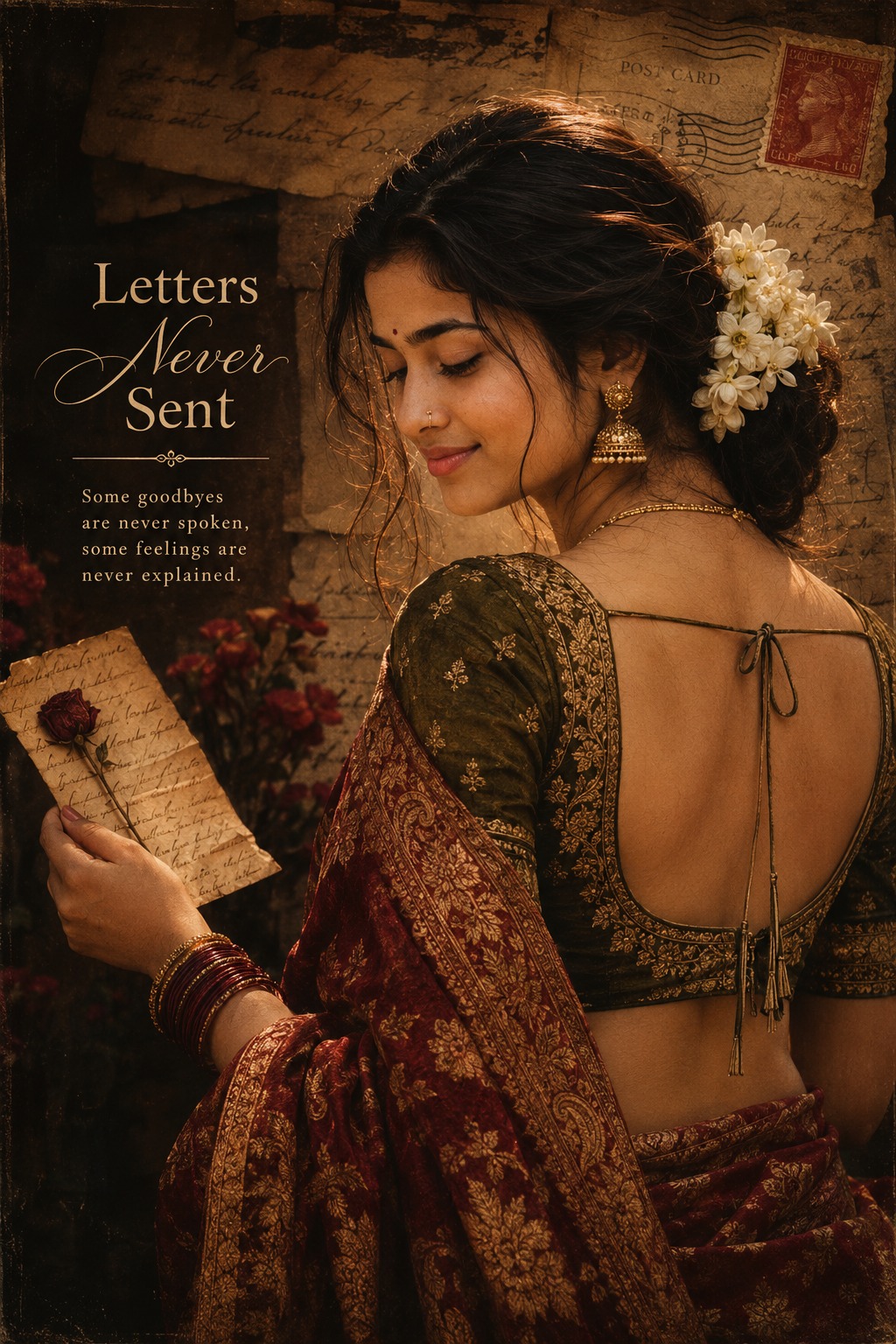
Vintage Bridal Poster
The Vintage Bridal Poster concept represents a beautiful combination of traditional Indian bridal fashion, emotional storytelling, antique photography, and dark cinematic editorial design. It features a woman standing with her back partially toward the camera, gently turning her face toward the left while holding an old handwritten letter. Her traditional saree, detailed blouse, jasmine-adorned hairstyle, and antique jewelry create an elegant appearance, while the surrounding vintage correspondence introduces a meaningful emotional story.
The main subject is an Indian woman presented in a sophisticated three-quarter rear-profile composition. Her body faces away from the camera, while her head turns toward the left side of the frame. This arrangement reveals her exposed upper back, shoulder, part of her face, and traditional clothing simultaneously. The pose creates a natural sense of depth and makes the portrait feel like a carefully composed cinematic photograph.
The woman’s facial identity is an important personalization feature. Her recognizable facial structure, forehead, eyes, nose, lips, jawline, cheekbones, and natural skin tone contribute to her individual appearance. The facial identity is adapted to the original character’s left-facing side profile, lowered chin, and closed-eye expression.
Her expression is quiet, thoughtful, and emotionally restrained. The closed eyes and gently lowered face communicate introspection rather than an exaggerated display of sadness. This subtle expression is essential to the storytelling because it suggests that the woman is remembering something meaningful while holding the handwritten letter.
The camera angle is particularly distinctive. It is positioned behind and slightly to the left of the woman, approximately around her upper-back and shoulder height. This perspective captures her back and side profile together. The composition feels intimate and editorial rather than like a conventional front-facing bridal portrait.
The woman’s body occupies most of the right side of the composition. Her upper back and shoulder area create the central visual focus, while her head appears in the upper-right region. Her left arm extends diagonally toward the lower-left foreground, creating a natural visual connection with the handwritten letter.
Her left hand holds the aged paper gently. The fingers curl around the edges, creating a believable interaction with the prop. Multiple dark-red and maroon glass bangles surround her wrist. These accessories introduce additional traditional details and connect visually with the deep-red saree.
Her right arm remains mostly concealed behind her body and saree. This keeps the composition uncluttered and maintains attention on the exposed-back blouse, left arm, and letter.
The hairstyle is one of the most beautiful traditional elements. Her dark brown-black hair is gathered into a loosely arranged low bun. The hairstyle has a slightly relaxed appearance, with fine strands falling naturally around the forehead, cheek, ear, and neck.
Small creamy-white jasmine flowers decorate the rear-right side of the bun. Their delicate appearance creates a beautiful contrast against the dark hair. The flowers also introduce a familiar element of traditional Indian bridal styling.
The outfit combines a luxurious deep crimson-red and dark maroon Banarasi silk saree with a dark olive-green blouse. The saree features intricate antique-gold floral embroidery, elaborate paisley motifs, traditional ornamental patterns, and broad golden borders.
The rich fabric drapes naturally over the shoulder and flows diagonally toward the lower-right portion of the composition. Its layered folds and detailed silk weave create a realistic textile appearance. The golden threadwork introduces subtle metallic reflections that complement the antique jewelry.
The blouse is equally important to the character’s appearance. It features a dark olive-green and antique bronze-green color combination with a deep rounded open-back design. Intricate golden embroidered borders decorate the back opening and sleeve edges.
Tiny golden motifs are scattered across the blouse, adding decorative detail without making the fabric appear excessively bright. Thin tie strings cross the back, creating a traditional open-back design. A small decorative bow and a longer fastening string complete the arrangement.
The contrast between the dark olive blouse and crimson saree gives the outfit a distinctive traditional identity. Both colors work beautifully with the antique background and dark cinematic lighting.
Traditional jewelry completes the styling. Large antique-gold jhumka earrings introduce a rich ethnic detail near the face. A delicate nose ring adds another traditional accent, while a small dark-red bindi provides a subtle forehead detail.
A fine gold necklace extends along the back of the neck. Multiple deep-red and dark-maroon glass bangles decorate the left wrist. The jewelry is presented with detailed craftsmanship and restrained golden reflections, maintaining the overall vintage aesthetic.
The handwritten letter is the central storytelling prop. It is an aged rectangular piece of beige-brown paper held in the woman’s left hand. Its surface contains delicate cursive handwriting, antique parchment grain, natural creases, faded dark-brown ink, and irregular distressed edges.
A small dried dark-red rose-like flower rests diagonally across the letter. This detail creates an emotional connection between the paper and the overall theme of memories, affection, and unspoken feelings.
The letter appears in the lower-left foreground, where it balances the woman’s position on the right. Its aged appearance suggests an old personal message preserved for many years.
The background is designed as an elaborate antique postal correspondence collage. It contains weathered dark-brown parchment sheets, old handwritten letters, vintage postcards, faded cursive correspondence, postal cancellation marks, circular post office stamps, and distressed ink imprints.
An aged red postage stamp appears in the upper-right background. Muted dark-burgundy floral elements are placed behind the woman’s arm and shoulder. Overlapping paper fragments, faded handwriting, worn edges, and aged textures make the environment resemble a collection of historical letters.
The left side of the composition provides space for the poster typography. The main headline reads “Letters Never Sent”. The words “Letters” and “Sent” use elegant vintage serif typography, while “Never” appears in delicate flowing cursive script.
The combination of serif and script lettering creates a refined antique editorial appearance. The headline remains relatively small and understated so that the woman’s portrait remains the primary attraction.
A thin decorative antique-gold divider appears beneath the headline. The supporting sentence reads “Some goodbyes are never spoken, some feelings are never explained.”
This subtitle is arranged in small, refined serif lettering across approximately four short lines. Its emotional meaning complements the handwritten letter and the woman’s thoughtful expression.
The lighting is one of the most important characteristics of this concept. The scene uses very dark, low-key cinematic illumination with warm amber highlights and deep chocolate-brown shadows. Light enters from the upper-left or front-left direction, gently illuminating the woman’s facial profile, shoulder, exposed back, and left forearm.
Golden reflections appear on the saree embroidery and traditional jewelry. Deep shadows remain visible around the neck, hair, blouse, lower saree folds, and background. This controlled illumination gives the portrait its dramatic character.
The color palette combines dark sepia brown, antique gold, burnt amber, deep crimson, dark maroon, and olive green. These colors establish an aged and sophisticated visual identity.
The maroon saree introduces richness, the olive blouse creates contrast, and antique gold adds decorative elegance. The brown parchment background connects the entire composition through a consistent vintage color language.
The artistic style combines photorealistic Indian bridal editorial photography, vintage cinematic portraiture, historical storytelling, and antique poster design. Natural skin texture, realistic fabric folds, metallic embroidery, aged paper surfaces, and analog film grain contribute to the detailed appearance.
Subtle film grain, fine photographic noise, matte finishing, restrained highlight bloom, gentle halation, and a darkened edge vignette create an authentic old-film atmosphere. These effects add character without making the composition appear artificially processed.
The camera presentation uses a natural portrait perspective similar to a 50–85mm lens. The three-quarter rear view provides a sophisticated editorial appearance, while shallow depth of field creates separation between the woman and the antique background.
The intended composition follows a vertical 2:3 poster format. The woman occupies approximately 60–65% of the visual width, while the remaining left portion provides space for typography and the letter-related background details.
The strongest storytelling element is the connection between the woman and the handwritten letter. Her closed eyes, lowered chin, traditional bridal clothing, and the dried rose create an emotional atmosphere that suggests memories that have never been fully expressed.
The Vintage Bridal Poster style is suitable for personalized bridal portraits, wedding editorial designs, romantic storytelling posters, traditional Indian fashion collections, nostalgic social media artwork, and personalized vintage photography.
It is especially attractive for people who appreciate Banarasi silk sarees, traditional jewelry, antique paper textures, and dark cinematic visual compositions.
Overall, this concept combines Indian bridal elegance with emotional vintage storytelling. The crimson saree, olive-green blouse, jasmine flowers, antique jewelry, handwritten letter, dried rose, and delicate typography create a memorable artistic identity. Every detail contributes to a sophisticated portrait that communicates nostalgia, intimacy, traditional beauty, and unspoken emotions.
[[[
FULL MASTER PROMPT — USER IDENTITY REPLACEMENT + DARK VINTAGE INDIAN BRIDAL POSTER
Identity Replacement Locked
Darkness & Contrast Locked
Full English Prompt
This complete prompt combines the original reference composition, natural user identity replacement, dark cinematic exposure, strong contrast, smaller typography, and all original visual details.
MASTER IMAGE RECONSTRUCTION PROMPT
1. USER IDENTITY REPLACEMENT — HIGHEST PRIORITY / STRICTLY LOCKED
Use the user’s uploaded personal photograph as the exclusive facial identity reference. Naturally replace the original woman’s facial identity in the reference image with the recognizable facial identity of the person shown in the user’s uploaded photograph.
The user’s photograph must be used ONLY as the identity source. The original reference image must remain the master visual blueprint for the entire composition.
Accurately preserve the user’s recognizable facial characteristics, including:
- Natural face shape and facial proportions.
- Forehead shape and structure.
- Eye shape, eyelids, and natural eye spacing.
- Eyebrow shape, density, and structure.
- Nose bridge, nose shape, and nostril structure.
- Lip shape and natural mouth proportions.
- Jawline, chin shape, and cheekbone structure.
- Natural skin tone and distinctive facial characteristics.
NATURAL IDENTITY INTEGRATION:
Reconstruct the user’s recognizable face within the reference character’s original left-facing side-profile orientation. Naturally adapt the user’s facial identity to the reference’s specific head rotation, lowered chin, closed-eye expression, and side-profile perspective.
The user’s face must look as though it was naturally photographed as part of the original scene. Seamlessly integrate facial anatomy, perspective, proportions, skin texture, lighting, shadows, and color grading.
Preserve the user’s actual facial identity even when adapting it to the reference’s specific camera angle and expression. Do not generate a generic face, substitute an unrelated identity, or mix the original character’s facial features with the user’s identity.
STRICT IDENTITY SEPARATION:
The user’s uploaded photograph is the ONLY source of facial identity.
The original reference image is the ONLY source of the character’s visual composition, body positioning, pose, outfit, hairstyle arrangement, accessories, camera perspective, lighting, background, typography, and visual effects.
Do not transfer the user’s original clothing, body pose, background, camera angle, or lighting into the reconstructed scene.
Replace the original character’s facial identity naturally while retaining the reference character’s original visual design.
2. CAMERA ANGLE AND PHOTOGRAPHIC COMPOSITION
Cinematic Vintage Portrait Photography + Photorealistic Indian Bridal Editorial Photography + Fine-Art Cinematic Portraiture + Dark Romantic Vintage Poster Aesthetic + Antique Epistolary Storytelling Photography + Historical Nostalgic Film Photography + Three-Quarter Rear Profile Composition + Over-the-Shoulder Camera Angle + Eye-Level Camera Perspective + Slightly Elevated Shoulder-Level Camera Position + Natural Portrait Perspective + Medium Three-Quarter Body Framing + Vertical 2:3 Composition + Asymmetrical Editorial Layout + Right-Aligned Subject Placement + Shallow Depth of Field + Selective Subject Sharpness + Natural 50–85mm Portrait Lens Perspective + Soft Background Separation.
Position the camera behind and slightly to the left of the woman, approximately at her upper-back and shoulder height. Capture a distinctive three-quarter rear view showing most of her exposed back, left shoulder, upper torso, and left-facing facial profile simultaneously.
The camera looks toward the woman’s back and side profile rather than directly toward her face. Maintain natural portrait perspective, realistic body proportions, minimal perspective distortion, and no wide-angle stretching.
The woman occupies approximately 60–65% of the visual width, positioned predominantly on the center-right and right side of the composition.
3. BODY POSE AND GEOMETRY
The woman stands with her back facing the camera and her upper torso naturally rotated slightly toward the left.
Her left shoulder is slightly closer to the camera. Her head turns independently toward the left side of the frame. Her neck is gently extended, shoulders naturally relaxed, and upper back exposed through the open-back blouse.
Maintain a graceful, relaxed standing posture without exaggerated body arching. Her waist is partially visible beneath the blouse and saree. The lower body remains naturally covered by the saree and cropped by the composition.
LEFT ARM AND HAND:
Left arm extending diagonally downward toward the lower-left foreground. Elbow softly bent, forearm naturally extended away from the torso, wrist gently positioned, and left hand holding an aged rectangular handwritten letter.
Fingers naturally curl around the lower-left and side edges of the paper. Multiple deep-red and dark-maroon glass bangles surround the left wrist.
Right arm remains mostly concealed behind the torso and saree.
Maintain anatomically correct hands, natural finger proportions, realistic wrist structure, and believable contact between the fingers and the letter.
4. FACE DIRECTION AND EXPRESSION
Preserve the reference character’s original facial orientation while using the user’s recognizable facial identity.
Head rotated toward the left, presenting a nearly complete left-facing side profile. Nose pointing toward the left edge of the frame, chin gently lowered, slight forward head inclination, eyes completely closed or softly lowered.
Maintain naturally defined eyebrows, delicate eyelashes, naturally full closed lips, and a quiet, restrained, introspective expression.
The face must inherit the reference’s natural side-profile perspective and lowered head position without distorting the user’s facial proportions.
The original facial identity must be replaced completely, while the reference’s head position and expression remain unchanged.
5. HAIRSTYLE AND FLOWERS
Thick, voluminous, very dark brown-black hair gathered into a loosely arranged traditional low bun.
Slightly messy and naturally textured hairstyle with fine loose strands falling around the forehead, cheek, ear, and neck.
Visible individual hair strands, subtle natural hair shine, deep hair shadows, and delicate warm reflections.
A dense but naturally arranged cluster of small creamy-white jasmine flowers decorating the rear-right side of the bun.
Preserve the hairstyle’s original placement and silhouette. Adapt the hair naturally around the reconstructed face without changing the reference’s overall hairstyle arrangement.
6. TRADITIONAL INDIAN SAREE
Luxurious deep crimson-red and dark maroon Banarasi silk saree with intricate antique-gold floral embroidery, elaborate paisley motifs, traditional ornamental patterns, broad richly embroidered golden borders, and fine metallic gold threadwork.
Saree draped naturally over the shoulder and flowing diagonally toward the lower-right portion of the frame.
Rich layered fabric folds, natural textile weight, detailed silk weave, subtle golden embroidery reflections, and deep maroon shadow regions.
Maintain dark, saturated crimson tones without turning the saree bright scarlet or orange.
7. OPEN-BACK BLOUSE
Dark olive-green and antique bronze-green traditional short-sleeved blouse.
Deep rounded open-back design exposing the upper back, intricate antique-gold embroidered borders around the back opening and sleeve edges, tiny scattered golden motifs, thin blouse tie strings crossing the back, and a small decorative bow.
A longer fastening string hangs naturally downward.
Matte textured fabric with subtle gold detailing. Preserve deep olive-green shadows and restrained highlights.
8. TRADITIONAL JEWELLERY
Large antique-gold traditional Indian jhumka earrings, delicate gold nose ring with a small ornamental detail, small dark-red forehead bindi, fine gold necklace extending along the back of the neck, and multiple deep-red and dark-maroon glass bangles around the left wrist.
Jewellery should display intricate craftsmanship and subtle localized antique-gold reflections.
Avoid oversized, modern, or additional unrequested accessories.
9. HANDWRITTEN LETTER
An aged rectangular beige-brown vintage handwritten letter held in the woman’s left hand.
Fine delicate cursive handwriting covering the paper, antique parchment grain, naturally creased surface, distressed and irregular worn edges, faded dark-brown ink, subtle stains, and an aged historical appearance.
Include a small dried dark-red rose-like flower resting diagonally across the letter.
Keep the letter clearly visible in the lower-left foreground, naturally illuminated but not excessively bright.
10. ANTIQUE BACKGROUND AND ENVIRONMENT
An elaborate antique postal correspondence collage covering the entire background.
Layered weathered dark-brown parchment sheets, old handwritten letters, vintage postcards, faded cursive correspondence, historical postal cancellation marks, faded circular post office stamps, distressed ink imprints, and an aged red postage stamp positioned in the upper-right background.
Include muted dark-burgundy floral elements behind the woman’s arm and shoulder.
Add aged paper folds, worn edges, overlapping postcard fragments, faded handwriting, and organic historical textures.
The background should resemble a collection of old personal letters and postcards preserved for decades.
Maintain rich historical detail without making the background excessively bright or visually distracting.
11. COMPOSITION AND SPATIAL ARRANGEMENT
Vertical 2:3 editorial poster composition.
The woman occupies approximately 60–65% of the visual width, positioned predominantly on the center-right and right side of the frame.
Her head is positioned in the upper-right quadrant, with the jasmine-adorned bun extending toward the right edge.
Her exposed back and olive-green embroidered blouse dominate the center-right. The deep crimson saree fills the lower-right and bottom portions.
Her left arm extends toward the lower-left foreground, creating a visual connection with the handwritten letter.
Keep the left 35–40% of the composition relatively dark and visually balanced for typography.
Maintain the original asymmetrical layout and natural spacing between the woman, letter, and background elements.
12. TYPOGRAPHY AND POSTER DESIGN — STRICTLY CONTROLLED SIZE
Elegant, understated antique editorial typography positioned on the left side of the composition.
Typography must remain relatively small, delicate, and secondary to the woman’s portrait.
The complete typography block should occupy approximately 25–30% of the overall visual width.
Use refined antique serif typography for the main headline, combined with thin, graceful cursive lettering for the central word.
Muted antique-gold color with subtle aged metallic texture.
Main headline — exact wording:
“Letters Never Sent”
Set “Letters” and “Sent” in elegant, moderately sized vintage serif lettering.
Set “Never” in delicate flowing cursive script with restrained flourishes.
Maintain compact text proportions, controlled line spacing, and refined letter spacing. Do not enlarge the headline to dominate the poster.
Place a thin decorative antique-gold ornamental divider beneath the headline.
Supporting text — exact wording:
“Some goodbyes are never spoken, some feelings are never explained.”
Display the supporting text in very small, refined serif typography, arranged in approximately four short lines.
Maintain subtle visual hierarchy and generous negative space.
Keep the headline and supporting text aligned toward the left margin.
Preserve exact spelling and punctuation.
No additional text, slogans, labels, or decorative typography.
13. STRICT DARKNESS, EXPOSURE AND CONTRAST CONTROL
Very Dark Low-Key Cinematic Exposure + Deep Underexposed Vintage Photographic Appearance + Strong Chiaroscuro Lighting + High Contrast Tonal Separation + Deep Chocolate-Brown Shadows + Near-Black Background Corners + Dense Natural Shadow Regions + Rich Black Levels + Dark Midtones + Restrained Amber Highlights + Limited Golden Illumination + Strong Shadow Density + Pronounced Subject-to-Background Contrast + Deeply Shadowed Blouse + Dark Hair Masses + Dark Saree Folds + Heavy Edge Vignette + Moody Antique Film Atmosphere.
CRITICAL EXPOSURE INSTRUCTION:
Match the original reference photograph’s dark, gritty, underexposed appearance.
Do not brighten the overall image. Do not lift the black levels. Do not increase shadow exposure. Preserve naturally dark areas, especially the background, hair, blouse, lower saree folds, and image corners.
The final image must look noticeably dark and contrast-rich, not bright, glowing, golden-washed, or evenly illuminated.
Allow some background handwriting, fabric folds, and surrounding objects to remain naturally submerged in darkness.
Preserve rich black-brown tonal depth. Highlights must remain localized and controlled.
14. LIGHTING AND SHADOWS
Soft but directional warm amber light originating from the upper-left/front-left side of the subject.
Restrained illumination across the forehead, nose, cheek, lips, shoulder, exposed upper back, and left forearm.
Gentle golden reflections on the embroidered saree border and antique jewellery.
Deep shadows beneath the jawline, around the neck, inside the hair, across the olive-green blouse, and throughout the background.
Soft directional shadow transitions, strong natural chiaroscuro, limited ambient fill, and deep shadow falloff.
Maintain realistic lighting rather than artificial glowing illumination.
The reconstructed user’s face must receive the same directional illumination and shadow density as the original reference character.
15. COLOR GRADING AND TONAL PALETTE
Dark Antique Sepia Color Grading + Deep Brown Monochromatic Toning + Muted Earthy Color Palette + Rich Chocolate-Brown Shadows + Dark Bronze Undertones + Deep Burgundy and Crimson Red + Dark Olive Green + Restrained Antique Gold + Warm Amber Skin Highlights + Low-Key Vintage Tonal Mapping + Rich Black Point + Strong Contrast + Controlled Saturation.
Preserve warm natural skin tones without excessive orange grading.
Keep the overall palette dark, earthy, rich, and nostalgic.
The user’s facial skin tone must remain recognizable and natural while harmonizing with the reference’s antique sepia grading.
16. SKIN AND FACIAL TEXTURE
Natural skin pores, delicate facial lines, subtle natural skin shine, visible tonal variation, soft amber highlights, and naturally shadowed facial contours.
Maintain authentic facial texture and the user’s recognizable facial characteristics.
Avoid excessive retouching, artificial smoothness, plastic-looking skin, and unnecessary beautification.
17. FABRIC AND MATERIAL TEXTURES
Intricate Banarasi silk weave, detailed gold embroidery, metallic thread reflections, naturally folded saree fabric, matte olive-green blouse texture, visible decorative stitching, realistic jewellery surfaces, antique parchment grain, aged paper stains, and organic distressed surfaces.
Preserve natural material imperfections.
18. CINEMATIC TEXTURE AND POST-PROCESSING EFFECTS
Subtle but visible analog film grain + Fine vintage film noise + Antique photographic texture + Distressed parchment grain + Matte film finish + Restrained highlight bloom + Very subtle light halation + Darkened edge vignette + Strong shadow preservation + Soft atmospheric background haze + Organic texture preservation + Natural film imperfections + Gentle tonal fading in selected paper areas.
Keep the photograph gritty, dark, and authentic.
Do not apply modern digital clarity, excessive sharpening, artificial HDR, or excessive post-processing.
19. FINAL VISUAL TARGET
A sophisticated, photorealistic, dark vintage Indian romantic editorial poster featuring the USER’S RECOGNIZABLE FACIAL IDENTITY naturally integrated into the original reference character.
The woman wears a deep crimson embroidered Banarasi saree and dark olive-green open-back blouse, standing with her back toward the camera, turning her head toward the left in a lowered side profile while holding an aged handwritten letter.
Her loosely arranged jasmine-adorned bun, antique-gold jewellery, rich textile details, and exposed back form the primary visual focus.
An elaborate antique correspondence collage fills the background, with small elegant antique-gold typography on the left.
The entire image maintains deep chocolate-black shadows, strong cinematic contrast, restrained amber highlights, dark sepia grading, subtle analog grain, distressed paper textures, and an authentic aged photographic atmosphere.
20. ABSOLUTE PRESERVATION AND IDENTITY LOCK
The user’s recognizable facial identity MUST replace the original reference character’s facial identity.
Never retain the original woman’s face as the final identity.
Never mix, merge, duplicate, or substitute facial identities.
Preserve the user’s actual facial structure while adapting it naturally to the reference’s head angle, side profile, lowered chin, and closed-eye expression.
Preserve the reference’s three-quarter rear camera viewpoint, original body geometry, arm position, hand gesture, clothing, hairstyle arrangement, jasmine flowers, jewellery, handwritten letter, antique postal background, typography placement, dark lighting, color grading, contrast, textures, and composition.
Do not transfer the user’s original pose, outfit, body, or background.
Do not beautify, reshape, or artificially modify the user’s face.
Do not brighten the original dark atmosphere.
Do not enlarge the typography.
Do not introduce unrequested visual changes.
FINAL PRIORITY: USER IDENTITY FIRST, REFERENCE POSE AND COMPOSITION SECOND, CAMERA AND PERSPECTIVE THIRD, OUTFIT AND ANATOMY FOURTH, DARK LIGHTING AND COLOR GRADING FIFTH, AND FINE DETAILS LAST.
NEGATIVE PROMPT
Wrong identity, original reference woman’s face retained, generic face, unrelated facial identity, mixed identities, merged faces, duplicated faces, face swapping artifacts, pasted face, floating face, artificial face replacement, mismatched facial perspective, incorrect side profile, distorted facial proportions, altered jawline, altered nose, altered eye shape, changed lip structure, artificial beautification, excessive skin smoothing, plastic skin, identity loss, facial asymmetry caused by compositing, mismatched skin tone, mismatched lighting, inconsistent shadows, artificial facial blending, bright exposure, high-key photography,
overexposed image, washed-out shadows, lifted black levels, gray shadows, flat contrast, low contrast, excessive ambient lighting, excessive golden glow, bright orange color grading, luminous background, bright parchment, evenly illuminated scene, excessive shadow recovery, faded black tones, bright scarlet saree, luminous green blouse, excessive HDR, artificial clarity, oversized headline, huge typography, large cursive lettering, bold modern fonts, oversized supporting text, typography dominating the portrait, excessive decorative flourishes, incorrect spelling, additional text, missing headline, missing supporting text, modern background, clean studio background, wrong camera angle, frontal portrait, front-facing body,
incorrect head direction, raised chin, open eyes, smiling expression, unnatural body rotation, exaggerated back arch, incorrect arm position, missing handwritten letter, deformed hands, extra fingers, duplicated limbs, incorrect saree draping, modern clothing, missing open-back blouse, missing blouse tie strings, missing jasmine flowers, incorrect hairstyle, missing traditional jewellery, additional accessories, cartoon rendering, anime style, 3D appearance, artificial anatomy, generic fashion photography, loss of antique atmosphere, unrequested composition changes.
FINAL LOCKED VARIABLES
| Variable | Locked value |
|---|---|
| User identity | Uploaded user photograph |
| Identity replacement | Mandatory |
| Face integration | Natural and seamless |
| Reference pose | Preserve |
| Camera angle | Three-quarter rear profile |
| Face direction | Left-facing profile |
| Expression | Closed eyes, lowered chin |
| Body geometry | Preserve reference |
| Saree | Deep crimson Banarasi |
| Blouse | Dark olive open-back |
| Hair | Messy low bun + jasmine |
| Jewellery | Antique gold |
| Hand gesture | Holding old letter |
| Background | Antique postal collage |
| Lighting | Dark warm directional |
| Exposure | Deep low-key |
| Contrast | Strong |
| Black levels | Deep chocolate-black |
| Typography | Small and understated |
| Aspect ratio | Vertical 2:3 |
Final instruction: The final character must look like the user naturally photographed in the original reference scene—not like the original model wearing a pasted face. Preserve the user’s recognizable identity and preserve everything else from the reference unless explicitly authorized to change it.
Note: Identity resemblance depends on the quality and angle of the uploaded identity photograph and the image-generation system’s ability to follow facial references. A text prompt alone cannot guarantee exact identity reproduction.
]]]