
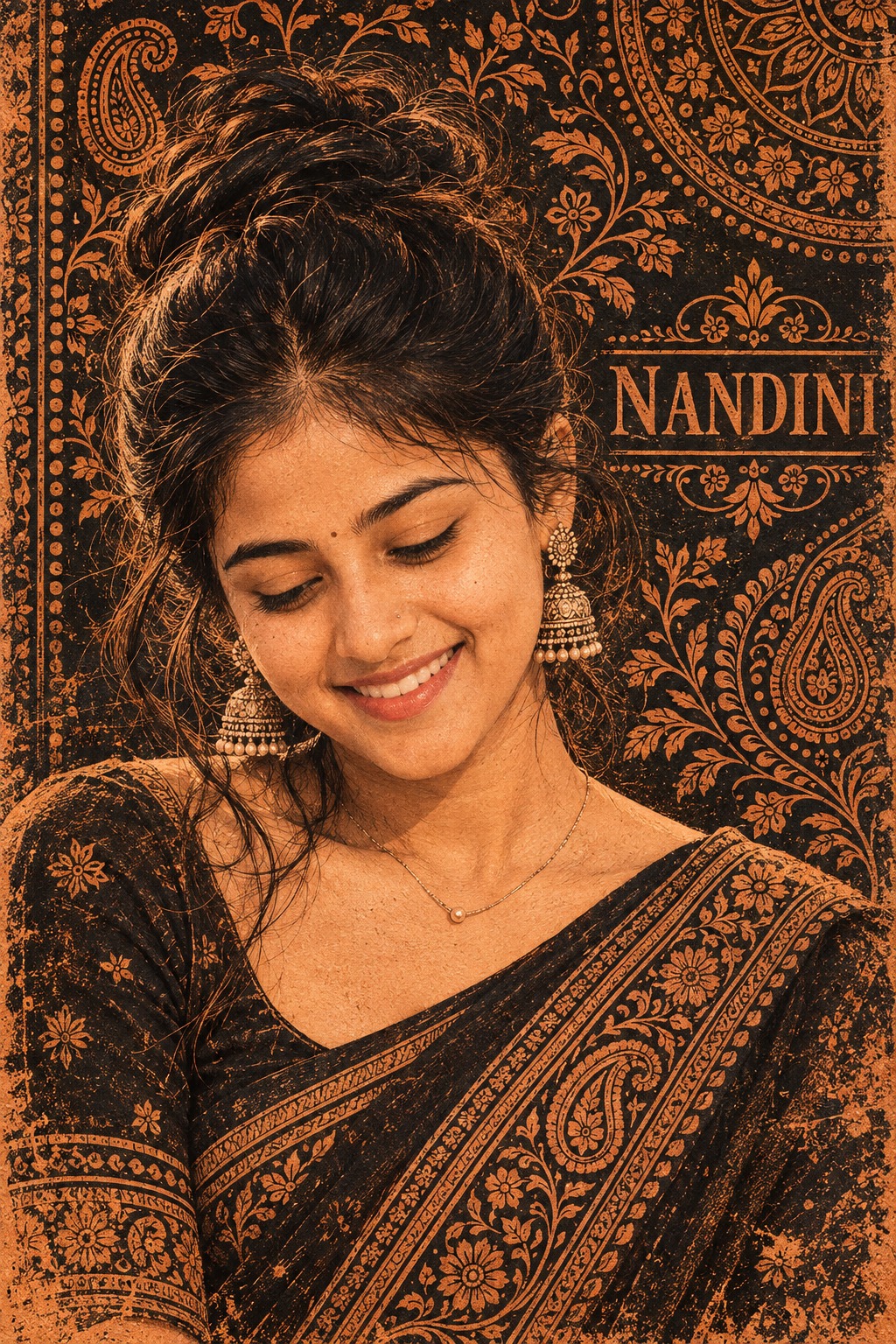
Copper Sari Print
The concept presents a single female subject in a highly stylized vintage Indian textile-inspired artwork. The woman fills most of the vertical composition, creating an intimate close-up in which the face, hair, jewelry, shoulders and upper portion of the sari become the primary visual elements. Instead of using conventional photographic realism, the entire portrait is interpreted through a restricted copper-orange and deep black visual language that resembles an old textile print, etched artwork, or hand-pulled decorative print.
The composition is deliberately tight. The woman’s hair approaches the upper edge of the frame, while her shoulders and upper sari area extend toward the lower edges. Only the upper torso is visible, keeping the attention concentrated on her expression and ornamental styling. This close crop gives the artwork a strong poster-like presence and makes the face the main point of recognition.
The pose has a quiet and intimate quality. The woman’s head is gently angled downward and slightly toward the right. Her eyes are lowered or closed, and she wears a broad natural smile. This expression creates warmth without requiring an exaggerated gesture. The lowered gaze and smile give the subject a peaceful, personal quality that works particularly well with the traditional print aesthetic.
Facial identity is an important part of the concept. The woman’s recognizable facial structure, eyes, eyebrows, nose, lips, jawline, cheeks and natural asymmetry remain visually important. The artistic treatment translates these features into engraved and printed marks instead of presenting a photographic face. This allows the personal identity to remain recognizable while becoming part of the vintage artwork language.
The hairstyle is dark, voluminous and loosely arranged into a bun or updo. It is not intended to look perfectly controlled. Several irregular strands and wisps fall around the forehead and face, adding softness and a handmade quality. The darker hair mass creates a strong graphic shape against the copper-patterned background.
Traditional jewelry provides delicate points of detail. A large ornate dangling earring is visible on the subject, accompanied by a small nose ring and a very delicate necklace. These accessories reinforce the Indian styling and introduce intricate shapes that translate naturally into etched linework. The jewelry also helps frame the face without overpowering the expression.
The sari is dark and carries an intricate traditional patterned border. Textile motifs, paisley forms, floral elements and decorative linework contribute to the clothing’s identity. Because the artwork uses a limited color palette, the sari pattern becomes especially important for adding visual richness without relying on many colors.
The background is one of the defining characteristics of the concept. Instead of a plain wall or simple gradient, the woman is surrounded by a dense ornamental textile-like field. The base is deep black or brown, while copper-orange paisley, floral, mandala-like and repeating decorative patterns fill the surrounding space.
The ornamental background creates a sense of depth through repetition. Curving paisley forms, floral curls, circular structures and decorative motifs surround the subject without becoming a conventional photographic environment. The result feels closer to a traditional Indian textile panel, decorative print, or heritage-inspired poster than a normal portrait background.
The limited palette is extremely important. Burnt orange and copper tones provide the main highlights, while deep black and brown create the shadows and structural areas. This restriction gives the artwork a unified appearance and makes it immediately recognizable as a vintage print concept.
The face itself follows the same copper-and-black visual treatment. Orange highlights can define illuminated or prominent facial planes, while black areas establish hair, shadows, contours and deeper features. The face therefore appears to be physically printed or etched rather than photographed and then placed over a decorative background.
The technique is intentionally imperfect. Distressed pigment, stippling, crosshatching, engraved linework, rough edges, uneven ink coverage and visible paper or fabric grain all contribute to the vintage appearance. These imperfections are not flaws within the design; they are part of what gives the artwork its traditional print character.
The texture can suggest several physical processes at once. Fine etched lines can describe facial features and ornaments, while stippling can build tonal areas. Crosshatching can add depth to hair and clothing, and rough pigment edges can make the copper color appear naturally absorbed into paper or textile fibers.
The artwork avoids conventional photographic lighting. Instead, tonal separation comes primarily from the contrast between copper-orange marks and deep black or brown areas. This makes the image feel like a graphic print rather than a portrait illuminated by a studio light.
The warm copper treatment also creates an intimate mood. Orange and terracotta tones naturally suggest warmth, heritage and handcrafted materials. Combined with the woman’s gentle smile and lowered gaze, the palette supports a feeling that is traditional, artistic, personal and quietly elegant.
The background patterns are not merely decorative fillers. They create a visual frame around the subject and establish the cultural identity of the artwork. Paisley motifs, floral curls, mandala-like geometry and ornamental circles help create a continuous decorative field that surrounds the woman’s silhouette.
The design balances figure and pattern carefully. The woman’s face remains the strongest recognition point, while the surrounding ornament supplies texture and context. The limited color system prevents the background from becoming visually chaotic, even though it contains many repeated decorative elements.
Personalization is another important part of the concept. A user’s name, date, title, occasion, quote, dedication or custom message can become part of the ornamental print itself. The information is not intended to appear as a modern caption or digital textbox. Instead, it can be integrated through engraved lettering, decorative inscription, traditional print typography or an ornamental text panel.
A name or title can become an elegant decorative inscription within an open ornamental region. A date can resemble a small heritage-style print marking. A quote or dedication can be treated as an engraved passage or decorative panel. An occasion can become a traditional heading that feels physically printed into the same material.
The typography should share the same visual qualities as the artwork. Rough ink edges, copper-orange coloring, black shadowing and distressed print texture make the text feel connected to the surrounding patterns. This creates a unified visual language in which the personalized information belongs naturally to the artwork.
Exact supplied text is particularly important when the design is personalized. Names, dates, quotations, dedications and messages can carry specific emotional meaning. The concept therefore treats supplied wording as content that should retain its intended spelling, capitalization, punctuation and numerical information.
If there is no personal information, the composition remains focused on the woman, sari, jewelry and ornamental background. The absence of additional wording keeps the artwork clean while preserving its traditional print character.
The overall mood is warm, traditional, intimate and artistic. The woman’s broad smile adds human warmth, while the lowered gaze gives the expression a quiet quality. The vintage copper palette adds heritage character, and the dense textile motifs create an environment that feels decorative without requiring a realistic location.
The style is especially suited to users who appreciate Indian textile aesthetics, heritage-inspired artwork, vintage print design, decorative portrait posters and traditional visual motifs. The artwork can function as a personalized keepsake while still maintaining a strong standalone decorative identity.
The composition also makes the design adaptable to different digital and print uses. Its close-up framing can work for social graphics, profile artwork, celebration designs, traditional-themed posters, personalized gifts, cultural artwork and decorative wall pieces. The ornamental background can support meaningful text while maintaining the central importance of the subject.
The woman’s expression gives the artwork a particularly approachable quality. Because she is smiling naturally rather than posing dramatically, the portrait feels personal and human. This warmth balances the more serious engraved treatment and prevents the design from becoming overly formal.
The jewelry, sari and hairstyle work together to create a cohesive traditional appearance. The loose bun provides a recognizable silhouette, the ornate earring adds intricate detail, the nose ring introduces a small facial accent, and the delicate necklace completes the upper styling. These details become especially effective when translated into fine etched marks.
The sari border contributes another layer of storytelling. Traditional textile motifs can echo the decorative patterns surrounding the subject, creating a visual connection between clothing and background. This repetition makes the woman feel integrated into the ornamental environment rather than simply placed in front of it.
The copper-orange highlights also create a consistent visual rhythm. The same color can describe facial planes, jewelry details, sari patterns and background ornaments. Deep black or brown then provides the structural contrast needed to make those highlights readable.
The final creative direction is therefore a heritage-inspired female portrait that combines Indian textile ornament, copper engraving, screen-print aesthetics, distressed paper texture, traditional styling and personalized decorative typography. The artwork is designed to feel tactile and handcrafted, with visible imperfections that suggest a physical print rather than a smooth contemporary graphic.
What makes the concept distinctive is the way the portrait and ornament share the same visual treatment. The woman’s face is not separated from the decorative environment by a photographic effect. Instead, both are built from the same limited colors, etched lines, rough pigment and distressed texture. This creates a unified visual object with a strong vintage identity.
The concept can also appeal to users looking for a traditional yet contemporary presentation. The subject, jewelry and sari provide recognizable cultural elements, while the copper-black graphic treatment gives them a modern poster format. The result can feel rooted in heritage while still being suitable for contemporary visual communication.
The personalized version becomes even more meaningful because names and messages can be integrated into the same heritage-inspired print language. Rather than treating personalization as an afterthought, the artwork makes it part of the composition itself. This can make a commemorative or celebratory design feel more intentional and handcrafted.
Overall, the concept is defined by a smiling woman, tight portrait framing, loose dark bun, ornate earring, nose ring, delicate necklace, dark patterned sari, copper-orange ornamental background, black engraved shadows, distressed texture and a warm vintage Indian mood. Every visual element supports the same print-inspired aesthetic.
The finished artwork is best understood as an intimate traditional portrait transformed into a decorative heritage print. The woman’s identity and expression remain central, while textile motifs, engraving marks and distressed pigment surround her with a rich ornamental environment. The combination produces a distinctive visual style suitable for personal, cultural, decorative and celebratory artwork.
[[[
REFERENCE ANALYSIS
- Composition: Vertical close-up portrait with a single woman filling most of the frame. The image is a highly stylized vintage Indian textile / block-print inspired portrait.
- Subject scale: Head and upper torso dominate the frame. Hair reaches close to the top and shoulders extend toward the bottom edges. Preserve this exact crop and scale.
- Pose: Woman’s head is angled downward and slightly toward the right. Eyes are lowered/closed, with a broad natural smile. Preserve the exact facial direction and expression.
- Hair: Dark hair gathered into a loose, voluminous bun/updo with several wispy strands falling around the forehead and face.
- Jewelry: Large ornate traditional dangling earring on the visible ear, small nose ring, and a very delicate necklace.
- Clothing: Dark sari with an intricate patterned border and traditional textile motifs.
- Background: Deep black/brown base covered with dense orange/copper paisley, floral and mandala-like ornamental patterns.
- Graphic treatment: The portrait itself is rendered almost like a single-color copper/terracotta etching or screen print, with black shadows and orange highlights.
- Texture: Strong distressed paper/fabric grain, rough ink edges, stippling, etched linework and vintage print imperfections.
- Lighting: No conventional photographic lighting; tonal separation is created through the orange/black print treatment.
- Mood: Warm, traditional, intimate, artistic and vintage.
- Personalization: User can provide name, date, quote, dedication, occasion or other details. These should be integrated into the same ornamental print language rather than appearing as a modern overlay.
MASTER PROMPT
Use the supplied reference image as the master visual blueprint. Replace only the reference character with the supplied user identity. Maintain the exact subject scale, screen-space proportion, cropping, and visibility of the reference character; do not normalize, enlarge, or reframe. Preserve all other visual information, composition, environment, lighting, color, depth, atmosphere, objects, background and artistic rendering as faithfully as possible.
Reconstruct the reference as a vertical vintage Indian textile-print / copper-etching style portrait.
Preserve the exact tight portrait framing. One female character fills most of the image from the top of the hair to the upper torso and sari area. Keep the same camera distance, head size, body visibility and crop. Do not reveal additional lower body.
Replace the original woman’s identity with [USER IDENTITY]. Preserve the user’s recognizable facial structure, eyes, eyebrows, nose, lips, jawline, cheeks, natural asymmetry and distinctive features. Translate the identity into the same orange-and-black engraved/printed artistic language rather than inserting a photorealistic face.
Preserve the exact pose: head gently angled downward and toward the right, eyes lowered/closed, with a broad natural smile. Preserve the cheek, jaw, neck, shoulder and facial-angle geometry exactly. Do not substitute a different expression or pose from the user’s identity photograph.
Preserve the hairstyle as a dark, voluminous loose bun/updo, with irregular strands and wisps falling across the forehead and around the face.
Preserve the traditional accessories: large ornate dangling earring, small nose ring and delicate necklace. Maintain their approximate scale, placement and intricate ornamental character.
Preserve the dark sari and its intricate traditional patterned border, including paisley/floral textile motifs and dense decorative linework.
The background must remain a deep black/brown ornamental textile-like field covered with dense copper-orange decorative patterns. Preserve the paisley forms, floral curls, mandala geometry, ornamental circles and repeating motifs surrounding the subject. Do not replace the background with a plain gradient.
The entire artwork must use the same restricted burnt orange/copper + deep black/brown palette. Render the face, hair, clothing and background through an etched/screen-printed treatment with orange highlights and black shadows.
Preserve the distinctive vintage print texture: distressed pigment, stippling, crosshatching, engraved linework, rough edges, paper/fabric grain, imperfect ink coverage and subtle aged-print irregularities. The result should resemble a hand-pulled traditional print or etched textile artwork rather than a clean digital illustration.
LIVE USER TEXT / DETAILS
The user may provide any combination of:
- [USER NAME]
- [DATE]
- [OCCASION]
- [TITLE]
- [CUSTOM MESSAGE]
- [QUOTE]
- [DEDICATION]
- [ADDITIONAL DETAILS]
At generation time, replace these variables with the exact values supplied by the user.
The supplied information must be incorporated using the same copper-orange/black ornamental print style as the reference.
For a name or title, use elegant engraved/decorative lettering integrated into an ornamental area.
For a date, use small vintage print lettering or a decorative inscription.
For a quote/message, create a subtle engraved inscription or ornamental text panel that feels printed into the artwork.
For an occasion, use an appropriate traditional decorative heading.
Text should never look like a modern digital overlay. It should have rough ink edges, distressed print texture, copper-orange/black coloration and ornamental integration matching the surrounding artwork.
Exact-text rule: reproduce user-provided text exactly as supplied. Do not paraphrase, shorten, autocorrect, translate or invent any information.
If the user provides multiple details, arrange them elegantly within the ornamental composition without covering the woman’s eyes, face or other important identity features.
If no text/details are supplied, do not invent any personalization.
Do not add creator names, usernames, watermarks or signatures unless explicitly requested.
The final result should look like the original vintage print artwork was created specifically for [USER IDENTITY] and the user’s supplied details, with the personalized information physically belonging to the same engraved/copper-print process.
EDITABLE VARIABLES
- [USER IDENTITY]: Supplied user’s identity.
- [USER NAME]: User-provided name.
- [DATE]: User-provided date.
- [OCCASION]: User-provided occasion.
- [TITLE]: User-provided title.
- [CUSTOM MESSAGE]: User-provided message.
- [QUOTE]: User-provided quote.
- [DEDICATION]: User-provided dedication.
- [ADDITIONAL DETAILS]: Any other supplied information.
- [OUTFIT]: Reference dark sari and patterned border unless explicitly changed.
- [TEXT STYLE]: Vintage engraved/block-print/copper-etching typography.
- [POSE CHANGE]: None unless explicitly requested.
- [OBJECT CHANGE]: None unless explicitly requested.
NEGATIVE PROMPT
identity loss, different face, generic face, original character remaining, added person, extra person, face swap, pasted realistic face, wrong facial proportions, wrong expression, open eyes, different gaze, wrong head angle, altered pose, changed crop, changed framing, enlarged subject, reduced subject, recentered composition, changed camera distance, altered screen-space proportion, full body, missing hair, missing bun, missing earring, missing nose ring, missing necklace, wrong sari, modern western clothing, missing textile pattern, plain background, missing paisley, missing mandala, missing floral ornament,
clean digital background, photorealistic photography, glossy skin, anime, cartoon, 3D render, modern vector illustration, smooth gradients, bright multicolor palette, neon colors, blue lighting, excessive saturation, lost copper texture, lost black ink, lost engraving, lost stippling, lost paper grain, clean edges, invented text, altered user text, misspelled name, wrong date, missing user details, placeholder text, visible variable names, modern textbox, modern UI typography, creator watermark, username, signature, unnecessary modifications. ]]]