
Cinematic Double Exposure
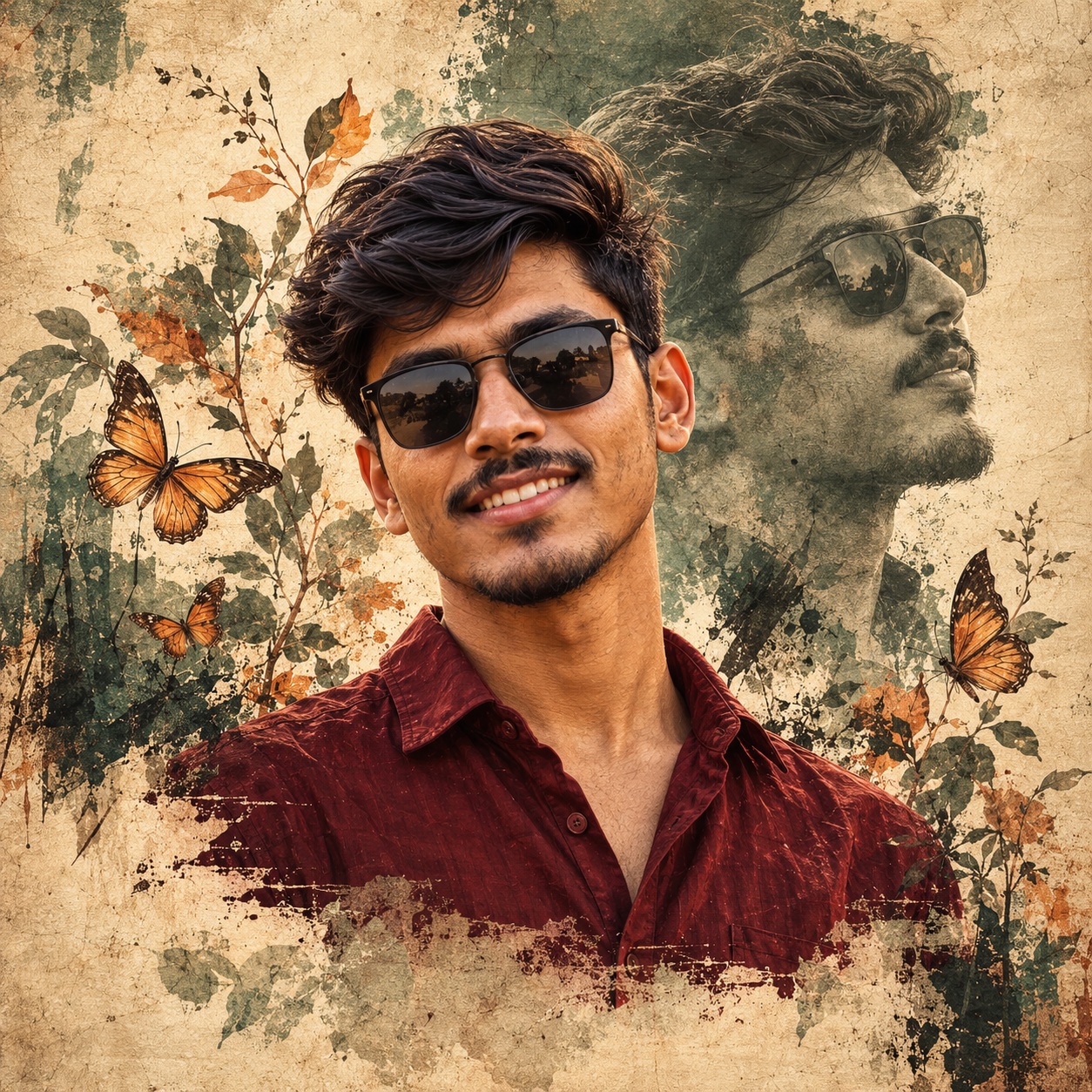
Cinematic Double Exposure is a distinctive portrait art concept that combines realistic facial details with layered imagery, vintage textures, and expressive editorial design. The central subject is a stylish young man wearing black sunglasses and a deep burgundy shirt. His confident appearance, textured hairstyle, and carefully defined facial hair establish a strong visual identity. Behind him, a faded secondary male profile creates the signature double-exposure effect, adding depth and a sense of artistic mystery.
The main portrait occupies the central area of the composition. The subject is shown from the chest upward, with his head slightly turned and his chin raised. This pose creates a confident, thoughtful expression that works well with the cinematic atmosphere. Reflective black sunglasses cover the eyes, introducing glossy highlights and a subtle metallic frame. The natural facial shading, detailed beard, fine mustache, and realistic skin texture contribute to the portrait’s semi-realistic finish.
The hairstyle features voluminous, textured black hair with individual strands and natural movement. Its darker tones contrast with the weathered background and help define the subject’s silhouette. The deep burgundy shirt introduces a rich color accent, while its open collar, fabric folds, and natural shadows add dimension. The clothing remains understated enough to let the face, sunglasses, and layered background remain the primary visual elements.
The double-exposure treatment is the defining feature of this artwork. A faded male profile appears behind the main portrait, blending into the background with reduced opacity and a painterly finish. This secondary image creates the impression of overlapping photographic layers without making the composition feel crowded. The contrast between the sharply rendered foreground portrait and the ghosted profile creates a strong visual hierarchy.
The background uses muted sage green, warm beige, cream, and charcoal-gray tones. Weathered plaster, cracked surfaces, distressed paper, and antique parchment textures give the composition an aged, handcrafted character. These elements create a vintage atmosphere while allowing the central portrait to remain visually prominent. Botanical foliage and watercolor leaf textures introduce organic patterns that soften the harder edges of the grunge design.
Orange-brown butterflies add movement and color to the artwork. Their detailed wings provide warm accents against the muted background, creating a connection between the natural botanical elements and the central portrait. Delicate branches, scattered leaves, ink splatters, and paint marks enrich the composition with layered visual details. These decorative elements are integrated into the background rather than appearing as unrelated additions.
Lighting supports the portrait’s dramatic character. Soft illumination defines the face, nose, lips, and beard, while gentle shadows preserve the natural structure of the head and neck. The sunglasses reflect subtle highlights that give the lenses a realistic appearance. Controlled contrast separates the main subject from the faded profile, and the burgundy shirt maintains depth through darker folds and restrained highlights.
The color palette is deliberately earthy and cinematic. Muted sage green and beige establish the vintage foundation, while charcoal tones provide depth. Burgundy clothing and orange-brown butterflies introduce selective warmth. Cream highlights soften the composition and complement the handwritten lettering. This combination creates a visually rich result without relying on excessive saturation or artificial color effects.
The artistic style combines semi-realistic digital painting, mixed-media portraiture, grunge editorial design, and vintage fine-art illustration. Photorealistic facial details contrast with textured brushwork, distressed paper, paint bleed, and organic ink marks. Fine grain and rough edges contribute to the handcrafted appearance, while selective sharpness keeps the face more detailed than the surrounding background.
The square album-cover composition creates a compact, balanced visual presentation. The main portrait sits prominently in the center, while the ghosted profile occupies the background. Botanical details and butterflies fill selected areas around the subject, creating visual movement without overwhelming the face. The lower portion provides space for a handwritten signature, which adds a personal and expressive finishing detail.
Typography plays an important role in the poster’s identity. Sweeping calligraphic lettering across the bottom introduces an elegant contrast to the distressed background. Its cream tone remains visible against the darker clothing and paint marks. The handwritten treatment contributes to the appearance of a personalized music cover or contemporary editorial artwork.
This style is suitable for digital profile artwork, music-cover concepts, personal poster designs, social media graphics, editorial portraits, and creative portfolios. Its combination of realistic portraiture and textured composition appeals to viewers who enjoy vintage aesthetics, dramatic lighting, and layered visual storytelling.
The strength of Cinematic Double Exposure lies in the balance between the main portrait and its surrounding details. The sunglasses establish a bold focal point, the burgundy shirt provides color, and the faded profile adds depth. Butterflies, botanical illustrations, and weathered textures create atmosphere, while the handwritten signature gives the composition a distinctive finishing touch.
[[[
Bhai, is reference ke saare diye hue effects ko unki sahi jagah par rakhkar complete master prompt bana diya hai. Ismein double exposure, butterflies, grunge texture, sunglasses, background portrait aur handwritten typography sab include hain.
REFERENCE ANALYSIS
- Style: Stylized digital portrait illustration, semi-realistic digital painting, cinematic mixed-media artwork, vintage fine-art portraiture aur grunge editorial poster aesthetic.
- Composition: Square album-cover framing, central head-and-shoulders portrait, slight low-angle perspective, near-eye-level facial framing, asymmetrical layout aur typography ke liye bottom mein negative space.
- Face and hair: Photorealistic facial rendering, natural skin texture, detailed beard stubble, fine mustache detailing, voluminous textured black hair aur realistic nose-lip shading.
- Sunglasses: Reflective black sunglasses, glossy lens highlights aur subtle metallic frame details.
- Outfit: Deep burgundy shirt, original collar, fabric folds aur natural shadows.
- Double exposure: Background mein faded secondary male profile silhouette, ghosted portrait overlay aur layered image compositing.
- Background: Muted sage-green, warm beige aur cream tones, weathered plaster, antique parchment, botanical foliage aur watercolor leaf textures.
- Decorative elements: Warm orange-brown butterflies, detailed wings, delicate branches, floating decorative elements aur subtle ink splatters.
- Lighting: Soft diffused illumination, dramatic side lighting, gentle facial highlights, ambient occlusion aur soft cast shadows.
- Texture and finish: Distressed paper, rough brush edges, paint bleed, fine grain, selective edge sharpening, facial micro-contrast aur soft vignette.
- Typography: Bottom area mein handwritten calligraphic signature, high-contrast script lettering aur minimalist placement.
- Mood: Moody, artistic, vintage, contemporary music-poster aesthetic.
MASTER PROMPT
Use supplied ref image as master blueprint. Replace only ref character’s face with supplied user identity. COMPLETELY IGNORE the user’s original photo pose and body; force the user into the exact body pose, hand placement, and posture of the reference character. Maintain exact scale, proportion, crop, visibility. Preserve 1000% of all visual info including darkness, grading, mood, lighting, shadows, contrast, saturation, composition, environment, objects, bg, text, props, rendering, outfit (exact style/color/condition), ref pose (exact body pos/hands/expression), vibe (exact emotional tone), and natural human anatomy (correct head-to-body ratio, proportional hands/limbs, no distortions). Output must look IDENTICAL to ref except face swap. Do NOT brighten, enhance, modify, change outfit, ref pose, or vibe.
ART STYLE AND RENDERING: Stylized digital portrait illustration, cinematic mixed-media artwork, semi-realistic digital painting, grunge editorial poster aesthetic and vintage fine-art portraiture. Maintain photorealistic facial rendering integrated with painterly background blending. Use textured brushwork, distressed paper texture, weathered plaster texture, antique parchment effects, rough brush edges, organic ink splatter, subtle paint bleed and fine grain texture. Preserve the original balance between realistic facial detail and stylized artistic rendering.
FACE AND IDENTITY: Replace only the reference character’s facial identity with the supplied user’s recognizable face. Preserve the user’s defining facial features, natural face shape, skin tone and realistic facial proportions. Match the reference head angle, expression, perspective, facial scale and existing shadows. Render natural skin texture, detailed beard stubble, fine mustache detailing, realistic nose and lip shading, gentle facial highlights and high micro-contrast on facial features. Retain the exact black sunglasses, including reflective lenses, glossy lens highlights and metallic frame details. Preserve their original size, position, angle and reflections. Do not remove or redesign them.
HAIR AND OUTFIT: Preserve the reference’s voluminous textured black hair, individual hair strands, natural hairline and original hairstyle silhouette. Retain the exact deep burgundy shirt, collar, neckline, fabric folds, shadows and visible clothing area. Maintain the original clothing color, design and condition without substitutions or embellishments.
BACKGROUND AND DOUBLE EXPOSURE: Reproduce the exact weathered, painterly background using muted sage green, warm beige, cream and charcoal-gray accents. Preserve the faded secondary male profile silhouette behind the main portrait, including its original location, scale, transparency, orientation and ghosted appearance. Maintain the layered image compositing and atmospheric depth. Add no new portraits or people beyond those visible in the reference.
BOTANICAL ELEMENTS AND BUTTERFLIES: Preserve the existing botanical foliage illustrations, delicate branch silhouettes, watercolor leaf textures and their exact placement. Retain the autumnal butterfly motifs with detailed wings and warm orange-brown accents. Preserve the original number, size, spacing and orientation of all butterflies and floating decorative elements. Keep their painterly integration with the background. Do not add, remove or reposition decorative elements.
LIGHTING AND SHADING: Match the reference’s soft diffused lighting and dramatic side lighting. Preserve the precise direction and intensity of illumination, gentle facial highlights, subtle ambient occlusion, soft cast shadows and natural shading on the shirt. Maintain the original contrast and shadow depth. Do not brighten the face, lift the blacks, flatten shadows or introduce artificial glow.
COLOR GRADING: Preserve the original desaturated earth-tone color grading, muted sage-green palette, warm beige and cream tones, charcoal-gray accents and deep burgundy shirt. Maintain selective color saturation, allowing the orange-brown butterflies and burgundy clothing to contrast naturally against the subdued background. Keep the original tonal relationships and moody atmosphere. No automatic exposure correction, excessive vibrance, oversaturation or unwanted orange color grading.
DETAIL AND FINISH: Apply selective edge sharpening, high facial micro-contrast, fine grain texture, soft background focus, shallow depth simulation and foreground-background layer separation. Preserve the distressed paper surface, antique plaster texture, painterly tonal transitions and subtle vignette. Keep the face detailed without sharpening the entire background uniformly. Avoid overly clean, glossy, modern or artificially polished rendering.
COMPOSITION AND TYPOGRAPHY: Preserve the exact square album-cover composition, central three-quarter portrait, slight low-angle camera perspective, near-eye-level facial framing, head-and-shoulders crop, slight head turn, chin-neutral pose and asymmetrical poster layout. Maintain the original scale, placement, negative space and visibility of the subject. Preserve the handwritten calligraphic signature at the bottom, using the same high-contrast script lettering, approximate scale, placement and minimalist text treatment. Retain existing meaningful text and its visual style; do not invent extra words or logos.
FINAL OUTPUT: A faithful reproduction of the supplied reference poster, preserving the original double-exposure portrait, muted earth-tone palette, textured mixed-media rendering, botanical illustrations, butterflies, burgundy shirt, reflective sunglasses and handwritten signature. The supplied user identity should replace only the main character’s facial identity. Preserve the original composition, artistic character, natural anatomy, lighting and mood without redesigning any other element.
EDITABLE VARIABLES
- [USER IDENTITY]: User’s actual face, recognizable facial features and natural proportions.
- [OUTFIT]: Exact deep burgundy shirt from the reference.
- [TEXT]: Preserve the existing handwritten signature and typography; replace only if the user supplies specific text.
- [OBJECT CHANGE]: None.
- [POSE CHANGE]: None; preserve the reference head angle, posture and crop.
- [ADDITIONAL EDIT]: None.
NEGATIVE PROMPT
identity loss, wrong face, generic face, altered facial features, original character identity, changed sunglasses, missing sunglasses, different sunglasses, altered lens reflections, changed hairstyle, different hairline, changed beard, missing mustache, changed shirt, different outfit, altered burgundy color, added accessories, altered pose, wrong head angle, changed expression, user’s original pose, oversized head, tiny head, disproportionate limbs, bad anatomy, deformed hands, altered crop, zoomed portrait, recentered composition,
changed camera angle, altered square framing, redesigned background, missing double exposure, altered secondary profile, additional people, missing butterflies, extra butterflies, changed butterfly placement, missing foliage, added branches, removed objects, changed typography, missing signature, invented text, modern typography, brightened image, lifted shadows, lost darkness, excessive saturation, orange grading, artificial HDR, oversharpened background, plastic skin, excessive skin smoothing,
unwanted photorealism, cartoon conversion, 3D rendering, clean vector art, missing paper grain, missing plaster texture, missing cross-hatching, lost brushwork, excessive glow, polished commercial aesthetic, altered mood, changed color grading, simplified textures, composition redesign, unnatural anatomy, giant head, tiny hands, polio. ]]]