
Diwali Portrait
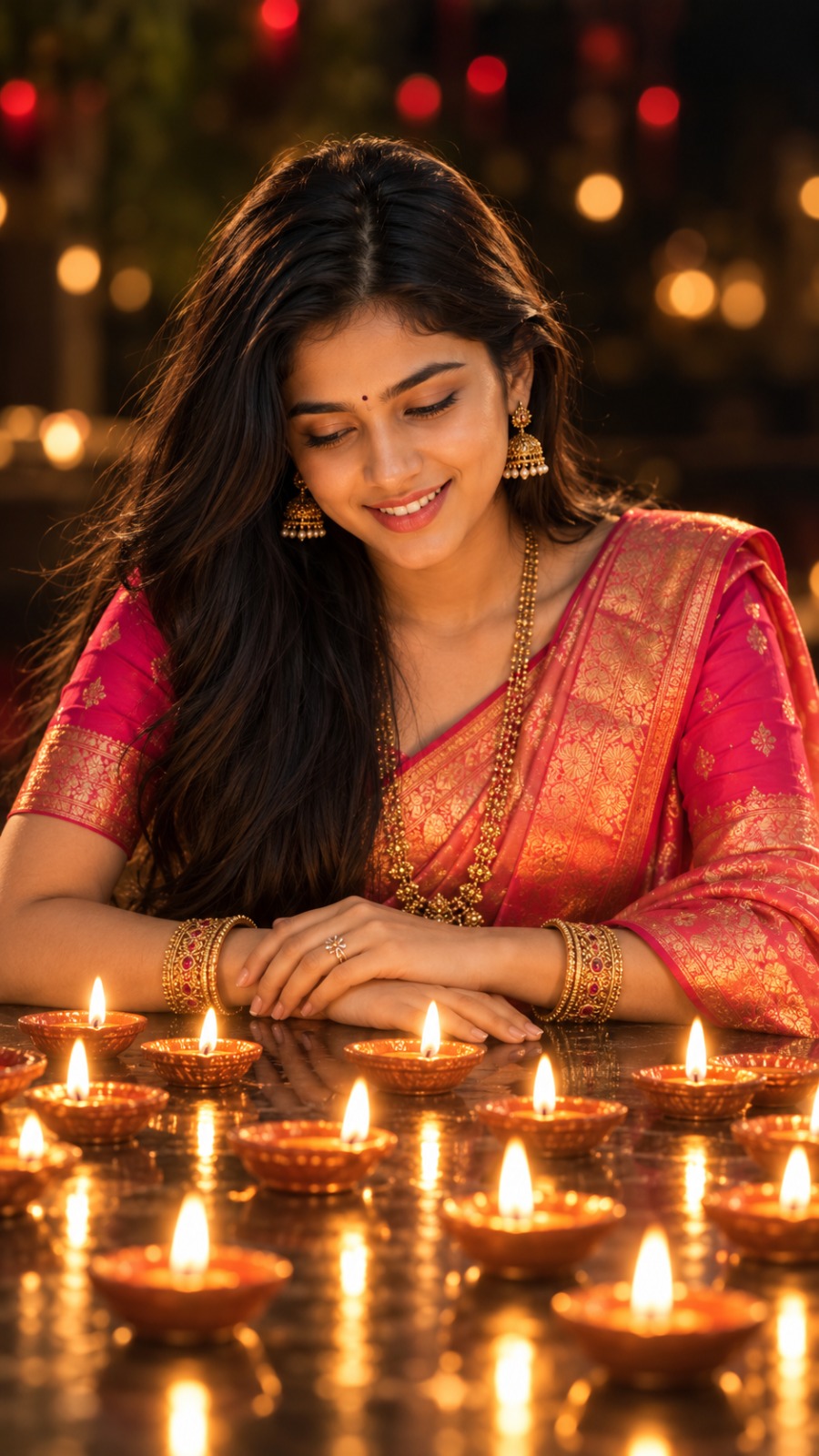
The Diwali Portrait concept captures the beauty of traditional Indian festive fashion through a carefully balanced combination of warm firelight, rich fabric colors, intricate jewelry, and expressive body language. The central subject is an Indian woman leaning gently over a dark tabletop decorated with numerous small oil lamps. Her relaxed posture and downward gaze create the feeling of a quiet, personal moment during Diwali, when the glow of the lamps becomes the center of attention. Rather than presenting a conventional fashion pose, the composition focuses on the relationship between the woman, the diyas, and the warm light that connects every element.
The woman’s face occupies the upper-middle area of the vertical composition. Her head is lowered slightly and turned toward the viewer’s right, allowing her gaze to follow the lamps arranged in front of her. Her expression is gentle and peaceful, with a subtle smile and slightly parted lips. A small dark bindi sits above her eyebrows, providing a traditional detail that complements the rest of her appearance. Her facial expression feels natural rather than theatrical, giving the portrait a personal and welcoming quality.
Her long, glossy black hair is parted to one side and falls over the viewer-right shoulder. The smooth strands create a dark, flowing shape that contrasts with the bright pink blouse and coral-colored sari. Selective warm highlights bring out the hair’s natural sheen without making it appear artificial. The placement of the hair also helps guide attention toward the face, necklaces, and hands resting on the tabletop.
The outfit is one of the strongest visual features of the concept. The woman wears a vivid fuchsia-pink blouse decorated with tiny gold motifs. Over it, a coral-pink and orange-gold sari drapes across her chest and shoulder. Its ornate metallic patterns, reflective details, and natural folds provide texture and movement. The bright fabrics introduce festive color while remaining visually connected to the golden flames and jewelry.
The jewelry adds richness and traditional elegance. Large tiered jhumka-style earrings frame the face, while long decorative necklaces extend vertically across the chest. Broad gold-toned wrist cuffs emphasize the forearms, and a prominent hand ornament provides an additional decorative detail. These accessories catch the diya light in small, concentrated highlights. Their purpose is not simply to make the subject look more elaborate; they also help distribute warm reflections across the composition and reinforce the celebratory atmosphere.
The body posture is essential to the visual story. The woman leans forward slightly, with both forearms resting horizontally on the tabletop. One arm extends inward from the viewer-left, while the other rests across the surface from the opposite side. Her hands meet near the lower center and overlap delicately. The fingers remain relaxed, with natural separation and gentle curves rather than a tight clasp. This arrangement communicates calmness and care while keeping the lamps visible in the foreground.
The position of the hands creates a visual connection between the woman and the diyas. They rest just behind the nearest lamps, making the subject appear close to the warm light without touching the flames. The hands also create a horizontal line that balances the vertical arrangement of the face, necklaces, and sari. Because the wrists and fingers are illuminated by the flames, their shape remains clearly readable against the darker tabletop.
The foreground contains numerous small clay or brass-toned oil lamps arranged in staggered rows. Their placement is intentionally irregular, with visible gaps between neighboring lamps. Some sit close to the woman’s forearms, while others extend toward both sides of the frame. The nearest lamps are partially cropped at the bottom edge, suggesting that the arrangement continues beyond the photograph. This layered placement creates a sense of depth rather than making the lamps look like a flat decorative pattern.
Each diya contains a small teardrop-shaped flame with a bright yellow-white center and a soft orange-gold outer glow. The individual flames remain distinct, allowing the viewer to recognize each lamp separately. Their different sizes and slight variations in shape help the scene feel natural. The concentrated brightness of the flames contrasts with the dark surroundings and provides the visual foundation for the entire lighting design.
The tabletop is dark, smooth, and reflective. Golden reflections stretch downward from the lamps, creating elongated streaks that vary according to the distance and position of each flame. The closest reflections appear broader and softer, while those farther away are smaller and more defined. Dark gaps remain between the reflections, preserving the texture of the surface. This detail adds another layer to the composition and gives the foreground a polished, cinematic appearance.
Lighting is the defining feature of this Diwali Portrait. The diyas act as practical light sources positioned below the woman’s face. Their warm illumination rises across her chin, lips, cheeks, hands, forearms, necklaces, and sari. The light creates gentle highlights along the nose and cheekbones while leaving softer shadows beneath the eyebrows, chin, arms, and jewelry. This directional effect gives the portrait depth without making the face appear unnaturally bright.
The background remains almost completely black, allowing the colorful clothing and golden lamps to stand out. A faint dark olive-brown area provides subtle separation behind the subject, while a few blurred red and amber circles appear near the upper edge. These bokeh lights suggest a festive environment without introducing recognizable objects or competing with the woman. Their soft appearance maintains the intimate feeling of the scene.
The color palette combines fuchsia pink, coral, orange-gold, warm amber, and deep charcoal-black. The bright clothing provides a vivid focal point, while the gold jewelry and flames create visual harmony. Warm skin tones remain natural, and the dark background preserves strong contrast. Controlled glow around the flames adds atmosphere without obscuring the lamp shapes, fabric details, or jewelry.
The overall artistic style is photorealistic cinematic portrait photography with traditional Indian festive influences. Natural skin texture, fine hair detail, realistic silk sheen, metallic reflections, shallow depth of field, and selective sharpness contribute to the photographic character. The subject remains the central focus, while the foreground lamps and distant bokeh create distinct visual layers.
The vertical 9:16 format makes this concept suitable for mobile screens and portrait-oriented displays. It works well for festive profile images, social media posts, Diwali greeting designs, cultural photography collections, personalized wallpapers, and fashion editorial layouts. The tall framing accommodates the woman’s face, jewelry, arms, tabletop, and rows of lamps without losing the relationship between the subject and the festive setting.
The strongest quality of the composition is its balance between elegance and intimacy. The rich sari and ornate accessories establish a luxurious festive appearance, while the lowered gaze and gently overlapping hands create a quieter emotional moment. The lamps provide warmth, the reflective tabletop adds depth, and the nearly black background keeps the attention focused. Every visual element contributes to a consistent mood rather than competing for attention.
This Diwali Portrait concept is especially valuable for creative projects that need traditional Indian styling without relying on an overly crowded setting. The combination of realistic fabric, intricate jewelry, glowing diyas, and controlled shadows creates a polished appearance that feels celebratory yet refined. Its carefully arranged colors and lighting also make it a useful reference for photographers, portrait editors, designers, and digital artists exploring festive visual storytelling.
Ultimately, the Diwali Portrait style celebrates the emotional warmth of the festival through a simple but expressive arrangement. The woman, her traditional clothing, and the glowing oil lamps work together to communicate peace, elegance, and celebration. The result is a visually rich portrait concept that preserves cultural detail while using cinematic lighting and thoughtful composition to create a memorable festive atmosphere.
[[[
A. REFERENCE ANALYSIS
- Camera: Vertical 9:16 portrait, medium-close framing, slightly elevated viewpoint, mostly frontal with natural perspective.
- Pose: Woman leaning forward over a tabletop, both forearms resting horizontally across the surface, hands delicately overlapping near the center.
- Face: Head lowered and turned toward the viewer’s right, eyes looking down toward the diyas, gentle smile with slightly parted lips, small centered bindi.
- Hair: Long, smooth, glossy black hair, side-parted and cascading over the viewer-right shoulder.
- Outfit: Vivid fuchsia-pink blouse with tiny gold motifs, coral-pink and orange-gold sari drape with ornate metallic detailing.
- Jewelry: Large tiered dangling earrings, long decorative necklaces, broad gold-toned wrist cuffs, and a prominent hand ornament.
- Lighting: Warm, upward-facing diya light illuminating the face, hands, jewelry, and silk fabric. Deep shadows surround the subject.
- Foreground: Multiple small clay or brass-toned diyas in staggered rows across a reflective tabletop, with elongated golden reflections.
- Background: Nearly black, with scattered red and amber circular bokeh near the upper edge.
- Color grading: Rich pink, coral, gold, and fiery amber against deep black shadows, with soft flame bloom and selective focus.
B. MASTER PROMPT
Photorealistic Cinematic Portrait Photography + Traditional Indian Diwali Festival Aesthetic + High-Detail Indian Festive Fashion Portrait + Warm Low-Key Illumination + Dramatic Chiaroscuro Lighting + Practical Diya Flame Lighting + Golden Amber Firelight + Rich Saturated Fuchsia and Coral Color Palette + Deep Black Background + Controlled Highlight Bloom + Natural Skin Texture + Fine Hair Strand Detail + Ornate Traditional Indian Jewelry + Realistic Reflective Surfaces + Vertical 9:16 Portrait Composition.
CAMERA AND FRAMING: Slightly elevated, mostly frontal camera viewpoint, looking gently downward toward the subject and tabletop. Medium-close portrait framing, approximately waist-up or mid-torso-up, with the woman’s head, shoulders, upper torso, both forearms, hands, tabletop, and multiple foreground diyas visible. Natural portrait perspective, approximately 50–85 mm full-frame equivalent as an estimate. Keep the woman’s face in the upper-middle portion of the frame, slightly right of the vertical center. Place the lamps across the bottom third, with the glossy tabletop extending to the bottom edge. No camera tilt or excessive wide-angle distortion.
POSE AND FACE: An Indian woman leans forward over the table, her upper torso angled gently toward the viewer. Her head tilts downward and turns slightly toward the viewer’s right. Her nose points diagonally down and right. Both eyelids are lowered as she looks at the lamps and her hands, never toward the camera. Her lips are slightly parted in a natural, gentle smile, with just a subtle glimpse of upper teeth. A small, dark bindi sits centered above the eyebrows. Preserve the soft cheek contours, defined brows, natural eyelashes, and relaxed facial expression.
HAIR, CLOTHING, AND JEWELRY: Long, glossy, dark brown-to-black hair, side-parted, swept away from the viewer-left side of the face and cascading heavily over the viewer-right shoulder and chest. She wears a vivid fuchsia-pink short-sleeved blouse with tiny scattered gold motifs. A lustrous coral-pink and orange-pink traditional sari drape crosses her chest and covers the viewer-right shoulder,
featuring elaborate gold-toned woven patterns, reflective highlights, and natural fabric folds. Add large, intricate tiered jhumka-style dangling earrings, long heavy gold-toned patterned necklaces hanging vertically down the chest, broad ornate gold wrist cuffs on both wrists, and a prominent decorative ring or hand ornament. Jewelry catches the diya light in small, realistic metallic highlights. Keep the outfit rich in color and ornamentation without inventing additional accessories.
EXACT ARM AND HAND ARRANGEMENT: Both arms extend inward from opposite sides of the frame, creating a low, horizontal base across the tabletop. The arm entering from the viewer-left emerges from the vivid pink sleeve and stretches diagonally down toward the center, with the forearm resting on the table. The opposite forearm emerges from beneath the coral sari drape on the viewer-right and lies across the table at a similar height. Both hands meet near the lower center of the subject,
behind the nearest row of lamps and just above the tabletop. The hands overlap lightly and elegantly rather than gripping or clasping tightly. One hand rests diagonally over the other, with relaxed fingers extending toward the viewer-right and gently curving downward. Preserve natural finger separation, realistic knuckles, plausible wrist angles, and the broad decorative wrist cuffs. Keep the hands close to the lamps but not touching flames, wicks, or lamp rims. The hands must remain behind the foreground diya arrangement, clearly separated from the nearest flames.
FOREGROUND DIYA ARRANGEMENT: Cover the lower third of the image with numerous small, shallow, rounded clay or brass-toned oil lamps arranged in staggered, irregular rows across the width of a glossy tabletop. The lamps vary slightly in size and apparent distance due to perspective. The frontmost lamps are partially cropped by the bottom edge, while the lamps nearest the woman’s forearms form a loose rear row. Maintain visible gaps between neighboring lamps so each bowl and flame can be distinguished. Avoid a perfectly straight grid or a single crowded pile.
Place several diyas immediately in front of the woman’s resting forearms, including a small cluster beneath the center of her overlapping hands. Distribute additional lamps across the viewer-left and viewer-right sides, with some extending toward both frame edges. A few slender gold-toned lamp tools or decorative elements lie diagonally between the lamps, following the tabletop’s horizontal perspective without obscuring the hands. Each diya contains a small, distinct teardrop-shaped flame, with a bright yellow-white core and a soft orange-gold outer glow. Keep the flames upright and individually separated, with natural variations in height and curvature. Do not let the flames merge into one continuous band of light.
REFLECTIONS AND FOREGROUND DEPTH: The tabletop is dark, smooth, and highly reflective. Each lit diya produces a localized golden reflection directly beneath it, stretching vertically toward the lower frame edge. Reflections are elongated, softly blurred, and broken by the natural texture and curvature of the glossy surface. The closest reflections are larger and more diffuse; the more distant reflections are smaller and tighter. Preserve visible dark gaps between reflected light streaks. The foreground should feel layered, with near lamps and reflections creating depth while the woman’s hands remain clearly readable behind them.
LIGHTING: Use the diya flames as the primary practical light sources. Warm light rises from the tabletop, illuminating the lower face, chin, cheeks, lips, hands, forearms, jewelry, and reflective sari fabric. Maintain golden highlights across the forehead, nose, and cheekbones, balanced by soft shadows beneath the eyebrows, chin, arms, and jewelry. Add realistic specular highlights on the gold necklaces and wrist cuffs, bright points on the flame cores, and warm reflections on the glossy table. Keep the face clearly visible without flattening the shadows. Do not introduce a strong white studio key light or bright frontal flash.
BACKGROUND AND COLOR: A nearly black, uncluttered background fills the upper half. Include a faint, soft dark olive-brown horizontal region behind the subject and a sparse scattering of out-of-focus red and amber circular bokeh lights near the top edge. One relatively bright red circular bokeh spot sits near the upper center, with several dimmer red-orange spots scattered farther left and right. Keep all background lights heavily defocused, subdued, and behind the subject. The hair and shoulders must remain clearly separated from the background through selective warm illumination.
FINAL RENDERING: Rich, saturated magenta-pink, coral, gold, amber, and flame-orange colors against deep charcoal-black shadows. Cinematic festive color grading, natural warm skin tones, realistic silk sheen, detailed metallic jewelry, physically plausible flames, soft localized flame halation, controlled highlight exposure, shallow depth of field, selective sharpness on the face and hands, and progressively softer foreground reflections. Preserve the intimate celebratory mood, exact downward gaze, forward-leaning posture, overlapping hands, sari colors, jewelry arrangement, staggered lamps, reflective tabletop, and sparse red background bokeh. No unrequested changes.
C. EDITABLE VARIABLES
- [CAMERA ANGLE] Slightly elevated, mostly frontal — locked.
- [POSE & BODY GEOMETRY] Leaning forward, forearms resting on the table, hands lightly overlapping — locked.
- [FACE DIRECTION & EXPRESSION] Downward gaze, head turned slightly viewer-right, gentle open smile, small bindi — locked.
- [OUTFIT & ACCESSORIES] Fuchsia blouse, coral-pink sari, ornate gold jewelry — locked.
- [LIGHTING & SHADOWS] Warm diya underlighting, deep shadows, gold reflections — locked.
- [BACKGROUND & OBJECTS] Black background, red-amber bokeh, staggered diya rows, reflective tabletop — locked.
- [TEXTURE & EFFECTS] Glossy silk, metallic highlights, subtle flame glow, shallow depth of field — locked.
- [ASPECT RATIO] 9:16 vertical — locked.
- [OBJECT CHANGE] No changes to the lamp arrangement or hand-to-lamp relationship — locked.
- [ADDITIONAL EDITS] None specified.
D. NEGATIVE PROMPT
Horizontal framing, square crop, full-body shot, extreme close-up, overhead camera angle, extreme low angle, direct eye contact, eyes looking upward, exaggerated smile, open mouth, changed head direction, upright torso, raised arms, hands clasped tightly, hands held in the air, hands covering the lamps, hands touching flames, fingers merged, extra fingers, missing fingers, duplicated hands, broken wrists, distorted jewelry, missing necklaces, missing earrings, missing wrist cuffs, altered blouse color, blue or green clothing,
plain unembellished sari, excessive invented jewelry, short hair, hair falling over the wrong shoulder, flat synthetic hair, plastic skin, excessive beauty retouching, unnatural facial smoothing, harsh white flash, cool blue lighting, flat frontal illumination, washed-out colors, gray shadows, overexposed skin, blown-out flame cores, enormous flames, floating flames, fused flames, identical perfectly aligned lamp rows,
lamps arranged in a rigid grid, overcrowded foreground, lamps covering the hands, missing diyas, missing tabletop reflections, reflections extending in random directions, matte tabletop, excessive mirror-like reflections, excessive lens flare, heavy smoke, dense fog, bright background, sharp background bokeh, additional people, extra props, text, watermark, logo, cartoon rendering, painterly style, CGI appearance, unnatural anatomy, excessive HDR, unrequested composition changes.
E. RECONSTRUCTION BLUEPRINT
A vertical 9:16 photorealistic festive portrait shows an Indian woman leaning forward behind a glossy dark tabletop filled with small, lit oil lamps. Her head is lowered and turned slightly toward the viewer’s right, her eyes directed toward the diyas, and her slightly parted lips form a gentle smile. A small dark bindi sits above her eyebrows. Her long, glossy black hair is side-parted and falls over her right shoulder. She wears a vivid fuchsia blouse with tiny gold motifs and a coral-pink sari with intricate gold detailing, complemented by large tiered earrings, long ornate necklaces, broad gold wrist cuffs, and a decorative hand ornament.
Both forearms rest horizontally across the tabletop. Her hands meet near the lower center, lightly overlapping with relaxed, naturally curved fingers. A staggered arrangement of shallow clay or brass-colored diyas fills the foreground, extending from the space immediately in front of her arms to the bottom edge. Each lamp has a distinct yellow-white flame surrounded by a warm amber glow.
The flames illuminate her face, hands, jewelry, and silk fabric from below. Golden reflections stretch across the polished tabletop beneath the lamps, creating depth between the foreground and the subject. The background remains nearly black, interrupted only by scattered, blurred red and amber circles of light near the upper edge. Rich pink, coral, and gold tones contrast with deep shadows, producing a warm, intimate Diwali atmosphere with realistic textures and controlled cinematic glow.
F. LIMITATIONS
The precise number and placement of the lamps cannot be established reliably because several are partially overlapping or cropped. The prompt therefore preserves the visible arrangement as staggered rows with individually separated flames rather than enforcing an arbitrary exact count. The original image also does not establish the exact camera settings, jewelry materials, or source of the background bokeh.
]]]