
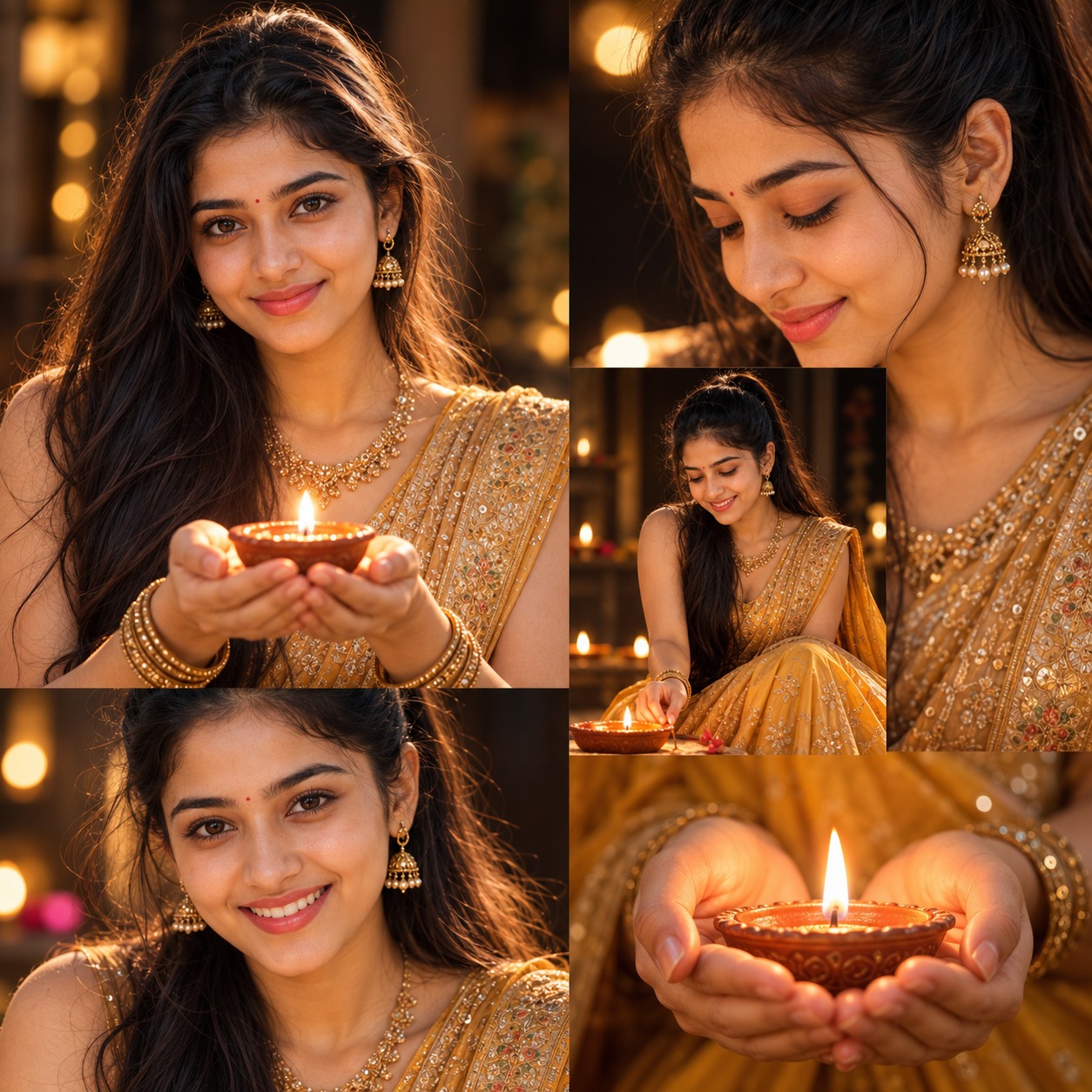
Diwali Gold Saree Collage
The Diwali Gold Saree Collage concept presents an elegant Indian festive photography composition that combines traditional clothing, expressive portraits, warm lighting, and the timeless beauty of a glowing diya. Its main subject is an adult Indian woman dressed in a champagne-gold sari, photographed in several complementary views. Rather than relying on a single portrait, the concept tells a visual story through different expressions, angles, and small details that together capture the warmth and sophistication of Diwali.
The woman is the central visual focus throughout the composition. Her long, dark brown-to-black hair falls naturally around her face and shoulders, creating a soft contrast against the reflective gold fabric and the deep, shadowy background. Her hairstyle is polished without appearing overly arranged, allowing individual strands and subtle highlights to contribute to the realistic photographic appearance. A small traditional bindi adds a recognizable cultural detail, while muted rose lipstick, softly defined eyebrows, and delicate eyeliner create a balanced, natural beauty look.
Her facial expressions change from one panel to another, giving the collage a sense of personality and emotional variety. In the main portrait, she looks toward the camera with a gentle, closed-mouth smile. Her expression feels composed, welcoming, and quietly confident. The downward-facing profile offers a more reflective mood, as her lowered eyes and peaceful smile suggest a private moment of appreciation. In the lower portrait, a brighter smile and direct eye contact bring a more joyful, celebratory quality to the composition.
The different expressions make the overall presentation feel more like a collection of photographs captured during one carefully planned festive session. Each view contributes something different without losing the identity of the subject. The consistent facial appearance, hairstyle, makeup, and wardrobe help the panels feel connected rather than like unrelated photographs placed together.
The sari plays an important role in the visual design. Its champagne-gold, antique-gold, and bronze-gold tones provide richness without relying on excessively bright or saturated colors. Intricate metallic embroidery, fine sequin accents, and a lustrous silk-like texture create a refined appearance. Small highlights across the fabric suggest the way embroidered threads catch warm light, while deeper folds retain brown-gold shadows that give the material dimension.
The traditional gold earrings and delicate necklace complement the sari without overwhelming the face. Their restrained decorative detail adds elegance to the portraits, particularly in the smiling close-up, where the visible floral earring and necklace help establish a polished festive look. Keeping the jewelry consistent across the panels strengthens the impression that every photograph belongs to the same editorial collection.
A traditional clay diya is another defining feature. In the main portrait, the woman holds the small lamp carefully in both cupped hands. The gesture feels gentle and meaningful, drawing attention to the relationship between the subject, the flame, and the celebration. The diya is small rather than exaggerated, making its presence believable within the photographic scene.
The seated portrait adds a quieter moment to the visual story. The woman looks down toward the lamp near her lap, with one hand supporting it and the other positioned as though she is carefully tending or shielding the wick. Her sari falls naturally over her knees, forming elegant folds that introduce movement and texture. This panel balances the tighter facial portraits with a view of her posture, hands, and clothing.
The detailed diya panel provides a different kind of visual interest. Instead of focusing on facial expression, it emphasizes the hands, earthen lamp, wick, and flame. The fingers curve naturally around the diya, while the warm light creates delicate highlights along the fingertips, nails, palm creases, and patterned rim. These tactile details make the festive setting feel intimate and personal.
Lighting is central to the concept’s atmosphere. The scene uses low-key illumination, meaning that much of the background remains dark while selected areas of the face, sari, jewelry, and hands receive gentle light. Warm amber tones create a welcoming glow, while deep espresso and chocolate-brown shadows add visual depth. The diya provides a small practical light source that softly illuminates the palms and lower facial area, connecting the flame to the surrounding scene.
The lighting is deliberately controlled. Facial highlights remain soft, metallic embroidery reflects light in restrained accents, and the flame has a bright yellow-white center surrounded by a subtle orange glow. The background does not compete with the subject. Instead, it gradually fades into dark brown and near-black tones, allowing the illuminated details to remain visually prominent.
The composition uses a square canvas with an asymmetrical multi-panel layout. The upper-left portrait acts as the primary focal point, while the upper-right side profile introduces a contrasting angle. A smaller seated photograph occupies the middle-right area, and the lower portion pairs a smiling close-up with the diya detail. The overlapping inset creates a magazine-inspired arrangement, adding layers and visual movement while preserving clear divisions between photographs.
This structure gives the viewer several ways to appreciate the same festive scene. Facial expressions attract attention first, the sari and jewelry provide decorative richness, and the flame detail creates a natural secondary focal point. Each panel has its own purpose, yet consistent color grading and styling bring the entire arrangement together.
The photographic style is realistic and editorial rather than illustrated. Natural skin texture, believable facial proportions, individual hair strands, accurate fabric folds, and carefully rendered hands contribute to the intended photographic feel. Shallow depth of field keeps the subject prominent while allowing the dark indoor environment to remain softly blurred. The camera perspective is natural, avoiding exaggerated distortion and preserving a graceful portrait appearance.
The color palette combines muted champagne gold, antique bronze, warm peach skin tones, amber illumination, and deep brown shadows. These colors communicate luxury and tradition without making the scene feel excessively bright. Their balance is especially useful for festive designs that need both visual richness and an understated, sophisticated finish.
The overall mood is intimate, elegant, traditional, and cinematic. The diya introduces a recognizable Diwali element, while the gold sari and warm lighting give the composition a premium editorial quality. The portraits suggest the quieter, more personal side of a celebration rather than a crowded festival scene filled with distracting decorations.
This concept is suitable for festive social media posts, Diwali greeting designs, personal portrait collections, fashion-inspired editorial layouts, cultural celebration graphics, and seasonal website content. It can also serve as visual inspiration for a magazine-style collage, a profile feature, a festive album cover, or a decorative digital poster.
One of its main strengths is the balance between personal expression and cultural detail. The subject remains recognizable across multiple views, the clothing adds texture and elegance, and the diya creates a simple focal element that connects the panels emotionally. Together, these features establish a polished visual identity that feels warm, celebratory, and timeless.
The result is a cohesive festive portrait concept built around graceful expressions, luxurious traditional styling, controlled cinematic lighting, and the gentle glow of a small lamp. It celebrates the beauty of Indian festive fashion while using varied portrait perspectives to create a richer and more engaging visual narrative.
[[[
A. REFERENCE ANALYSIS
- Composition: Square 1:1 canvas containing a four-panel photographic collage. The panels have clean rectangular divisions and different sizes, with a warm, consistent color treatment throughout.
- Top-left panel: Close-up portrait of a woman looking toward the camera with a subtle smile, holding a small illuminated clay diya in both cupped hands. Her gold sari occupies the lower-right area.
- Top-right panel: Large, cropped side-profile portrait. Her head is tilted downward, eyes lowered, with a gentle smile. Long dark hair falls around her face and shoulder.
- Middle-right panel: Smaller three-quarter seated portrait. The woman looks down while tending to a diya held near her lap. Her gold sari drapes across her knees.
- Bottom-left panel: Close-up portrait with direct eye contact and a broader smile, wearing delicate gold jewelry.
- Bottom-right panel: Close-up detail of both hands cupping a small decorative diya, with the flame illuminating the fingertips.
- Camera and perspective: A combination of eye-level portraiture, close-up facial framing, side-profile photography, and a seated medium shot. Perspective is natural, without strong wide-angle distortion.
- Wardrobe: Champagne-gold and bronze-gold sari with intricate metallic embroidery, sequins, and a lustrous silk texture. Traditional gold earrings and delicate necklaces.
- Lighting: Low-key, warm amber illumination with soft facial fill, subtle underlighting from the diya, and deep chocolate-brown shadows.
- Background: Nearly black and dark brown indoor environment with minimal distractions and soft background blur.
- Mood: Intimate, elegant, traditional, and cinematic Diwali editorial photography.
B. MASTER PROMPT
Photorealistic Indian Festive Portrait Photography + Diwali Editorial Photography + Four-Panel Photographic Collage + Multi-Perspective Portrait Montage + Square 1:1 Canvas + Cinematic Low-Key Lighting + Warm Golden-Amb er Color Grading + Deep Chocolate-Brown Shadows + Muted Champagne Gold Highlights + Rich Bronze Tones + Natural Skin Texture + Refined Editorial Retouching.
COLLAGE LAYOUT AND COMPOSITION: Create a square 1:1 photographic collage composed of four distinct rectangular photographic panels with clean, straight panel divisions and no decorative borders. Preserve the asymmetrical editorial layout: a large upper-left portrait panel occupying approximately the upper-left three-fifths of the canvas and extending to the middle of the composition; a large upper-right side-profile portrait occupying the upper-right area;
a smaller seated portrait inset positioned across the middle-right area; and a bottom row divided into a smiling portrait on the left and a close-up diya detail on the right. The inset panel overlaps the larger portrait areas, creating a layered magazine-editorial composition. Keep each photograph visually distinct while maintaining consistent warm lighting, wardrobe, subject identity, and color grading across all four panels. Preserve the original square crop and the relative proportions of the panels.
PANEL 1 — UPPER LEFT, MAIN PORTRAIT: A close-up portrait of an adult Indian woman with long, dark brown-to-black hair, softly parted near the center and falling naturally around her face and shoulders. She faces mostly toward the camera, with her head slightly inclined and her eyes looking directly into the lens. Her expression is calm and warm, with a gentle closed-mouth smile, softly defined eyebrows,
dark expressive eyes, subtle eyeliner, natural lashes, a tiny traditional bindi, and muted terracotta-rose lipstick. Her skin has realistic fine texture, delicate highlights on the cheeks and nose, and smooth but natural tonal transitions. She wears a rich champagne-gold sari with densely embroidered metallic gold threadwork and subtle sequins.
Both hands are cupped together near the lower-left portion of the panel, gently holding a small traditional clay diya with a decorative scalloped or patterned rim. The small yellow-orange flame illuminates the palms and fingertips, creating a soft warm glow beneath her chin. Her face is the primary focal point, while the sari and dark background gradually fade into soft shadow.
PANEL 2 — UPPER RIGHT, LARGE SIDE-PROFILE PORTRAIT: A larger cropped close-up of the same woman in three-quarter side profile, facing toward the viewer’s left. Her forehead and nose form a graceful downward-facing profile, her eyes are lowered toward an unseen point below the frame, and her lips form a faint, peaceful smile. Her long, smooth dark hair sweeps backward from the crown and falls behind her shoulder, with fine warm-brown highlights along individual strands.
A few delicate loose strands frame her cheek. Her visible shoulder and upper chest are wrapped in the same champagne-gold embroidered sari. Soft directional amber light illuminates her forehead, nose, cheekbone, lips, and jawline, while the far side of her face and hair merge gently into a deep brown-black background. Use tight facial cropping, natural perspective, shallow depth of field, and subtle highlights without overexposure. Maintain continuity with the woman in the other panels.
PANEL 3 — MIDDLE RIGHT, SEATED MEDIUM PORTRAIT INSET: A smaller rectangular photograph overlapping the middle-right area of the collage. The woman sits in a relaxed pose with her torso turned slightly sideways and her head bowed toward a small diya held near her lap. Her eyes are gently lowered, and she has a soft, contented smile. Her long dark hair falls over her back and one shoulder. She wears the same lustrous gold sari, draped naturally over her shoulder and knees,
with delicate metallic embroidery and fine reflective details. One hand supports the small lamp while the other carefully adjusts or shields the wick, with anatomically natural fingers and believable contact with the lamp. Frame her from approximately the waist or mid-thigh upward, with the sari forming elegant folds across the lower portion of the panel. The setting is dark, with faint horizontal architectural lines in the background. Use gentle warm side lighting and a localized diya glow to define her profile, hands, and sari folds.
PANEL 4 — BOTTOM LEFT, SMILING BEAUTY PORTRAIT: A close-up portrait of the same woman, framed from the upper chest to just above the head. Her face turns slightly toward the camera, with direct eye contact and a bright, natural smile revealing her upper teeth. Her dark eyes have softly defined eyeliner, her eyebrows are neat and natural, and her lips retain a muted warm rose color.
Her long dark hair frames the sides of her face, with a few strands tucked behind one ear to reveal an ornate gold floral earring. A delicate gold necklace with small decorative elements rests along her collarbone. The gold sari is visible along the lower edge of the panel. Warm light softly illuminates her forehead, cheeks, nose, and chin, while the background remains deep brown with a faint, defocused amber light at the far left. Preserve the natural facial proportions and consistent appearance established in the other panels.
PANEL 5 — BOTTOM RIGHT, DIYA DETAIL: A tightly framed close-up of two gently cupped hands holding a small traditional clay diya. The hands enter from opposite sides of the frame, with fingers naturally curved around the base and sides of the lamp. The diya has a warm brown earthen texture and a decorative ridged or scalloped rim. A short cotton wick supports a small yellow-white flame with an amber-orange outer glow.
The flame creates delicate golden highlights on the fingertips, palm creases, nails, and lamp rim. Surrounding skin and clothing recede into deep chocolate-brown shadows. A portion of the gold embroidered sari appears softly out of focus at the far right. Use selective focus on the lamp, flame, and closest fingertips, with realistic hand anatomy and subtle highlight bloom. Preserve the intimate, tactile quality of a real photograph.
WARDROBE AND ACCESSORIES: Across all panels, the woman wears the same champagne-gold, antique-gold, and bronze-gold traditional sari, featuring intricate metallic thread embroidery, fine sequin accents, and a lustrous silk-like surface. Fabric folds catch small warm highlights, while the deeper folds retain rich brown-gold shadows. Add traditional gold earrings and a delicate necklace in the portrait panels, with jewelry designs remaining consistent. Preserve natural draping and avoid exaggerated ornamentation.
LIGHTING AND COLOR GRADING: Use warm low-key cinematic lighting with soft directional key light, gentle facial fill, and subtle underlighting from the diya. The overall palette consists of deep espresso brown, near-black, bronze, muted amber, champagne gold, and warm peach skin tones. Create a strong but smooth transition between illuminated facial features and shadowed hair and backgrounds.
The flame should be a small practical light source with a bright yellow-white center and a soft orange glow, not an oversized artificial light effect. Metallic jewelry and embroidery should produce restrained, realistic specular reflections. Apply subtle localized highlight bloom, gentle shadow gradation, shallow depth of field, and a faint photographic texture. Keep the shadows rich and dark rather than brightening the image globally.
BACKGROUND AND FINAL FINISH: Maintain a dark indoor setting with nearly black and deep chocolate-brown backgrounds, minimal architectural detail, and restrained background blur. No bright modern decor or distracting props. The four portrait panels should feel like photographs from the same Diwali editorial session, with consistent identity, makeup, hairstyle, sari, jewelry, exposure, and warm color grading. Preserve the layered asymmetrical collage, realistic facial detail, natural expressions, soft diya illumination, intricate gold textile work, and intimate festive atmosphere. High-quality photorealism, controlled highlights, fine hair strands, realistic hands, accurate fabric texture, and clean panel divisions. No unrequested changes.
C. EDITABLE VARIABLES
[ASPECT RATIO]
Square 1:1 collage
Locked
[COMPOSITION]
Asymmetrical four-area editorial collage with overlapping middle-right inset
Locked
[POSE & EXPRESSION]
Direct-gaze portrait, downward side profile, seated diya interaction, smiling close-up, hand-detail shot
Locked
[OUTFIT & ACCESSORIES]
Champagne-gold embroidered sari, traditional gold jewelry
Locked
[LIGHTING & COLOR]
Warm amber diya light, deep brown shadows, muted gold highlights
Locked
[BACKGROUND]
Dark, softly blurred indoor environment
Locked
D. NEGATIVE PROMPT
Single portrait only, missing collage panels, incorrect panel proportions, equal four-grid layout, irregular panel borders, thick white borders, decorative frames, inconsistent subject identity, different faces across panels, duplicated facial features, merged faces, extra people, inconsistent hairstyle, inconsistent sari, different jewelry in each panel, missing diya, extra lamps, oversized flame, floating lamp, unnatural hand positions, extra fingers, missing fingers, fused fingers, distorted palms, broken wrists,
incorrect hand-to-lamp contact, exaggerated smile, direct gaze in every panel, identical pose in every panel, wrong profile direction, harsh flash lighting, bright white background, daylight setting, oversaturated orange skin, excessive gold saturation, plastic skin, excessive skin smoothing, artificial sharpening, excessive glow, large lens flares, heavy smoke, bright distracting background objects, cartoon, illustration, CGI, text, logo, watermark, unrequested props, altered composition.
E. RECONSTRUCTION BLUEPRINT
A square, photorealistic Diwali editorial collage featuring the same Indian woman in four portrait views and one integrated diya-detail view. The composition has a large close-up portrait in the upper-left, a large downward-facing side profile in the upper-right, a smaller seated portrait inset across the middle-right, and two bottom panels: a smiling close-up on the left and cupped hands holding a lit diya on the right. The woman has long dark hair, natural makeup, a small bindi, and muted rose lips.
She wears a champagne-gold sari with intricate metallic embroidery and traditional gold jewelry. In the main portrait, she looks directly at the camera while holding a small diya in both hands. In the side profile, she looks downward with a gentle smile. In the seated inset, she carefully tends a diya near her lap. In the bottom-left portrait, she smiles brightly at the camera, and the bottom-right panel focuses on the diya flame illuminating her hands.
Use warm, low-key amber lighting, deep espresso-brown shadows, muted gold highlights, realistic skin and fabric textures, delicate flame glow, and soft background blur. Keep the backgrounds dark and unobtrusive. All panels share consistent styling, identity, wardrobe, lighting, and color grading, creating an intimate and elegant festive photographic story.
F. LIMITATIONS
- The exact dimensions of the overlapping inset and the lower panel divisions are estimated from the reference.
- Some jewelry details and the diya’s material are partially obscured; gold filigree and textured clay are reasonable visual approximations.
- For the most accurate multi-panel reconstruction, use the reference image as a composition guide and maintain a consistent identity reference across every panel.
]]]