
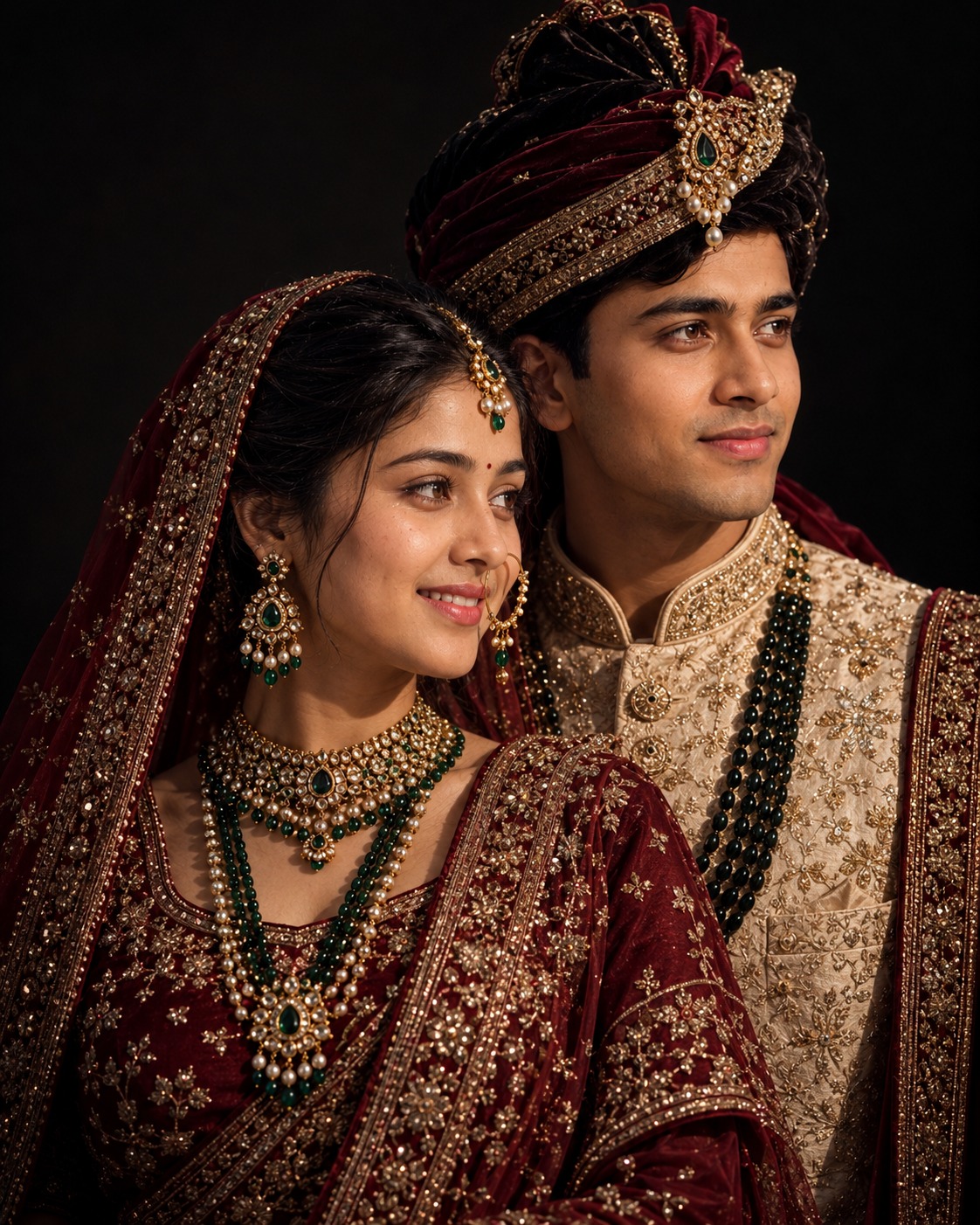
Cinematic Bridal Portrait
The Cinematic Bridal Portrait concept presents an elegant Indian bride and groom in a dramatic, fine-art wedding photography style. Its defining feature is the combination of traditional wedding clothing, detailed jewelry, carefully arranged facial angles, and deep cinematic shadows. Rather than relying on a bright or heavily decorated environment, the composition uses a nearly black background to draw attention toward the couple. This approach creates a sophisticated atmosphere in which the richness of the clothing and the emotional presence of the subjects become the main visual attractions.
The bride stands in the left foreground, while the groom is positioned immediately behind her on the right. Their close arrangement creates depth without requiring physical contact or an exaggerated romantic gesture. Both subjects stand upright and turn their faces toward the right side of the frame, looking beyond the camera. Their shared gaze gives the portrait a composed, thoughtful character. The bride’s face approaches a side profile, while the groom’s face remains more open in a three-quarter view. This difference creates visual variety while maintaining a unified direction of attention.
The bride’s expression is restrained and graceful. Her eyes remain open, her chin stays nearly level, and her head turns naturally toward the right. The composition emphasizes the outline of her face, the decorative details near her forehead, and the jewelry surrounding her cheeks and neck. Because her face sits in the foreground, it becomes one of the first details viewers notice. The groom’s face appears beside and behind hers, establishing a clear visual hierarchy without diminishing his presence.
The groom maintains an upright head position and a composed expression. His three-quarter facial angle allows the viewer to see more of his facial structure than the bride’s profile. His beard and mustache contribute to the detailed, traditional appearance of the portrait. The placement of his head beside the bride’s creates a strong relationship between the two figures, while their shared rightward gaze makes them appear connected through a common moment rather than through a direct interaction.
The bride’s clothing is built around deep burgundy and maroon tones. These rich colors establish the central visual identity of the portrait and work especially well against the nearly black background. Dense metallic embroidery covers the fabric, creating intricate patterns that catch the available light. The ornate neckline adds detail around the upper chest, while the diagonally draped veil creates a strong line across the shoulder and chest. The veil also frames the bride’s head and connects the embroidery around her face with the broader garment.
The fabric’s dark red tones are important to the overall atmosphere. Instead of appearing bright or highly saturated, the maroon and burgundy shades retain a subdued richness. Bronze and antique-gold reflections reveal the embroidery without making the material look overly shiny. The combination of dark fabric and selective highlights creates the impression of layered, luxurious textiles. Fine beadwork and metallic thread details give the clothing depth, helping it remain visually interesting even where the surrounding shadows are strong.
The bride’s jewelry provides another major layer of visual detail. A large traditional nose ring forms a distinctive focal point near her profile. Its delicate chain extends toward the ear, creating a fine decorative line across the cheek. The forehead ornament adds detail near the hairline, while a small bindi creates a subtle point of color. Elaborate earrings frame the face, and a layered metallic necklace draws attention toward the neckline. Dark-green beads and emerald-colored stones introduce a controlled contrast against the surrounding gold and maroon tones.
These accessories work together to create a coordinated traditional bridal appearance. The metallic surfaces reflect small amounts of warm light, while the green stones add depth and color variation. The nose-ring chain, layered necklace, and forehead ornament are especially important because they help define the bride’s profile and frame. Their scale and placement contribute to the overall balance of the portrait, ensuring that the jewelry complements rather than overwhelms the facial features.
The groom’s outfit provides a complementary visual counterpoint. His cream and champagne-gold sherwani features dense floral embroidery, intricate metallic threadwork, and a richly decorated standing collar. The lighter fabric creates contrast with the bride’s darker clothing, allowing both outfits to remain distinct. The embroidery gives the sherwani a textured appearance, while the high collar adds structure around the neck and lower face. Dark bead necklaces extend across the upper chest, introducing darker details that connect with the turban and the surrounding shadows.
The groom’s turban is a defining element of his appearance. It combines black and deep-maroon fabric with a tall, structured silhouette. Layered folds give the material dimension, while metallic trim introduces narrow reflective lines. The burgundy sections coordinate with the bride’s outfit, and the jeweled front ornament provides a concentrated point of detail near the upper part of the composition. These elements create a formal, traditional appearance that complements the sherwani and the bride’s elaborate accessories.
Lighting is one of the most important aspects of this creative concept. The portrait uses dramatic low-key illumination from the upper-left or front-left direction. Light falls selectively across portions of the faces, jewelry, embroidery, and turban, while the opposite contours merge into deep shadow. This contrast creates a sculpted appearance without requiring exaggerated highlights or artificial glow. The visible facial details remain expressive, while the dark areas preserve the atmosphere and mystery of the composition.
The chiaroscuro approach also enhances material quality. Metallic embroidery catches narrow highlights, gemstone surfaces reflect small points of light, and the sherwani’s raised threadwork becomes more visible where illumination falls across it. The bride’s jewelry appears detailed because the light reveals its contours and reflective surfaces. Meanwhile, the dark veil and turban retain their depth instead of becoming flat, uniformly illuminated shapes.
The color palette is carefully restrained. Deep blacks form the background, while burgundy and maroon establish the bridal color scheme. Champagne gold, muted cream, antique metallic tones, bronze highlights, and dark emerald accents complete the palette. This controlled combination creates a luxurious atmosphere without relying on excessive saturation. The warm highlights provide visual richness, while the deep shadows keep the overall composition serious, elegant, and cinematic.
The background remains almost completely black, with only extremely subtle dark-brown tonal variation. Its large areas of negative space are especially noticeable in the upper-left region. This empty space balances the subjects and makes their illuminated faces and elaborate clothing appear more prominent. Unlike portraits that use smoke, flowers, scenery, or decorative architecture, this concept relies on simplicity. The absence of additional elements allows the viewer to focus on the couple’s profiles, jewelry, and clothing.
The vertical three-to-four composition uses a tight medium-close crop. The bride occupies the left foreground, and the groom remains immediately behind her on the right. Limited headroom above the turban keeps the subjects visually connected to the upper frame, while the crop excludes unnecessary body details. The eye-level viewpoint creates a natural perspective, and the overlap between the figures establishes depth. Their faces, clothing, and accessories form the main visual structure.
Texture and realistic rendering are equally important. Natural skin texture, defined eyebrows, fine beard hairs, realistic facial contours, delicate jewelry chains, and intricate embroidery contribute to the photographic quality. The face and illuminated accessories remain clear, while the darker areas retain subdued details. This balance creates a polished fine-art appearance without depending on excessive skin smoothing or artificial beautification.
A key strength of the concept is the consistency of its visual elements. The shared rightward gaze, layered subject placement, dark background, warm highlights, and traditional outfits all support the same mood. The portrait’s character depends on preserving the relationship between these elements. A change in head angle or lighting direction could alter the visual balance, while brighter colors or decorative background effects could weaken the restrained atmosphere.
This style can be useful for wedding album covers, bridal photography portfolios, engagement portraits, anniversary artwork, personalized wedding keepsakes, and sophisticated social media posts. It also provides inspiration for designers creating wedding invitations, editorial layouts, portrait collections, and culturally themed visual projects. The combination of traditional clothing and dramatic lighting makes the concept suitable for audiences who appreciate both Indian wedding heritage and modern fine-art photography.
The overall design communicates elegance through contrast rather than excess. Rich fabrics provide texture, jewelry introduces intricate detail, and the black background creates visual focus. The couple’s composed expressions and shared gaze contribute a dignified atmosphere. Every major element supports the same creative direction, producing a portrait concept that feels luxurious, traditional, and timeless.
[[[
REFERENCE ANALYSIS
- Composition: Vertical 3:4 portrait, tight medium-close framing. Bride in the left foreground, groom immediately behind her on the right.
- Pose: Both stand upright, heads turned toward the right, gazing off-camera. The bride’s face is closer to profile; the groom’s face is a more open three-quarter view.
- Bride’s outfit: Deep burgundy/maroon bridal attire with dense metallic embroidery, an ornate neckline, and a diagonally draped embroidered veil.
- Bride’s jewelry: Large traditional nose ring with chain, decorative forehead ornament, layered metallic necklace with dark-green accents, earrings, and a small bindi.
- Groom’s outfit: Cream-gold embroidered sherwani, richly decorated standing collar, dark bead necklaces, and a tall black-maroon turban with metallic embellishments.
- Lighting: Dramatic low-key chiaroscuro lighting from the upper-left/front-left. Selective illumination across the faces and jewelry, with deep shadows covering portions of the subjects.
- Color grading: Deep blacks, dark burgundy, muted maroon, champagne gold, bronze highlights, and subtle emerald-green accents.
- Background: Almost completely black, with extensive negative space. No smoke, haze, or decorative background elements.
- Style: Cinematic fine-art Indian wedding photography, high contrast, detailed embroidery, realistic skin texture, and restrained warm highlights.
- Critical details: Preserve the shared rightward gaze, layered subject placement, dark atmosphere, original clothing, jewelry, turban, crop, and directional lighting.
MASTER PROMPT
Use supplied ref image as master blueprint. Replace only ref characters’ faces with the supplied user identities. COMPLETELY IGNORE the user’s original photo pose and body; force the user into the exact body pose, hand placement, and posture of the reference character. Maintain exact scale, proportion, crop, visibility.
Maintain exact 1000% reference preservation. Preserve all visual information, including darkness, grading, mood, lighting, shadows, contrast, saturation, composition, environment, objects, background, text, props, rendering, outfit (exact style, color, and condition), reference pose (exact body position, hand placement, and expression), vibe (exact emotional tone), and natural human anatomy (correct head-to-body ratio, proportional hands and limbs, no distortions). Output must look IDENTICAL to the reference except face swap. Do NOT brighten, enhance, modify, change outfit, reference pose, or vibe.
IDENTITY REPLACEMENT: Use the supplied user’s face as the identity source for the corresponding reference subject. Preserve the user’s recognizable facial features, facial structure, eye shape, nose, lips, skin tone, and natural proportions. Adapt the face to the reference character’s exact head rotation, gaze, expression, lighting, and shadows. Do not transfer the user’s original body, clothing, posture, or background. Integrate the replacement naturally into the original photograph without enlarging the head or altering the body.
EXACT POSE AND SUBJECT PLACEMENT: Reproduce the bride in the left foreground and the groom close behind her on the right. Both subjects remain upright with their heads turned toward the right side of the frame, looking off-camera. Preserve the bride’s three-quarter profile approaching a side profile, nearly level chin, open eyes, and restrained expression. Preserve the groom’s more open three-quarter facial angle, upright head, composed expression, and rightward gaze. Keep the bride’s head overlapping the groom’s chest area, with the groom’s face immediately beside and behind her head. Do not introduce forehead contact, a romantic embrace, new hand positions, or a different head angle. Keep hands and lower bodies outside the original crop.
BRIDAL OUTFIT LOCK: Preserve the exact deep maroon and burgundy bridal garment, dark veil or head covering, densely packed metallic embroidery, intricate beadwork, ornate neckline, and heavily decorated diagonal drape across the shoulder and chest. Preserve the forehead ornament, small bindi, large circular traditional nose ring with dangling details and chain extending toward the ear, elaborate earrings, layered metallic necklace, and dark emerald-green beads or stones. Keep the original jewelry scale, placement, reflections, and fine details. Do not recolor, simplify, remove, or redesign the clothing or accessories.
GROOM OUTFIT LOCK: Preserve the exact cream and champagne-gold sherwani with dense floral embroidery, elaborate metallic threadwork, raised-looking fabric details, and high decorated collar. Retain the layered dark bead necklaces across the upper chest. Preserve the tall, structured black and deep-maroon turban, burgundy fabric section, layered folds, ornate reflective gold-toned trim, and jeweled front ornament. Maintain the original beard and mustache appearance except for the requested facial identity replacement. Do not change the garment’s color, pattern, condition, or silhouette.
LIGHTING LOCK — LOW-KEY CHIAROSCURO: Preserve the reference’s dramatic directional lighting, coming from the upper-left or front-left. Illuminate only the same portions of the faces, forehead, nose bridges, cheeks, lips, beard edges, jewelry, and embroidered fabric. Allow the opposite facial contours, dark veil, turban, and parts of the clothing to merge into deep shadow. Maintain minimal fill light, strong shadow falloff, deep crushed blacks, restrained rim highlights, and small realistic metallic reflections. The replacement faces must inherit the same lighting direction, exposure, shadow depth, and warm highlights. Never independently brighten the faces or lift the shadows.
COLOR AND TONAL LOCK: Preserve the original near-black background, deep burgundy and maroon fabrics, muted cream-gold sherwani, warm bronze highlights, antique metallic jewelry, and dark-green gemstone accents. Retain high contrast, restrained saturation, warm reddish-brown undertones, and smooth cinematic highlight roll-off. Do not introduce vivid colors, excessive vibrance, orange grading, artificial glow, automatic exposure correction, or a brighter overall image.
BACKGROUND AND FRAMING LOCK: Keep the nearly uniform black background with extremely subtle dark-brown tonal variation and extensive negative space, particularly in the upper-left area. Maintain the original vertical 3:4 composition, close medium portrait crop, natural three-quarter perspective, eye-level viewpoint, and limited headroom above the groom’s turban. Preserve the bride’s foreground placement, the groom’s position behind her, and the original overlap of their silhouettes. Do not zoom, recenter, expand the canvas, change the camera angle, reveal hidden body parts, or add scenery. Preserve the small existing white photographer’s logo in the upper-left corner if reproducing the reference’s graphic overlay; do not invent new logos or text.
TEXTURE AND RENDERING: Maintain natural skin texture, fine beard hairs, defined eyebrows, realistic facial contours, detailed bridal nose-ring chain, intricate layered necklaces, metallic filigree, gemstone reflections, turban embellishments, and fine embroidered threadwork. Keep facial features and illuminated jewelry sharp while preserving the original darkness and subdued details in the shadows. Retain the polished, dramatic, fine-art Indian wedding editorial aesthetic without excessive retouching or style changes.
FINAL REQUIREMENT: The final image must look identical to the reference photograph except for the requested face replacement. Preserve the exact two-person arrangement, rightward gaze, upright posture, clothing, jewelry, turban, low-key lighting, nearly black background, tonal grading, natural anatomy, scale, and crop. Do not add smoke, haze, flowers, props, furniture, architecture, extra people, or any new visual elements. Only replace the requested facial identity while maintaining the reference’s original visual language.
EDITABLE VARIABLES
- [USER IDENTITY]: Supplied user face; preserve unique facial traits and natural proportions.
- [OUTFIT]: Exact deep-maroon bridal outfit and cream-gold embroidered sherwani, including original jewelry and turban.
- [TEXT]: Preserve the existing upper-left photographer’s logo if required; add no new text.
- [OBJECT CHANGE]: None.
- [POSE CHANGE]: None. Preserve the original upright posture and shared rightward gaze.
- [ADDITIONAL EDIT]: Face replacement only.
NEGATIVE PROMPT
identity loss, wrong face, original character face, incorrect identity, user’s original body, user’s original pose, wrong head angle, forward-facing gaze, looking at camera, changed gaze direction, forehead contact, romantic embrace, altered subject positions, changed crop, zoomed image, recentered composition, expanded canvas, enlarged head, tiny hands, disproportionate limbs, deformed anatomy, distorted face, changed outfit, different clothing colors, bright red bridal outfit, changed embroidery, missing jewelry,
altered nose ring, missing nose-ring chain, missing necklace, redesigned turban, missing turban ornament, changed beard style, brighter image, lifted shadows, gray background, visible smoke, fog, haze, artificial glow, orange color grading, oversaturation, excessive vibrance, changed lighting direction, flat lighting, frontal fill light, lost deep blacks, reduced contrast, excessive skin smoothing, plastic skin, unwanted beautification,
altered facial proportions, extra people, removed people, flowers, furniture, architecture, new props, extra text, new logos, watermark, altered photographer logo, changed visual style, polished bright commercial look, cinematic blue-orange grading, reconstructed hidden body parts, different camera angle, changed subject scale, altered atmosphere, different composition. ]]]