
Teal Double Exposure
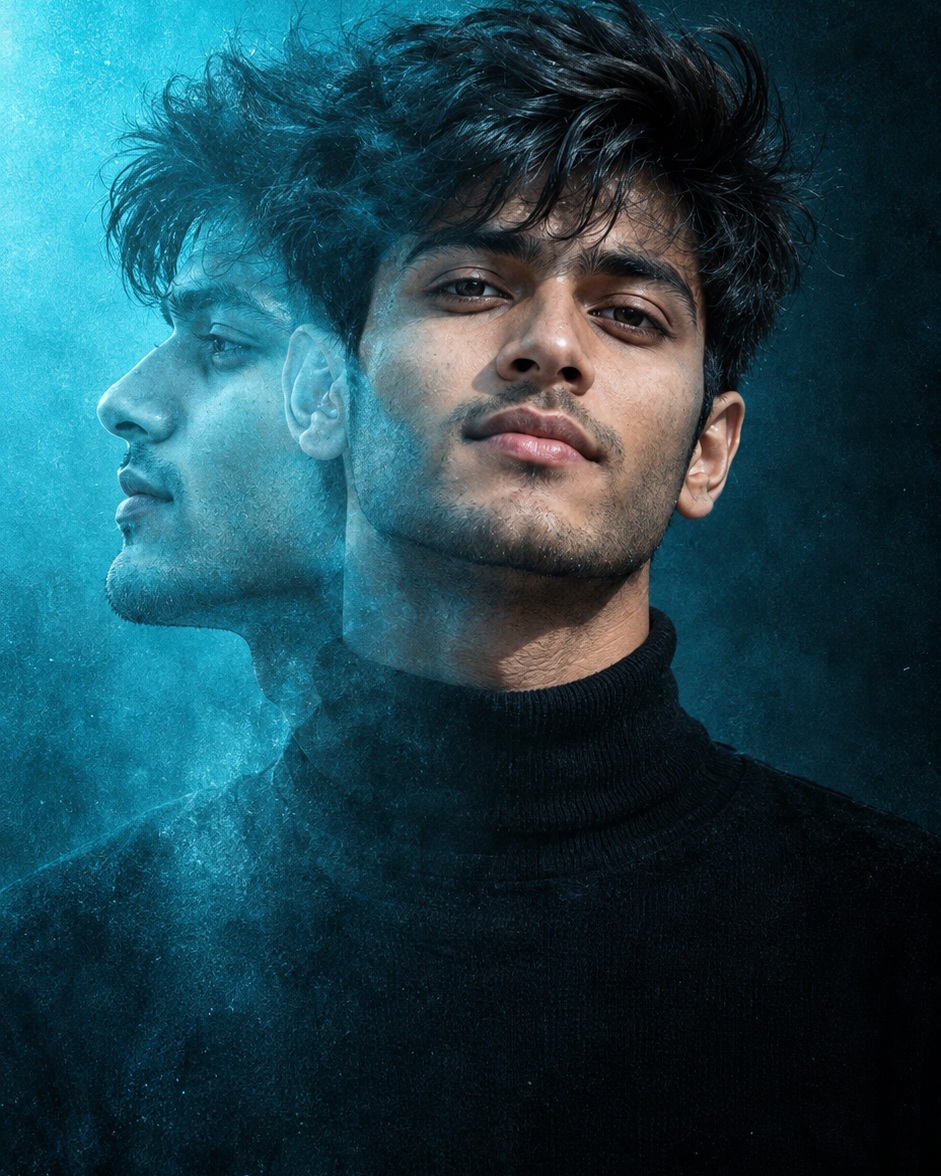
The Teal Double Exposure concept explores a distinctive form of cinematic fine-art photography in which two views of the same person become part of one expressive portrait. The main subject is a young adult man facing the camera directly, while a translucent side profile overlaps the left portion of his face. This combination creates a dreamlike visual effect that feels introspective, artistic, and emotionally layered. Instead of depending on a complicated setting, the composition uses facial expression, light, texture, and color to communicate its mood.
The frontal face serves as the primary focal point. The subject’s head remains upright, his shoulders relaxed, and his torso facing forward. His eyes look directly toward the viewer, while his closed lips and neutral-serious expression create a quiet sense of confidence and reflection. The face is intended to remain the clearest and most recognizable element of the composition. This visual priority allows the viewer to connect with the subject before noticing the more experimental overlapping profile.
The hairstyle contributes significantly to the portrait’s character. Thick black hair is lifted and brushed loosely backward, with shorter sides and a textured crown. Individual strands appear naturally irregular rather than perfectly arranged. Subtle cyan highlights follow parts of the upper hair silhouette, helping the dark hair stand out against the cooler background. Slightly softened edges support the analog photographic atmosphere without removing the natural texture of the hairstyle.
The signature element of the Teal Double Exposure style is the semi-transparent, left-facing profile layered across the left side of the frontal portrait. This second facial view belongs to the same subject and is not intended to resemble another person standing nearby. The profile has a recognizable forehead, nose, lips, chin, and jawline, creating a distinct silhouette that points toward the left edge of the frame.
The secondary profile overlaps the main face rather than sitting independently beside it. Its contours blend with the frontal features and the surrounding blue atmosphere. The profile is softer and less defined than the primary face, allowing the two perspectives to coexist without competing equally for attention. This visual layering suggests memory, introspection, identity, and the experience of seeing a person from more than one perspective.
Transparency is important to the effect. If the secondary profile is too opaque, it can obscure the main facial features and make the image appear like a poorly aligned composite. If it is too faint, its silhouette may become difficult to recognize. The intended balance allows the nose, lips, forehead, and chin to remain visible while letting the cheek, eye area, and surrounding contours merge softly into the main portrait.
Lighting gives the composition its distinctive atmosphere. Soft cyan-blue illumination comes from the front and upper-left, gently revealing the forehead, nose bridge, and upper cheeks. The deeper areas around the eye sockets, sides of the nose, lower cheeks, jaw, and neck transition into teal and blue-green shadows. This lighting creates depth without making the face look harshly illuminated or artificially glossy.
The black turtleneck becomes part of the darker lower frame. Its high collar and plain matte fabric keep the clothing understated, allowing the face and overlapping profile to remain the dominant elements. As the torso fades toward the bottom edge, the nearly black clothing blends naturally with the deeper teal shadows. This transition reinforces the feeling that the subject is emerging from a dim, atmospheric environment.
The color palette centers on cyan, teal-blue, cool gray, and deep black. Cyan highlights bring a subtle glow to selected facial planes and hair strands, while darker teal tones provide visual depth. The restrained monochromatic treatment keeps the composition cohesive. Warm orange, yellow, and magenta tones are avoided so that the image retains its cool, melancholic character.
The background is a softly textured studio surface that appears brighter toward the left and upper-left and darker toward the right and lower corners. This gradual tonal transition complements the direction of the light and creates a natural setting for the overlapping profile. The absence of furniture, recognizable scenery, props, and decorative objects prevents unnecessary distractions.
Analog texture plays an essential role in the visual finish. Fine-to-moderately heavy film grain introduces an organic quality across the background, skin, and shadowed regions. Subtle luminance noise makes the image feel less digitally polished, while diffuse haze and gentle highlight glow soften the atmosphere. The goal is to preserve a believable photographic appearance while allowing the composition to feel slightly dreamlike and imperfect.
Soft focus is applied selectively rather than uniformly. The frontal facial features remain legible, particularly around the eyes, while the secondary profile receives softer edges and reduced definition. This distinction reinforces the hierarchy between the two facial layers. A restrained vignette darkens the corners and lower frame, guiding attention toward the central face and the overlapping silhouette.
The vertical 9:16 composition is suitable for mobile-oriented portrait presentations. The subject sits near the center, slightly right of the visual midpoint, leaving space for the profile to extend across the left portion of the frame. Moderate headroom prevents the image from feeling cramped, while the shoulders slope naturally toward the bottom corners. The torso gradually fades into the dark lower edge, creating a balanced portrait silhouette.
The Teal Double Exposure concept can be used for creative profile pictures, cinematic social media artwork, music-inspired visuals, fine-art photography collections, personal branding, and experimental editorial projects. Its cool palette and layered composition help establish a recognizable creative identity. The style is especially useful when the goal is to communicate thoughtfulness, solitude, memory, emotional depth, or a mysterious atmosphere without adding an elaborate setting.
Another important benefit is the composition’s visual hierarchy. The frontal face attracts attention first, the translucent profile becomes apparent next, and the viewer then notices the grain, haze, and subtle color transitions. Every element supports the same artistic direction. This consistency makes the portrait memorable while keeping the overall design restrained.
Ultimately, the concept brings together realistic portraiture, surreal photographic layering, and analog-inspired finishing. The direct gaze provides a human connection, the side profile introduces an additional visual perspective, and the cyan-teal lighting creates a unified atmosphere. The black hairstyle, high-neck clothing, textured backdrop, and deep shadows complete the composition. Together, these details create an expressive fine-art portrait style that balances recognizable facial features with experimental visual storytelling.
[[[
A. REFERENCE ANALYSIS
- Camera: Eye-level, straight-on frontal portrait, vertical 9:16 framing, chest-up.
- Main pose: Head upright, shoulders relaxed, torso facing forward.
- Face and expression: Direct gaze, closed lips, neutral-serious expression.
- Hair: Thick black hair, lifted and brushed loosely backward, textured crown with shorter sides.
- Double exposure: A semi-transparent, left-facing side profile overlaps the left side of the frontal face. The profile’s nose, lips, forehead, and chin remain recognizable.
- Outfit: Plain black high-neck turtleneck, blending into the dark lower frame.
- Lighting: Soft cyan-blue illumination from the front and upper-left, with deep teal shadows.
- Color grading: Cool teal and cyan monochromatic palette, muted highlights, dark blacks.
- Texture: Noticeable analog film grain, soft focus, diffuse haze, subtle glow, and dark corner vignetting.
- Background: Plain, subtly textured teal-blue backdrop, brighter on the left and darker toward the right.
- Mood: Dreamlike, introspective, melancholic, experimental fine-art photography.
B. MASTER PROMPT
Double Exposure Portrait Photography + Cinematic Fine-Art Photography + Surrealist Photographic Composition + Experimental Editorial Portraiture + Analog Film Emulation.
Create a realistic, vertical 9:16 cinematic portrait of a young adult man wearing a plain black turtleneck against a textured teal-blue background. Use the provided identity reference for the subject’s recognizable facial features, preserving his natural face shape, eyes, eyebrows, nose, lips, jawline, skin tone, and distinctive characteristics.
CAMERA AND COMPOSITION: Eye-level camera, straight-on frontal perspective, natural facial proportions, chest-up portrait framing. Center the main face slightly right of the composition’s visual midpoint, with the top of the hair approximately 14% below the upper edge. Keep moderate negative space above the head and along both sides. The shoulders slope outward and downward, while the torso fades into the bottom edge. Maintain a natural portrait perspective without wide-angle distortion.
PRIMARY FACE AND POSE: The main subject faces directly toward the camera with an upright head, neutral-to-slightly-lowered chin, relaxed shoulders, and a still, frontal posture. His eyes look toward the viewer, and his lips remain closed. Preserve a quiet, serious, introspective expression without exaggeration. The primary face is the clearest and most visually dominant facial layer.
HAIRSTYLE: Thick, dense black hair with shorter sides and a lifted, tousled top brushed loosely upward and backward. Include naturally irregular strands, a softly defined hairline, subtle cyan highlights along the upper silhouette, and slightly diffused edges consistent with analog film photography.
SIGNATURE DOUBLE-EXPOSURE EFFECT: Superimpose a semi-transparent, left-facing profile of the same subject over the left side of the primary portrait. Place the secondary profile approximately 14–49% across the frame width, overlapping the main face rather than appearing as a separate person beside him. Its forehead begins near the left side of the primary hairline; the projecting nose points toward the left frame edge; the lips, chin, and jaw descend toward the lower-left; and the neck fades into the blue atmosphere.
Blend the profile into the primary face and background with approximately 35–50% visual opacity as a starting estimate. Preserve a recognizable profile silhouette while allowing the eyes, cheek, forehead, and mouth to merge softly with the frontal face. The profile must remain softer, more translucent, and less defined than the main portrait. Create an intentional layered photographic ghost image, not a sharp duplicate, mirrored face, or two separate people.
LIGHTING AND SHADOWS: Use soft, diffused cyan and teal-blue illumination from the front and upper-left. Gently illuminate the forehead, nose bridge, and upper cheeks while maintaining deeper blue-green shadows around the eye sockets, sides of the nose, lower cheeks, jaw, and neck. Allow faint cool highlights on the hair and the overlapping profile. The lower face and black turtleneck should merge gradually into dark teal and near-black shadows. Maintain subdued exposure and smooth tonal transitions without flattening the image.
COLOR GRADING: Apply a restrained monochromatic teal-cyan grade, with muted cyan highlights, deep teal-blue shadows, cool gray midtones, and almost-black clothing. Avoid warm orange, yellow, or magenta tones. Preserve a matte tonal response with gentle highlight roll-off and moderate facial contrast against a darker background.
ATMOSPHERE AND TEXTURE: Add subtle atmospheric haze, a soft smoky diffusion concentrated around the left profile and lower-left background, gentle highlight glow, fine-to-moderately heavy organic analog film grain, and visible luminance noise across the background and shadows. Use intentional soft focus and slightly reduced edge clarity, especially on the translucent profile. Keep the main facial features legible without clinical digital sharpness. Add a restrained vignette around the corners and lower frame.
BACKGROUND: A plain, softly textured teal-blue studio backdrop, brighter cyan toward the left and upper-left, transitioning into deeper teal toward the right and lower corners. No recognizable scenery, furniture, props, text, or decorative elements.
FINAL VISUAL PRIORITIES: The frontal face must remain dominant and centered. The translucent left-facing profile must overlap the left half of the primary face with a clearly readable nose, lips, forehead, and chin. Preserve the lifted black hairstyle, black high-neck clothing, cool cyan-teal palette, dark exposure, grainy analog texture, atmospheric softness, and vertical 9:16 composition. The final result should feel like an atmospheric, imperfect analog photograph with a deliberate double-exposure effect, not a glossy commercial portrait or a digitally sharpened composite.
C. EDITABLE VARIABLES
| Variable | Current value |
|---|---|
| [USER IDENTITY] | Use supplied identity photo if available |
| [CAMERA ANGLE] | Frontal, eye-level |
| [POSE & BODY GEOMETRY] | Upright, shoulders relaxed |
| [FACE DIRECTION & EXPRESSION] | Direct gaze, closed lips, serious |
| [CAMERA & PERSPECTIVE] | Chest-up, natural portrait perspective |
| [OUTFIT & ACCESSORIES] | Black turtleneck, no accessories |
| [LIGHTING & SHADOWS] | Soft cyan light, deep teal shadows |
| [COLOR & MOOD] | Teal-cyan, dark, introspective |
| [TEXTURE & EFFECTS] | Double exposure, film grain, haze, soft focus |
| [BACKGROUND & OBJECTS] | Textured teal-blue background |
| [ASPECT RATIO] | 9:16 vertical |
| [OBJECT CHANGE] | None |
| [POSE CHANGE] | None; preserve frontal pose |
| [ADDITIONAL EDITS] | Translucent profile overlay |
| [NEGATIVE CONSTRAINTS] | No extra people, warm grading, excessive sharpness, or added objects |
D. NEGATIVE PROMPT
Wrong identity, mixed facial identities, different person in profile, extra person beside subject, three separate faces, duplicate sharp face, mirrored face, incorrectly positioned profile, profile facing right, profile outside the main composition, missing double exposure, overly opaque overlay, excessively transparent profile, misaligned facial layers, distorted nose, deformed lips, incorrect jawline, asymmetrical eyes, exaggerated facial proportions, wrong hairstyle, slicked-back hair, changed outfit, visible logos, jewelry, bright clothing,
altered pose, tilted camera, high-angle view, low-angle view, wide-angle distortion, horizontal crop, incorrect aspect ratio, bright exposure, warm orange grading, yellow highlights, magenta lighting, oversaturated colors, flat shadows, crushed facial details, glossy skin, beauty retouching, plastic skin, excessive sharpening, clean digital appearance, absent film grain, excessive motion blur, strong lens flare, harsh artificial glow, excessive smoke, recognizable background objects, scenery, text, watermarks, decorative graphics, extra limbs, invented anatomy, unrequested changes.
E. RECONSTRUCTION BLUEPRINT
A vertical 9:16 fine-art portrait shows a young man in a black high-neck garment, centered against a softly textured teal-blue background. He faces the camera directly with a quiet, serious expression, closed lips, and thick black hair brushed upward and loosely backward. A second, translucent image of his left-facing profile is layered over the left half of his frontal face. The profile projects toward the left edge, revealing a distinct forehead, nose, lips, chin, and jawline,
while its contours blend into the main face and the surrounding blue atmosphere. Soft cyan light illuminates the upper facial planes, while the eye sockets, lower cheeks, jaw, neck, and clothing fall into deep blue-green shadow. The background is brighter on the left and darker toward the right. Fine analog grain, subtle haze, diffused highlights, soft edges, matte contrast, and a restrained vignette create a dreamlike, melancholic photographic atmosphere. The frontal face remains the dominant layer, with the secondary profile providing the defining surreal visual effect.
F. LIMITATIONS
- The exact opacity and positioning of the profile are estimates; different image models may interpret the overlap differently.
- The reference does not establish the original camera, lens, lighting equipment, or compositing method.
- Heavy grain, haze, and facial overlap may reduce identity fidelity. If recognizable identity is essential, use a clear identity reference and preserve the main face as the highest-priority layer.
- The prompt describes the target appearance but cannot guarantee pixel-perfect reproduction.
]]]