
Dark Red Portrait
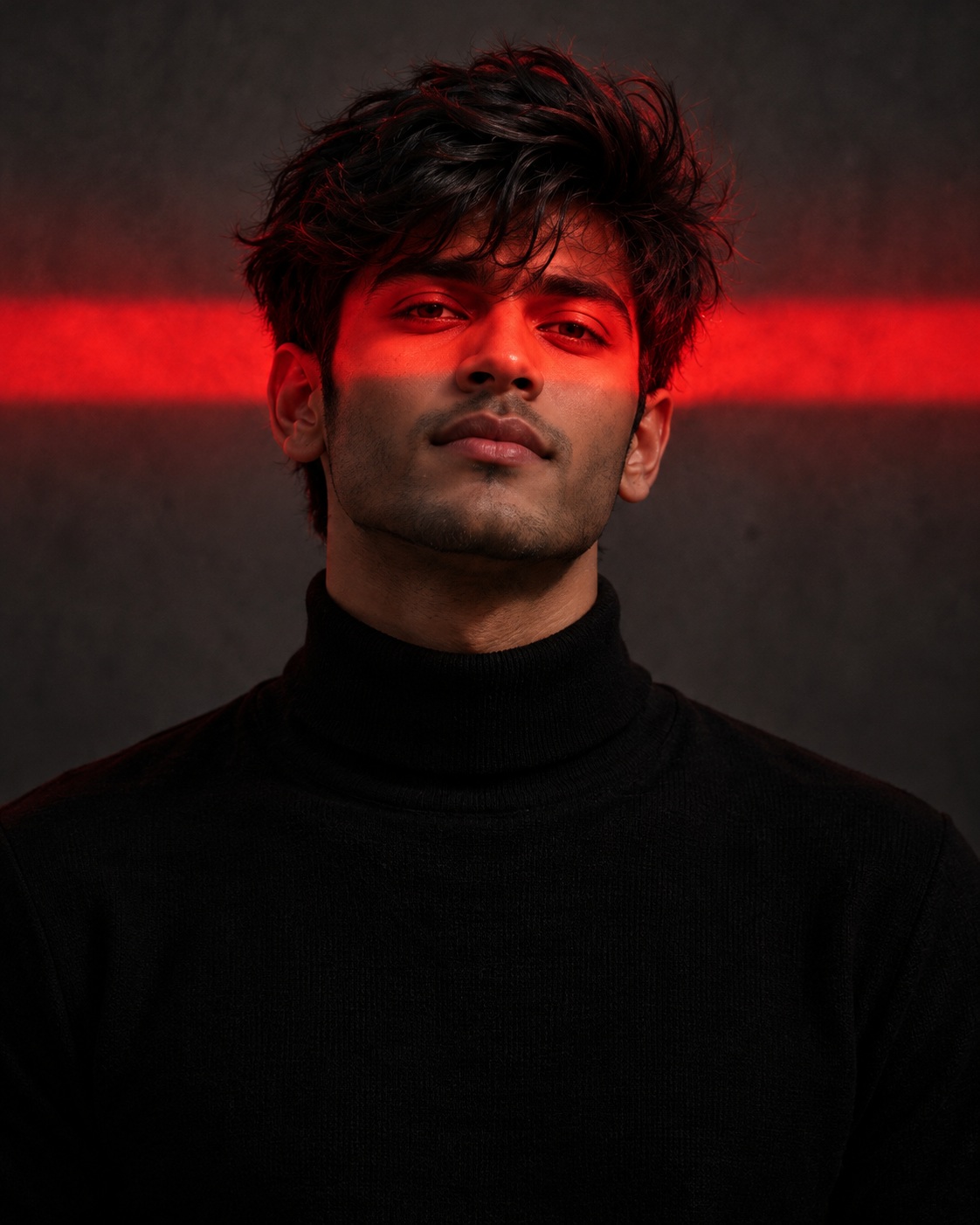
The Dark Red Portrait concept presents a powerful approach to cinematic photography in which a simple human portrait becomes visually striking through controlled lighting, deep shadows, and a carefully balanced color palette. The main subject is a young adult man facing the camera directly. His expression is serious and composed, creating an atmosphere of mystery, confidence, and quiet intensity. Rather than relying on elaborate scenery or decorative elements, the concept uses facial expression, hair texture, clothing, and a distinctive red light effect to establish its visual identity.
The subject’s face is the central point of attention. His head remains upright, with the chin positioned naturally and the shoulders aligned toward the camera. Direct eye contact creates an immediate connection with the viewer, while the closed lips and restrained expression preserve the serious editorial character. The face does not communicate exaggerated anger or theatrical emotion. Instead, the controlled expression suggests introspection, strength, and a cinematic sense of tension. This understated approach makes the portrait suitable for contemporary fashion-inspired visuals, personal profile artwork, and dramatic social media presentations.
Hair is one of the most recognizable details in this composition. The subject has thick, voluminous black hair with a naturally tousled appearance. Its irregular crown, loose strands, and slightly wavy texture create a strong silhouette against the gray background. A long fringe falls diagonally across the forehead and partially obscures the eye on the viewer’s right. This asymmetrical detail gives the face additional character and creates a visual relationship between the hair and the horizontal red illumination. The hairstyle feels textured and natural rather than carefully arranged or glossy.
The clothing is deliberately simple. A fitted black turtleneck covers the neck and upper torso, with a high collar that reaches the base of the jaw. Its matte finish prevents unnecessary reflections from competing with the facial lighting. The absence of logos, patterns, jewelry, and decorative accessories keeps the overall appearance clean. The dark clothing also blends into the lower portion of the composition, allowing the face and illuminated eye area to remain the primary focal points.
The signature feature of the Dark Red Portrait concept is a vivid crimson-red band crossing the frame horizontally at eye level. The light stretches from one side of the image to the other, creating a strong graphic line through the eyebrows, eyes, and upper cheeks. Its saturated red center and subtly softened edges resemble a controlled cinematic projection. The effect is more than a decorative color overlay because the illumination also influences the surrounding hair and the wall behind the subject. This relationship between subject and background helps the red band feel integrated into the photographic environment.
The upper and lower portions of the face have intentionally different levels of brightness. The forehead, eyes, eyebrows, and upper cheeks receive the strongest red illumination, while the nose, mouth, chin, jawline, and lower cheeks remain deeply shadowed. Small amounts of natural skin detail can still be perceived within the darkness, but the lower face does not become evenly illuminated. This contrast creates a dramatic division across the portrait and gives the composition its characteristic neo-noir mood.
Lighting plays a central role in the visual storytelling. The image uses high-contrast chiaroscuro, a photographic approach that emphasizes the relationship between illuminated surfaces and deep shadows. Instead of lighting every facial feature equally, the composition concentrates attention on a narrow horizontal area. The restrained highlights preserve the natural shape of the face, while the dark regions create depth and a sense of visual mystery. The controlled exposure also prevents the black clothing from becoming an unnecessarily bright element.
The background is a plain charcoal-gray indoor wall with subtle horizontal tonal variation. It contains no furniture, decorations, scenery, or distracting objects. This simplicity is important because it gives the red light band room to extend across the entire frame. The slight separation between gray tones prevents the background from appearing completely flat, while its subdued appearance maintains the portrait’s dark editorial character. The wall supports the composition without competing with the subject.
Color is used selectively throughout the scene. Crimson red provides the dominant accent, charcoal gray establishes the background, and deep black defines the clothing and lower shadows. Natural skin undertones remain subdued beneath the colored illumination. The overall grading avoids a bright, colorful appearance and instead favors restrained saturation, controlled highlights, and a low-key photographic finish. These choices help the portrait feel contemporary and visually cohesive.
The framing is another important part of the concept. The portrait uses a vertical 4:5 aspect ratio with a tight chest-up composition. The head and shoulders sit near the center, with moderate space above the hair and the shoulders extending toward the lower corners. The torso continues beyond the bottom edge, creating a substantial dark area beneath the face. This arrangement works well for portrait posts, profile artwork, editorial layouts, and vertical creative presentations.
The camera perspective is intended to feel natural rather than exaggerated. An estimated 50–85 mm full-frame-equivalent focal length communicates the desired portrait perspective, although the exact lens cannot be established from the visual description alone. The eye-level viewpoint maintains a direct relationship between the subject and viewer. Facial proportions remain realistic, and the framing avoids the distortion associated with an excessively wide-angle perspective.
Texture is equally important to the finished appearance. Natural skin detail, visible hair strands, and crisp focus around the visible eye help maintain photographic realism. The image favors controlled sharpness instead of artificial enhancement. Excessive smoothing, heavy beauty retouching, strong lens flare, exaggerated glow, and unnecessary grain would weaken the carefully restrained aesthetic. The goal is to preserve a believable human face within an intentionally dramatic lighting environment.
The Dark Red Portrait style can serve several creative purposes. It works particularly well for dramatic profile pictures, fashion editorials, music-inspired artwork, personal branding, cinematic posters, and dark-themed social media graphics. Its simple background also makes the composition easy to incorporate into larger layouts when additional typography or graphic elements are desired separately. Because the underlying design is minimal, the portrait can communicate a strong visual identity without requiring a complex scene.
Another benefit of this concept is its clear visual hierarchy. The viewer notices the face first, the crimson eye-level band second, and the dark silhouette and gray background afterward. Every major element supports the same mood rather than introducing unrelated visual details. This consistency makes the design memorable and helps it stand apart from ordinary studio portraits.
The overall concept combines realistic portrait photography with a restrained neo-noir editorial sensibility. Its strongest qualities are direct eye contact, textured black hair, a plain high-neck outfit, dramatic horizontal illumination, and carefully preserved darkness. The result is a visual language built around simplicity, contrast, and atmosphere. Each component has a defined purpose, from the serious expression to the limited palette, making the Dark Red Portrait concept suitable for anyone seeking a bold, polished, and cinematic portrait aesthetic.
[[[
A. Reference Analysis
- Camera: Straight-on, eye-level perspective; vertical 4:5 portrait framing, tight chest-up composition.
- Pose: Head upright, shoulders squared, torso facing forward, direct eye contact.
- Expression: Serious, composed face with closed lips and a steady gaze.
- Hair: Thick, voluminous, messy black hair, with long fringe falling across the forehead and partially covering the eye on the viewer’s right.
- Outfit: Plain black, fitted turtleneck with a high collar and matte fabric.
- Lighting: Intense horizontal red light strip crossing the eyes and upper cheeks; lower face remains heavily shadowed.
- Background: Plain charcoal-gray wall with subtle horizontal tonal separation.
- Effects: High-contrast chiaroscuro, deep blacks, selective red highlights, minimal glow, realistic skin texture, restrained cinematic color grading.
- Composition: Centered head and shoulders, moderate headroom, dark torso occupying the bottom half.
B. Master Prompt
Low-Key Cinematic Portrait Photography, Dark Editorial Photography, Moody Neo-Noir Aesthetic, Natural Photographic Realism, High-Contrast Chiaroscuro Lighting, Dramatic Red Monochromatic Illumination, Minimalist Studio Portraiture.
Create a realistic, vertically framed 4:5 cinematic portrait of a young adult man standing or sitting upright against a plain charcoal-gray indoor wall. Use the provided identity reference for the subject’s recognizable facial features, preserving natural face shape, eyes, nose, lips, jawline, skin tone, and distinctive characteristics. Match the frontal head orientation, eye-level perspective, lighting, and expression described below.
CAMERA AND COMPOSITION: Straight-on, eye-level camera position, natural portrait perspective, approximately 50–85 mm full-frame-equivalent focal length (estimated). Tight chest-up framing, centered head and shoulders, moderate negative space above the hair, shoulders extending toward the lower corners, and the torso continuing beyond the bottom edge. Keep natural facial proportions without wide-angle distortion or an artificial zoom effect.
POSE AND EXPRESSION: Upright, symmetrical posture, shoulders squared toward the camera, head nearly vertical, chin neutral to slightly lowered, and direct eye contact. Closed relaxed lips, no smile, steady serious expression. Preserve the original head angle and facial geometry.
HAIR AND CLOTHING: Thick, voluminous, tousled black hair with an irregular, slightly wavy crown, loose strands, and a long diagonal fringe falling across the forehead and partially obscuring the eye on the viewer’s right. Preserve realistic individual hair strands and the predominantly black silhouette. Plain fitted black turtleneck, high collar reaching the base of the jaw, matte fabric, no logos, patterns, or decorative accessories. Keep the clothing extremely dark, nearly merging into the lower background.
SIGNATURE RED LIGHT EFFECT: A vivid, saturated horizontal red light band extends continuously from the left edge to the right edge of the image, crossing the subject’s eyes, eyebrows, and upper cheeks. Maintain a bright crimson-red center with subtly softened edges, creating a controlled laser-like projection effect without a visible laser device. The red illumination must affect both the subject’s face and the wall behind him. Concentrate the strongest red highlights around the eyes and brow, with selective red illumination on intersecting hair strands. Keep the light band perfectly horizontal and at the original eye-level position.
SPLIT-FACE LIGHTING: Preserve the dramatic separation between the red-lit upper face and the deeply shadowed lower face. The nose, mouth, chin, jawline, and lower cheeks remain predominantly dark, with only faint natural skin detail visible. Maintain strong shadow masking, deep shadow falloff, subtle facial highlights, and controlled highlight roll-off. Do not brighten the lower face to reveal additional detail.
BACKGROUND AND COLOR: Plain, uncluttered neutral charcoal-gray wall with subtle tonal variation and a horizontal transition behind the head. No furniture, scenery, decorations, or additional objects. Restrained red-and-charcoal palette, vivid crimson highlights, neutral-to-cool gray background, deep black clothing, subdued skin undertones, high contrast, low overall exposure, and dark cinematic grading.
IMAGE QUALITY AND TEXTURE: Realistic skin texture, natural facial detail, detailed hair strands, crisp focus around the visible eye, subtle ambient fill, strong subject-to-background separation, and minimal depth-of-field effects. Preserve the dark exposure, intentional shadow detail loss, and restrained photographic finish. No excessive bloom, artificial lens flare, added grain, motion blur, beauty retouching, or artificial sharpening.
The final image must retain the distinctive frontal gaze, messy black fringe, horizontal red eye-level light band, dark lower face, black turtleneck, centered chest-up framing, and minimalist gray background. Prioritize faithful facial identity, pose, light placement, silhouette, and tonal contrast over decorative styling.
C. Editable Variables
| Variable | Current setting |
|---|---|
| [USER IDENTITY] | Use the supplied identity photo, if provided |
| [CAMERA ANGLE] | Frontal, eye-level |
| [POSE & BODY GEOMETRY] | Upright, shoulders squared |
| [FACE DIRECTION & EXPRESSION] | Direct gaze, closed lips, serious expression |
| [CAMERA & PERSPECTIVE] | Tight chest-up, estimated 50–85 mm equivalent |
| [OUTFIT & ACCESSORIES] | Plain black high-neck turtleneck, no accessories |
| [LIGHTING & SHADOWS] | Red horizontal eye-level band, deep lower-face shadows |
| [COLOR & MOOD] | Charcoal gray, crimson red, deep black, neo-noir |
| [TEXTURE & EFFECTS] | Natural skin, textured hair, restrained glow |
| [BACKGROUND & OBJECTS] | Plain gray wall, no additional objects |
| [ASPECT RATIO] | 4:5 vertical |
| [AUTHORIZED CHANGES] | None specified |
| [LOCKED ELEMENTS] | Pose, hair silhouette, outfit, red band, framing, shadows, background |
D. Negative Prompt
Wrong identity, mixed identity, duplicate face, altered facial proportions, artificial face replacement, beautified skin, plastic skin, excessive smoothing, altered hairstyle, slicked-back hair, missing fringe, wrong head angle, three-quarter view, tilted camera, looking away, smiling, open mouth, exaggerated expression, changed outfit, visible logos, jewelry, accessories, bright clothing, brightened lower face, missing red light band, diagonal red stripe, misplaced eye-level lighting, orange lighting, pink-dominant lighting, excessive neon glow,
lens flare, excessive bloom, flat lighting, washed-out blacks, crushed red highlights, oversaturated colors, brightened exposure, generic cinematic teal-orange grading, changed crop, excessive zoom, wide-angle distortion, redesigned background, extra objects, text, watermarks, smoke, fog, particles, rain, motion blur, artificial grain, excessive sharpening, loss of hair detail, incorrect anatomy, asymmetrical eyes, deformed facial features, distracting background, unrequested edits.
E. Reconstruction Blueprint
Create a minimalist, dark editorial portrait in a vertical 4:5 frame. A young man with thick, tousled black hair faces the camera directly, centered against a plain charcoal-gray wall. His irregular fringe falls diagonally across his forehead, partially hiding the eye on the viewer’s right. He wears a fitted black turtleneck whose high collar covers most of his neck, while his shoulders and upper torso blend into the deep black lower portion of the image. A vivid, horizontal crimson-red band stretches across the entire frame at eye level,
illuminating the eyebrows, eyes, upper cheeks, and selected hair strands. The lower face remains substantially darker than the upper face, creating a strong horizontal division between red illumination and deep shadow. Maintain natural facial proportions, realistic hair and skin texture, a restrained serious expression, direct eye contact, subtle gray background tonal separation, high contrast, and minimal photographic styling. Preserve the intentional darkness and avoid introducing any elements absent from the scene.
F. Limitations
- The precise lens, camera settings, and lighting equipment cannot be determined from the reference; focal length is an estimate.
- The red band could originate from a physical light, projection, or post-processing.
- The lower face and partially obscured eye contain limited visible detail, so hidden features cannot be reconstructed reliably.
- If you want to reproduce the composition with your own face, provide your identity photo alongside this reference. Text prompts alone cannot guarantee an exact identity or pixel-perfect reconstruction.
]]]