
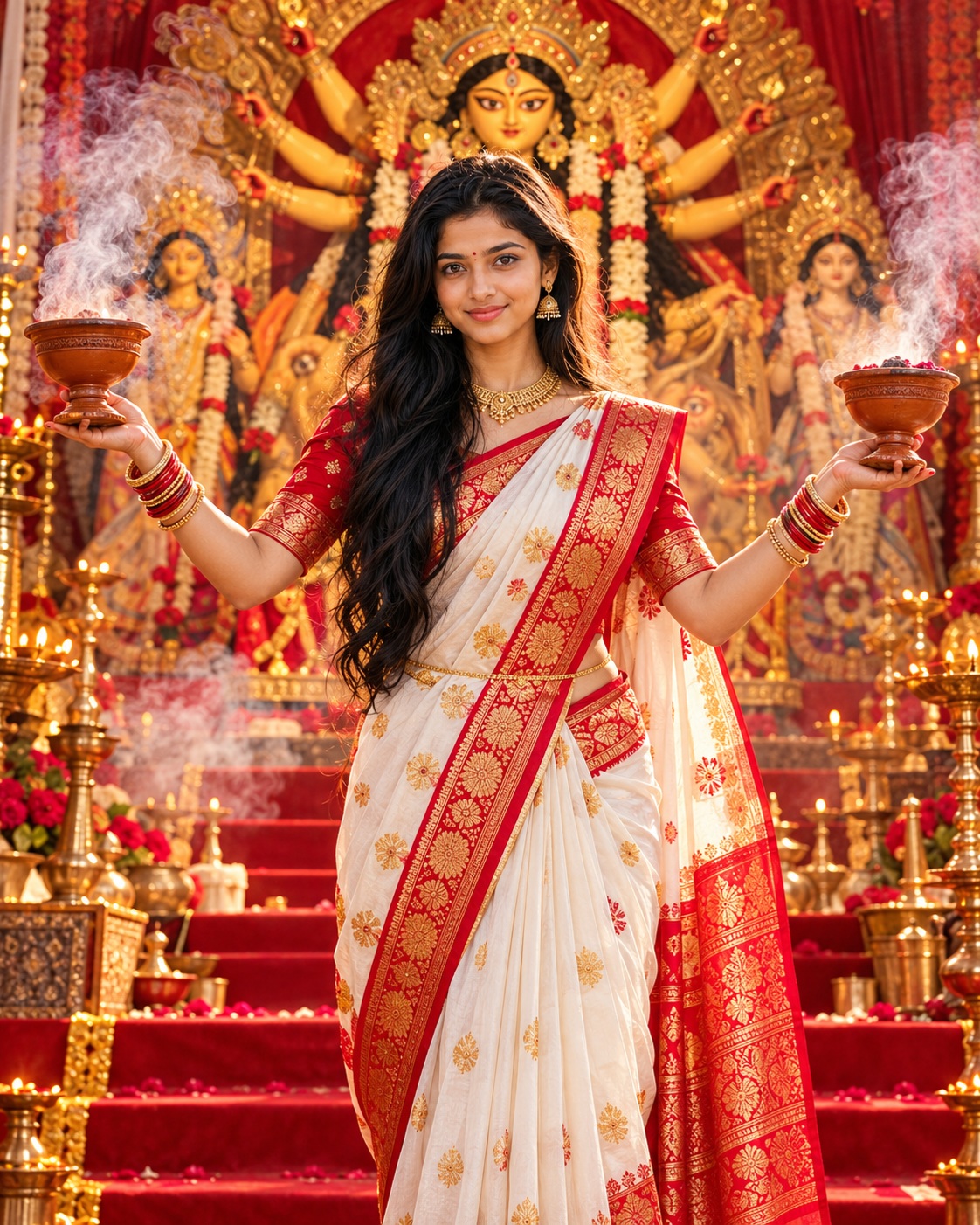
Bengali Durga Portrait
This Bengali Durga Portrait concept centers on a woman placed in a deeply traditional Bengali devotional environment. The main subject is shown as the clear visual focus, standing upright in a poised full-body stance. Her presence feels ceremonial rather than casual, and the composition gives her enough space to read clearly from head to toe while keeping the devotional setting strongly visible behind her. The overall design is built around dignity, cultural richness, and the feeling of a carefully observed festive moment.
The face is important because the supplied user identity is meant to become part of the reference character without changing the character’s established visual role. The facial identity should feel naturally integrated into the lighting, perspective, and expression already present in the reference. The face should not look separately illuminated, artificially retouched, or disconnected from the surrounding scene. Natural facial proportions, realistic skin texture, and believable integration are central to the concept.
The pose is equally important. The woman stands upright with both arms extended outward, holding traditional puja vessels in the same manner as the reference. The hands, fingers, elbows, shoulders, torso position, head angle, gaze, and overall body language are treated as fixed visual elements. This gives the Bengali Durga Portrait a balanced, symmetrical character and makes the devotional gesture immediately understandable. The stance communicates participation in a ritual rather than a conventional fashion pose.
The clothing is a major part of the visual identity. The woman wears a traditional white Bengali saree with a rich red border and gold motifs, paired with a red blouse. The saree should retain the authentic appearance, fabric fall, folds, borders, surface detail, and condition seen in the reference. Traditional jewelry, bangles, and other accessories add ceremonial richness. These details are not merely decoration; they establish the cultural setting and help the subject feel connected to the Durga Puja atmosphere.
Behind the woman is a large Durga idol that anchors the devotional scene. The idol should remain visually important without competing unnecessarily with the central subject. The temple or pandal environment, red steps, lamps, incense smoke, and surrounding decorative elements create depth and context. The background is therefore not a generic festive backdrop. It carries the visual language of a real devotional celebration, with layered objects, atmospheric haze, architectural cues, and ritual details.
The environment has a warm, slightly smoky quality. Incense smoke softens parts of the background and creates natural separation between foreground and distance. Lamps and warm illumination introduce small points of visual warmth, while the darker areas help preserve the original atmosphere. The lighting is designed to feel soft and believable, with the subject receiving enough illumination for clear facial and clothing detail without making the scene look like a bright studio photograph.
Color is one of the most distinctive aspects of the concept. Red, white, gold, and warm earthy tones form the main palette. The requested treatment increases saturation and vibrance across the complete scene rather than selectively making the woman brighter. Rich reds become deeper and more energetic, white fabric stays clean and dimensional, and gold jewelry gains a warmer, more radiant quality. Background tones also receive greater color depth, allowing the environment to feel richer while remaining believable.
The important balance is between vivid color and natural realism. The Bengali Durga Portrait should have a noticeable festive glow, but it should not become neon, cartoonish, glossy, or aggressively HDR. Skin tones remain natural, shadows remain meaningful, and smoke keeps its atmospheric softness. The higher vibrance is intended to make the existing palette feel alive, not to replace the original grading with an unrelated visual style.
Composition is highly controlled. The subject remains centered, the crop stays consistent with the reference, and the proportions of the figure relative to the Durga idol and surrounding architecture remain stable. This creates a symmetrical visual rhythm. The extended arms also contribute to the horizontal balance, while the vertical figure, idol, steps, and temple elements create a strong central axis. The result feels organized and ceremonial rather than randomly arranged.
The camera feel is that of a carefully composed full-body portrait photographed in a real festive environment. Perspective should remain consistent with the reference, with no unnecessary zooming, recentering, or dramatic change of angle. The viewer should be able to appreciate the complete outfit, the ritual vessels, the jewelry, the idol, and the environmental details in one coherent frame. This makes the Bengali Durga Portrait suitable for both close visual inspection and use as a polished vertical cultural portrait.
Anatomy and proportion are also important design qualities. The head-to-body relationship should remain realistic, with properly scaled hands, fingers, arms, legs, and torso. The reference pose should determine the body placement rather than the user’s original photograph. This creates a deliberate reconstruction in which identity and composition are separated: the user’s facial identity is retained, while the established character, clothing, gesture, and environment remain visually consistent.
The devotional mood comes from the combination of posture, objects, idol, smoke, lamps, clothing, and color. None of these elements needs to be exaggerated. Their strength comes from working together. The red-and-white saree immediately establishes a Bengali cultural association, while gold ornaments and ritual vessels reinforce the ceremonial quality. The Durga idol adds spiritual focus, and the atmospheric background makes the setting feel immersive.
The visual finish is premium because the concept preserves detail at multiple levels. Fabric texture can be appreciated in the saree, small gold motifs remain visible, jewelry retains dimensional highlights, smoke creates depth, and background decorations maintain enough clarity to support the story. At the same time, the composition avoids becoming visually chaotic because the central woman remains the strongest organizing element.
This Bengali Durga Portrait also has a strong emotional quality. The extended-arm pose can suggest offering, welcome, devotion, and participation in a sacred celebration. The expression and gaze should therefore remain compatible with the reference rather than being replaced with an unrelated dramatic expression. The atmosphere is festive but respectful, elegant but grounded, and richly decorative without losing realism.
From a design perspective, the Bengali Durga Portrait works because it combines portrait identity with cultural storytelling. It is not simply a picture of a person wearing traditional clothing. The idol, ritual vessels, steps, smoke, lamps, jewelry, saree, and carefully controlled lighting all contribute to a single visual narrative. Every major element has a purpose, and the reference composition provides the structure that keeps those elements connected.
The concept can be useful for Durga Puja portraits, Bengali cultural posts, festive social media artwork, devotional profile images, personal celebration designs, greeting graphics, festival memories, and premium vertical portrait compositions. It can also work as a reference-driven creative direction for photographers, designers, and editors who want a traditional scene with strong visual polish. The rich color treatment makes it particularly suitable for digital displays where red, gold, and white details need enough depth to remain visually striking.
Overall, the Bengali Durga Portrait describes a refined devotional portrait with a strong cultural identity, controlled symmetry, realistic human presentation, traditional clothing, and a richly atmospheric Durga Puja environment. Its most important qualities are reference fidelity, natural identity integration, authentic ceremonial styling, realistic anatomy, warm lighting, visible environmental depth, and enhanced but disciplined color. The final creative impression should feel festive, luminous, elegant, and culturally grounded while preserving the darkness, shadows, smoke, and visual character that make the reference distinctive.
[[[
REFERENCE ANALYSIS
- Composition: Vertical portrait, full-body subject centered, symmetrical devotional setting.
- Pose: Woman standing upright with both arms extended outward, holding traditional puja vessels; exact hand/arm placement preserved.
- Outfit: Traditional white Bengali saree with rich red border and gold motifs, red blouse, ornate jewelry, bangles and traditional accessories.
- Background: Large Durga idol behind the subject, temple/pandal environment, red steps, incense smoke, devotional elements and lamps.
- Lighting: Soft warm subject lighting mixed with atmospheric smoky background light.
- Color: Red, white, gold and warm earthy tones dominate.
- Vibe: Festive, devotional, elegant, richly cultural, slightly atmospheric.
- Visual finish: Add noticeably higher saturation and vibrance while keeping skin tones natural and preserving the original lighting and darkness. Colors should have a rich, luminous, premium glow rather than looking artificially oversaturated.
MASTER PROMPT
Use supplied ref image as master blueprint. Replace only the reference character’s face with the supplied user identity. COMPLETELY IGNORE the user’s original photo pose and body; force the user into the exact body pose, hand placement, arm position, posture, head angle, and gaze of the reference character. Maintain exact scale, proportion, crop, visibility, framing and composition.
Preserve 1000% of all visual information including the reference’s darkness, lighting, shadows, atmosphere, background, Durga idol, temple/pandal environment, incense smoke, stairs, lamps, props, jewelry, saree, blouse, accessories, textures and devotional setting. Preserve the exact outfit style, white-and-red color scheme, gold motifs, fabric appearance and condition.
IMPORTANT COLOR/VIBRANCE TREATMENT: Increase saturation and vibrance across the entire final image to create a distinctive luminous, rich and eye-catching finish. Every photograph should have a subtle premium color glow and enhanced color depth, with reds becoming richer, whites remaining clean and dimensional, gold jewelry and decorative details becoming more radiant,
and background colors becoming more vivid. Enhance color separation and richness without destroying natural skin tones, facial realism, texture, shadows or atmospheric smoke. The result should have a beautiful high-vibrance festive glow, with richer reds, warm golds and deeper environmental tones. Do NOT make the image neon, cartoonish, overly HDR, artificially glossy, or excessively saturated. Preserve the reference’s original mood and lighting while making the colors noticeably more alive and luminous.
Maintain natural human anatomy and proportions: correct head-to-body ratio, proportional hands, fingers, arms and legs, realistic skeletal structure, no enlarged head, no tiny hands, no distorted limbs. Render the user’s facial identity naturally within the reference’s exact lighting and perspective. Do not brighten the face independently or alter facial proportions.
Output must look IDENTICAL to the reference except for the face and the explicitly requested enhanced saturation/vibrance. Do NOT change the reference pose, outfit, background, props, framing, camera angle, atmosphere, composition or visual style.
EDITABLE VARIABLES
- [USER IDENTITY]: Supplied user’s facial identity and unique facial traits only.
- [OUTFIT]: Exact reference outfit — white saree with red border and gold motifs, red blouse, traditional jewelry and bangles.
- [TEXT]: Preserve any meaningful existing text exactly.
- [COLOR TREATMENT]: Higher saturation + higher vibrance + rich luminous color depth + subtle premium glow, while retaining natural skin tones.
- [OBJECT/POSE/ADDITIONAL]: None unless explicitly specified.
NEGATIVE PROMPT
“identity loss, different face, original character, user’s original pose, user’s body posture, changed pose, different hand placement, altered outfit, different saree, different colors, redesigned background, changed Durga idol, missing props, added props, altered lighting, brighter exposure, lifted shadows, lost darkness, dull colors, flat colors, muted colors, low saturation, low vibrance, greyish image, washed-out colors, neon colors, excessive saturation, oversaturation, artificial HDR, cartoonish colors, orange skin,
unnatural skin tones, plastic skin, excessive glow, excessive sharpening, changed grading, different mood, different atmosphere, changed composition, zoomed, recentered, enlarged, distorted anatomy, big head, small hands, disproportionate limbs, deformed fingers, extra limbs, different camera angle, different crop, beautification, generic aesthetic, modernized outfit, simplified details, lost jewelry, lost fabric texture, lost smoke, lost background details, auto-corrected exposure, cinematic color change, polished studio look, user’s original body, user’s original posture” ]]]