
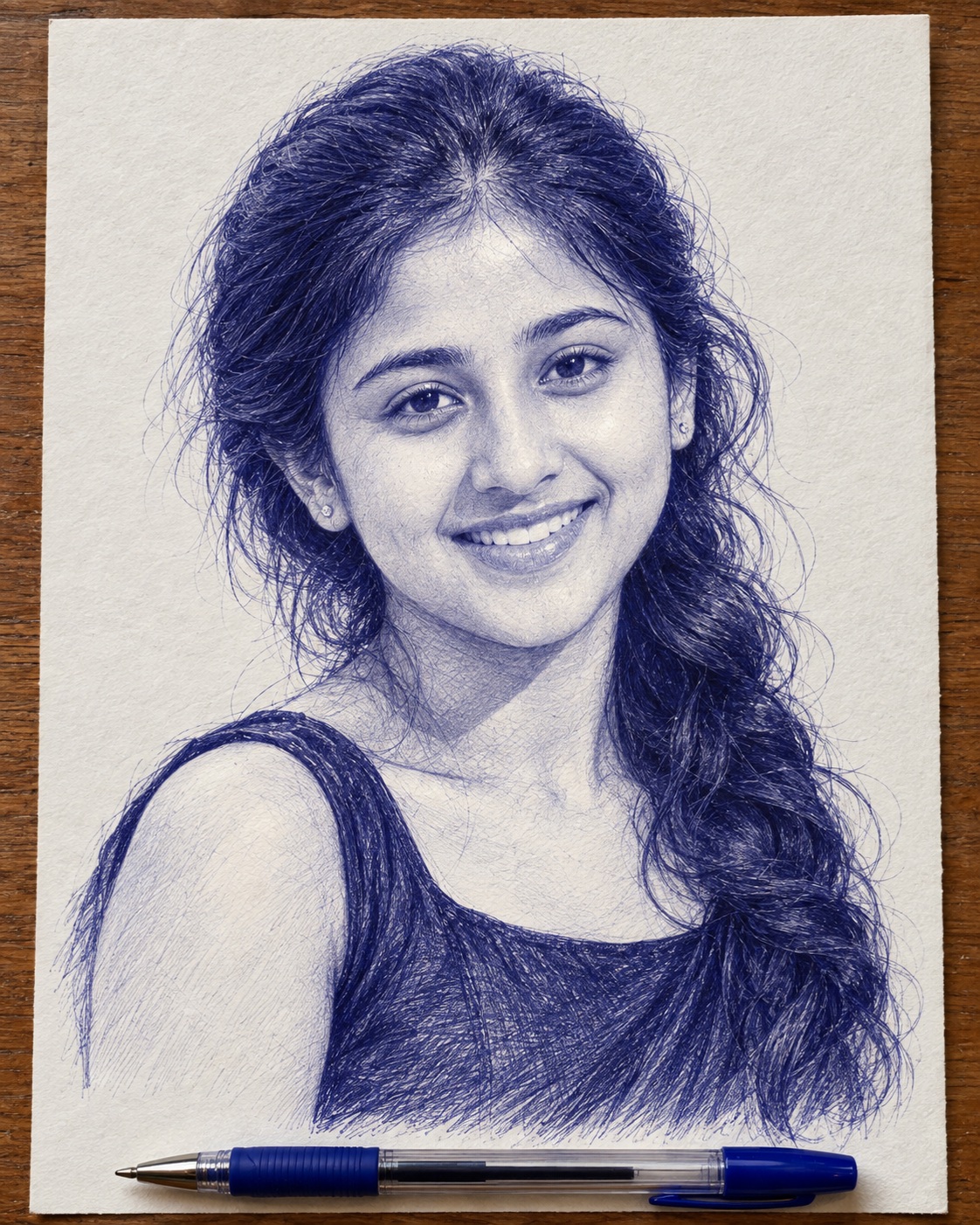
Blue Ink Portrait
The concept presents a single female subject as an authentic handmade portrait drawn entirely with blue ballpoint ink on a physical sheet of textured white paper. The artwork is presented as a real drawing rather than a digital illustration, with the paper placed on a warm wooden surface and photographed under soft natural lighting. The combination of realistic facial detail, visible pen strokes, paper texture and the surrounding tabletop creates an intimate artistic presentation that feels personal and handmade.
The woman is shown from approximately the upper torso or shoulders upward, with the portrait centered on the rectangular sheet. Her face is the strongest focal point, while generous areas of white paper remain visible around the hair. This surrounding paper is important because it gives the portrait breathing room and makes the drawing surface immediately recognizable. The composition is vertical, approximately 3:4, creating a balanced portrait format without making the subject feel overly close to the viewer.
The body is turned slightly toward the viewer’s left while the face turns back toward the camera. This creates a subtle difference between body direction and facial direction, giving the portrait a natural sense of dimension. The head remains upright with a slight tilt, while the shoulders stay relaxed. The pose feels casual and approachable rather than stiff or formally posed.
The expression is one of the defining characteristics of the concept. The woman has a warm, natural open smile with visible teeth. Her eyes contribute to the friendly expression, giving the portrait a cheerful and welcoming personality. The smile should feel genuine rather than exaggerated, which helps preserve the intimate quality of a personal hand-drawn portrait.
The hair is large, voluminous and wavy. It sweeps across the forehead and extends toward the viewer’s right side. A long loose section creates a flowing, braid-like shape over the right shoulder. The hair silhouette is visually important because it occupies a significant area around the face and provides a strong contrast against the white paper.
Individual strands are represented through extremely fine blue pen marks. Instead of relying on smooth digital shading, the hair gains volume through repeated lines, directional strokes and darker accumulated areas. This gives the hairstyle a tactile quality and reinforces the impression that an artist has carefully built the portrait stroke by stroke.
The face is rendered realistically through ballpoint marks. The eyes, eyebrows, nose, cheeks, lips and teeth are all described using layers of fine blue strokes. This approach allows the artist to create subtle tonal differences without introducing additional colors. Darker areas around the eyes, hair and facial contours establish depth, while lighter sections allow the white paper to remain visible.
The medium itself is the central artistic identity. The entire portrait uses strict monochromatic blue or indigo ink. There are no additional colors competing with the blue strokes. The result is visually consistent and immediately recognizable as a detailed blue ballpoint drawing.
The drawing technique is highly detailed. Fine hatching, cross-hatching, stippling, contour strokes and layered tonal buildup create the facial planes and shadows. Different levels of pen pressure produce darker and lighter regions. Some areas contain dense clusters of marks, while other areas remain relatively open, allowing the paper to contribute to the tonal range.
This variation in ink density gives the portrait a natural handmade quality. A completely uniform digital rendering would remove much of the character that makes a ballpoint portrait appealing. Here, the visible marks communicate the physical process of drawing and give the artwork a sense of craftsmanship.
The clothing is intentionally simple. The woman wears a dark sleeveless top with a straightforward neckline. The exposed shoulder area and neckline shape remain visible within the portrait. Because the clothing is dark, it provides a strong tonal foundation beneath the lighter facial areas and creates a natural transition toward the lower portion of the drawing.
The dark top also helps keep the visual hierarchy focused. The face remains the brightest and most detailed human area, while the clothing provides a darker supporting shape. This makes the portrait easy to read while preserving the simple character of the reference artwork.
The paper is a physical rectangular drawing sheet with a white or slightly warm off-white appearance. Its texture is visible rather than being represented as a perfectly smooth digital background. The rectangular edges remain part of the composition, making it clear that the portrait exists on a real sheet rather than inside an artificial frame.
The warm wooden surface surrounding the paper adds another physical layer. The wood provides a subtle environmental contrast against the white sheet and blue ink. Its warm neutral color also creates a natural tabletop setting that supports the handmade character of the artwork without distracting from the portrait.
A blue ballpoint pen lies horizontally along the bottom edge of the paper. This prop is especially useful because it visually confirms the medium used to create the portrait. Its blue body and recognizable shape connect the finished drawing to the physical act of sketching.
The pen is positioned as a supporting object rather than a central subject. It occupies the lower edge and provides a small horizontal counterpoint to the vertical portrait. This creates balance within the composition while reinforcing the authenticity of the scene.
Lighting is soft and natural. The physical drawing receives gentle overhead illumination, creating subtle shadows across the paper and wooden surface. The lighting is not dramatic or theatrical. Its purpose is to document the artwork naturally and reveal the physical qualities of the paper.
The color relationship is intentionally limited. Blue or indigo ink dominates the drawing, white and off-white paper provide the primary background, and warm wood surrounds the sheet. This restrained palette gives the artwork an elegant and timeless appearance.
The overall style is realistic but handmade. The facial rendering contains enough detail to communicate a recognizable human identity, while the visible pen strokes keep the work firmly connected to traditional sketching. It therefore sits between realistic portrait drawing and casual personal artwork.
The mood is friendly, elegant, realistic and artistic. The open smile provides warmth, while the monochromatic ink treatment gives the portrait a refined visual character. The physical paper and pen add intimacy, making the artwork feel like a personal drawing rather than a commercial illustration.
The identity replacement concept is focused entirely on the face. The user’s recognizable facial characteristics become part of the established portrait while the pose, expression, hairstyle, clothing and drawing medium remain consistent with the reference. This allows the final artwork to feel personalized without changing the established artistic language.
The facial identity must still work naturally within the three-quarter body arrangement. The face turns toward the camera while the upper body remains slightly angled. This relationship creates a believable portrait structure and allows the identity to remain visually prominent.
The hair provides an important framing device around the face. Its volume creates a natural border, while the long flowing section over the right shoulder extends the composition downward. The hair therefore connects the facial area with the upper torso and gives the portrait a stronger overall silhouette.
The smile also interacts with the drawing technique. Visible teeth and relaxed lips require careful tonal control because ballpoint ink can easily become too dark. Fine strokes and lighter paper-revealing areas allow the expression to remain open and natural while preserving the monochrome style.
The eyes are another important focal region. Detailed contour marks around the eyes and eyebrows create expression without relying on color. The fine linework allows the artist to communicate warmth and personality through small changes in tone and shape.
The paper texture adds authenticity to these fine details. Slight surface variation gives the ink marks a physical context and prevents the portrait from appearing digitally isolated. The relationship between paper grain and pen strokes contributes significantly to the handmade appearance.
The composition is deliberately uncomplicated. There is only one person, one sheet of paper, one pen and one wooden surface. This simplicity keeps attention on the facial identity and drawing technique. The absence of scenery or additional objects makes the portrait feel intimate and focused.
The concept is useful for personalized artistic portraits, social media artwork, creative profile images, friendship or birthday designs, handmade-themed posts, artistic portfolios and personal keepsake visuals. Its recognizable ballpoint style can make a familiar face feel more personal and handcrafted.
The blue monochrome treatment is especially suitable for viewers who enjoy traditional drawing aesthetics. Ballpoint ink is an ordinary and familiar medium, but detailed portrait work transforms it into something visually sophisticated. This contrast between everyday material and detailed craftsmanship is one of the concept’s strongest qualities.
The wooden surface adds a quiet sense of place. Rather than placing the drawing against a generic digital background, the artwork is shown as an object resting on a real tabletop. This physical presentation helps the viewer imagine the portrait as a finished artwork that can be held, displayed or signed.
The absence of a signature is also meaningful. The clean artwork remains unsigned by default, allowing the portrait itself to remain the focus. If a personal name is later requested, it can function as a small handwritten addition without changing the rest of the composition.
The overall visual hierarchy begins with the face, continues through the hair and shoulders, and then moves toward the paper and pen. The viewer first notices the smile and eyes, then the intricate hair and facial hatching, and finally the physical drawing environment.
The portrait therefore communicates both identity and process. The face represents the person, while the pen marks represent the artist’s hand. The paper and tabletop document the physical context. Together, these elements make the artwork feel like a personal artifact rather than a generic portrait graphic.
The realistic anatomy is important to maintaining this effect. The head, neck, jaw and shoulders remain proportionate, while the facial features maintain natural relationships. Because the medium is highly detailed, even small anatomical inconsistencies would be noticeable. The realistic structure therefore supports the authenticity of the drawing.
The final creative direction is a cheerful female portrait rendered entirely in blue ballpoint ink on a textured white sheet. The woman has voluminous wavy hair, a warm open smile, a dark sleeveless top and a relaxed upper-body pose. The drawing rests on a warm wooden surface with a blue pen positioned along the bottom edge.
The concept succeeds because it balances realism with visible handmade imperfection. The face remains detailed and recognizable, while hatching, stippling, cross-hatching and pen-pressure variation reveal the physical process of drawing. The result feels elegant without becoming overly polished.
The combination of blue ink and warm wood also creates subtle visual harmony. The cool monochrome portrait remains the focal point, while the warm tabletop provides a quiet environmental contrast. The white paper acts as a neutral bridge between these elements.
Overall, the concept describes a sophisticated personal artwork with the warmth of a handmade sketch and the detail of a carefully rendered portrait. Its strongest qualities are the cheerful expression, voluminous hair, realistic facial rendering, monochromatic blue pen technique, physical paper, wooden surface and visible ballpoint prop.
[[[
REFERENCE ANALYSIS
- Format: Vertical portrait, approximately 3:4, presented as a physical blue-ballpoint drawing on a rectangular sheet of textured white paper.
- Composition: Single female portrait, centered and framed from upper torso/shoulders upward. Face is the main focal point, with generous white paper around the hair.
- Pose: Body turned slightly toward the viewer’s left while the face turns toward camera. Head upright with a subtle tilt, shoulders relaxed. Preserve exact head angle, neck position and shoulder placement.
- Expression: Warm, natural open smile with visible teeth; friendly and cheerful expression. Preserve exact eye expression and smile.
- Hair: Voluminous shoulder-length/wavy hair swept across the forehead and toward the viewer’s right, with a long loose section/braid-like flow over the right shoulder. Preserve exact silhouette and strand direction.
- Rendering: Detailed blue ballpoint pen portrait, using extremely fine hatching, cross-hatching, stippling, contour strokes and layered tonal buildup.
- Color: Strict monochromatic blue/indigo ink on white/off-white paper.
- Face: Realistic facial rendering translated entirely into ballpoint strokes, with detailed eyes, eyebrows, nose, cheeks, lips and teeth.
- Clothing: Dark sleeveless top with a simple neckline. Preserve exact shoulder and neckline shape.
- Paper: Rectangular textured white drawing sheet placed on a warm wooden surface. Preserve paper edges, subtle texture and surrounding wood.
- Prop: Blue ballpoint pen placed horizontally along the bottom edge of the paper. Preserve exact approximate position, orientation and scale.
- Lighting: Soft natural overhead photographic lighting on the physical drawing, with subtle paper and wood shadows.
- Style: Authentic hand-drawn ballpoint portrait photographed as a real artwork, not a digital illustration.
- Mood: Friendly, elegant, realistic and artistic.
- Signature: Remove/omit the reference’s existing signatures, initials, artist marks and symbols. No sign by default.
- Personalization: If the user later provides a name and explicitly requests it, the supplied name may be added as an optional handwritten element in an appropriate area.
MASTER PROMPT
Use supplied ref image as master blueprint. Replace only ref character’s face with supplied user identity. COMPLETELY IGNORE the user’s original photo pose and body; force the user into the exact body/head pose, head angle, shoulder placement, posture, gaze and expression of the reference character. Maintain exact scale, proportion, crop, visibility. Preserve 1000% of all visual info including monochrome blue ballpoint rendering, paper texture, wood surface, lighting, shadows, composition, prop placement, hairstyle, facial expression, clothing, ref pose, framing and natural human anatomy. Output must look IDENTICAL to ref except face. Do NOT brighten, enhance, modify, change outfit, ref pose, or vibe.
Recreate the supplied reference as an authentic highly detailed blue-ballpoint-pen portrait drawn on textured white paper and photographed on a wooden surface.
Preserve the exact vertical composition and physical-art presentation. The portrait must remain centered on the rectangular sheet with the same amount of white paper surrounding the character and the same visible wooden surface around the sheet.
Preserve the exact reference pose: upper body turned slightly toward the viewer’s left, face turned toward camera, upright/slightly tilted head, relaxed shoulders and direct gaze. Preserve the exact warm open smile with visible teeth and the same facial expression. Completely ignore the user’s original pose and body.
Replace ONLY the facial identity with the supplied user’s identity. Preserve the user’s unique facial traits while naturally adapting them to the reference’s exact viewing angle, smile and hand-drawn rendering. Do not copy the user’s original body, hairstyle, clothing or pose.
Preserve the exact voluminous wavy hairstyle, including the sweeping hair across the forehead, large hair mass around the sides of the head and the long flowing section over the viewer’s right shoulder. Preserve individual hair strands through fine blue pen strokes.
Preserve the exact dark sleeveless top, neckline, shoulder exposure, fabric folds and proportions. Do not change the outfit.
Render everything in strict monochromatic blue/indigo ballpoint ink. Preserve authentic ballpoint characteristics: microscopic pen strokes, cross-hatching, fine parallel lines, stippling, contour shading, pressure variation, darker accumulated areas and lighter paper-revealing areas. The face, hair, neck, shoulders and clothing must all visibly be made from hand-drawn blue pen marks.
Preserve the exact realistic portrait rendering while retaining the handmade ballpoint aesthetic. Do not turn the artwork into digital painting, watercolor, pencil, charcoal, photography or vector art.
Preserve the exact white/off-white textured drawing paper, including its rectangular edges and subtle surface grain. Preserve the warm wooden tabletop surrounding the paper and its natural soft shadows.
Preserve the exact blue ballpoint pen lying horizontally along the bottom of the paper, including its blue body, darker components, approximate length, scale and position. Do not remove or redesign it.
Maintain natural human anatomy and facial proportions: realistic head-to-body ratio, natural eyes, nose, mouth, jaw, neck and shoulders. No distortions.
SIGNATURE/TEXT RULE: Remove and do not reproduce the reference’s existing signatures, initials, artist marks, symbols or watermark-like marks. Keep the artwork clean and unsigned. No name or text by default. If the user later supplies a name and explicitly asks for it, add only that supplied name as a small handwritten element, without changing the rest of the reference.
Reference = FINAL IMAGE. The reference is the base layer; only the user’s facial identity changes. Everything else remains locked at 1000%.
EDITABLE VARIABLES
- [USER IDENTITY]: Supplied user’s face/identity only.
- [OUTFIT]: Exact dark sleeveless top and neckline from reference.
- [TEXT]: None by default. No signature, watermark, initials or artist mark.
- [USER NAME — OPTIONAL]: User may provide a name later; add only if explicitly requested.
- [OBJECT/POSE/ADDITIONAL]: None. Preserve exact paper, wood surface, pen, pose and composition.
NEGATIVE PROMPT
“identity loss, different face, original character identity, user’s original pose, user’s original body, wrong head angle, wrong head tilt, wrong gaze, wrong smile, closed mouth, different expression, altered shoulder position, altered posture, different hairstyle, different hair length, different hair direction, missing hair strands, different outfit, different neckline, changed clothing, colored portrait, multicolor ink, black ink, graphite pencil, charcoal, watercolor, oil painting, digital painting, photorealistic portrait, anime, cartoon, 3D render, vector art,
smooth digital shading, lost ballpoint texture, lost hatching, lost cross-hatching, lost stippling, lost pen strokes, clean digital artwork, redesigned paper, missing paper texture, missing wooden surface, missing paper edges, missing blue pen, moved pen, vertical pen, altered pen position, added objects, removed objects, changed lighting, harsh lighting, dramatic shadows, changed composition, zoomed, cropped, recentered,
enlarged, altered scale, altered negative space, distorted anatomy, big head, small head, distorted face, malformed eyes, distorted smile, deformed teeth, stretched neck, disproportionate shoulders, unnatural proportions, beautification, excessive smoothing, polished digital look, generic portrait, changed mood, changed style, changed rendering, signature, watermark, artist signature, artist initials, artist name, logo, random text, fixed name, handwritten text, unwanted lettering, user’s original hairstyle, user’s original clothing, user’s original posture” ]]]