
Cinematic Music Poster
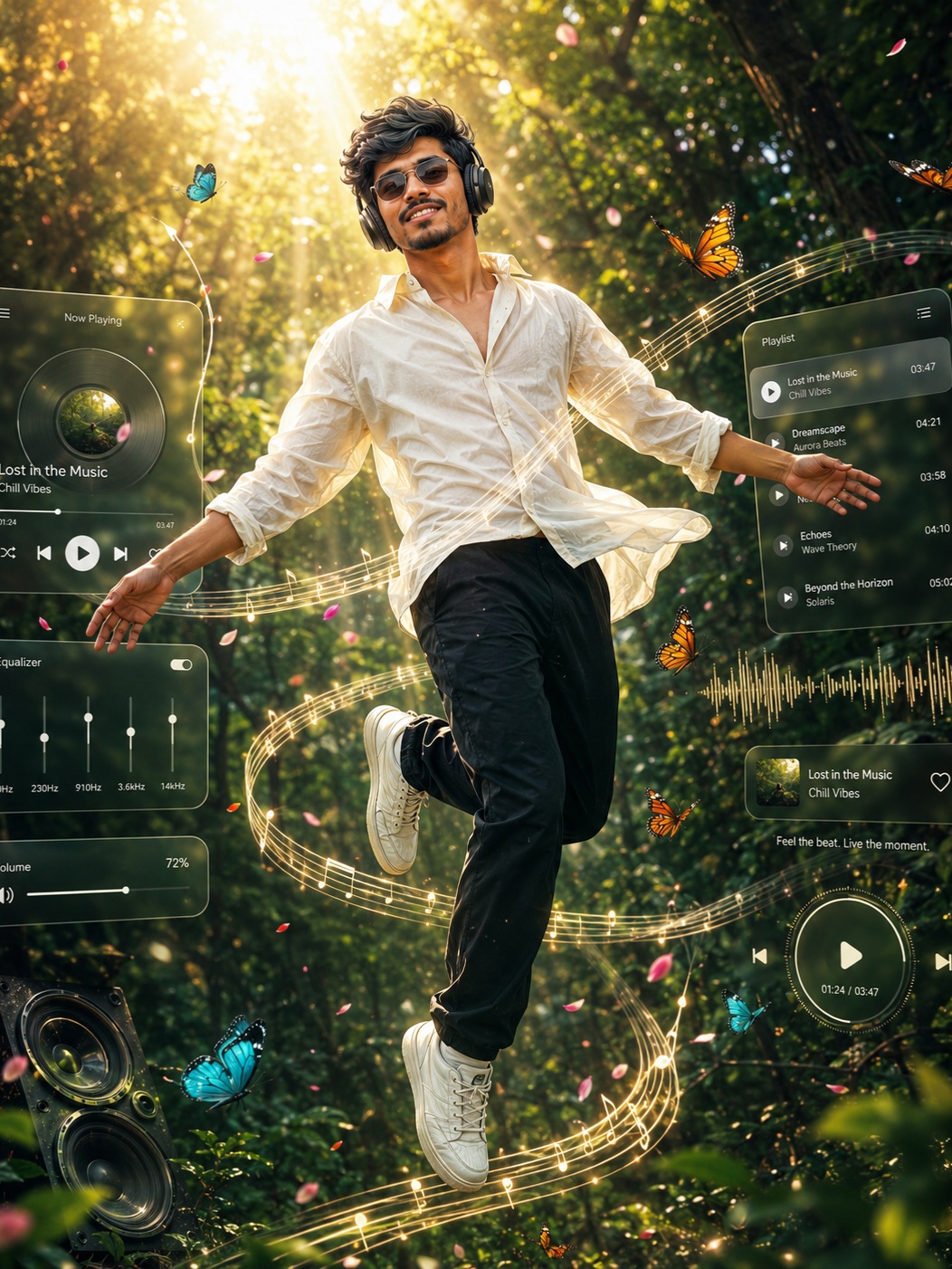
This prompt describes a premium cinematic portrait concept built around a single male subject who appears to be floating peacefully inside a lush, illuminated forest. The visual direction combines realistic photographic detail with a dreamy music-inspired atmosphere. Instead of presenting the subject in an ordinary standing portrait, the composition creates a sense of weightlessness, freedom, and emotional immersion. The forest, sunlight, butterflies, petals, glowing trails, headphones, sunglasses, and translucent music controls all work together to communicate the feeling of becoming completely absorbed in music.
The main subject is a man shown in a complete full-body composition. His body floats slightly backward, creating a relaxed suspended posture. His head is tilted upward, suggesting that he is emotionally absorbed in the surrounding sound and atmosphere. Both arms extend outward with relaxed open hands, while one leg reaches downward and the opposite leg bends backward with the foot raised. This arrangement gives the portrait a strong sense of motion even though the subject appears calm.
The pose is one of the most important structural features. The head angle, shoulder orientation, arm placement, hand position, torso direction, leg geometry, foot positions, and overall floating silhouette are based on the main reference. The person’s separate source is used only to preserve facial identity and natural body thickness. This separation helps retain recognizable identity without allowing a different source pose to interfere with the intended composition.
Facial identity is treated with particular care. The facial structure, jawline, hair characteristics, skin tone, proportions, and natural asymmetry remain recognizable. The rendering should feel photographic and detailed rather than like a generic character. Natural skin texture contributes to the realism, while controlled cinematic lighting adds depth without excessive smoothing or artificial beautification.
The face is supported by sunglasses and headphones. These accessories are important because they reinforce the music theme while adding a contemporary fashion quality. Their position must remain naturally connected to the head, face, ears, and upward tilt. The sunglasses should sit correctly across the facial structure, while the headphones should follow the natural shape of the head.
The outfit is relaxed, fashionable, and designed to respond naturally to the floating motion. The subject wears a loose off-white or cream long-sleeve button shirt with an open collar. The fabric appears lightweight and naturally flowing, with visible movement through the sleeves, collar, folds, and lower edges. Loose black trousers provide a darker visual foundation, while clean white sneakers create bright accents at the lower part of the composition.
The clothing is not merely decorative. Its movement helps explain the floating state. The shirt should appear affected by airflow, with believable folds and drape rather than rigid fabric. The trousers maintain a loose silhouette and realistic construction. The sneakers remain clean and proportionate, giving the full-body composition clear visual endpoints.
The forest is the environmental heart of the scene. Dense green foliage surrounds the subject, creating depth and a natural sense of immersion. The background should feel rich and alive without becoming chaotic. Layers of leaves, distant greenery, atmospheric softness, and natural shadows provide a believable outdoor setting.
Warm sunlight filters through the forest canopy. Golden beams and soft backlight create a luminous atmosphere around the subject. A subtle golden rim can define the hair, shoulders, arms, shirt, and legs while helping separate the figure from the darker foliage. This lighting approach gives the portrait a premium cinematic character without losing the feeling of natural daylight.
The color palette is deliberately controlled. Deep natural greens dominate the forest. Warm golden highlights provide the primary illumination. The shirt and sneakers introduce white and cream tones, while the trousers provide deep black contrast. Natural skin tones maintain the identity of the subject. Glowing effects can include warm white, golden, green, and restrained cyan accents.
The music theme appears through translucent interface elements distributed around the scene. These glass-like panels contain small interface typography, playback controls, waveform graphics, equalizer information, volume indicators, track listings, playlist details, and circular audio controls. Their purpose is to establish a visual connection to digital music without overpowering the photographic portrait.
The UI treatment uses a sophisticated glassmorphism appearance. Panels are translucent and smoky, with subtle borders, internal blur, soft reflections, and carefully controlled opacity. They should feel integrated into the forest environment rather than appearing as solid graphic stickers placed over the photograph.
Typography remains small and secondary. The interface can retain the music-related information that naturally exists in the reference, but no personal name, title, signature, watermark, or unrelated caption should be introduced. The small interface labels support the concept while allowing the subject to remain the dominant visual element.
Glowing energy trails add a magical interpretation of music. Warm luminous lines can move through the forest around the subject, suggesting sound waves, rhythm, emotional energy, or invisible musical motion. Their placement and layering are important because some trails may pass behind the subject while others may appear in front. Controlled transparency keeps these effects integrated with the photographic scene.
Butterflies and floating petals provide a softer organic counterpoint to the technological interface. Their presence creates movement throughout the frame and adds a youthful, dreamy character. They should remain naturally distributed rather than appearing as repetitive decorative objects. Small floating particles can also contribute to the atmospheric depth.
The subject remains the main focal point. The figure should occupy the same relative scale as the reference, with substantial forest visible around the body. The composition should never enlarge the person until the environment disappears. The surrounding space is essential because it communicates the feeling of being immersed in a larger world.
The vertical poster format gives the scene a strong editorial structure. The full body remains visible from head to both sneakers. The central figure establishes a clear vertical axis, while the forest, interface panels, glowing trails, butterflies, and petals form supporting layers around that axis.
The camera perspective is medium-wide and slightly below eye level. This perspective gives the floating body a subtle sense of elevation and allows the surrounding environment to remain visible. Cinematic depth of field separates the subject from distant foliage while preserving enough environmental detail to make the forest immediately recognizable.
The concept depends on a careful relationship between realistic photography and magical design. The human body, clothing, forest, and sunlight should remain believable, while the translucent interface, glowing trails, butterflies, and floating posture introduce a heightened artistic atmosphere. The result should feel like a premium music campaign rather than a conventional fantasy illustration.
One of the strongest creative ideas is the connection between nature and digital listening. The forest represents freedom and organic life, while the glass UI represents modern music technology. The floating body sits between these worlds, visually expressing the feeling of escaping ordinary surroundings through sound.
The prompt also emphasizes accurate body proportions. Head-to-body ratio, shoulder width, torso thickness, neck size, arm length, leg length, hand size, and foot proportions should remain natural. The floating pose should never produce distorted anatomy. The sense of weightlessness comes from positioning, fabric movement, lighting, and environmental context.
The overall mood is dreamy, magical, youthful, peaceful, and immersive. It is not aggressive or heavily dramatic. The soft expression, upward head position, relaxed hands, flowing clothing, sunlight, butterflies, and glowing particles all reinforce a feeling of emotional freedom.
The composition can be useful for music-themed editorial artwork, artist branding, album-inspired visuals, streaming campaign graphics, social media posters, creative portfolios, fashion campaigns, lifestyle artwork, and atmospheric personal portraits. Its vertical structure is especially suitable for modern digital publishing and mobile-first presentation.
The clean separation between subject and environment also gives the concept strong visual flexibility. The forest remains rich enough to communicate location, but the controlled composition prevents it from competing with the person. The UI remains detailed enough to establish the music concept without turning the artwork into a text-heavy design.
The lighting, color, and compositing are intended to feel premium. Natural skin detail, realistic hair strands, believable fabric physics, atmospheric forest depth, controlled bloom, glass reflections, and subtle volumetric sunlight all contribute to a polished campaign-quality finish.
The prompt deliberately avoids random logos, unrelated branding, extra people, duplicate figures, ghosting, excessive typography, fake interface elements, and unnecessary scenery. This keeps the visual language consistent and prevents secondary details from weakening the main story.
The final concept is therefore a carefully balanced combination of human identity, floating movement, forest atmosphere, music technology, and magical light. Every major component has a specific role: the face provides identity, the pose provides emotional freedom, the outfit provides fashion, the forest provides depth, the UI provides musical context, and the glowing effects provide dreamlike energy.
[[[
1. Main Goal & Scenario
Reconstruct the MAIN REFERENCE as a premium cinematic music-themed editorial poster, preserving its exact vertical composition, floating pose, forest environment, UI overlays, glowing music effects, butterflies, and dreamy immersive atmosphere.
2. Identity Mapping & Face Scale
Use the PERSON SOURCE only for exact face identity and body thickness. Preserve recognizable facial structure, hair characteristics, jawline, skin tone, and natural proportions while converting the subject into the MAIN REFERENCE’s photographic cinematic style.
3. Pose Source Lock
100% LOCK the MAIN REFERENCE pose: subject floating slightly backward, head tilted upward, arms extended outward, relaxed open hands, one leg extended downward, opposite leg bent backward with raised foot. NEVER copy the PERSON SOURCE pose.
4. Typography Letter Content Lock
NO USER NAME OR PERSONAL TEXT. Preserve only the music-interface text that naturally exists in the MAIN REFERENCE UI panels, without introducing additional personal names or captions.
5. ONE TEXT ONE PLACE Lock
Do not add any new name, title, signature, watermark, or personal text. Existing interface typography remains only inside its original UI elements.
6. Exact Text Style & Size Replication Lock
Replicate every visible interface panel with the same translucent glassmorphism treatment, tiny clean sans-serif typography, spacing, alignment, icon scale, and subtle white/gray appearance. Never enlarge the UI text.
7. Direct Text Injection Command
Preserve the reference’s visible music-player interface content and layout as closely as possible, including track listings, playback controls, equalizer labels, volume percentage, waveform graphics, and playlist information. Do not invent prominent additional typography.
8. No Giant Central Figure Lock
Keep the subject at exactly the same relative scale as the MAIN REFERENCE, occupying the central vertical region while leaving substantial forest environment visible around the body. Do not enlarge the figure or place it over the interface panels.
9. Vibe, Color & Mood Lock
Exact dreamy, magical, youthful music-fantasy atmosphere. Preserve the lush green forest, soft golden sunlight, floating petals, glowing warm-white energy trails, translucent glass UI, colorful butterflies, and ethereal cinematic mood.
10. Micro-Details & Crop
Preserve the exact head tilt, sunglasses/headphones placement, open collar, shirt movement, sleeve folds, finger positions, trouser folds, raised sneaker, extended sneaker, floating posture, hair movement, butterflies, petals, light particles, and edge crop.
11. Identity, Raw Skin & Anti-Fake
Preserve exact facial identity from the PERSON SOURCE without beautifying or replacing facial structure. Keep realistic skin texture and natural facial asymmetry, rendered with cinematic photographic detail rather than a generic AI face.
12. Hand-Prop & Neck-Head Alignment
Match the MAIN REFERENCE’s relaxed extended arms and open hands precisely. Preserve correct wrist, elbow, shoulder, neck, and head alignment. Headphones and sunglasses must remain correctly positioned on the face.
13. Body Proportion & Limb Scaling
Use MAIN REFERENCE for complete pose and limb geometry, PERSON SOURCE only for body thickness. Preserve realistic torso-to-head ratio, shoulder width, leg length, hand size, feet size, and natural floating anatomy.
14. Outfit Fit, Drape & Wrap
Recreate the MAIN REFERENCE outfit exactly: loose semi-transparent/off-white long-sleeve button shirt with open collar and naturally flowing fabric, loose black trousers, and clean white sneakers. Preserve the wind-driven shirt movement and exact drape.
15. Selective Color & Tone Mapping
Forest: deep natural greens with warm golden highlights.
Subject: bright white/cream shirt, deep black trousers, clean white sneakers, natural skin tones.
Effects: warm luminous white/golden energy trails with subtle green/cyan accents. UI: translucent smoky glass with restrained white typography.
16. No Random Logos & Clean Text
No random brands, logos, watermarks, signatures, social-media marks, or unrelated interface elements. Preserve only the music UI language already established by the MAIN REFERENCE.
17. Perfect Spelling & Text Rendering
Keep interface typography clean, sharp, correctly aligned, and legible at its original scale. No warped letters, gibberish, duplicated text, oversized labels, or random words.
18. Text Ratio & Style Lock
UI text must remain small and secondary to the photograph. Preserve the exact reference ratio between subject, interface panels, and typography. Never convert the interface into giant poster typography.
19. Opacity, Layering & Ghost
Match the translucent glass panels with subtle borders, internal blur, reflections, and controlled opacity. Glowing energy trails must pass naturally behind/in front of the subject according to the reference. No solid ghosting.
20. Duplicate Mapping & Pose Variety
Exactly one primary human subject. No duplicate person, no mirrored person, no extra limbs, and no secondary portrait. Butterflies and floating petals may appear as environmental elements matching the reference density.
21. Professional Quality Boost
Ultra-premium cinematic photography, realistic fabric physics, high-detail skin, natural hair strands, physically believable forest lighting, crisp glassmorphism UI, realistic depth of field, volumetric sunlight, controlled bloom, sophisticated compositing, high-end music campaign aesthetic.
22. Body Visibility & Scene Density
Maintain the full floating body visibility from head to both sneakers. Preserve the dense forest background, falling petals, butterflies, glowing particles, multiple UI cards, circular audio controls, waveform elements, and speaker detail without overcrowding the central figure.
23. Composition/Camera & Lighting
Vertical poster composition matching the MAIN REFERENCE aspect ratio exactly. Medium-wide full-body framing from slightly below eye level, centered floating subject, lush forest surrounding the figure, strong natural backlight filtering through leaves, soft golden rim light, cinematic depth, subtle lens bloom.
24. Quality Lock & User Customization
Create a faithful reconstruction of the MAIN REFERENCE using the PERSON SOURCE only for face identity and body thickness. Preserve every major compositional relationship, pose, outfit, environment, interface panel position, lighting effect, color palette, and dreamy music aesthetic. No personal name or added custom text.
25. Bad Output Mistakes & Negative Prompt
BLOCK: wrong identity, generic face, face paste, plastic skin, beautified face, wrong pose, copied PERSON SOURCE pose, normalized pose, standing pose, broken floating anatomy, broken neck, bad hands, extra fingers, missing fingers, hulk hands, incorrect limb proportions, duplicate person, extra person, wrong outfit, shirt tucked in, wrong shirt color, wrong trousers, wrong shoes, missing headphones, missing sunglasses, wrong forest, studio background, empty background, wrong color grade, dull greens, excessive darkness,
warm orange forest, flat lighting, missing sunlight, missing petals, missing butterflies, missing glowing trails, missing UI panels, giant UI text, giant typography, random logos, watermarks, signatures, unauthorized personal name, hallucinated text, duplicated text, gibberish letters, distorted UI, solid opaque glass panels, excessive glow, excessive bloom, fake particles, low density, flat composition, giant central figure, same pose duplicates, AI artifacts, low resolution, blurry subject, amateur compositing, WRONG VIBE, WRONG COLOR PALETTE. ]]]
” https://prompt.mahantababu.com/