
Odia Monsoon Poster
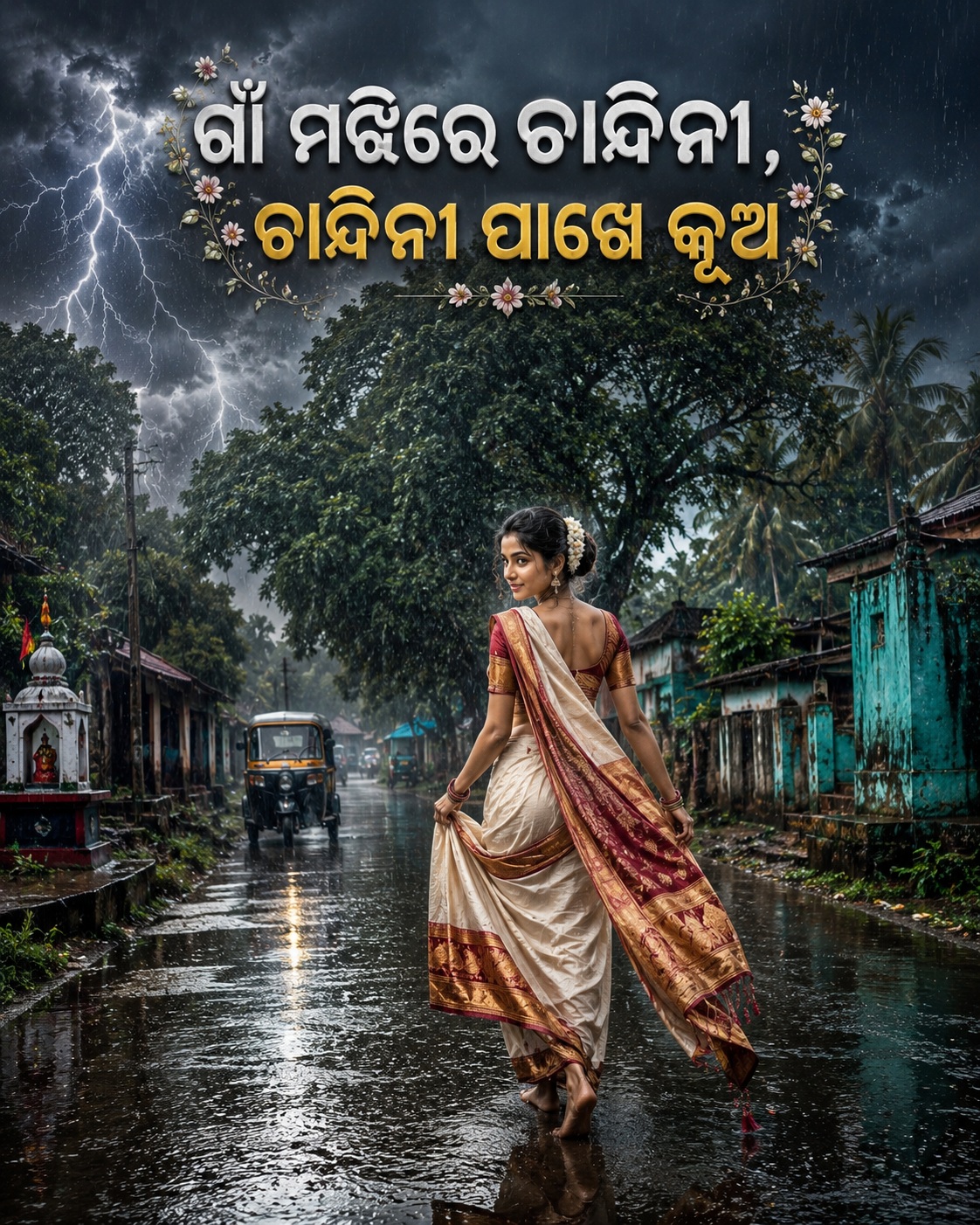
This prompt describes a highly cinematic Indian monsoon portrait poster set in a rainy village environment. The creative concept combines realistic photography, dramatic weather, traditional sari styling, rural architecture, atmospheric mist, wet-road reflections, lightning, and decorative Odia typography. The overall presentation is intended to feel emotional, romantic, dramatic, and deeply connected to the visual character of an Odisha monsoon. Instead of presenting the woman against an isolated background, the composition places her naturally inside a complete village landscape where every environmental detail contributes to the story.
The main subject is a single woman walking along a wet village road. She is positioned toward the lower-center or lower-right area of the frame, leaving a large amount of visual space above her for the stormy sky and title treatment. Her body is seen from head to feet, allowing the sari, walking movement, posture, and interaction with the rainy environment to remain visible. The woman is not intended to become an oversized central figure. Her scale remains closely connected to the reference so that the surrounding village continues to feel substantial and immersive.
Her pose is carefully controlled. She walks away from the viewer at a slight three-quarter angle while gently turning her head toward the side. One foot moves forward in a natural walking step, while her arms remain positioned exactly according to the reference. Her hands interact naturally with the sari fabric, helping control the flowing material. This creates a candid, graceful moment rather than a staged fashion pose. The body language should retain the original movement and should not be normalized into a straight standing position.
Identity is another major component of the concept. The woman’s recognizable facial structure, eyes, nose, lips, jawline, skin tone, and natural proportions remain important. The face should retain realistic texture and subtle asymmetry instead of becoming excessively smooth or artificially beautified. The person’s separate source provides identity and natural body thickness, while the main reference determines the pose, clothing, framing, and environment.
The head and neck alignment contributes to the natural quality of the portrait. The gentle head turn must remain consistent with the shoulders and torso. The neck should transition naturally into the shoulder line, while the arms, wrists, elbows, and hands should follow believable anatomy. Because the hands interact with the sari, their placement is especially important for preserving the storytelling quality of the scene.
The sari is a major visual element. The woman wears an elegant off-white or cream sari with rich maroon-red and antique-gold detailing. The traditional drape is preserved carefully, including the direction of the fabric, pleats, border, and flowing pallu. The sari should feel naturally weighted by the damp monsoon atmosphere, with believable folds and movement. The pallu trails naturally as she walks, creating a subtle sense of motion against the rain.
The gold border adds warmth to an otherwise cool rainy composition. Maroon-red accents provide a second warm color layer, allowing the woman to remain visually distinct from the gray-blue environment. The cream body of the sari catches diffused light, while darker wet folds provide depth and realism. This combination creates an elegant traditional appearance without making the clothing feel artificially bright.
Her hairstyle also contributes to the identity and cultural styling. The prompt emphasizes the hair bun or tied arrangement, loose strands, and floral details. Rain and humidity can subtly influence the hair without making it appear disordered. Small flowers around the hairstyle provide a delicate traditional accent that complements the sari.
The environment is built around a village road during a powerful monsoon storm. The road is wet, dark, and reflective, with puddles capturing broken reflections of the sky, trees, structures, and surrounding lights. Rain streaks remain visible through the frame, while atmospheric mist softens distant elements and adds depth.
The sky occupies a large portion of the upper composition. Heavy charcoal-gray, blue-gray, and silver storm clouds create a dramatic ceiling above the village. Lightning branches through the upper-left cloud formation, introducing a cool-white electric highlight. The lightning should feel integrated into the storm rather than appearing like an isolated graphic effect.
The trees are dense and naturally wet from rainfall. Deep green foliage surrounds the road, creating a strong contrast with the gray sky and cream sari. A large central tree canopy helps frame the village path and gives the composition additional vertical depth. Palm trees and other local vegetation reinforce the rural Indian setting.
Village architecture adds authenticity. Muted turquoise structures, earthy walls, roadside buildings, small shrine-like elements, and practical rural details appear naturally along the road. These elements should remain believable and subdued, supporting the story without turning the scene into a collection of decorative objects.
A visible auto-rickshaw or similar local vehicle contributes to the village atmosphere. It should remain part of the environmental storytelling rather than becoming a secondary focal point. Its placement and scale are connected to the main reference, helping preserve the original sense of depth and perspective.
The wet road is especially important because it reflects the storm environment. Dark gray-black asphalt or compacted wet road surfaces can contain soft reflections of foliage, sky, structures, and light. These reflections create visual depth and reinforce the realism of the rain. The road should never appear dry or artificially smooth.
Mist plays a subtle but powerful role. It softens distant buildings and trees, creates atmospheric layering, and helps connect the foreground to the stormy background. The mist should remain translucent and natural rather than becoming a heavy fog that hides the village.
The color palette is intentionally dramatic. The sky uses charcoal, blue-gray, and silver tones. Lightning contributes cool-white highlights. Foliage remains deep wet green. The road uses dark reflective gray and black. The sari introduces cream, maroon, and antique-gold accents. Village structures remain muted turquoise, brown, gray, and earthy shades.
This color contrast creates a strong cinematic hierarchy. The environment stays cool and stormy, while the sari supplies warm visual interest. The woman’s figure can therefore remain readable even within a dense rainy landscape.
Typography is an important part of the poster design. The exact Odia phrase is placed at the top center in two lines: “ଗାଁ ମଝିରେ ଚାନ୍ଦିନୀ , ଚାନ୍ଦିନୀ ପାଖେ କୂଅ”. The first line uses a light white or pale-gray treatment, while the second line uses warm yellow-gold. A subtle dark shadow or outline provides separation from the stormy sky.
The title is decorative but controlled. Floral or vine-like ornaments can frame the lettering without covering the characters. The typography should remain proportionate to the reference and should not become oversized. The title belongs naturally in the large sky area and works as part of the cinematic poster composition.
Text accuracy is critical because the Odia characters carry cultural and visual meaning. The requested phrase should appear only once, with the intended two-line hierarchy. There should be no additional names, captions, signatures, logos, watermarks, or unrelated lettering elsewhere in the image.
The overall lighting is created by the storm. Diffused rainy daylight provides the base illumination, while lightning produces occasional cool highlights. Wet surfaces reflect the available light, and atmospheric haze creates a soft transition between foreground and distance. This gives the poster a high dynamic range and sophisticated cinematic depth.
The scene should feel photographed rather than artificially constructed. Rain has physical direction and density, the sari responds naturally to movement and moisture, puddles reflect their surroundings, tree leaves appear wet, and distant structures fade naturally through mist. These details make the monsoon atmosphere convincing.
The emotional mood is dark, romantic, dramatic, and reflective. The woman walking through the rain creates a sense of quiet movement and personal storytelling. Her gentle head turn introduces intimacy, while the stormy landscape gives the scene a larger cinematic scale.
The composition is particularly useful for an Odia cultural poster, romantic monsoon artwork, regional film-inspired design, music or literary poster, social media artwork, editorial photography concept, or personal creative project. The combination of authentic Odia lettering and village monsoon imagery gives it a strong regional identity.
The design purpose is to balance a human story with environmental drama. The woman is important, but the village, rain, storm clouds, road, trees, and mist are equally important to the atmosphere. Keeping the subject at the correct scale allows the viewer to experience the entire scene rather than focusing only on the portrait.
The strongest visual relationship is between the warm sari and the cool storm environment. Cream fabric catches soft light, maroon and gold add warmth, and the surrounding blue-gray rain creates contrast. The Odia title then introduces a bright graphic layer that connects the cultural and cinematic aspects of the poster.
Overall, this prompt represents a carefully controlled monsoon storytelling composition. It combines identity, traditional fashion, village architecture, dramatic weather, realistic reflections, atmospheric mist, lightning, and culturally specific typography. The intended result is a polished cinematic poster that feels emotionally rich, geographically grounded, and visually authentic.
[[[
1. Main Goal & Scenario
Reconstruct the MAIN REFERENCE as a cinematic Odia monsoon poster, preserving the exact rainy village atmosphere, woman placement, road perspective, storm clouds, lightning, trees, buildings, puddle reflections, mist, and dramatic photographic mood.
2. Identity Mapping & Face Scale
Use the PERSON SOURCE only for exact face identity and natural body thickness. Preserve recognizable facial structure, eyes, nose, lips, jawline, skin tone, and natural proportions. Never copy the PERSON SOURCE pose or clothing.
3. Pose Source Lock
100% LOCK the MAIN REFERENCE pose: woman walking away at a slight three-quarter angle, head turned gently toward the side, one foot stepping forward, sari flowing naturally behind her, arms positioned exactly as shown. Never normalize or beautify the pose.
4. Typography Letter Content Lock
Render exactly this user-provided Odia text: “ଗାଁ ମଝିରେ ଚାନ୍ଦିନୀ , ଚାନ୍ଦିନୀ ପାଖେ କୂଅ”. Preserve the two-line structure shown in the MAIN REFERENCE, with the first line above the second.
5. ONE TEXT ONE PLACE Lock
Write the exact requested text ONLY ONCE, in the same top-center location as the MAIN REFERENCE. Do not repeat the phrase anywhere else.
6. Exact Text Style & Size Replication Lock
Replicate the reference typography exactly: bold decorative Odia lettering, large but proportionate, first line white/light gray, second line warm yellow-gold, subtle dark shadow/outline, cinematic poster treatment, and elegant ornamental floral/vine decoration around the lettering.
7. Direct Text Injection Command
Render the exact text “ଗାଁ ମଝିରେ ଚାନ୍ଦିନୀ , ଚାନ୍ଦିନୀ ପାଖେ କୂଅ” using the EXACT Odia letterforms, font character, color treatment, size ratio, spacing, alignment, and decorative style of the MAIN REFERENCE. Preserve every Odia character correctly.
8. No Giant Central Figure Lock
Keep the woman at the exact relative scale and lower-center/right position of the MAIN REFERENCE. Do not enlarge her into a dominant giant figure or overlap her with the title.
9. Vibe, Color & Mood Lock
Exact dark, romantic, dramatic monsoon mood. Preserve charcoal-gray storm clouds, cool blue-gray rain, deep green foliage, wet reflective asphalt, muted village colors, warm sari accents, misty atmosphere, and cinematic storm lighting.
10. Micro-Details & Crop
Preserve lightning branching through the upper-left clouds, dense central tree canopy, rain streaks, atmospheric mist, wet road texture, puddle reflections, auto-rickshaw, shrine/roadside structure, turquoise building, village architecture, palm trees, sari pleats, gold border, hair bun/flowers, and exact framing.
11. Identity, Raw Skin & Anti-Fake
Preserve exact face identity from the PERSON SOURCE with realistic skin texture and natural facial asymmetry. No plastic skin, face replacement, generic Indian face, or artificial beautification.
12. Hand-Prop & Neck-Head Alignment
Maintain the exact hand positions holding and controlling the sari fabric. Preserve natural wrist, elbow, shoulder, neck, and head alignment. No malformed fingers or generic hand pose.
13. Body Proportion & Limb Scaling
Pose and limb geometry come entirely from the MAIN REFERENCE. Body thickness comes only from the PERSON SOURCE. Preserve realistic head-to-body ratio, shoulder width, arm thickness, leg length, and foot scale.
14. Outfit Fit, Drape & Wrap
Reproduce the MAIN REFERENCE sari precisely: elegant off-white/cream sari with rich maroon-red and gold pallu/border, traditional drape, natural wet-fabric weight, realistic pleats, and flowing pallu movement. Do not convert the sari into another wrapping style.
15. Selective Color & Tone Mapping
Sky: stormy charcoal, blue-gray and silver.
Lightning: bright cool-white electric highlights.
Foliage: deep wet greens.
Road: dark reflective gray-black.
Sari: warm cream with maroon/red and antique-gold accents.
Village structures: muted turquoise, brown, gray, and earthy tones.
16. No Random Logos & Clean Text
No random logos, watermarks, signatures, modern advertisements, brand marks, or unrelated graphic elements. Preserve only authentic environmental details visible in the MAIN REFERENCE.
17. Perfect Spelling & Text Rendering
The Odia text MUST be rendered exactly as:
ଗାଁ ମଝିରେ ଚାନ୍ଦିନୀ , ଚାନ୍ଦିନୀ ପାଖେ କୂଅ
No spelling changes, missing matras, malformed conjuncts, substituted characters, random glyphs, or Latin characters.
18. Text Ratio & Style Lock
The title must occupy the same approximate percentage of the canvas as the MAIN REFERENCE. Do not make the text excessively large or small. Maintain the same two-line hierarchy and top-centered placement.
19. Opacity, Layering & Ghost
Text remains crisp and solid with subtle dimensional shadow. Decorative flowers/vines remain integrated around the title without obscuring the Odia characters. Rain and atmospheric mist may pass naturally behind the typography.
20. Duplicate Mapping & Pose Variety
Exactly one woman in exactly one pose. No duplicate person, ghost figure, mirrored figure, or repeated body parts. Environmental reflections should remain natural and must not create duplicate human figures.
21. Professional Quality Boost
Ultra-realistic cinematic photography, premium Indian monsoon poster aesthetic, physically realistic rain, wet-surface reflections, volumetric mist, dramatic cloud detail, realistic fabric physics, high dynamic range, sharp subject separation, cinematic depth, professional color grading.
22. Body Visibility & Scene Density
Maintain the full visible body from head to feet as shown in the MAIN REFERENCE. Keep the surrounding village environment dense but believable, with rain, trees, road, vehicles, structures, mist, puddles, and reflections.
23. Composition/Camera & Lighting
Vertical poster composition with the EXACT MAIN REFERENCE aspect ratio. Low-to-medium eye-level perspective looking down the wet village road. Woman positioned in the lower-center/right. Large stormy sky occupies the upper section for the title. Dramatic lightning backlighting, diffused rainy daylight, wet-surface reflections, and atmospheric haze.
24. Quality Lock & User Customization
Faithfully reconstruct the MAIN REFERENCE while using the PERSON SOURCE only for face identity and body thickness. Preserve the exact composition, pose, sari, environment, storm, title placement, typography style, color palette, lighting, and cinematic monsoon emotion. Replace/retain the title with exactly the user’s requested Odia text and nothing else.
25. Bad Output Mistakes & Negative Prompt
BLOCK: wrong identity, generic face, face paste, plastic skin, beautified face, wrong pose, copied PERSON SOURCE pose, normalized pose, standing-straight pose, broken neck, bad anatomy, bad hands, extra fingers, missing fingers, hulk hands, distorted feet, wrong sari, incorrect sari wrap, saree-style error, wrong sari colors, missing gold border, missing pallu, wrong crop, giant central figure, duplicated woman, ghost woman, mirrored person, wrong village, sunny weather, clear sky, missing storm clouds, missing lightning, missing rain,
missing mist, dry road, flat road, no reflections, wrong color grade, bright cheerful palette, random logos, watermark, signature, unauthorized text, hallucinated names, hardcoded names, duplicate text, text in multiple places, spelling mistakes, Odia glyph errors, missing matras, broken Odia characters, Latin text, giant typography, tiny typography, wrong font, single-line text, stacked beyond reference, wrong text colors, wrong decorative flowers, cluttered title, low detail, blurry image, amateur quality, AI artifacts, WRONG VIBE, WRONG COLOR PALETTE, altered aspect ratio. ]]]
” https://prompt.mahantababu.com/