
Realistic Hindu Wedding
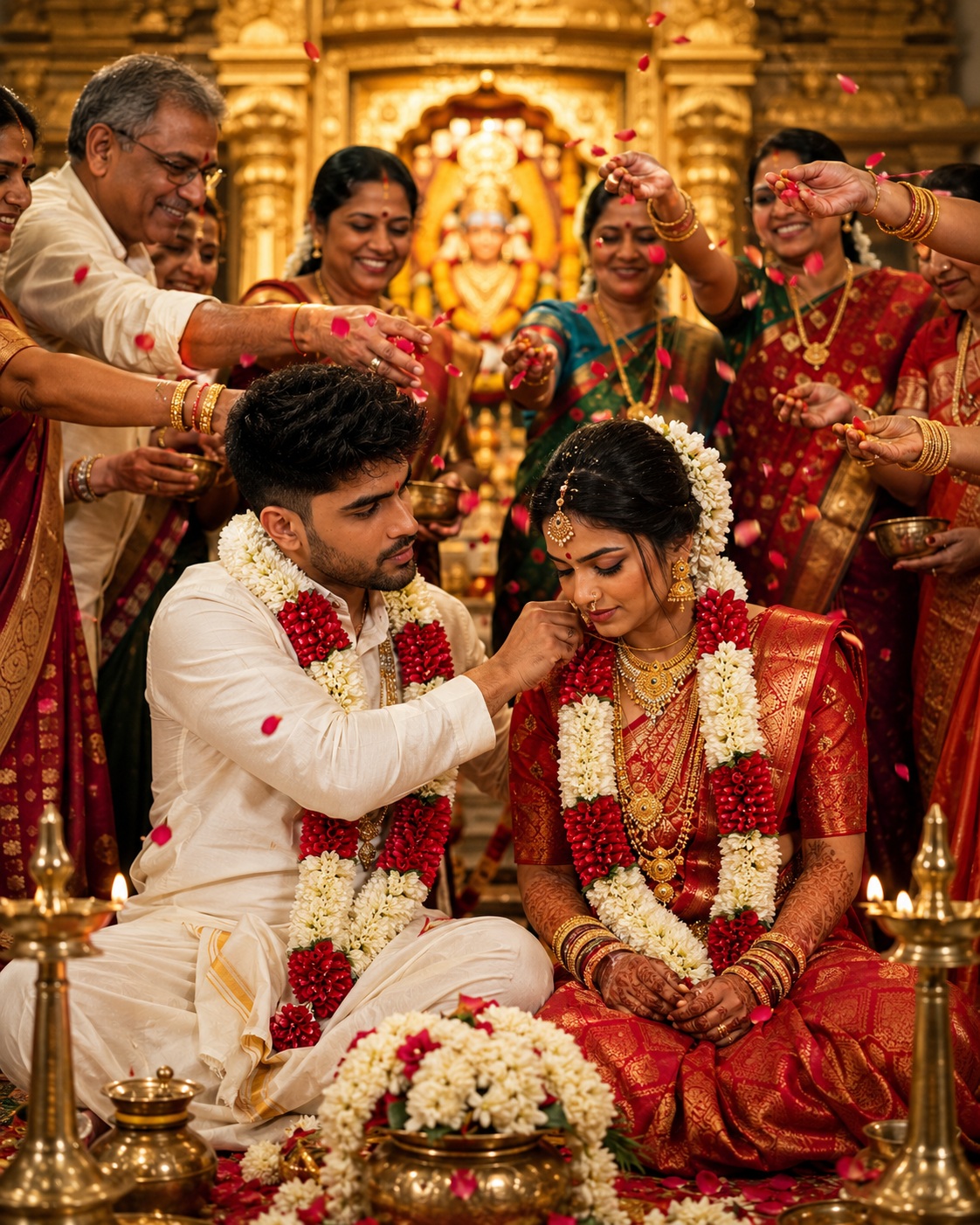
This concept centers on a traditional Indian Hindu wedding ritual captured as a rich, intimate, documentary-style celebration. The couple is the visual focus, but the scene is deliberately built as a complete family moment rather than a simple two-person portrait. The groom sits in the lower-left or central-left foreground and faces the bride, while the bride sits beside him on the lower-right. Their proximity to the camera naturally gives them greater visual importance without turning either person into an oversized central figure.
The bride is presented with the detailed visual language of a traditional Hindu bridal look. Her rich red silk sari carries ornate gold woven motifs and a substantial gold border, with the fabric falling into realistic seated folds and pleats. Her red blouse, layered jewelry, earrings, forehead ornament, bangles and other visible bridal accessories create a dense but believable ceremonial appearance. Her hands and forearms are decorated with intricate mehndi, adding another layer of cultural detail. Her dark hair is arranged in a traditional bridal style and surrounded by white jasmine flowers, making the hairstyle part of the floral story of the scene rather than a separate decorative element.
The groom has a complementary cream or white traditional outfit with loose, natural folds and a relaxed drape. His tousled dark hair remains textured with individual strands, and his small ceremonial red mark is retained where it appears in the reference. His wristwatch is an important personal detail because it adds realism and helps preserve the original character of the photograph. The interaction between the groom and bride is especially important: his right hand reaches naturally toward her neck as part of the ritual, while her head is gently lowered and her eyes look downward. Her hands remain together in her lap, giving the moment a quiet sense of concentration and emotional participation.
The family members surrounding the couple are not background decoration. They are active participants in the ceremony. Their individual identities, genders, poses, clothing and positions remain distinct. The people behind the couple extend their hands outward while releasing small red and pink rose petals, creating a lively celebratory frame around the ritual. Their traditional colorful saris, jewelry and cream-colored male clothing add visual variety while maintaining the cultural character of the setting. Because they are farther from the camera, their bodies and heads remain naturally smaller, preserving realistic perspective and the original visual hierarchy.
The setting has the character of a warm temple or ceremonial wedding interior. A central shrine or deity remains visible behind the group, supported by decorative architecture, floral arrangements and ceremonial objects. Brass lamps and vessels occupy the lower areas of the composition, with metallic surfaces showing believable reflections, small imperfections and natural wear. Garlands contain dense red flowers mixed with white flowers, while individual clusters remain readable rather than becoming a generic mass of color. Loose petals appear at different distances from the camera, so some are crisp and others naturally softer.
Color is one of the strongest parts of the concept. Deep crimson and traditional red dominate the bridal clothing and floral decorations, while cream, white, gold, brass and warm brown provide balance. The palette should feel festive and luxurious without becoming excessively orange. Skin tones remain individual and natural instead of being pushed toward the surrounding warm colors. Gold jewelry should read as reflective metal rather than flat yellow paint, and white fabric should remain recognizably white or cream under the warm ambient illumination.
The facial treatment is intentionally natural. Each person retains a distinct face, with authentic proportions, pores, fine lines, hair texture, facial hair where present, eye shape, nose, lips and cheeks. Natural asymmetry is valuable because it keeps the people recognizable and human. Expressions should remain consistent with the original moment instead of being replaced with generic smiles or polished studio expressions. The overall photographic quality is crisp and premium, but it does not depend on plastic skin or aggressive retouching.
The body language also carries much of the emotional meaning. The groom’s reaching hand communicates participation in the ritual, while the bride’s lowered gaze suggests attention, modesty and ceremonial focus. The family members’ raised hands and falling petals introduce movement and shared joy. Together, these gestures make the photograph feel like a real event that is unfolding rather than a posed studio scene.
Composition is vertically framed and closely follows the reference. The camera feels positioned around seated eye or chest level, allowing the couple and surrounding participants to occupy the frame naturally. The foreground couple remains the primary sharp area, while the background has a moderate depth-of-field effect that preserves enough clarity to identify family members, the shrine and decorative objects. This balance prevents the scene from becoming either too flat or excessively blurred.
Small details give the concept its premium character. The placement of each garland, the density of jasmine, the texture of mehndi, the folds in the sari, the groom’s clothing drape, the arrangement of flowers near the lower center, the brass vessels, lamps and loose petals all contribute to visual credibility. Even the absence of typography is meaningful: the scene is intended to stand on its photographic and emotional qualities, without names, dates, captions, logos or decorative lettering competing with the ritual.
The overall creative purpose is to preserve the feeling of a genuine family wedding photograph while giving it a refined professional photographic finish. It can suit wedding albums, anniversary memories, family keepsakes, cultural portrait collections, ceremonial photography portfolios and premium social media posts where authenticity matters more than graphic decoration. The dense group arrangement also makes the concept useful when the goal is to remember not only the bride and groom but the family participation surrounding their important moment.
For a viewer, the appeal comes from the combination of intimacy and scale. The couple can be read immediately, yet the surrounding people, shrine, flowers, lamps and ceremonial objects reward closer attention. The result feels culturally specific, emotionally warm and visually layered. Every element supports the same story: a joyful Hindu wedding ritual shared by the couple and their family, photographed with natural skin, believable anatomy, detailed textiles, reflective jewelry, warm temple light and a strong sense of place.
[[[
1. Main Goal & Scenario
Reconstruct the uploaded wedding photograph as an ultra-realistic, premium Indian Hindu wedding scene. Use the MAIN REF as the absolute authority for composition, people placement, pose, clothing, décor, lighting, camera angle, crop, colors, props, flowers, jewelry, and every visible micro-detail. Recreate the exact emotional feeling of a joyful traditional wedding ritual.
2. Multi-Person Identity & Gender Mapping Lock
- Preserve every person as a distinct individual with no face blending or identity mixing.
- Male subjects remain male and female subjects remain female.
- Never swap faces, bodies, genders, or facial characteristics between people.
- Keep the bride and groom clearly separated from all surrounding family members.
3. Strict Facial & Skin Tone Preservation Lock
- Preserve each person’s exact natural facial identity and original skin tone.
- Do not lighten, darken, tan, warm, cool, beautify, or artificially alter skin.
- Preserve natural facial asymmetry, pores, fine lines, hair texture, facial hair, eye shape, nose, lips, cheeks, and individual expressions.
- No plastic skin or generic AI faces.
4. Micro-Detail & Calendar/Prop Marking Lock
- Faithfully reproduce every visible object in the reference: brass ceremonial lamps, brass vessels, flower petals, garlands, jewelry, ritual items, flowers, decorative arch, shrine, background deity, fabrics, ornaments, floor arrangement, and tiny floral details.
- Preserve the exact positions, shapes, textures, reflections, scratches, metallic highlights, and natural wear of visible brass objects.
- Reproduce the shower of small red/pink rose petals throughout the scene with the same density and approximate trajectories.
- No calendar or date marking is present in this reference; do not invent one.
5. Identity Mapping & Face Scale
- Groom occupies the lower-left/center foreground and bride occupies the lower-right/center foreground exactly as shown.
- Maintain their relative head sizes and realistic body scale.
- Background family members remain smaller because of their distance from the camera.
- Never enlarge any person disproportionately.
6. Pose Source Lock
- Lock every pose to the MAIN REF.
- Groom sits facing toward the bride, extending his right hand toward her neck while performing the wedding ritual.
- Bride sits beside him with her head gently lowered and eyes cast downward, hands resting together in her lap.
- Family members behind them extend their hands outward while showering flower petals.
- Do not normalize, straighten, redesign, or beautify any pose.
7. Typography Letter Content Lock
There is no visible typography or lettering in the MAIN REF. Do not introduce any text, title, slogan, initials, wedding date, watermark, or decorative lettering.
8. ONE TEXT ONE PLACE Lock
No text is required. Keep the entire reconstructed image completely free of added text.
9. Exact Text Style & Size Replication Lock
No typography exists in the reference, therefore do not generate any typography.
10. Direct Text Injection Command
Render NO TEXT. Do not generate names, dates, captions, logos, watermarks, initials, or decorative lettering anywhere in the image.
11. No Giant Central Figure Lock
- Do not create a giant central bride or groom.
- Maintain the exact balanced group composition.
- Bride and groom are prominent because they are closest to camera, but neither should overpower the frame.
- Preserve substantial visibility of the surrounding family members and temple décor.
12. Vibe, Color & Mood Lock
- Preserve the warm, celebratory, devotional, intimate Indian wedding atmosphere.
- Rich traditional palette dominated by deep red, crimson, cream, white, gold, brass, and warm brown.
- Keep the luxurious golden temple ambience without turning the entire image artificially orange.
- Preserve the joyful flower-shower moment and authentic family participation.
- Maintain natural cinematic warmth and festive saturation.
13. Micro-Details & Crop
- Preserve the vertical portrait crop and framing.
- Groom’s tousled dark hair remains naturally textured with individual strands.
- Bride’s dark hair is tied into a traditional bridal hairstyle and surrounded by white jasmine flowers.
- Preserve the groom’s small red tilak/bindi-like ceremonial mark exactly where visible.
- Preserve the bride’s forehead jewelry, central maang-tikka, earrings, layered necklaces, bangles, nose jewelry if visible, and traditional bridal adornments.
- Preserve the bride’s intricate mehndi covering her hands and forearms.
- Preserve the groom’s wristwatch.
- Preserve every individual flower cluster in both garlands.
- Preserve white flowers interspersed with dense red flowers in the garlands.
- Preserve loose rose petals floating between foreground and background.
- Preserve the bride’s red silk sari with gold woven motifs, rich red blouse, ornate gold border, and realistic fabric folds.
- Preserve the groom’s cream/white traditional outfit with the same loose folds and drape.
- Preserve the flower arrangement resting near the lower center of the couple.
- Preserve the ceremonial brass vessels and lamps around the bottom edges.
14. Identity, Raw Skin & Anti-Fake
- Photorealistic human skin with authentic pores and subtle texture.
- No airbrushing, waxy complexion, excessive beauty retouching, or porcelain skin.
- Maintain realistic age, facial structure, and natural expression for every individual.
- Facial details must remain sharp without becoming overprocessed.
15. Hand-Prop & Neck-Head Alignment
- Groom’s hand must remain positioned naturally near the bride’s neck as he performs the ritual.
- Preserve the exact interaction between groom’s fingers, ceremonial thread/necklace, and bride’s neck area.
- Bride’s hands remain naturally folded/resting together in her lap.
- Background hands must remain anatomically connected to the correct arms and bodies.
- Flower petals must appear naturally released from the family members’ hands.
- No floating hands, detached fingers, duplicated arms, or impossible wrist rotations.
- Preserve realistic neck-to-head alignment for every subject.
16. Body Proportion & Limb Scaling
- Maintain anatomically realistic proportions.
- Groom’s arms, hands, shoulders, torso, and legs must match his natural body thickness.
- Bride’s arms, hands, shoulders, torso, and seated posture must remain realistic.
- Background family members must have proportionally smaller bodies according to perspective.
- No oversized hands, swollen fingers, elongated limbs, tiny heads, or distorted joints.
17. Outfit Fit, Drape & Wrap
- Groom: preserve the exact cream/white traditional Indian wedding clothing, including loose sleeve shape and lower garment arrangement.
- Bride: preserve the exact rich red bridal sari, gold border, gold motifs, red blouse, pleats, folds, and seated drape.
- The sari must remain a sari, never transform into a gown, lehenga, western dress, or incorrectly wrapped fabric.
- Preserve the exact density and placement of bridal jewelry.
- Background women retain their traditional colorful saris and jewelry exactly according to their positions in the reference.
- Background older male retains his cream traditional clothing.
- Clothing must show realistic fabric weave, folds, creases, embroidery, and natural gravity.
18. Selective Color & Tone Mapping
- Keep whites and creams naturally neutral while retaining the warm ambient temple lighting.
- Deep reds remain rich crimson/red rather than becoming orange or purple.
- Gold jewelry and temple décor remain metallic gold/brass with realistic reflections.
- Skin tones must remain individually accurate and must not be color-graded to match the red/gold environment.
- Maintain natural highlight-to-shadow transitions.
19. No Random Logos & Clean Text
- Absolutely no logos, brand marks, signatures, watermarks, artificial symbols, or generated typography.
- Do not invent signage or lettering on the temple décor.
- Any indistinct decorative background detail must remain decorative and non-textual.
20. Perfect Spelling & Text Rendering
No text is requested. Therefore render zero text and do not hallucinate any letters.
21. Text Ratio & Style Lock
No text exists in the reference. Preserve the original image entirely without adding typography.
22. Opacity, Layering & Ghost
- Every person must be fully opaque and naturally integrated into the environment.
- Rose petals at different depths may vary naturally in sharpness according to focus distance.
- No artificial ghosting, transparent people, duplicated silhouettes, or semi-transparent bodies.
- Foreground petals can overlap subjects naturally without obscuring important facial identity.
23. Duplicate Mapping & Pose Variety
- Do not duplicate any person.
- Every family member appears only once.
- Preserve the distinct hand positions and individual poses visible around the couple.
- Each falling petal should feel naturally varied in size, orientation, distance, and motion rather than copy-pasted.
24. Professional Quality Boost
Ultra-photorealistic professional wedding photography, high dynamic range, crisp facial detail, realistic textile texture, physically accurate jewelry reflections, natural depth of field, high-resolution skin detail, sophisticated exposure, clean edges, realistic optical rendering, premium editorial wedding photography quality.
25. Body Visibility & Scene Density
- Preserve the dense celebratory composition.
- Couple occupies the main foreground.
- Multiple family members remain clearly visible behind and beside them.
- Preserve the temple/shrine architecture behind the group.
- Do not simplify the background.
- Do not remove ceremonial objects, lamps, flowers, petals, jewelry, or participating family members.
26. Composition/Camera & Lighting
- Exact vertical portrait composition matching the MAIN REF.
- Camera positioned approximately at seated eye/chest level with the couple.
- Groom on the left foreground, bride on the right foreground.
- Family members form a natural semicircular/background arrangement around them.
- Central temple deity/shrine remains visible behind the couple.
- Warm indoor temple lighting with golden illumination on architectural details.
- Soft natural falloff across faces and clothing.
- Moderate shallow depth of field: couple remains the primary sharp subjects while background retains enough clarity to recognize family and temple details.
- Preserve the exact crop, perspective, subject spacing, negative spaces, and visual hierarchy of the reference.
27. Quality Lock & User Customization
Create a faithful photographic reconstruction, not an interpretation or redesign. The MAIN REF controls everything except identity information supplied by separate person-source images. If person-source images are later supplied, use them only for the corresponding person’s face identity, body thickness, and exact original skin tone while retaining the MAIN REF’s pose, outfit, composition, background, lighting, and styling.
28. Bad Output Mistakes & Negative Prompt
BLOCK: wrong identity, generic faces, face paste, face blending, gender swap, cross-contamination of features, copied person-source pose, normalized pose, altered skin tone, darkened skin, artificial tan, plastic skin, beauty filter, smooth skin, wrong facial proportions, wrong bride/groom placement, wrong pose, broken neck, bad anatomy, bad hands, extra fingers, missing fingers, fused fingers, oversized hands, hulk hands, detached limbs, duplicated people, duplicate family members, floating hands, wrong sari, incorrect sari wrap,
western clothing, incorrect jewelry, missing jasmine flowers, missing garlands, missing mehndi, missing petals, missing temple deity, missing brass lamps, missing ceremonial vessels, simplified background, empty background, wrong color palette, excessive orange cast, dull colors, flat lighting, harsh studio lighting, random logos, watermark, signatures, unauthorized text, names, dates, captions, letters,
hallucinated typography, giant text, giant central figure, cartoon, illustration, CGI appearance, waxy skin, low-resolution faces, blurry subjects, oversharpening, AI artifacts, unnatural expressions, unrealistic fabric, unrealistic metallic surfaces, missing micro-details, altered crop, altered aspect ratio, wrong perspective, wrong depth of field, amateur wedding photography, WRONG VIBE, WRONG COMPOSITION. ]]]
” https://prompt.mahantababu.com/