
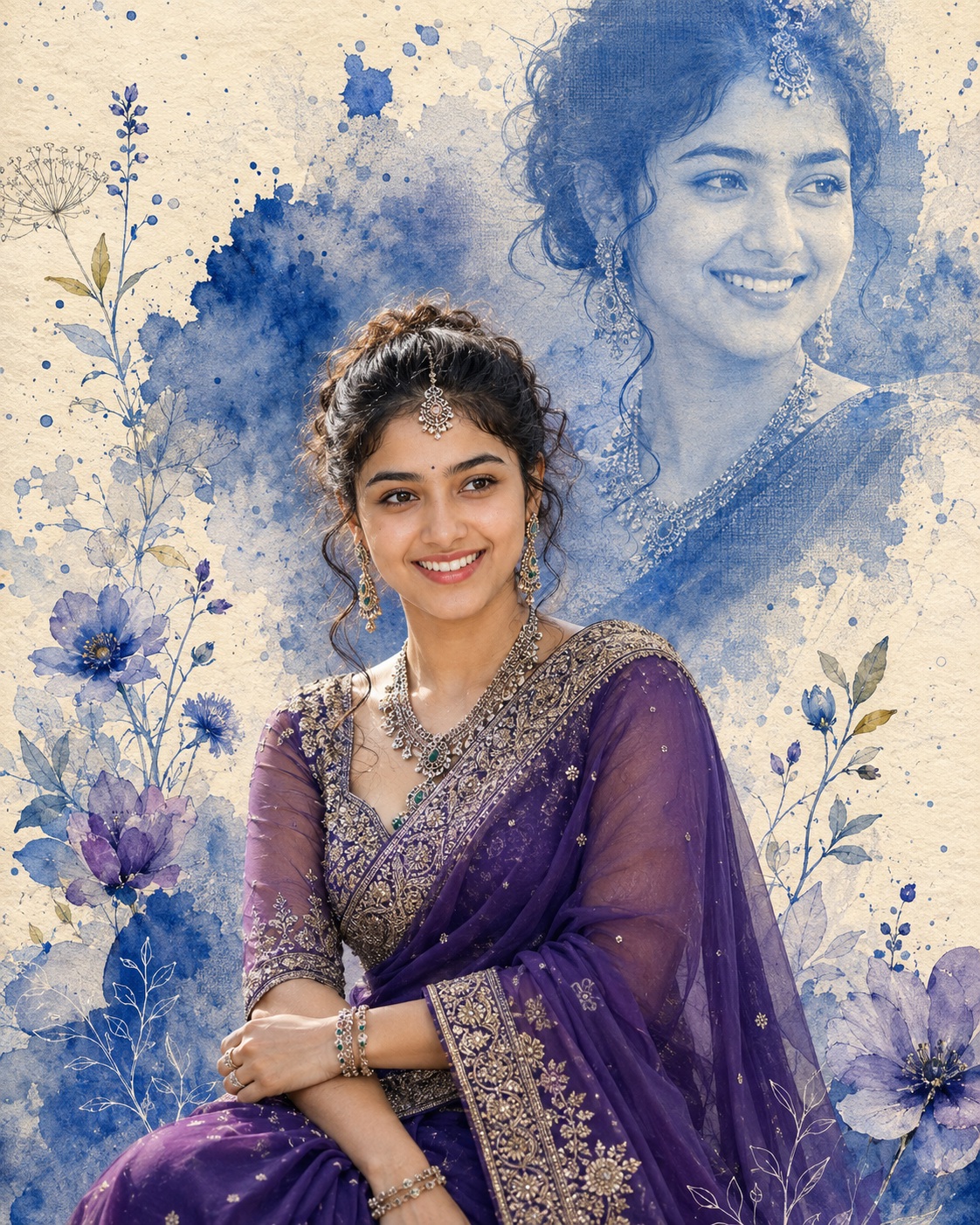
Watercolor Bridal Poster
This creative concept centers on a single female subject presented as the dominant photographic figure within a carefully layered editorial poster. The woman is not treated as a generic fashion model; her individual facial identity is an important part of the visual character. The concept places strong emphasis on keeping her recognizable appearance, natural facial structure, original skin tone, and realistic physical proportions intact.
Her face should retain the qualities that make her distinct, including the shape of the eyes, nose, lips, cheeks, jawline, hairline, natural skin texture, pores, eyelashes, and small facial characteristics. The overall intention is to make the woman look like a real photographed person integrated into a handcrafted art poster rather than a digitally smoothed or overly beautified character.
The pose has a graceful Indian editorial quality. The woman is seated or positioned in the same elegant three-quarter orientation established by the reference, with her torso naturally angled and her head turned slightly toward the viewer’s right. Her shoulders remain relaxed rather than rigid. Her arms rest or fold naturally across the lower torso, creating a calm and sophisticated body language. The hands remain close to the waist and forearm area, contributing to the composed fashion portrait rather than creating an exaggerated modeling pose. Anatomical realism is particularly important here because the concept depends on a believable relationship between the head, neck, shoulders, arms, wrists, fingers, and torso.
The face and expression are designed to feel natural, refined, and quietly confident. There is no intention to create an exaggerated smile, dramatic expression, or artificial glamour look. Instead, the facial presence should complement the romantic vintage editorial atmosphere. Natural skin variation, subtle facial lines, authentic eyes, individual eyelashes, realistic teeth, and small imperfections help maintain the photographic quality of the main subject. Loose curly strands around the face and the detailed updo contribute to the sophisticated bridal styling while preventing the hairstyle from appearing overly artificial.
The wardrobe is one of the strongest visual anchors in the concept. The woman wears a deep royal-purple sari with an elaborate silver or antique-metallic embroidered border. The sari includes dense ornamental motifs and a richly decorated blouse. A semi-sheer purple fabric element appears around the right arm, while the heavily detailed pallu crosses the lower and front portion of the body. The folds, fabric weight, embroidery density, border direction, transparency, and natural wrinkles all contribute to the luxurious character of the clothing. The styling is distinctly Indian and bridal-inspired without losing the editorial fashion-poster quality.
Jewelry adds another layer of visual richness. The styling includes a small forehead bindi, an ornate central maang-tikka, layered earrings, multiple necklaces, bracelets, and rings. Subtle green gemstone accents provide a restrained contrast against the purple and metallic palette. The jewelry is meant to appear physically connected to the body, with believable reflections and natural contact against the skin and sari fabric. Rather than functioning as isolated decorative objects, the ornaments help communicate a polished traditional fashion identity.
The background is deliberately different from the realistic foreground subject. It is built around warm ivory and cream paper combined with deep royal or cobalt blue watercolor washes. The upper-right portion contains a large faded artistic portrait representation of the same woman. This secondary portrait is not intended to look like another person physically standing behind her. Instead, it behaves like an illustrated layer made from watercolor, ink, halftone texture, and faded print treatment. Its semi-transparent quality creates depth while keeping the main photographic woman visually dominant.
The background artwork contains a dense collection of handcrafted details. Blue watercolor splashes spread organically across the paper, with irregular edges and visible pigment variation. Purple and blue ink droplets appear as small scattered marks. Fine botanical outlines resemble delicate pencil or ink drawings. Translucent flowers, thin stems, leaves, small circular floral centers, and white botanical linework create an ornamental frame around the portrait. Paint bleed and uneven watercolor transitions make the surface feel handmade rather than digitally flat.
Paper texture is also an important part of the concept. The cream background should feel tactile, with subtle grain and distressed print characteristics. Small imperfections in the painted areas help establish the appearance of a premium physical poster or editorial art print. The watercolor edges should not look perfectly geometric. Instead, they should have the soft irregularity associated with pigment spreading through paper. This handcrafted character is central to the visual identity of the Watercolor Bridal Poster concept.
The color palette is intentionally controlled. Warm ivory and cream establish the foundation, while cobalt and royal blue dominate the illustrated portions. Deep purple provides the primary clothing color, and muted silver or antique metallic tones define the jewelry and embroidery. Small green gemstone accents provide restrained visual variation. The woman’s natural skin tone remains independent from the surrounding blue and purple artwork, producing a selective-color relationship between photographic subject and illustrated environment.
Lighting remains soft and flattering on the main woman. The portrait should retain realistic studio or editorial illumination rather than becoming heavily cinematic or dramatically color-graded. Skin highlights should remain believable, jewelry should catch light naturally, and the sari should show dimensional folds. The cool blue background and warm paper surface provide the atmosphere, while the foreground lighting keeps the woman visually clear and photographic.
Composition is vertically oriented and poster-like. The woman occupies the central-to-right and lower visual region without becoming an oversized figure. Considerable painted and decorative space remains around her. The large faded portrait occupies the upper-right background, while the blue wash expands around the head and integrates the secondary artwork into the cream paper. Botanical drawings, flowers, paint splatters, and cropped decorative elements populate the sides and lower edges, creating visual density without overwhelming the subject.
An especially important design decision is the complete removal of typography from the reference. The original vertical lettering, handwritten word, branding, watermark, signatures, captions, and other textual marks are intentionally absent. The area previously occupied by lettering becomes clean painted-paper space that continues the surrounding watercolor treatment. This allows the composition to remain balanced while making the finished artwork suitable for later personalization.
The Watercolor Bridal Poster concept is therefore less about simple portrait decoration and more about combining photography, Indian bridal fashion, watercolor illustration, and vintage print design into one coherent visual language. The photographic woman provides realism and identity, while the faded blue portrait provides artistic depth. The cream paper gives the composition a tactile foundation, and the botanical artwork creates a handcrafted decorative frame.
The creative value comes from the contrast between realism and illustration. The woman’s face, skin, sari, jewelry, and body remain photographic and detailed, while the surrounding portrait wash and botanical graphics feel painted. This contrast makes the composition visually memorable and gives it the character of an exclusive fashion editorial print. The Watercolor Bridal Poster approach also creates enough negative space for future personalization without requiring the artwork itself to contain any words.
The concept is particularly suitable for bridal portraits, wedding keepsakes, anniversary artwork, fashion editorials, traditional Indian portrait collections, premium social-media artwork, personalized gifts, studio portfolio presentations, and decorative wall posters. Because the composition contains no fixed name or message, it can also serve as a flexible personalized design where custom typography may be introduced later without disturbing the original visual hierarchy.
Overall, the design combines a graceful female portrait, rich purple sari styling, elaborate jewelry, expressive but natural facial detail, botanical illustration, cobalt watercolor painting, cream paper texture, halftone character, and vintage editorial finishing. Every layer contributes to the same handcrafted Indian-fashion-poster mood. The result is intended to feel refined, artistic, tactile, luxurious, and emotionally warm while still retaining the realism expected from a professional portrait.
[[[
1. Main Goal & Scenario
Reconstruct the uploaded MAIN REFERENCE as an ultra-detailed premium editorial portrait poster, preserving the exact composition, pose, framing, wardrobe styling, background artwork, color palette, lighting, layering, floral graphics, paint textures, and overall visual mood of the reference.
IMPORTANT: The user will add their own name later. For this version, render NO TEXT whatsoever.
2. Multi-Person Identity & Gender Mapping Lock
Use the provided Person Source only for the identity of the female subject, if a Person Source is supplied.
Keep the subject unmistakably female and preserve her individual facial identity; do not introduce features from any other person.
3. Strict Facial & Skin Tone Preservation Lock
Preserve the Person Source female’s exact original facial identity and exact original skin tone without brightening, darkening, tanning, whitening, or recoloring.
Retain natural pores, facial texture, eye shape, nose, lips, cheeks, jawline, hairline, and all distinctive facial characteristics; no plastic beauty filter or generic face.
4. Micro-Detail & Calendar/Prop Marking Lock
Reproduce every visible micro-detail of the MAIN REFERENCE: cream paper texture, blue watercolor splashes, irregular paint edges, scattered blue/purple ink droplets, faint pencil-like botanical outlines, translucent flowers, fine stems, leaves, tiny circular floral centers, white botanical linework, paint bleed, paper grain, distressed print texture, and layered watercolor imperfections.
There is no calendar or date marking in this reference, so do not invent any calendar, date, icon, symbol, badge, or additional prop.
5. Identity Mapping & Face Scale
The central woman must remain the dominant human subject, with a realistic face-to-body scale matching the reference.
Preserve the natural facial proportions and expression; do not enlarge the head, shrink the body, or create an oversized fashion-model face.
6. Pose Source Lock
Copy the MAIN REFERENCE pose exactly: woman seated/posed in the same elegant three-quarter orientation, torso angled naturally, head turned slightly toward the viewer’s right, relaxed shoulders, arms folded/resting across the lower torso, hands positioned naturally near the waist and forearm, and the same overall body posture.
Never copy pose, clothing, or background from a Person Source image.
7. Typography Letter Content Lock
The reference contains large vertical lettering and a handwritten-style word, but ALL ORIGINAL REFERENCE TEXT MUST BE REMOVED.
Do not reproduce the vertical title, handwritten lettering, watermark, branding, initials, signatures, captions, or any other textual element.
8. ONE TEXT ONE PLACE Lock
For this version: ZERO TEXT, ZERO LETTERS, ZERO WORDS anywhere in the image.
Leave the composition visually balanced after removing the reference typography; do not replace it with placeholder text.
9. Exact Text Style & Size Replication Lock
No typography is required in this version.
Do not generate fake lettering, decorative alphabets, random symbols, pseudo-text, watermarks, logos, or text-like artifacts.
10. Direct Text Injection Command
Render no text. The user will provide their own name later. Do not anticipate, invent, or hallucinate any name.
11. No Giant Central Figure Lock
Do not make the woman excessively large or crop her unnaturally.
Preserve the reference’s elegant poster proportions, with the woman occupying the central-right/lower area while the painted background remains clearly visible around her.
12. Vibe, Color & Mood Lock
Match the reference’s romantic, artistic, vintage editorial, handcrafted Indian-fashion-poster mood.
Use the exact dominant palette: warm ivory/cream paper, deep royal/cobalt blue watercolor, rich purple/violet sari, muted silver/antique metallic jewelry, subtle green gemstone accents, and restrained natural skin tones.
Do not convert the image into dark cinematic gold, orange, red, neon, or monochrome styling.
13. Micro-Details & Crop
Preserve the exact portrait crop and vertical poster framing.
Maintain the loose curly strands around the face, detailed updo, tiny forehead bindi, ornate central maang-tikka, layered earrings, multiple necklaces, bracelets, rings, sari embroidery, translucent sleeve fabric, embroidered border, scattered floral overlays, paint splatters, and fine botanical strokes.
Keep partially cropped flowers and paint marks exactly where they visually occur at the frame edges.
14. Identity, Raw Skin & Anti-Fake
The woman’s face must look photographic and naturally textured rather than AI-generated.
Preserve realistic skin pores, subtle facial lines, natural highlights, authentic teeth, realistic eyes, individual eyelashes, and naturally imperfect hair strands; no excessive smoothing, airbrushing, face reshaping, or artificial glamour filter.
15. Hand-Prop & Neck-Head Alignment
Preserve the exact hand placement and relaxed arm interaction from the MAIN REFERENCE.
Maintain anatomically correct wrists, fingers, knuckles, nails, elbows, shoulders, neck, jaw, and head alignment; jewelry must sit naturally against the skin and fabric.
16. Body Proportion & Limb Scaling
Maintain realistic feminine anatomy and the same body thickness/proportions established by the Person Source while following the MAIN REFERENCE pose.
Hands must remain naturally sized—no oversized/Hulk hands, elongated fingers, missing fingers, fused fingers, or distorted wrists.
17. Outfit Fit, Drape & Wrap
Reproduce the exact deep royal-purple sari styling from the reference.
The sari has an elaborate silver/antique embroidered border with dense ornamental motifs, a matching richly decorated blouse, semi-sheer purple fabric on the right arm, small scattered embroidered motifs, and a heavily detailed pallu draped across the lower/front body.
Preserve the exact drape, folds, fabric weight, border direction, embroidery density, transparency, and natural fabric wrinkles; do not convert the sari into a different wrap or outfit.
18. Selective Color & Tone Mapping
Keep the woman’s natural skin tone independent from the blue/purple artwork.
The background uses intentionally cool blue watercolor portrait treatment, while the main woman remains full-color and photographic.
Preserve this selective-color contrast exactly: realistic full-color foreground subject + blue/cream/purple illustrated background treatment.
19. No Random Logos & Clean Text
Remove the small branding/watermark visible in the lower-left area of the reference as well as every other textual mark.
Do not add studio logos, creator signatures, AI watermarks, brand marks, social-media handles, or decorative typography.
20. Perfect Spelling & Text Rendering
No text is required.
Therefore the image must contain no accidental words, letters, numbers, captions, pseudo-writing, malformed typography, or hidden watermark text.
21. Text Ratio & Style Lock
The original typography area should become a clean, naturally integrated painted-paper/background area, retaining the original blue paint textures and surrounding composition without introducing replacement text.
22. Opacity, Layering & Ghost
Recreate the large faded monochrome/blue-tinted secondary portrait behind the main woman as an integrated watercolor/ink illustration layer.
It should appear semi-transparent and painterly, with halftone/printed texture and irregular watercolor edges—not as a second sharp photographic person.
Preserve the layered relationship between the main subject, blue portrait wash, paint splashes, and foreground botanical illustrations.
23. Duplicate Mapping & Pose Variety
There is one main photographic woman plus one faded artistic portrait representation of the same subject in the upper-right background.
The background portrait must remain a stylized, semi-transparent graphic treatment rather than an additional solid person standing behind her.
Do not duplicate the main photographic body or create extra people.
24. Professional Quality Boost
Ultra-high-end professional fashion editorial quality, crisp facial detail, realistic sari fabric, extremely detailed embroidery, realistic jewelry reflections, refined watercolor integration, sophisticated print texture, clean edges, subtle paper grain, premium poster finishing, high-resolution photographic rendering.
25. Body Visibility & Scene Density
Keep the woman visible from approximately head through the lower seated/torso region as shown in the reference.
Do not excessively zoom in, cut off the face, or fill the entire canvas with the body.
Maintain the dense but controlled decorative environment of watercolor splashes and botanical artwork around her.
26. Composition/Camera & Lighting
Vertical portrait poster composition, matching the reference aspect ratio and framing.
Main woman positioned centrally with a slight right-side emphasis; substantial negative/painted space around her; large faded blue portrait occupying the upper-right background; blue paint wash spreading organically behind the head; botanical line drawings and watercolor flowers concentrated around the lower and side edges.
Use soft, flattering but realistic studio/editorial lighting on the main woman while preserving the cream-paper and cool-blue painted atmosphere.
27. Quality Lock & User Customization
The user will provide their own name later. Do not include any name now.
The reconstruction must preserve the reference’s exact visual hierarchy while making the final result clean and text-free, ready for later personalized typography insertion.
Do not alter the aspect ratio, pose, sari styling, background density, facial identity, skin tone, or artistic treatment.
28. Bad Output Mistakes & Negative Prompt
NEGATIVE PROMPT: wrong identity, generic face, face paste, face blending, plastic skin, smooth skin, beauty filter, altered skin tone, darkened skin, whitened skin, artificial tan, wrong pose, copied Person Source pose, normalized pose, broken neck, bad anatomy, malformed hands, extra fingers, missing fingers, fused fingers, hulk hands, distorted wrists, wrong sari, wrong sari wrap, saree drape error, incorrect embroidery, missing jewelry, missing maang-tikka, missing bindi, wrong jewelry, duplicate photographic person, extra people,
solid duplicate background person, wrong background portrait, wrong watercolor texture, flat background, photorealistic secondary portrait, incorrect blue wash, incorrect purple palette, warm golden color grading, dull colors, missing botanical artwork, missing paint splatters, missing paper grain, missing watercolor bleed, missing floral details, missing fine linework, giant central figure, excessive crop, wrong aspect ratio,
random logos, watermark, signature, creator credit, unauthorized text, letters, numbers, captions, pseudo-text, gibberish, hallucinated names, hardcoded names, placeholder text, typography, duplicate text, AI artifacts, low detail, low resolution, oversharpening, blurry face, unnatural eyes, artificial teeth, distorted jewelry, unrealistic fabric, amateur poster design. ]]]
” https://prompt.mahantababu.com/