
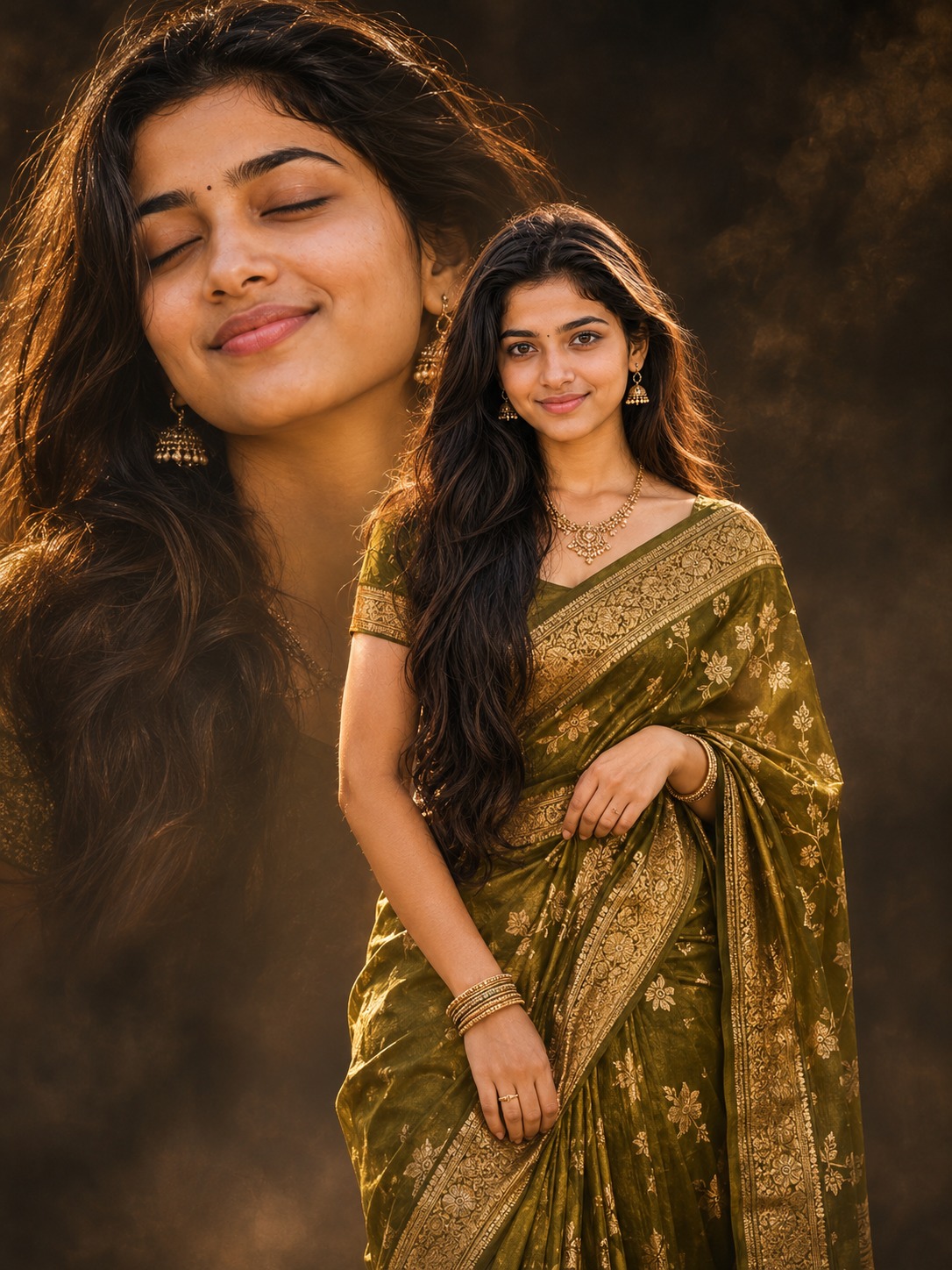
Olive Saree Double Exposure
The creative concept focuses on an elegant Indian woman wearing a rich olive-green silk saree, presented through a sophisticated double-exposure portrait composition. The artwork combines two views of the same woman within one vertical frame. A large, dreamy close-up fills much of the upper and left background, while a smaller standing portrait appears in the foreground. This arrangement creates depth and gives the design the appearance of a luxury fashion editorial.
The most distinctive feature is the relationship between the two portraits. The larger background portrait shows the woman with her eyes gently closed and a peaceful smile. Her head is slightly tilted, giving the close-up a calm and reflective feeling. The face occupies a significant part of the composition, allowing the viewer to notice the expression, facial details and traditional accessories. Its softer presentation makes it feel like an emotional visual memory behind the main portrait.
The foreground portrait presents the same woman standing gracefully and looking directly toward the camera. Her gentle smile creates a welcoming and confident expression. Her body is slightly angled, giving the pose a natural fashion-photography appearance rather than a rigid front-facing stance. One hand holds the saree pleats near her waist, while the other rests naturally near the lower waist. These hand positions bring attention to the saree draping and create a balanced silhouette.
The two portraits are designed to represent the same person consistently. Their expressions are different, but they share the same facial identity and overall appearance. This visual connection is important because the background close-up and foreground standing figure are not separate characters. They are two complementary views of one woman, creating a personal and polished double-portrait effect.
The olive-green silk saree is the central fashion feature. Its rich color gives the composition a traditional Indian appearance while also feeling refined and luxurious. Intricate golden woven motifs decorate the fabric, adding fine detail and visual richness. The decorative golden border gives the saree a clear outline, while the natural folds and pleats create depth around the waist and lower body. The silk surface has a soft sheen that responds beautifully to the warm studio lighting.
The matching short-sleeved blouse completes the traditional outfit. Its olive-green shade keeps the overall styling coordinated, allowing the gold embroidery and jewelry to stand out. The saree is draped elegantly, with the pleats arranged neatly near the waist. The foreground figure gives viewers a clear view of the fabric, its decorative patterns and the way the material falls naturally over the body.
Traditional gold jewelry adds another important layer of detail. Gold jhumka earrings frame the face and introduce a familiar Indian festive style. The elaborate necklace creates a decorative focal point around the neckline. Bangles and rings add smaller highlights around the hands and wrists. A small bindi completes the traditional appearance and brings attention to the forehead. The jewelry is intended to look coordinated rather than excessive, complementing the richness of the saree.
The woman’s hair is long, thick and dark, with natural waves swept over one shoulder. Its volume creates a graceful frame around the face and adds softness to the overall composition. In the foreground portrait, the hair cascades over the saree, creating a contrast between dark strands, olive fabric and gold detailing. In the background close-up, the hair blends into the darker surroundings while retaining enough detail to frame the face.
The background uses deep dark brown and black tones to create a smoky studio environment. Subtle golden atmospheric textures and soft haze add dimension without distracting from the portraits. The background is not designed as a recognizable outdoor or indoor location. Instead, it works like a carefully controlled fashion-photography setting, giving the artwork a dramatic and timeless appearance.
Warm amber lighting is one of the defining elements of the visual style. Soft golden illumination highlights the face, jewelry and silk fabric. A gentle rim light separates the subject from the dark background, helping the hair and shoulders remain visible. Dramatic shadows preserve the depth of the scene, while bronze highlights add warmth to the gold accessories. The lighting creates a rich atmosphere without making the portrait appear overly bright.
The color palette is carefully balanced around olive green, antique gold, warm bronze, amber and deep black. Olive green gives the saree its distinctive identity. Antique gold appears in the embroidery and jewelry, connecting the fashion elements. Bronze and amber tones create warmth, while black and dark brown provide contrast. These colors work together to make the artwork feel luxurious, traditional and cinematic.
The double-exposure arrangement is what makes the composition especially memorable. Instead of presenting only one conventional fashion portrait, the design places a large facial close-up behind a smaller standing figure. The oversized portrait gives the upper part of the artwork emotional presence, while the foreground figure shows the complete styling and graceful pose. The two layers create a sense of scale and visual storytelling.
The vertical 3:4 framing supports this layered arrangement. The large portrait occupies the upper and left background, while the standing woman remains the main foreground subject. The spacing between the two portraits helps each remain recognizable. The dark atmospheric areas provide breathing room around the figures, allowing the artwork to feel balanced rather than crowded.
The camera feeling combines the intimacy of close-up portrait photography with the elegance of a full-length fashion photograph. The background face feels soft and expressive, while the foreground figure presents the saree, jewelry and body language more clearly. Realistic skin texture, natural facial details and the sheen of the silk help the concept retain a photographic quality.
This style is suitable for traditional fashion editorials, personalised saree portraits, festive profile pictures, cultural celebration posters, social media posts and elegant printed artwork. It can also work well for special occasions where traditional clothing and personal identity are important. The layered design gives a simple portrait a more premium presentation.
The visual appeal comes from the balance of softness and richness. The closed-eye expression in the background creates a peaceful mood, while the direct gaze in the foreground adds confidence. The detailed saree and gold jewelry provide visual richness, and the smoky studio environment keeps the composition refined. Each element contributes to a consistent traditional fashion story.
For a personalised version, the facial identity is the main variable. The two portraits should clearly represent the same woman, while retaining their different expressions and angles. The standing pose, saree styling, jewelry, hairstyle, background and lighting form the established visual design. This consistency allows the final concept to feel like one carefully composed fashion photograph rather than two unrelated pictures.
Overall, the artwork celebrates Indian traditional fashion through a luxurious olive-green saree, intricate gold details and a cinematic double-exposure layout. It combines graceful posing, a peaceful expression, warm studio lighting and a dark atmospheric background. The result is elegant, expressive and suitable for anyone who appreciates traditional styling presented with a modern editorial touch.
[[[
REFERENCE ANALYSIS
- Image Type: Luxury cinematic Indian traditional portrait + double-exposure photography.
- Aspect Ratio: Vertical portrait, approximately 3:4.
- Main Subject: A young woman wearing an elegant olive-green silk saree.
- Foreground Portrait: Full-length/three-quarter standing portrait, gentle smile, looking directly at the camera.
- Background Portrait: An oversized close-up of the same woman’s face with closed eyes and a peaceful smile.
- Pose: Foreground woman standing gracefully, one hand holding the saree pleats near her waist and the other resting naturally near the lower waist.
- Outfit: Rich olive-green silk saree with intricate golden woven patterns, matching short-sleeved blouse and traditional gold jewelry.
- Accessories: Gold jhumka earrings, elaborate gold necklace, bangles and small bindi.
- Hair: Long, thick, dark wavy hair swept over one shoulder.
- Background: Deep dark brown and black smoky studio backdrop with subtle golden atmospheric textures.
- Lighting: Warm amber cinematic lighting, soft golden rim light, dramatic shadows and gentle highlights.
- Color Palette: Olive green, antique gold, warm bronze, amber and deep black.
- Style: Luxury Indian fashion editorial, cinematic double-exposure portrait photography, elegant traditional aesthetic.
MASTER PROMPT
Use the supplied reference image as the absolute master blueprint. Replace the facial identity of the woman in BOTH portraits with the supplied user’s exact facial identity. Both the large background close-up portrait and the smaller foreground standing portrait must represent the SAME user with consistent facial features.
CRITICAL IDENTITY LOCK: Accurately preserve the user’s real facial identity, including facial structure, eyes, eyebrows, nose, lips, cheeks, jawline, skin tone and distinctive facial characteristics. Do not generate a generic face, beautify, reshape or modify the user’s identity. Integrate the user’s face naturally into both portraits, matching the original facial angles, expressions, lighting and photographic perspective.
DOUBLE-PORTRAIT LOCK:
- BACKGROUND PORTRAIT: Preserve the oversized close-up face occupying the upper and left background. Maintain the exact closed eyes, peaceful smile, gently tilted head, facial scale and soft cinematic appearance. Replace only the face identity.
- FOREGROUND PORTRAIT: Preserve the smaller standing portrait in the center, with the original direct gaze, gentle smile, head angle and graceful posture. Replace only the face identity.
POSE LOCK — REFERENCE ONLY: Completely ignore the user’s original photo pose and body posture. Recreate the exact foreground reference pose. The woman must stand naturally with her body slightly angled, one hand holding the saree pleats near the waist and the other resting near the lower waist. Preserve the exact arm positions, wrist angles, hand placement, shoulder alignment and body proportions.
OUTFIT LOCK: Preserve the exact rich olive-green silk saree with intricate golden woven motifs, decorative golden borders and matching olive-green short-sleeved blouse. Maintain the original fabric texture, sheen, folds, draping, pleats, embroidery and colors. Do not redesign or recolor the saree.
JEWELRY LOCK: Preserve the original traditional gold jhumka earrings, elaborate gold necklace, bangles, rings and small forehead bindi. Maintain their original size, design, placement and appearance.
HAIR LOCK: Preserve the original long, thick, dark wavy hair, swept over the shoulder and cascading naturally down the front of the saree. Maintain the exact hair volume, length, texture and placement.
BACKGROUND LOCK: Preserve the original deep dark brown and black smoky studio background, subtle golden atmospheric textures, soft haze and cinematic depth. Do not add or remove background elements.
LIGHTING AND COLOR LOCK: Maintain the exact warm amber cinematic lighting, soft golden rim illumination, bronze highlights, deep shadows and natural skin tones. Preserve the original olive-green and antique-gold color palette, contrast, saturation, brightness and atmospheric mood. Do not brighten the shadows or introduce different color grading.
COMPOSITION LOCK: Maintain the exact vertical portrait framing, oversized background face, smaller foreground portrait, original subject scale, positioning, spacing, crop and negative space. Preserve the distinctive double-exposure arrangement. Do not zoom, enlarge, recenter or rearrange either portrait.
PHOTOGRAPHIC STYLE: High-end Indian traditional fashion editorial photography, realistic skin texture, cinematic double-exposure composition, luxurious silk fabric details, dramatic warm studio lighting and elegant photographic rendering.
Maintain exact scale, proportion, crop, visibility. Preserve 1000% of all visual information including darkness, grading, mood, lighting, shadows, contrast, saturation, composition, environment, objects, background, text, props, rendering, outfit (exact style/color/condition), reference poses (exact body positions/hands/expressions), vibe (exact emotional tone), and natural human anatomy (correct head-to-body ratio, proportional hands/limbs, no distortions).
Output must look IDENTICAL to the reference except for the facial identity replacement. Do NOT brighten, enhance, modify, change outfit, reference pose, background or vibe.
FINAL RESULT: The exact original double-exposure traditional portrait featuring the user’s recognizable face in both portraits. Preserve the original olive-green saree, gold jewelry, hairstyle, standing pose, oversized background portrait, dark smoky backdrop and warm cinematic lighting.
EDITABLE VARIABLES
- [USER IDENTITY]: Same supplied user’s face in both portraits.
- [OUTFIT]: Original olive-green silk saree with golden woven patterns.
- [TEXT]: None.
- [OBJECT CHANGE]: None.
- [POSE CHANGE]: None.
- [ADDITIONAL EDIT]: Replace facial identity in both portraits only.
NEGATIVE PROMPT
identity loss, inconsistent face between portraits, different faces, generic face, original character identity, incorrect facial features, altered facial structure, beautification, face distortion, changed expressions, open eyes in background portrait, changed gaze, wrong head angle, changed standing pose, different hand placement, altered saree pleats, changed outfit, different saree color, missing golden embroidery, redesigned blouse, missing jewelry, altered earrings, missing necklace, changed hairstyle, short hair,
different hair texture, redesigned background, missing smoky atmosphere, bright background, changed lighting, excessive brightness, lifted shadows, altered color grading, oversaturation, orange color cast, changed composition, wrong crop, zoomed, recentered, enlarged head, tiny hands, disproportionate limbs, deformed fingers, extra limbs, unnatural anatomy, cartoon, anime, 3D rendering, plastic skin, excessive smoothing, generic fashion poster, added elements, removed elements, altered double-exposure effect.
]]]