
Indian Jewelry Portrait
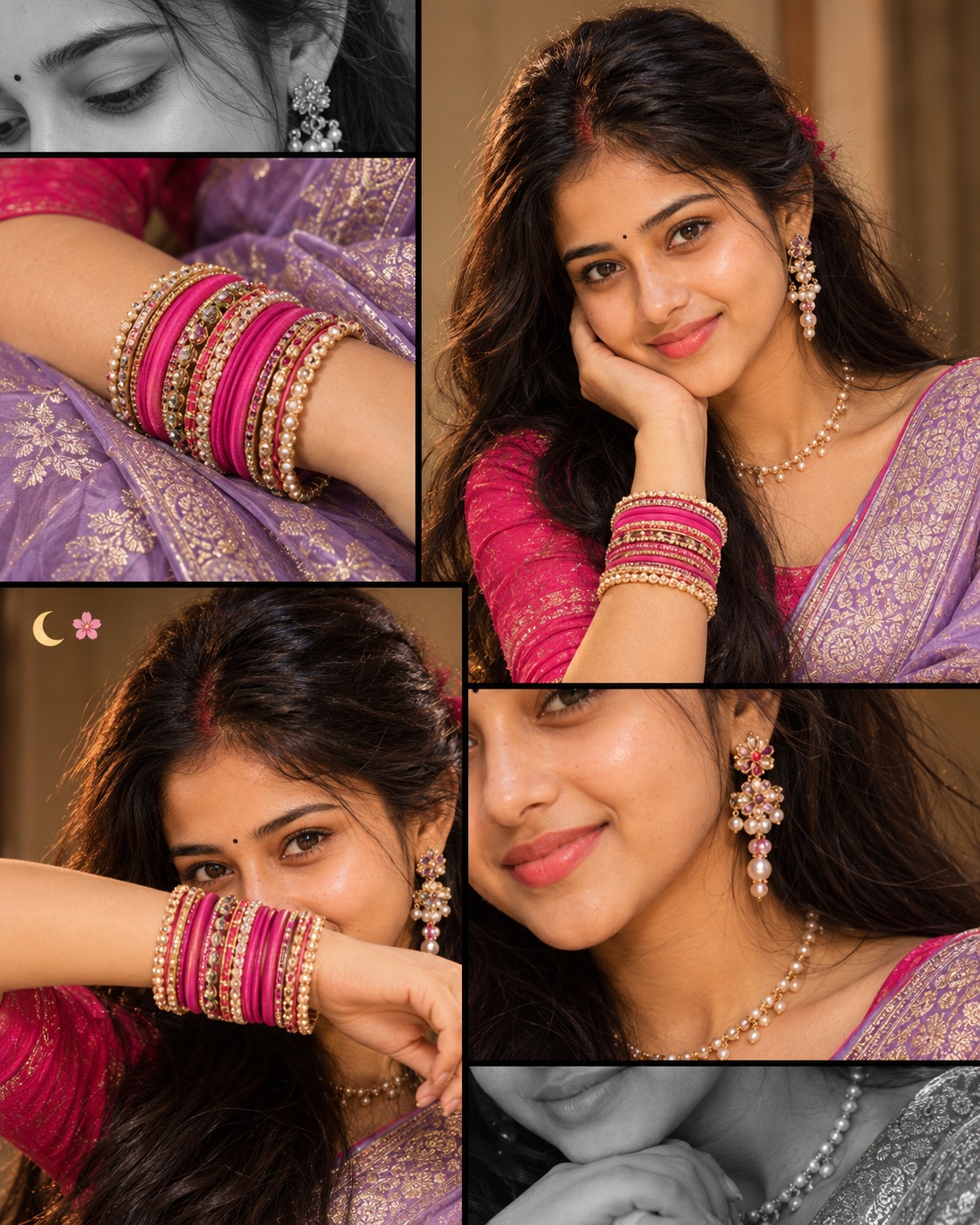
The Indian Jewelry Portrait concept combines traditional Indian fashion, intricate jewelry photography, and an editorial collage layout. The design presents a woman through multiple rectangular panels, with each section highlighting a different aspect of her appearance. Instead of relying on a single portrait, the composition brings together facial expressions, eye details, bangles, earrings, necklaces, and fabric textures. The result feels like a carefully assembled fashion scrapbook that celebrates traditional styling and decorative craftsmanship.
The main portrait occupies the upper-right central area and serves as the primary visual focus. The woman looks directly toward the camera with a gentle smile, creating a warm and approachable expression. Her chin rests on one hand, with the elbow bent and wrist positioned beside the cheek. This relaxed pose gives the portrait an intimate quality while allowing the face, bangles, and jewelry to remain visible together. Long, loose black hair frames the face and adds a natural softness to the composition.
Facial identity is important throughout the design because the same woman appears in several panels. The supplied user’s recognizable facial features provide the identity reference, while the original composition determines each pose, facial angle, expression, and crop. Natural skin texture, eye shape, nose, lips, and facial proportions contribute to a consistent appearance. A small black bindi remains an important traditional detail, linking the different views of the subject.
The collage includes several secondary panels that reveal details not fully visible in the main portrait. A close-up of the wrist and bangles emphasizes the arrangement, color, and shine of the jewelry. Another panel shows the woman’s eyes above a raised forearm, creating a more intimate composition in which the bangles become a prominent decorative feature. A tightly cropped facial panel reveals the cheek, lips, eye, earrings, hair, necklace, and blouse details.
The arrangement of rectangular panels is essential to the concept. Thin black separators distinguish the individual sections, giving the collage a structured editorial appearance. The upper black-and-white strip introduces a contrasting visual texture, while the main color portrait establishes the dominant look. Additional monochrome details along the bottom provide a subtle photographic contrast and help the layout feel varied rather than repetitive.
Traditional clothing provides the color foundation for the entire composition. The bright fuchsia-pink blouse contrasts beautifully with the lavender-purple saree. The blouse adds vivid warmth, while the saree introduces a softer, cooler shade. Its intricate silver-gold woven border creates a decorative line that catches the light and draws attention to the fabric’s craftsmanship. The folds, draping, and natural sheen of the material add depth to the photographs.
The saree is especially important in the close-up panels, where the woven border and fabric texture become more visible. Its metallic detailing connects the clothing to the gold accents in the jewelry. The contrast between pink and lavender also gives the collage a distinctive color identity, making the different panels feel connected even when their subjects and crops vary.
Jewelry is one of the strongest visual elements. Multiple pink bangles are stacked around the wrist, with fine gold, black, and pearl accents adding variety to the arrangement. Their closely grouped shapes create repeated lines and small reflections that become particularly striking in the wrist close-up. Preserving the original sequence, density, and arrangement of the bangles is important because these details form a recognizable part of the overall styling.
Dangling floral pearl earrings frame the face with delicate decorative shapes. Their pearl elements provide a soft, luminous quality, while the gold details introduce warmth. A matching pearl necklace complements the earrings, and a delicate gold chain adds another layer without overwhelming the outfit. The small bindi completes the traditional appearance and creates a subtle focal point on the forehead.
The background uses a warm, neutral beige tone that allows the pink, lavender, gold, and pearl-white details to remain prominent. Soft indoor lighting creates gentle shadows and natural golden highlights on the skin. The lighting also produces small reflections on the bangles, earrings, necklace, and metallic saree border. These details make the materials feel realistic without creating harsh glare.
Color consistency is important because the collage combines vivid color photography with monochrome sections. The fuchsia blouse, lavender saree, pink bangles, gold accents, and pearl-white jewelry establish the main palette. Deep black hair and thin black panel dividers provide contrast, while beige backgrounds keep the overall appearance warm and balanced. The monochrome strips add variety without disrupting the traditional fashion theme.
The photographic style emphasizes natural skin texture, realistic jewelry reflections, detailed fabric weave, and carefully controlled close-up framing. Each panel has a specific purpose. The main portrait establishes the subject’s identity, the bangle close-up highlights accessories, the eye panel adds expression, and the cropped jewelry portrait showcases the outfit’s smaller details. This variety makes the collage visually engaging and informative.
Small decorative moon and flower symbols above the lower-left portrait contribute a delicate finishing touch. Their restrained appearance complements the traditional styling without competing with the photographs. The absence of prominent typography keeps attention on the subject, jewelry, and clothing. The thin black dividers provide enough structure to organize the collage while preserving the feeling of a unified visual collection.
The vertical portrait layout is suitable for fashion-inspired social media posts, traditional outfit showcases, personalized portrait collections, and jewelry-themed editorial graphics. The combination of multiple views allows the design to communicate more than a conventional portrait. Viewers can appreciate the expression, accessories, textile patterns, and fine decorative details within a single composition.
One of the most important qualities of this concept is visual consistency across all panels. The woman’s facial identity, traditional styling, and color palette should feel connected throughout the collage. Each panel can have a different crop or pose while maintaining the same recognizable person. Consistent lighting and natural proportions help the separate views feel like parts of one coordinated editorial presentation.
The Indian Jewelry Portrait concept ultimately celebrates the relationship between personal expression and traditional craftsmanship. The gentle smile gives the collage warmth, the pink-and-lavender outfit creates a distinctive color combination, and the pearl and gold accessories provide intricate visual detail. The structured panel layout brings these elements together in a refined fashion composition that feels personal, elegant, and visually rich.
[[[
REFERENCE ANALYSIS
- Image type: Multi-panel traditional Indian fashion and jewelry collage, vertical portrait layout.
- Composition: A grid of rectangular panels separated by thin black borders. The main color portrait is in the upper-right center, with close-up details of bangles, eyes, earrings, necklace, saree fabric, and face in the surrounding panels. Narrow black-and-white strips appear at the top and bottom.
- Main portrait pose: Young woman with long, loose black hair, looking directly at the camera, gentle smile, chin resting on one hand, elbow bent, and wrist positioned beside the cheek.
- Secondary poses: Close-up of pink bangles on the wrist; eyes peeking over a raised forearm; a tight facial crop showing earrings, necklace, hair, and saree; additional monochrome fabric and jewelry details.
- Outfit lock: Bright pink blouse and lavender-purple saree with an intricate silver-gold woven border. Preserve the exact fabric sheen, embroidery, folds, and color contrast.
- Jewelry lock: Multiple pink, gold, and pearl-accented bangles; dangling floral pearl earrings; a matching pearl necklace; delicate gold chain; and small black bindi.
- Lighting: Warm indoor lighting, soft shadows, golden skin highlights, and a neutral beige background.
- Color palette: Hot pink, lavender, silver, gold, pearl white, warm beige, and deep black hair.
- Style: Photorealistic fashion photography with close-up editorial details, a scrapbook-like panel layout, and selective black-and-white panels.
- Text: No prominent typography. Small decorative moon and flower symbols appear above the lower-left portrait; preserve their placement and appearance.
MASTER PROMPT
Use supplied ref image as master blueprint. Replace only ref character’s face with supplied user identity. COMPLETELY IGNORE the user’s original photo pose and body; force the user into the exact body pose, hand placement, and posture of the reference character.
Create an extremely faithful recreation of the supplied multi-panel Indian traditional fashion collage. Preserve the original panel grid, black separators, portrait arrangement, jewelry details, fabric textures, color treatment, and selective monochrome panels. The user’s facial identity must replace the original character’s identity wherever her face is visible, while each panel retains its original pose, crop, scale, and visual purpose.
IDENTITY REPLACEMENT: Use the supplied user’s face, preserving recognizable facial features, natural skin texture, eye shape, nose, lips, and facial proportions. Apply the same identity consistently across all visible face panels. Match each panel’s original facial angle, expression, lighting, and crop. Preserve the small black bindi and the original gentle smile where visible. Do not copy the user’s original body, clothing, hairstyle, or pose.
COMPOSITION LOCK: Maintain the exact vertical collage layout with thin black panel borders. Preserve the narrow black-and-white strip at the top, the large bangle close-up on the middle-left, the main portrait on the upper-right, the eye-and-bangle portrait on the lower-left, the enlarged jewelry-and-face detail on the middle-right, and the monochrome strip along the bottom. Keep all panel dimensions, positions, crops, overlaps, and relative proportions unchanged. Do not rearrange panels or convert the collage into a single portrait.
MAIN PORTRAIT POSE: In the main color portrait, preserve the woman looking directly toward the camera with a soft smile, chin resting on one hand, elbow bent, wrist beside the cheek, and forearm positioned naturally. Keep the long black hair, head angle, shoulder position, and camera framing identical to the reference.
SECONDARY PANEL POSES: Preserve the exact wrist and bangle close-up, including the diagonal arm placement and purple saree fabric beneath it. In the lower-left panel, retain the forearm raised horizontally in front of the mouth, eyes looking toward the camera above the arm, and bangles prominently visible. In the middle-right panel, retain the tightly cropped cheek, lips, eye, ear, hair, necklace, earrings, and pink blouse. Preserve the existing black-and-white panels and their original crops.
OUTFIT LOCK: Preserve the bright fuchsia-pink blouse and lavender-purple saree with its intricate metallic woven border. Match the exact color, fabric sheen, draping, folds, embroidery, and visible garment placement in every panel. Do not redesign or recolor the clothing.
JEWELRY LOCK: Preserve the stacked pink bangles with fine gold, black, and pearl accents; long dangling floral pearl earrings; matching pearl necklace; delicate gold chain; and all visible jewelry details. Maintain the original jewelry sizes, arrangement, shine, and placement. The bangle close-up must retain the same number, density, and color sequence of bangles as the reference.
HAIR AND BACKGROUND: Preserve the long loose black hair, natural waves, loose strands around the face, and original hair volume. Maintain the warm neutral beige indoor background and soft natural shadows without introducing new objects.
COLOR AND LIGHTING: Match the reference’s warm indoor lighting, natural golden skin highlights, soft shadows, vibrant pink blouse, lavender saree, metallic jewelry reflections, and neutral beige background. Preserve the original distinction between the warm color panels and the monochrome strips. Do not brighten, desaturate, oversaturate, or apply a different color grade.
PHOTOGRAPHIC STYLE: Maintain realistic skin texture, detailed jewelry, natural facial proportions, authentic fabric weave, shallow depth of field where present, and high-resolution editorial fashion photography. Keep the original contrast and detail level in each panel.
DECORATIVE DETAILS: Preserve the small moon and flower symbols above the lower-left portrait, in their original position and scale. Do not add new text, logos, decorative graphics, or watermarks.
Maintain exact scale, proportion, crop, visibility. Preserve 1000% of all visual info including darkness, grading, mood, lighting, shadows, contrast, saturation, composition, environment, objects, background, text, props, rendering, outfit (exact style/color/condition), reference pose (exact body position/hands/expression), vibe (exact emotional tone), and natural human anatomy (correct head-to-body ratio, proportional hands/limbs, no distortions). Output must look IDENTICAL to ref except face swap. Do NOT brighten, enhance, modify, change outfit, reference pose, or vibe.
The final image must preserve the original collage exactly, with the same pink-and-lavender traditional styling, intricate jewelry close-ups, poses, panel divisions, and monochrome sections. Only the visible facial identity is replaced.
EDITABLE VARIABLES
- [USER IDENTITY]: User’s supplied face, consistently applied to all visible facial panels.
- [OUTFIT]: Exact fuchsia-pink blouse and lavender-purple saree with metallic woven border.
- [TEXT]: None; preserve the existing decorative moon and flower symbols.
- [OBJECT CHANGE]: None.
- [POSE CHANGE]: None; each panel must retain its original pose.
- [ADDITIONAL EDIT]: None.
NEGATIVE PROMPT
identity loss, different face in each panel, original character identity, changed facial expression, altered head angle, different hand placement, changed chin-resting pose, wrong arm position, missing bangle close-up, missing eye close-up, missing jewelry detail panel, missing monochrome panels, changed collage grid, rearranged panels, removed black separators, single portrait instead of collage, altered panel proportions, changed crop, zoomed-in composition, different blouse, different saree, changed pink color,
changed lavender color, missing metallic border, simplified embroidery, missing bangles, altered bangle sequence, missing earrings, missing pearl necklace, missing bindi, changed hairstyle, short hair, different background, harsh lighting, excessive brightness, oversaturated skin, washed-out colors, flat lighting, artificial skin smoothing, beauty filter, cartoon style, illustration, deformed hands, extra fingers, distorted wrists,
oversized head, unnatural proportions, blurred jewelry, missing decorative symbols, added text, incorrect typography, extra graphics, logos, watermark, border redesign, modernized fashion editorial, user’s original pose, user’s original body posture ]]]