
Indian Saree Portrait
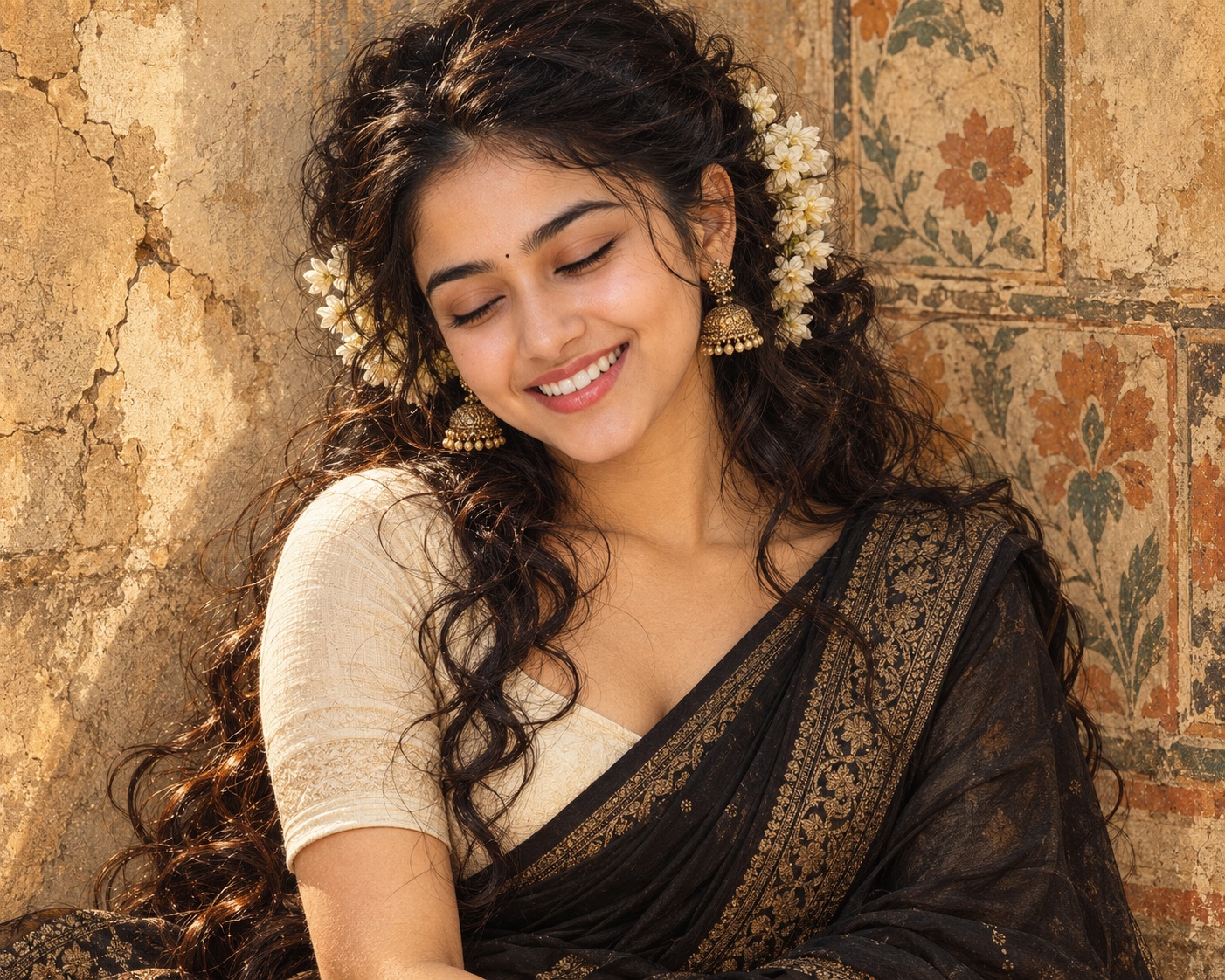
Indian Saree Portrait is a traditional Indian fashion illustration concept that combines a joyful facial expression, classic saree styling, natural curly hair, and a textured vintage environment. The visual identity is built around warmth, authenticity, and the charm of hand-drawn artwork. Rather than presenting a highly polished photographic appearance, the concept emphasizes painterly details, pencil-like textures, and the natural imperfections that make an illustration feel personal and expressive.
The main subject is a single Indian woman shown in a close three-quarter portrait. Her head is gently tilted, her eyes are closed, and her broad smile reveals her teeth. This expression creates a spontaneous and intimate feeling, similar to a happy candid moment captured during a relaxed conversation. The softly raised cheeks and natural shape of the lips contribute to the warmth of the portrait. The expression is central to the overall composition because it establishes the mood before the viewer notices the clothing, jewelry, or background.
The facial treatment focuses on natural proportions and subtle detail. Warm skin tones, rosy cheeks, delicate eyebrows, and fine eyelashes give the face a believable appearance. Gentle highlights across the nose and cheeks add dimension, while the lips retain a soft, glossy quality. The visible teeth contribute to the cheerful expression without making the smile appear exaggerated. The intended rendering preserves subtle skin texture and hand-drawn shading, allowing the face to remain expressive while fitting naturally into the illustrated style.
The hairstyle is another defining feature of the composition. Voluminous black curls surround the head and fall naturally around the shoulders. Loose strands and flyaway hairs create an organic silhouette instead of a perfectly arranged hairstyle. The curls vary in size and direction, adding movement and depth. White jasmine flowers are positioned on both sides of the hair, introducing a delicate floral accent that contrasts beautifully with the dark curls. Their individual petals provide additional texture and reinforce the traditional Indian styling.
The outfit consists of a deep black saree with a dark embroidered border and a matching visual harmony between the garment and the hair. Its charcoal-black fabric contains subtle tonal variation, realistic folds, and a restrained satin-like sheen. These features prevent the dark material from appearing completely flat. The ivory-white blouse provides contrast, with textured sleeves and natural creases adding detail. The difference between the dark saree and light blouse creates a strong visual anchor while keeping the overall styling elegant and traditional.
Antique-gold jhumka earrings add a decorative element to the portrait. Their traditional shape complements the saree and the floral hair accessories. A small bindi completes the forehead styling, contributing another familiar element of Indian fashion. The accessories remain balanced with the facial expression and hairstyle rather than competing for attention. Together, the flowers, earrings, bindi, and clothing create a cohesive appearance that feels culturally recognizable and visually refined.
The background is an important part of the artistic concept. An antique beige stone wall features cracked plaster, weathered surfaces, and distressed patina. Vintage floral tiles introduce muted terracotta, ochre, and grey tones. These decorative patterns create visual interest while retaining the subdued character of an aged interior. The background does not feel like a clean modern studio; instead, it suggests the charm of an old architectural surface that has developed texture and character over time.
Lighting brings the entire scene together through soft golden illumination. Gentle light across the face creates warm highlights without erasing the natural contours. Subtle shadows around the curls, earrings, and clothing maintain dimensionality. The lighting also interacts with the saree’s sheen and the ivory blouse’s textured surface. Its softness contributes to the nostalgic atmosphere, while the controlled contrast ensures that the face remains the primary focal point.
The color palette is deliberately warm and restrained. Beige, creamy ivory, muted ochre, and sepia-toned highlights dominate the background, while terracotta accents appear within the decorative tiles. Deep charcoal black provides contrast through the saree and hair. Antique gold adds a small amount of warmth to the accessories, and the white jasmine flowers create delicate points of brightness. This combination feels cohesive because each color has a clear role in the composition.
The artistic rendering combines semi-realistic painterly illustration, editorial portraiture, and fine-art drawing. Graphite-like linework helps define important shapes, while pencil shading and cross-hatching create depth within the face, hair, and clothing. Layered brushwork adds softer tonal transitions, and visible paper grain introduces the tactile quality of traditional illustration. Rough canvas texture and small organic imperfections keep the artwork from appearing mechanically smooth.
The horizontal landscape composition distinguishes this portrait from a typical vertical fashion image. A tight medium close-up frames the head and upper body, with the woman positioned slightly to the right of center. The mildly elevated camera perspective and diagonal shoulder line create a relaxed, dynamic arrangement. The head tilt and closed-eye smile further soften the composition, making it feel intimate rather than formally posed. Maintaining the original crop ensures that the hair, blouse, saree, and decorative wall retain their intended relationships.
The reference-based identity concept allows the portrait to be personalized while retaining its artistic character. When a separate user photograph is supplied, the intended approach uses the person’s recognizable facial features while preserving the reference expression, head tilt, hairstyle, clothing, and composition. Face shape, eyes, nose, lips, jawline, cheekbones, and natural skin tone remain important elements of recognition. The face should share the reference’s lighting, perspective, and illustrated surface texture so that it feels naturally integrated into the artwork.
This style is suitable for personal digital portraits, traditional Indian fashion illustrations, social media graphics, creative profile artwork, cultural design collections, and editorial-inspired visual projects. It is especially appealing to people who appreciate candid expressions, vintage textures, traditional accessories, and the combination of realistic facial details with hand-drawn artistic treatment.
The strongest quality of Indian Saree Portrait is its balance between joyful expression and understated styling. The smile gives the portrait emotional warmth, the curls and jasmine flowers create a distinctive silhouette, and the black saree provides elegance. The weathered background contributes history and texture, while the golden lighting unifies the scene. Every detail supports the same visual direction without making the composition feel crowded.
The overall concept celebrates a familiar moment of happiness through traditional Indian styling and textured illustration. Its appeal comes from the combination of natural expression, thoughtful composition, rich fabric detail, delicate floral accents, and an earthy vintage palette. The result is an expressive portrait concept that feels personal, warm, and artistically distinctive.
[[[
REFERENCE ANALYSIS
- Style: Semi-realistic painterly digital illustration, hand-drawn editorial portrait, fine-art rendering.
- Composition: Horizontal landscape frame, tight medium close-up, three-quarter portrait, slightly elevated camera angle, subject center se thoda right.
- Pose: Woman ka head halka tilted hai, eyes gently closed hain, natural broad smile ke saath teeth visible hain. Shoulders diagonal hain aur upper body slightly angled hai.
- Face: Natural Indian facial anatomy, warm skin tone, rosy cheeks, subtle nose highlights, glossy lips, detailed teeth, fine eyebrows aur eyelashes.
- Hair: Voluminous black curly hair, loose flyaway strands, messy natural curls, white jasmine flowers on both sides.
- Outfit: Black saree with dark embroidered border and subtle satin sheen, ivory-white blouse with textured sleeves.
- Accessories: Traditional antique-gold jhumka earrings, small bindi and white jasmine flowers.
- Background: Antique beige stone wall, cracked plaster, distressed surface patina, vintage floral tiles in muted terracotta, ochre and grey.
- Lighting: Soft golden ambient light, diffused illumination, gentle facial highlights, natural skin specularity and soft shadows.
- Color grading: Warm beige, muted ochre, sepia-toned highlights, creamy ivory and deep charcoal black. Rich but controlled saturation.
- Texture: Graphite-like linework, pencil shading, cross-hatching, visible paper grain, rough canvas texture and layered brushwork.
- Mood: Joyful, intimate, candid, warm and nostalgic.
MASTER PROMPT
Use supplied ref image as master blueprint. Replace only ref character’s face with supplied user identity. COMPLETELY IGNORE the user’s original photo pose and body; force the user into the exact body pose, hand placement, and posture of the reference character. Maintain exact scale, proportion, crop, visibility. Preserve 1000% of all visual info including darkness, grading, mood, lighting, shadows, contrast, saturation, composition, environment, objects, bg, text, props, rendering, outfit (exact style/color/condition), ref pose (exact body pos/hands/expression), vibe (exact emotional tone), and natural human anatomy (correct head-to-body ratio, proportional hands/limbs, no distortions). Output must look IDENTICAL to ref except face swap. Do NOT brighten, enhance, modify, change outfit, ref pose, or vibe.
ART STYLE AND RENDERING: Semi-realistic painterly digital illustration combined with editorial portrait aesthetics, traditional Indian fashion portraiture and fine-art illustrative realism. Preserve detailed graphite-like linework, textured pencil shading, delicate cross-hatching accents, layered brushwork, visible paper grain, rough canvas texture and organic imperfections. Maintain the exact illustrated appearance of the reference without converting it into a fully photographic image or a cartoon.
FACE AND EXPRESSION: Replace only the facial identity with the supplied user’s recognizable facial features while preserving the reference’s closed-eye expression, broad natural smile, visible teeth, head tilt and facial orientation. Integrate natural Indian facial anatomy, realistic facial proportions, delicate eyebrow hair detailing, fine eyelash definition, natural skin texture, soft rosy cheek blush, highlighted nose bridge, subtle skin specularity and glossy lip highlights. Match the original face’s warm illumination, painterly shading and fine surface texture. Keep the head size and facial placement unchanged.
HAIR AND FLOWERS: Preserve the reference’s voluminous dark black curly hair, loose natural curls, intricate individual hair strands and flyaway hairs around the head. Retain the white jasmine flower accessories positioned on both sides of the hair, with individually rendered petals and natural floral texture. Preserve the original hair silhouette, volume, placement and overlaps with the shoulders and clothing.
OUTFIT AND ACCESSORIES: Preserve the exact black saree, deep charcoal-black fabric, dark embroidered saree border, fine weave texture, realistic fabric folds and subtle satin sheen. Retain the ivory-white blouse with its original textured sleeves and natural fabric creases. Preserve the traditional antique-gold jhumka earrings and small forehead bindi. Do not redesign, recolor, clean up or replace any clothing or accessories.
BACKGROUND AND SURFACE TEXTURE: Preserve the original antique stone-wall background with weathered beige plaster, cracked stone details, distressed surface patina and intricate vintage floral tile patterns. Retain the exact placement, scale and colors of every decorative tile and crack. Render the wall with textured brushwork, rough plaster grain and hand-drawn surface details. No new architecture, decorative elements or objects.
LIGHTING AND COLOR GRADING: Maintain the original soft golden ambient lighting and diffused natural illumination. Preserve gentle facial highlights, subtle nose and lip reflections, soft shadow gradation and ambient occlusion. Retain the warm beige color grading, muted ochre palette, sepia-toned highlights, creamy ivory tones, terracotta decorative accents and deep charcoal-black saree. Maintain the original warm earthy harmony and strong black-and-cream contrast. Keep colors richly defined but controlled, with natural vibrance and moderate micro-contrast. No artificial orange grading, excessive saturation, lifted shadows or exposure correction.
COMPOSITION AND ANATOMY: Preserve the exact horizontal landscape framing, tight medium close-up, three-quarter portrait composition, slightly elevated camera perspective, mild high-angle view, tilted head, diagonal shoulder line and off-center subject placement. Keep the same amount of visible hair, blouse, saree and background. Maintain natural head-to-body ratio, anatomically correct shoulders, arms and hands wherever visible, and realistic human proportions. Preserve all original foreground hair strands and occlusions. Do not zoom, recenter, enlarge, extend the frame or reconstruct hidden body areas.
FINAL RENDERING: Use refined painterly tonal blending, detailed textured rendering, fine edge definition, selective sharpening, subject-focused detail and minimal atmospheric depth. Preserve the reference’s warm nostalgic mood, joyful candid expression, organic imperfections and intimate traditional Indian portrait aesthetic. Keep the background textured rather than artificially blurred. The final image must reproduce the reference as closely as possible, with only the user’s facial identity replaced. No other visual changes.
EDITABLE VARIABLES
- [USER IDENTITY]: User’s actual facial identity and recognizable features.
- [OUTFIT]: Exact black saree, ivory blouse, embroidered border and original fabric textures.
- [TEXT]: None.
- [OBJECT CHANGE]: None.
- [POSE CHANGE]: None; preserve closed eyes, smiling expression and tilted head.
- [ADDITIONAL EDIT]: None.
NEGATIVE PROMPT
identity loss, wrong face, generic face, altered facial identity, changed smile, open eyes, closed mouth, different expression, altered head tilt, changed pose, user’s original pose, wrong body posture, oversized head, tiny head, disproportionate limbs, deformed hands, extra fingers, bad anatomy, altered crop, zoomed composition, recentered subject, changed camera angle, vertical framing, expanded background, redesigned wall, missing cracks, altered floral tiles, added objects, removed objects, different hairstyle, straight hair, missing jasmine flowers, changed earrings, missing bindi, different saree, different blouse,
changed clothing color, missing embroidered border, glossy plastic fabric, altered fabric condition, brightened image, lifted shadows, oversaturation, orange color grading, cold blue grading, excessive HDR, harsh lighting, excessive glow, plastic skin, over-smoothed face, unwanted photorealism, cartoon style, 3D rendering, clean digital gradients, missing pencil texture, missing cross-hatching, lost paper grain, oversharpening, excessive background blur, modernized background, changed mood, generic cinematic enhancement, distorted anatomy, giant head, tiny hands, polio, altered proportions. ]]]