
Indian Mythological Portrait
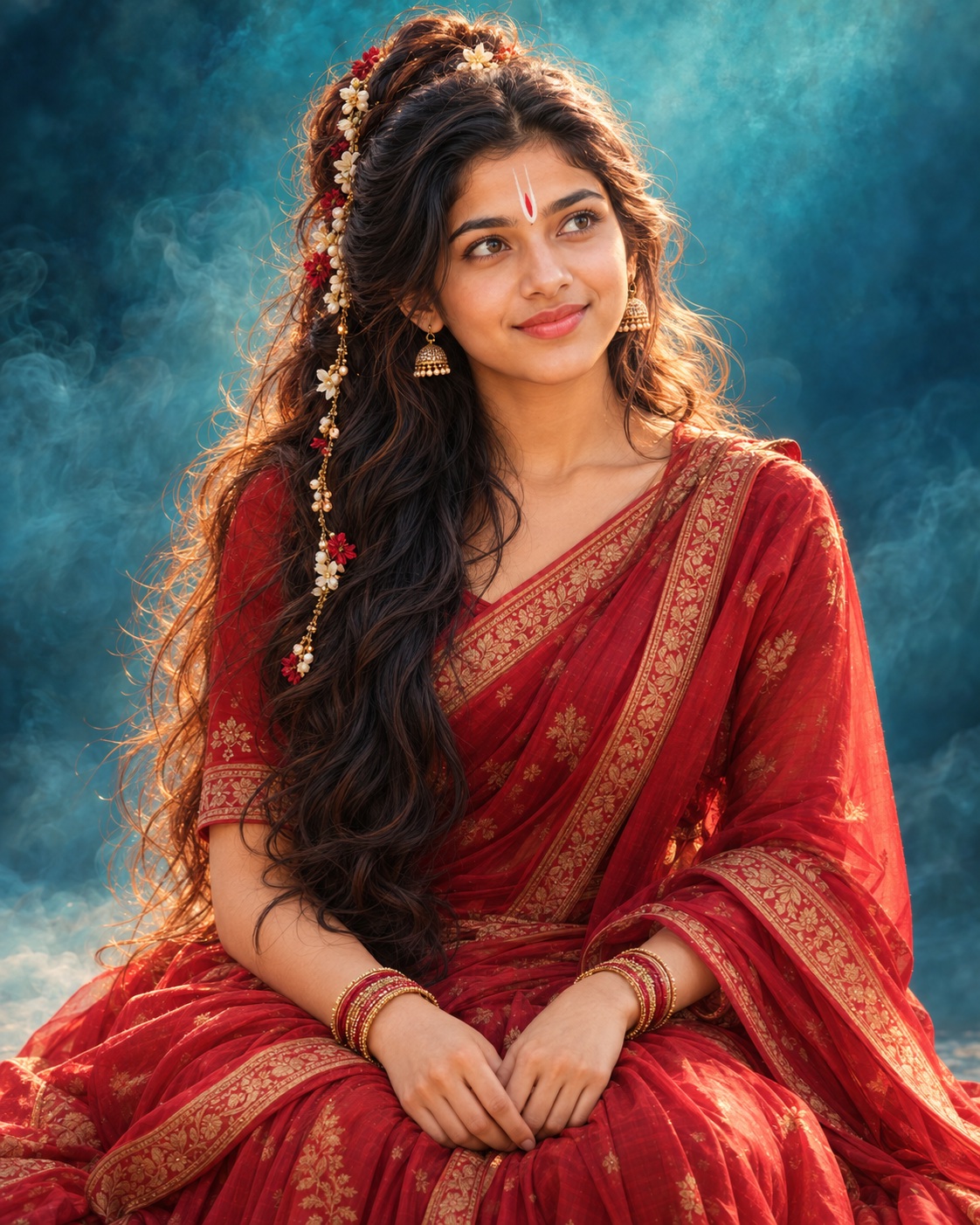
Indian Mythological Portrait is a traditional Indian-inspired fantasy art concept that combines graceful character styling, expressive facial details, cinematic lighting, and richly textured digital painting. The artwork centers on a seated female character whose calm expression, elaborate hairstyle, crimson-red saree, and atmospheric turquoise surroundings create a cohesive visual identity. Every element contributes to a peaceful yet dramatic presentation, bringing together cultural details and contemporary illustration techniques.
The main character has a serene and spiritually expressive appearance. Her face features naturally balanced proportions, softly defined eyebrows, detailed dark irises, delicate eyelashes, and subtle reflections in the eyes. Gentle rosy cheeks add warmth, while matte red lips complement the deep red clothing. Her gaze is directed slightly upward toward the right, giving the expression a reflective quality. Rather than appearing theatrical, the face communicates quiet emotion through its natural features and restrained expression.
A white-and-red Vaishnava tilak is positioned at the center of the forehead. This devotional marking introduces an important cultural detail and distinguishes the character’s spiritual styling. Its white shape and red central line contrast with the surrounding skin tones, making it recognizable without dominating the portrait. Soft shading around the forehead, cheeks, and nose maintains a natural facial structure while supporting the painterly finish.
The hairstyle is particularly elaborate. A high bun forms the upper structure, while long, voluminous dark auburn-brown hair flows over the shoulders and chest. Loose waves create movement, and multiple intricate braids add texture and visual complexity. Warm auburn highlights provide depth against the darker base color. Fine individual strands and delicate flyaway hairs help the hairstyle feel organic instead of rigid. Small white and reddish flowers are woven into the braids, providing traditional ornamentation that complements the character’s devotional appearance.
The outfit consists of a deep crimson-red saree and a matching red blouse. Its traditional silhouette is enriched by fine borders, vermilion highlights, layered draping, and carefully rendered fabric folds. The material has a subtle satin-like sheen that catches the light without appearing overly glossy. Deep maroon shadows define the overlapping layers and folds around the lap. These details give the clothing realistic weight and dimension while preserving its original design, color, and condition.
The seated pose establishes a composed and graceful body language. The torso is slightly angled, the head turns gently upward, and the eyes look toward the upper-right area of the frame. The shoulders remain relaxed, while the hands rest naturally in the lap. The original position of the forearms, hands, clothing, and hair creates a carefully arranged silhouette. Maintaining these relationships is important because the pose contributes as much to the character’s identity as the facial expression and traditional styling.
The background introduces a cool palette of teal, cyan, and turquoise. Softly blended clouds, smoky wisps, and atmospheric mist create depth without introducing recognizable scenery. Darker turquoise areas provide contrast, while pale cyan patches create a soft sense of space around the character. This abstract environment supports the fantasy mood and prevents unrelated objects from competing with the main subject. The background’s painterly texture also complements the blended shading used across the face and clothing.
Lighting plays a major role in defining the character’s appearance. Soft, diffused illumination highlights the cheeks, forehead, nose, and lips. Subtle rim lighting along selected strands separates the dark hair from the turquoise surroundings. Gentle highlights reveal the fabric’s folds, while natural cast shadows preserve depth around the braids, arms, and saree. The original exposure and shadow detail remain important to the atmosphere, allowing the portrait to retain its rich and dramatic appearance without becoming excessively bright.
The crimson-and-teal color relationship gives the artwork its distinctive visual character. Deep reds establish warmth and richness, while cool turquoise tones create contrast and atmospheric depth. Natural skin tones connect the two color families, and auburn hair highlights add another layer of warmth. Balanced saturation ensures that the colors remain vibrant without becoming artificial. Deep tonal gradation and a soft matte finish help preserve the painterly appearance.
The rendering style combines semi-realistic digital painting, cinematic fantasy portraiture, Indian mythological character art, and painterly photorealism. Facial features retain natural proportions, while soft brushwork and blended shading create an illustrated surface. Hair receives fine strand detailing, the saree displays carefully modeled folds, and the background remains softly focused. Selective sharpness draws attention to the face and other important details without removing the artwork’s textured character.
The vertical 9:16 composition supports a seated three-quarter portrait framed from the head to the lap. Slightly off-center placement creates visual balance while preserving the original camera perspective and crop. The relative scale of the head, torso, hands, and surrounding hair contributes to the overall harmony. Maintaining the original framing also keeps the negative space and atmospheric background consistent with the character’s silhouette.
A reference-based identity approach gives this concept a personal dimension. When a separate user photograph is supplied, the intended composition uses the person’s recognizable facial features while retaining the reference character’s established pose, outfit, hairstyle, lighting, and surroundings. Face shape, eyes, nose, lips, jawline, cheekbones, and natural skin tone are important parts of individual recognition. The face must fit the character’s original head angle and lighting so that it appears integrated with the surrounding illustration.
This style is suitable for personal digital portraits, Indian cultural artwork, devotional-themed graphics, fantasy illustration collections, vertical social media designs, and artistic profile presentations. Its traditional clothing and spiritual details appeal to people who appreciate Indian aesthetics, while its cinematic lighting and painterly textures create a contemporary visual finish.
The strongest quality of Indian Mythological Portrait is its balance between intricate detail and visual restraint. The floral braids provide ornamentation, the crimson saree establishes the dominant color, and the turquoise atmosphere creates depth. The calm expression gives the composition emotional focus. Instead of relying on crowded scenery or excessive effects, the concept uses posture, lighting, color, and texture to communicate its character.
Together, these elements describe a cohesive artistic presentation that celebrates traditional Indian styling through modern digital illustration. The face provides emotional connection, the hairstyle frames the character, the saree introduces richness, and the abstract background establishes a peaceful fantasy environment. The result is an elegant portrait concept built around cultural detail, consistent composition, and a refined painterly atmosphere.
[[[
REFERENCE ANALYSIS
- Style: Semi-realistic digital portrait painting, cinematic fantasy portraiture, Indian mythological character art, painterly photorealism.
- Composition: Vertical 9:16 portrait, seated woman framed from head to lap, subject slightly off-center, original crop and camera perspective preserved.
- Pose: Seated gracefully with hands resting naturally in her lap, torso slightly angled, head turned subtly upward, gaze directed toward the upper right. Preserve the exact hand placement, posture, head angle and expression.
- Face & expression: Natural facial anatomy, softly defined eyebrows, detailed irises with reflective highlights, subtle rosy cheeks, realistic skin shading, matte red lips and a serene, devotional expression. White-and-red Vaishnava tilak centered on the forehead.
- Hair: Voluminous dark auburn-brown hair arranged in a high bun, with long, loose waves and multiple intricate braids falling over the shoulders and chest. Fine individual hair strands, warm auburn highlights and delicate white-and-reddish floral embellishments.
- Outfit: Deep crimson-red traditional saree with a matching red blouse, vermilion highlights, fine embroidered borders, layered draping, realistic fabric folds, subtle satin-like sheen and deep maroon shadows. Preserve the exact outfit design and condition.
- Lighting: Soft diffused key light illuminating the face, warm facial highlights, gentle hair rim lighting, subtle specular highlights and natural cast shadows. Maintain the original exposure and shadow depth.
- Background: Textured teal-cyan and turquoise backdrop with wispy smoke, misty clouds, painterly blending and atmospheric depth.
- Color grading: Rich crimson-red against cool turquoise-teal, complementary cinematic color contrast, balanced saturation, vibrant yet controlled colors, deep tonal gradation and soft matte finish.
- Rendering: Soft textured brushwork, blended painterly shading, detailed hair and textiles, subtle skin texture, moderate micro-contrast, selective edge sharpening and softly focused background.
- Mood: Ethereal, serene, spiritual and devotional, with a dramatic yet peaceful Indian mythological atmosphere.
MASTER PROMPT
Use the supplied reference image as the master blueprint. Replace only the reference character’s face with the supplied user identity. COMPLETELY IGNORE the user’s original photo pose and body; force the user into the exact body pose, hand placement, and posture of the reference character. Maintain exact scale, proportion, crop, visibility.
Preserve 1000% of all visual information, including darkness, grading, mood, lighting, shadows, contrast, saturation, composition, environment, objects, background, text, props, rendering, outfit (exact style, color and condition), reference pose (exact body position, hands and expression), vibe (exact emotional tone), and natural human anatomy (correct head-to-body ratio, proportional hands and limbs, no distortions). Output must look IDENTICAL to the reference except for the face swap. Do NOT brighten, enhance, modify, change outfit, reference pose or vibe.
ART STYLE AND RENDERING: Apply semi-realistic digital portrait painting, cinematic fantasy portraiture, Indian mythological character art and painterly photorealism. Use high-detail digital rendering, soft textured brushwork, blended painterly shading, refined color transitions and delicate surface grain. Maintain the original balance between realistic facial rendering and painterly illustration. No conversion to a different art style.
FACE AND IDENTITY: Integrate the user’s actual facial identity while preserving recognizable facial features, natural facial proportions, face shape, eyes, nose, lips and skin tone. Match the reference face’s orientation, upward gaze, expression, lighting and perspective. Use naturalistic facial anatomy, smooth but subtly textured skin, soft rosy cheek blush, natural facial contouring, defined eyebrows, detailed irises, reflective eye highlights, softly defined eyelashes and matte red lip color. Preserve the white-and-red Vaishnava tilak on the forehead. Blend the replacement face seamlessly into the original illustration without enlarging the head or changing its position.
HAIR AND FLORAL DETAILS: Preserve the reference character’s high bun, long voluminous wavy dark auburn-brown hair, cascading braids and intricate braided textures. Add fine individual hair-strand detailing, natural warm auburn highlights and delicate white-and-reddish floral embellishments exactly where visible in the reference. Retain the original hair silhouette, volume, length, placement and overlap with the clothing.
OUTFIT AND FABRIC: Preserve the exact deep crimson-red saree and matching blouse, including their original color, sleeve length, borders, draping, fabric condition and placement. Render the existing satin-like fabric sheen, intricate saree border details, layered drapery, fine textile folds, soft fabric highlights and deep maroon shadow gradation without redesigning the outfit. Do not introduce new jewelry, accessories, embroidery or clothing elements.
LIGHTING AND SHADING: Preserve the exact reference lighting direction and intensity. Use soft diffused key lighting, warm facial illumination, subtle hair rim lighting, gentle specular highlights, soft ambient occlusion and delicate cast shadows only as already present in the reference. Maintain natural facial shadow transitions and the original exposure. Do not auto-brighten the face, lift black levels or flatten shadows.
BACKGROUND AND ATMOSPHERE: Retain the exact textured teal-cyan and turquoise background, smoky wisps, painterly cloud formations, misty haze and existing atmospheric depth. Use the original cool-warm complementary color relationship between the turquoise background and crimson-red saree. Preserve all existing background details and their positions. No additional objects, symbols, scenery or visual effects.
COLOR GRADING AND VIBRANCE: Preserve the reference’s distinctive crimson-and-teal cinematic palette. Maintain rich crimson reds, luminous vermilion accents, nuanced auburn hair highlights and deep turquoise-cyan background tones. Keep saturation and vibrance rich, clear and visually striking while retaining the reference’s original tonal balance, shadow depth, contrast and color relationships. Use refined color blending, rich tonal gradation, moderate micro-contrast, selective edge sharpening, soft background focus and subject-focused sharpness. Do not apply orange grading, artificial HDR, excessive saturation or automatic color correction.
COMPOSITION AND ANATOMY: Preserve the original vertical 9:16 framing, seated three-quarter portrait composition, subject placement, head size, torso angle, upward gaze, hand positions, lap placement, negative space, camera viewpoint and crop. Maintain realistic head-to-body ratio, anatomically correct shoulders, arms, wrists, hands and fingers, and natural limb proportions. Keep the character’s original body scale and silhouette. Do not shorten, shrink, stretch, widen or distort the body. Preserve every original overlap and occlusion between hair, arms, saree and background.
FINAL QUALITY: High-resolution digital artwork with intricate hair and textile detailing, naturalistic facial rendering, soft painterly blending, atmospheric depth separation and a refined matte finish. The final result must retain the exact reference’s serene devotional mood, spiritual Indian aesthetic, cinematic lighting and visual identity. This is a precise face-replacement task, not a redesign. The reference image remains the final composition; only the facial identity changes.
EDITABLE VARIABLES
- [USER IDENTITY]: User’s supplied face, recognizable facial features, natural proportions and skin tone.
- [OUTFIT]: Exact reference outfit — deep crimson-red saree and matching blouse, original borders, draping, sheen and condition.
- [TEXT]: None.
- [OBJECT CHANGE]: None.
- [POSE CHANGE]: None; preserve the reference pose exactly.
- [ADDITIONAL EDIT]: None; preserve the original teal-cyan background, floral hair decorations, Vaishnava tilak, lighting and color grading.
NEGATIVE PROMPT
identity loss, wrong face, original character face, generic face, face beautification, altered facial identity, wrong skin tone, oversized head, tiny head, unnatural head-to-body ratio, small hands, giant hands, disproportionate limbs, deformed fingers, extra fingers, missing fingers, extra limbs, unnatural anatomy, distorted shoulders, shortened body, shrunken body, stretched body, user’s original pose, user’s original body posture, incorrect hand placement, wrong gaze, altered head angle, different expression, standing pose, changed seated pose,
changed crop, zoomed-in composition, enlarged subject, recentered subject, expanded frame, altered camera angle, redesigned background, missing smoke, added objects, removed floral decorations, altered tilak, changed saree, different outfit, cleaner outfit, new clothing, altered fabric condition, changed saree color, missing braids, straightened hair, different hairstyle, excessive jewelry, brightened image, lifted shadows, washed-out colors, lost darkness, altered contrast, orange color grading, excessive saturation, artificial HDR, overexposure,
flat lighting, changed light direction, excessive glow, plastic skin, oversmoothed face, unwanted photorealism, mixed art styles, cartoon conversion, simplified rendering, excessive sharpening, lost painterly texture, generic cinematic enhancement, new visual effects, altered atmosphere, changed mood, layout redesign, reconstructed hidden areas, unnatural proportions, giant head, tiny hands, polio, bad anatomy, altered reference character silhouette. ]]]